Mastering Multicloud Management in the Enterprise: Strategies for 2026
Multicloud management in the enterprise is the practice of using centralized tools, processes, and governance frameworks to oversee IT resources across multiple public cloud providers, private clouds, and edge environments. This strate...
Multicloud management in the enterprise is the practice of using centralized tools, processes, and governance frameworks to oversee IT resources across multiple public cloud providers, private clouds, and edge environments. This strategy enables organizations to optimize costs, enhance resilience, and leverage specialized services from various vendors while maintaining a unified security and operational posture.
Contents
In 2026, the enterprise landscape has moved past the initial migration phase and into an era of sophisticated cloud orchestration. For most large-scale organizations, "multicloud" is no longer a choice but a functional reality—the result of organic growth, mergers and acquisitions, or a deliberate "best-of-breed" strategy. However, the complexity of managing disparate APIs, billing models, and security protocols across Amazon Web Services (AWS), Microsoft Azure, Google Cloud Platform (GCP), and specialized sovereign clouds has created a "complexity tax" that can erode the very benefits the cloud was intended to provide.
The Strategic Drivers of Multicloud Adoption
Enterprises adopt multicloud architectures primarily to mitigate risk and increase operational flexibility. One of the most significant drivers is the avoidance of vendor lock-in. By distributing workloads, companies ensure that they are not overly dependent on a single provider’s pricing changes, service outages, or technical limitations.
Furthermore, different cloud providers offer unique strengths. For example, an enterprise might prefer GCP for its advanced machine learning and data analytics capabilities, while relying on Microsoft Azure for seamless integration with legacy Windows environments and Microsoft 365. AWS often remains the backbone for massive-scale infrastructure and developer-centric services. In 2026, we also see a rise in the use of industry-specific "sovereign clouds" to meet strict data residency requirements in jurisdictions like the European Union.
Core Challenges in Enterprise Multicloud Environments
Despite the benefits, managing a multicloud estate introduces significant friction. The primary challenge is the lack of a "single pane of glass" visibility. Without unified management, IT departments often struggle with:
- Fragmented Visibility: It is difficult to track every asset, resulting in "shadow IT" where unauthorized resources are provisioned without oversight.
- Skill Gaps: Each cloud platform has its own certifications, command-line interfaces (CLIs), and architectural nuances. Expecting a single team to be expert in three or four different major ecosystems is often unrealistic.
- Security Inconsistency: A security group configuration in AWS does not directly translate to an Azure Network Security Group (NSG). These subtle differences can lead to misconfigurations, which remain the leading cause of cloud data breaches.
- Cost Egress and Sprawl: Moving data between clouds can be expensive due to egress fees. Without a rigorous FinOps (Financial Operations) practice, enterprises often find themselves paying for idle resources or overlapping services across platforms.
The Pillars of an Effective Multicloud Management Strategy
To resolve these challenges, enterprise leaders must focus on four foundational pillars: Governance, FinOps, Security, and Platform Engineering.
1. Unified Governance and Compliance
Governance involves setting the rules of engagement for how cloud resources are used. This includes naming conventions, tagging requirements, and automated policy enforcement. In 2026, enterprises use Policy-as-Code (PaC) to ensure that any resource launched—regardless of the provider—adheres to corporate standards. For instance, a policy might prevent any database from being launched without encryption or in a region that violates data sovereignty laws.
2. FinOps and Cost Optimization
FinOps is the cultural and technical practice of bringing financial accountability to the variable spend model of the cloud. Modern multicloud management platforms (CMPs) provide cross-cloud billing visualization, allowing organizations to see their total spend in one dashboard. Advanced FinOps tools now utilize AI to predict spending spikes and recommend "right-sizing" for instances that are underutilized.
3. Integrated Security and Identity
Identity is the new perimeter in a multicloud world. Enterprises must move toward a Zero Trust Architecture (ZTA) where identity is managed centrally, typically through a primary Identity Provider (IdP) that federates access to all cloud environments. Cloud Security Posture Management (CSPM) tools are essential here, as they continuously scan all environments for compliance with standards like CIS Benchmarks or SOC2.
4. Platform Engineering and Standardized Workflows
Rather than letting developers interact directly with cloud-specific APIs, many enterprises have adopted Platform Engineering. This involves building an Internal Developer Platform (IDP) that abstracts the underlying cloud complexity. A developer simply requests a "standard web server environment," and the IDP handles the provisioning on the most appropriate cloud provider using Infrastructure as Code (IaC) tools like Terraform or OpenTofu.
Comparative Overview of Management Approaches
Enterprises typically choose between native provider tools and third-party management platforms. The following table compares the two primary approaches:
| Feature | Native Cloud Management (e.g., Azure Arc, AWS Proton) | Third-Party Platforms (e.g., HashiCorp, VMware Aria, IBM Cloud Pak) |
|---|---|---|
| Depth of Integration | Deepest for the host provider; limited for competitors. | Broad support across multiple providers. |
| Learning Curve | High for each specific platform. | Moderate; requires learning one specialized tool. |
| Cost | Often included or low-cost for the host provider's resources. | Usually requires a separate, often substantial, license fee. |
| Best Use Case | Organizations primarily using one cloud with small "satellite" workloads elsewhere. | Enterprises with a balanced distribution of workloads across three or more clouds. |
| Automation Focus | Provider-specific automation (e.g., CloudFormation). | Cross-platform orchestration (e.g., Terraform, Ansible). |
The Role of AIOps and Automation in 2026
By 2026, Artificial Intelligence for IT Operations (AIOps) has become indispensable for multicloud management. The sheer volume of telemetry data—logs, metrics, and traces—generated by a distributed enterprise architecture is beyond human capacity to monitor in real-time.
AIOps platforms use machine learning to establish a baseline of "normal" behavior. When an anomaly occurs, such as a latency spike in a cross-cloud database connection, the AI can correlate events across different providers to find the root cause. Furthermore, "self-healing" infrastructure is now a reality for mature enterprises; if a cluster in Azure fails, automated scripts can automatically trigger a failover to a redundant environment in AWS or an on-premises data center.
Implementation Roadmap for Enterprises
Transitioning to a managed multicloud state requires a phased approach:
- Discovery and Inventory: Use automated discovery tools to map every asset currently running in the cloud. You cannot manage what you do not know exists.
- Establish a Cloud Center of Excellence (CCoE): Create a cross-functional team including IT operations, security, finance, and legal to oversee the multicloud strategy.
- Standardize Infrastructure as Code (IaC): Move away from manual console configuration. Use standardized templates to ensure reproducibility and auditability.
- Select a Management Layer: Determine if a third-party CMP or a combination of native tools like Azure Arc or Google Anthos best fits your organizational structure.
- Monitor and Iterate: Use FinOps and CSPM tools to continuously monitor the environment for cost leaks and security gaps.
Frequently Asked Questions
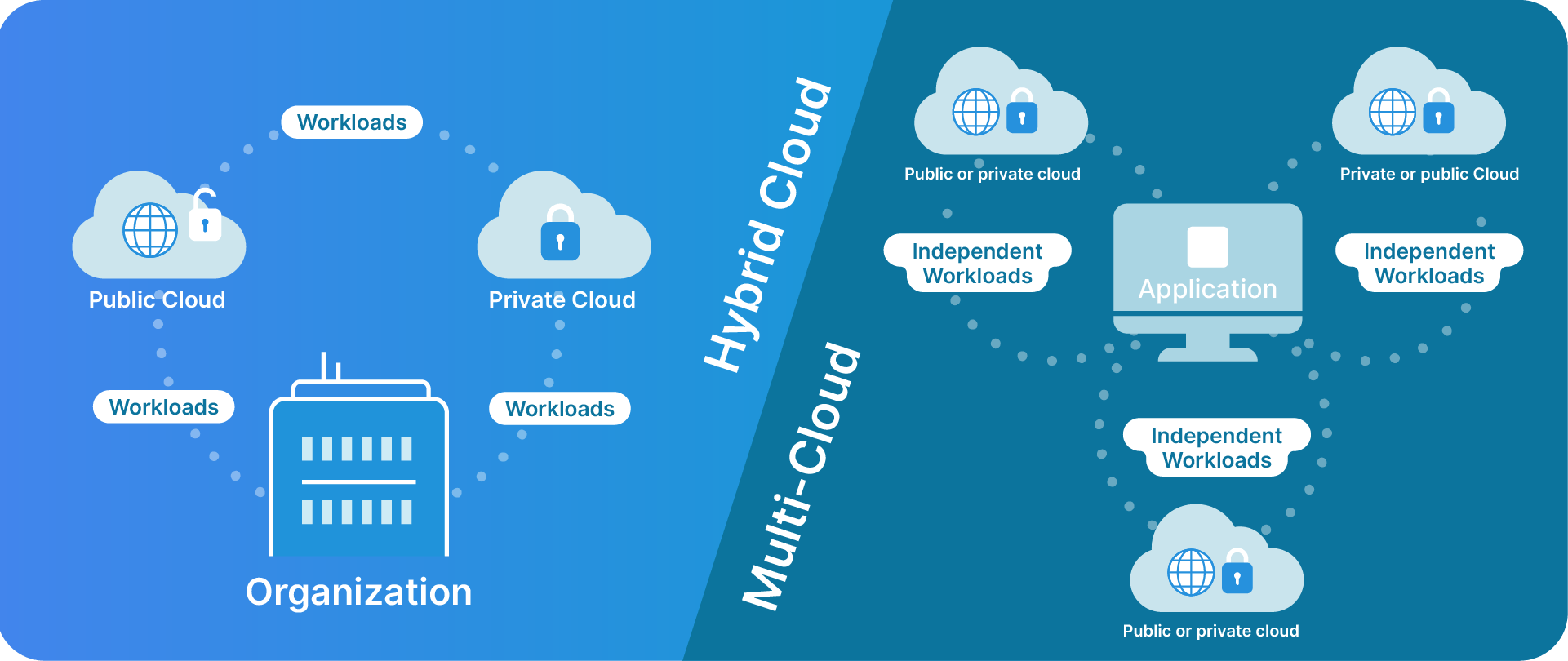
What is the difference between hybrid cloud and multicloud? Hybrid cloud specifically refers to the integration of private (on-premises) infrastructure with public cloud services. Multicloud refers to the use of two or more public cloud providers. Most modern enterprises utilize a hybrid multicloud model, combining their own data centers with multiple public providers.
Does multicloud management increase costs? Initially, the software licenses and the need for specialized personnel may increase overhead. However, in the long term, a managed approach reduces costs by eliminating unused resources, preventing expensive security breaches, and providing the leverage to negotiate better rates with providers.
Is multicloud more secure than using a single cloud? It depends on the management. Theoretically, multicloud is more resilient to provider-specific outages. However, it increases the "attack surface" and the risk of human error due to configuration complexity. A robust CSPM strategy is mandatory to maintain a high security posture in multicloud environments.
How do egress fees impact multicloud strategy? Egress fees—the costs associated with moving data out of a cloud provider—are a major hurdle. Successful enterprises minimize these fees by designing architectures where data remains local to the compute resources as much as possible, or by using dedicated interconnects like AWS Direct Connect or Azure ExpressRoute.
What are sovereign clouds, and why are they relevant in 2026? Sovereign clouds are cloud environments designed to meet the specific legal and regulatory requirements of a particular nation or region, particularly regarding data privacy and local control. As global regulations like the EU's AI Act and evolved GDPR standards tighten, enterprises use multicloud management to place sensitive data in sovereign clouds while keeping general compute in global public clouds.
Next Steps for Enterprise Leaders
To master multicloud management, enterprises must prioritize the reduction of operational silos. The technical goal for 2026 is to treat the entire multicloud estate as a single, programmable entity. Leaders should begin by auditing their current cloud spend and security posture using a pilot CMP. Focus on automating the most repetitive tasks—such as patching and identity provisioning—to free up technical talent for higher-value architectural work. Ultimately, the successful enterprise is not the one with the most cloud features, but the one that can orchestrate those features into a seamless, secure, and cost-effective service.
Image Gallery