Monthly Life Insurance with Twice Interest: Cash Value Growth and Policy Mechanics
Monthly life insurance policies featuring a "twice interest" or dual-interest crediting mechanism are permanent life insurance products designed to build cash value while providing a death benefit. In these policies, monthly premium pa...
Monthly life insurance policies featuring a "twice interest" or dual-interest crediting mechanism are permanent life insurance products designed to build cash value while providing a death benefit. In these policies, monthly premium payments fund both the cost of insurance and an accumulation account. The cash value grows through a two-tiered interest structure: a guaranteed baseline interest rate combined with an excess crediting rate, equity-index bonus, or account multiplier.
Contents
Disclaimer: This article is provided for general educational purposes and does not constitute formal financial, legal, or tax advice. Policy features, interest crediting rules, and tax treatments vary by jurisdiction and carrier guidelines as regulated by the National Association of Insurance Commissioners (NAIC).
Understanding the "Twice Interest" Concept in Life Insurance
In commercial life insurance, the term "twice interest" does not refer to a simple doubling of bank savings rates. Instead, it describes specific financial structures built into permanent life insurance policies—primarily Universal Life (UL) and Indexed Universal Life (IUL)—that allow cash values to earn return through two distinct compounding components.
- Monthly Premium Payment
- Cost of Insurance & Admin Fees
- Policy Accumulation Value
- Tier 1: Base/Guaranteed Interest Rate
- Tier 2: Excess/Indexed Bonus Multiplier
- Total Credited Interest
1. Dual-Tiered Crediting Rates
Many permanent policies apply a two-part crediting calculation. The insurer guarantees a baseline interest rate (for example, 1.5% to 3.0% per annum) on the policy's net cash value. On top of this base floor, the policy earns an additional performance-based interest credit—often called excess interest or indexed interest—tied to company portfolio yields or external market indexes such as the S&P 500.
2. Interest Multipliers and Bonus Rates
Certain modern indexed universal life policies include an "interest multiplier" or persistent bonus clause. After a policy has been in force for a set period (typically 5 to 10 years), the insurer applies a secondary percentage bonus—sometimes doubling the standard index crediting rate (e.g., applying a 100% multiplier on credited gains) or adding an extra 1% to 2% guaranteed interest bonus to the monthly cash accumulation.
3. Terminology Disambiguation: Interest vs. Double Indemnity
It is critical to distinguish "twice interest" cash accumulation from a Double Indemnity Rider. A double indemnity provision doubles the death benefit paid to beneficiaries if the insured dies due to a covered accident (e.g., a $250,000 policy paying $500,000). Double indemnity affects the death benefit payout under specific claim conditions, whereas dual-interest mechanisms dictate the internal growth rate of the policy’s living cash value.
How Dual Interest Functions Across Policy Types
Permanent life insurance offers several policy structures that accommodate monthly premium billing and multi-layered interest growth.
| Policy Type | Interest Mechanism |
|---|---|
| Fixed Universal Life (UL) | Guaranteed Floor + Declared Excess Interest |
| Indexed Universal Life (IUL) | Guaranteed Floor (0-1%) + Index Performance with Multiplier Bonuses |
| Participating Whole Life | Guaranteed Base Growth + Non-Guaranteed Reinvested Dividends |
Indexed Universal Life (IUL) Policies
Indexed Universal Life policies are the most common framework for dual-interest growth. In an IUL:
- The Minimum Floor: The insurer sets a guaranteed minimum interest rate (typically between 0% and 1%), ensuring that even if equity markets drop significantly, the policy cash value does not lose principal due to market declines.
- The Index Component: The second layer of interest is linked to the performance of an external equity index. If the index rises, the insurer credits interest up to an agreed cap rate (e.g., 8% to 10%) or participation rate.
- The Multiplier Bonus: Many IUL contracts feature an account multiplier (e.g., a 150% or 200% factor on earned index interest) starting in policy year 11. If the base index return is 4%, a 200% multiplier boosts the credited interest to 8%.
Fixed Universal Life Policies
Fixed Universal Life contracts utilize a two-part rate structure managed directly by the insurance carrier:
- Guaranteed Minimum Rate: Contractually fixed by the policy (e.g., 2.0%).
- Current Declared Rate: Set periodically by the carrier based on its general account investment performance. When carrier yields are strong, the credited rate rises above the guaranteed floor, combining the base guarantee with excess interest.
Participating Whole Life Insurance
While traditional Whole Life uses fixed premiums, participating policies offer a secondary earnings layer through non-guaranteed policy dividends. Dividends represent a return of surplus profits from the mutual insurer. Policyholders can choose to reinvest these dividends as Paid-Up Additions (PUAs), which generate their own guaranteed interest and dividends, establishing a compounding multi-tiered interest effect over time.
Mechanics of Monthly Premiums and Cash Accumulation
Paying for a dual-interest life insurance policy on a monthly basis introduces operational factors that impact how interest compounds over time.
- Gross Monthly Premium Payment
- Minus: Modal Premium Factor Surcharge (~2% to 5%)
- Minus: Monthly Administrative Charges & Premium Expense Charges
- Minus: Monthly Cost of Insurance (COI) Deductions
- Net Monthly Cash Value Allocation
- Monthly Interest Crediting (Base Guaranteed Floor + Excess/Indexed Rate)
Monthly Modal Factors and Administrative Costs
Insurance companies price policy premiums on an annual basis. When an insured chooses to pay monthly (via automated clearinghouse/ACH transfers or payroll deduction), the carrier applies a modal factor to cover additional processing expenses.
Common monthly modal factors range from 0.085 to 0.090 of the annual premium. For example, if an annual premium is $2,000: $$\text{Monthly Payment} = $2,000 \times 0.0875 = $175 \text{ per month}$$ $$\text{Total Annualized Cost} = $175 \times 12 = $2,100$$ This results in a $100 (5%) annual surcharge compared to paying a single annual sum. Policyholders must account for modal surcharges, as high processing fees offset early cash-value interest growth.
Monthly Crediting Cycles vs. Annual Segments
In dual-interest policies, cash value is credited differently depending on the chosen account options:
- Fixed Interest Accounts: Interest is calculated daily and credited monthly based on the policy’s current declared rate divided by 12.
- Indexed Interest Accounts: Premium payments received monthly are pooled and placed into 12-month index "segments" on specific dates each month. Each monthly segment earns interest based on the 12-month change of the reference index. This creates 12 overlapping annual segments, smoothing out market volatility through dollar-cost averaging.
Impact of Monthly Cost of Insurance (COI)
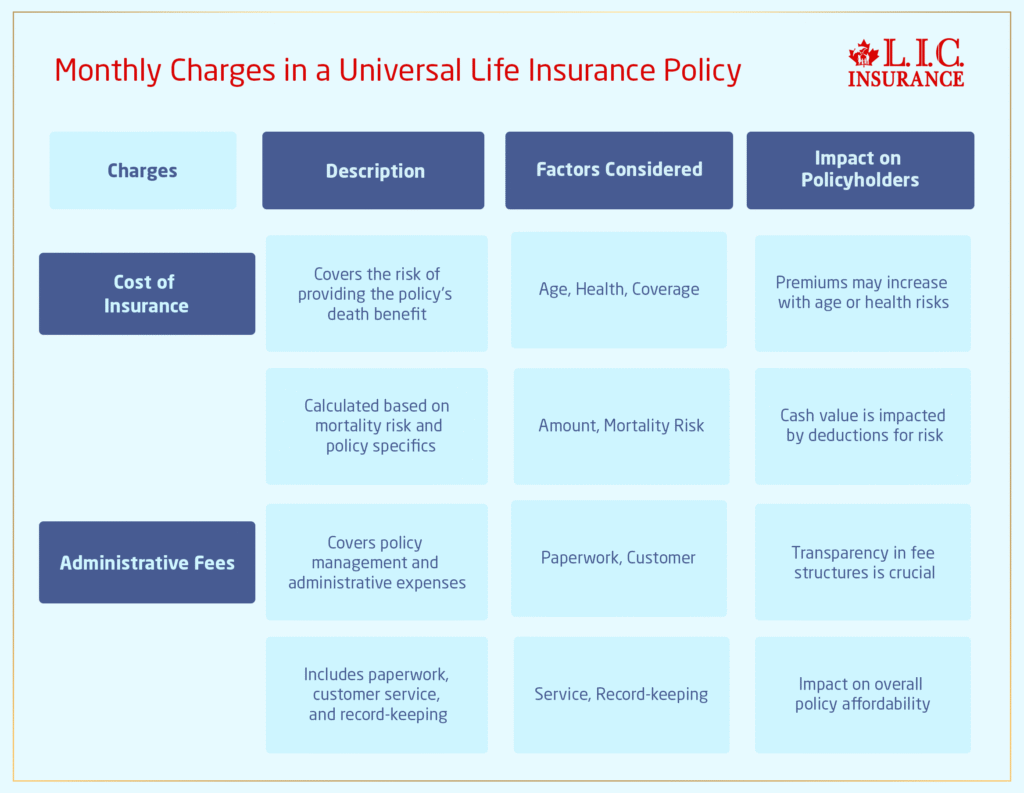
Every month, the insurer deducts the Cost of Insurance (COI) and administrative fees directly from the policy’s cash value. For the cash accumulation account to grow, the combined return from the base interest rate and the excess/multiplier rate must exceed these monthly fee deductions.
Comparing Interest Crediting Structures in Permanent Policies
The structural differences between policy options dictate how interest is calculated, capped, and protected.
| Policy Feature | Fixed Universal Life | Indexed Universal Life (IUL) with Multipliers | Participating Whole Life | Variable Universal Life (VUL) |
|---|---|---|---|---|
| Primary Interest Source | Declared fixed rate | Equity index allocation (e.g., S&P 500) | Guaranteed rate + Policy dividends | Underlying sub-account market performance |
| Secondary Rate / Bonus | Excess carrier return | Interest multiplier / Performance bonus | Dividend reinvestment (Paid-Up Additions) | Variable market upside (No fixed secondary rate) |
| Downside Risk Protection | Full (Guaranteed contract floor) | High (0% floor preserves principal against market losses) | High (Guaranteed cash values cannot decrease) | None (Direct investment loss potential) |
| Upside Interest Caps | Set by carrier declared rate | Cap rate (e.g., 8%-10%) or Spread rate | Subject to board-approved dividend scale | Uncapped market upside |
| Monthly Payment Flexibility | Flexible within minimum/maximum limits | Flexible within minimum/maximum limits | Fixed monthly schedules required | Flexible within minimum/maximum limits |
| Primary Financial Risk | Low crediting environment | Low index returns failing to cover COI charges | Reduced non-guaranteed dividend scales | Sub-account market volatility |
Technical Features: Caps, Floors, Participation Rates, and Spreads
To evaluate how "twice interest" works in practice, policyholders must understand the administrative boundaries insurers place on crediting rates:
- Maximum Return Limit: Cap Rate (e.g., 9.0%) (Upper Cap)
- Actual Credited Interest = (Index Return * Participation Rate) + Bonus Multiplier
- Minimum Return Protection: Floor Rate (e.g., 0.0%) (Lower Floor)
- Guaranteed Floor Rate: The minimum interest percentage credited to the cash value, regardless of economic downturns. IULs typically feature a 0% to 1% floor, shielding the policy from market crashes.
- Cap Rate: The maximum percentage of interest credited during an index segment period. If an index gains 15% over a year, but the policy cap is 9%, the credited rate before multipliers is capped at 9%.
- Participation Rate: The percentage of index gains recognized by the policy. A 100% participation rate credits all gains up to the cap; an 80% participation rate credits 80% of the movement.
- Asset-Based Spread Fees: Some policies replace caps with a spread. If an index earns 10% and the policy has a 2% spread, the net credited interest is 8%.
- Bonus / Multiplier Rules: An account multiplier increases credited earnings once threshold criteria are met. However, policies featuring high multipliers often carry higher monthly asset management fees or higher cost of insurance charges.
Federal Tax Considerations under IRC Section 7702
In the United States, dual-interest life insurance products receive specific tax advantages under Internal Revenue Code (IRC) Section 7702, provided they meet structural tests establishing them as genuine life insurance rather than investment vehicles.
- Tax-Deferred Accumulation: All interest credited to the policy cash value—whether from base rates, indexed gains, or secondary multipliers—accumulates tax-deferred under IRS Publication 525 guidelines. Policyholders pay no annual income taxes on earned interest while funds remain in the contract.
- Tax-Free Withdrawals and Loans: Policyholders can access accumulated cash value through policy loans or withdrawals up to the policy basis (total premiums paid) tax-free.
- Modified Endowment Contract (MEC) Limits: If a policyholder overfunds a policy with excessive premiums early in its life, the contract may breach the IRS 7-Pay Test and become a Modified Endowment Contract (MEC). If categorized as a MEC:
- Loans and withdrawals are taxed on a Last-In, First-Out (LIFO) basis.
- Gain withdrawals made prior to age $59\frac{1}{2}$ incur an additional 10% federal tax penalty.
Evaluating Pros and Cons of Monthly Dual-Interest Policies
Advantages
- Capital Protection with Growth Potential: Combining guaranteed floors with index-linked or multiplier bonuses provides a hedge against inflation without exposing capital to direct equity market losses.
- Flexible Monthly Budgeting: Flexible-premium universal life structures allow policyholders to adjust monthly premium amounts upward or downward depending on personal cash flows.
- Tax-Efficient Wealth Transfer: Upon the insured's death, beneficiaries receive the full death benefit income-tax-free under IRC Section 101(a).
Disadvantages and Risks
- Cost Structure and Drag: Permanent policies involve administrative fees, premium taxes, and monthly Cost of Insurance charges. In early policy years, these expenses often exceed interest earnings.
- Surrender Charges: Terminating a policy during the first 10 to 15 years results in surrender penalties that can forfeit a significant portion of accumulated interest.
- Non-Guaranteed Components: Multipliers, excess interest rates, and caps are generally not guaranteed for the life of the contract; carriers retain the legal right to adjust cap rates down to contractual minimums.
Common Mistakes When Purchasing Dual-Interest Policies
- Mistaking Illustrative Rates for Guarantees: Sales illustrations often model hypothetical multi-year returns using persistent high interest rates or maximum multipliers. Policyholders should request non-guaranteed sensitivity illustrations showing minimum floor returns to understand potential policy performance under adverse economic conditions.
- Failing to Account for Monthly Surcharges: Opting for monthly direct-billing options without reviewing modal factor costs can consume a notable fraction of the policy's base interest returns.
- Underfunding Flexible-Premium Policies: Paying only the minimum monthly premium required to cover cost-of-insurance fees prevents the policy from building sufficient cash value to generate meaningful dual-interest returns, risking eventual policy lapse as COI charges rise with age.
Frequently Asked Questions
Is the "twice interest" rate guaranteed for the life of the contract?
No. While the baseline interest floor (e.g., 0% to 2%) is contractually guaranteed, the excess interest component, index caps, and performance multipliers are subject to periodic adjustments by the insurance company based on prevailing economic conditions and carrier profitability.
How does a monthly payment plan affect total interest growth?
Paying premiums monthly slightly increases overall policy costs due to modal factor processing surcharges (~2% to 5% annually). However, monthly payments provide dollar-cost averaging when credited across multiple monthly index segments, smoothing out market entry points over time.
How does double indemnity differ from dual-interest cash value growth?
Double indemnity is an insurance rider that pays twice the face value of the policy's death benefit to beneficiaries if the insured dies in a qualified accident. Dual-interest growth refers to internal compounding mechanisms (base rate plus bonus/indexed rate) that build living cash value inside permanent policies.
What happens to monthly interest crediting if equity markets decline?
In an Indexed Universal Life policy, if the benchmark index yields a negative return over an annual segment, the policy's floor rate (typically 0%) prevents cash value loss from market performance. However, monthly internal policy costs (administrative fees and cost of insurance) will still be deducted from accumulated cash value.
Are interest gains in a monthly dual-interest policy taxable each year?
No. Interest earned within a compliant permanent life insurance contract grows on a tax-deferred basis under IRC Section 7702. Taxes are not due annually, and funds can be accessed tax-free through policy loans or withdrawals up to the cost basis, provided the policy does not become a Modified Endowment Contract (MEC).
Strategic Guidance and Next Actions
For consumers evaluating a monthly permanent life insurance policy featuring dual-interest rate structures:
- Review Contractual Minimums: Examine the policy contract for guaranteed minimum floor rates, maximum fee schedules, and mandatory holding periods required to unlock interest multiplier bonuses.
- Calculate Modal Surcharges: Compare the annual total of 12 monthly payments against a single annual premium payment to determine the exact cost of monthly billing.
- Inspect the Policy Illustration: Ask your insurance professional for an illustration showing three scenarios: guaranteed minimum returns, mid-range historical averages, and current non-guaranteed rates.
- Monitor Funding Levels: Ensure monthly premium contributions are calibrated above the minimum cost-of-insurance thresholds to build adequate principal for long-term compounding interest.
- Consult a Financial Advisor: Work with a licensed fiduciary or independent agent to verify that permanent cash-value insurance fits your broader financial plan and tax strategy.
Image Gallery