How to Use Workers Compensation Claims Resume Samples Effectively
To use workers compensation claims resume samples effectively, treat them as structural blueprints rather than templates for copying. Identify high-performing keywords like "reserve adequacy" and "statutory compliance," then replace ge...
To use workers compensation claims resume samples effectively, treat them as structural blueprints rather than templates for copying. Identify high-performing keywords like "reserve adequacy" and "statutory compliance," then replace generic sample text with your specific metrics, such as closing ratios or average settlement savings. This approach ensures your resume passes Applicant Tracking Systems (ATS) while highlighting your unique jurisdictional expertise.
Contents
The workers' compensation industry in 2026 remains a highly specialized field where technical knowledge of state-specific mandates and medical-legal procedures is paramount. Whether you are an aspiring claims adjuster or a seasoned claims manager, a resume sample provides the foundational "language" of the industry. However, the difference between a candidate who gets an interview and one who is filtered out by an algorithm often lies in how they adapt those samples to reflect their personal professional narrative.
Identifying and Selecting High-Quality Resume Samples
Before you begin drafting, you must find a sample that aligns with your specific career trajectory. The workers' compensation field is diverse, ranging from entry-level "medical-only" adjusters to complex "indemnity" examiners and litigation specialists. Using a generic "insurance adjuster" sample will not suffice if you are applying for a Senior Workers’ Comp Specialist role.
When evaluating a resume sample, look for the following "quality markers":
- Evidence of Jurisdictional Expertise: A good sample should demonstrate an understanding that workers' compensation is governed by state law. If a sample mentions "Section 32 settlements" (New York) or "Compromise and Release" (California), it shows a higher level of professional relevance than a sample that uses vague terms.
- Metric-Driven Achievements: High-quality samples do not just list tasks; they quantify success. Look for samples that use percentages, dollar amounts, and volume counts. For example, "Managed a pending of 150+ active files" is far more effective than "Managed a high volume of claims."
- Modern Formatting: In 2026, recruiters favor clean, sans-serif fonts and logical hierarchies. Avoid samples with excessive graphics, photos, or complex multi-column layouts that might confuse an Applicant Tracking System (ATS).
Decoding the Technical Structure of a Claims Resume
Once you have selected a relevant sample, analyze its structure. A successful workers' compensation resume follows a specific logic that mirrors the lifecycle of a claim.
The Professional Summary vs. Objective
Samples often include an "Objective" statement, but in the current 2026 job market, these are largely obsolete. Instead, use the sample's structure to build a Professional Summary. This 3–5 line paragraph should act as your "elevator pitch." It should lead with your years of experience, your primary jurisdictional focus (e.g., "Licensed in FL, GA, and TX"), and your core value proposition, such as your ability to reduce litigation rates or manage catastrophic (CAT) claims.
Hard Skills and Core Competencies
A resume sample will likely include a list of skills. Do not simply copy this list. Instead, categorize them into technical skills and soft skills. In workers' compensation, your technical skills must include:
- Regulatory Knowledge: FROI/SROI reporting, CMS (Centers for Medicare & Medicaid Services) reporting, and state-specific disability ratings.
- Software Proficiency: Experience with platforms like Guidewire, ImageRight, or proprietary TPA (Third-Party Administrator) software.
- Claims Handling: Three-point contact, investigation techniques, subrogation identification, and reserve setting.
Optimizing for ATS with Industry Keywords
Most medium-to-large insurance carriers and TPAs use Applicant Tracking Systems to scan resumes for specific keywords before a human ever sees them. A resume sample serves as an excellent "cheat sheet" for these keywords, but you must integrate them naturally.
If the sample uses the term "Reserve Adequacy," ensure your resume describes how you calculated and maintained reserves to prevent financial surprises for the carrier or self-insured client. If the sample highlights "Subrogation," include a bullet point about how much money you recovered from negligent third parties.
Essential Keywords for 2026 Workers' Comp Resumes:
- MMI (Maximum Medical Improvement): Crucial for showing you understand the transition from temporary to permanent disability.
- Utilization Review (UR): Demonstrates your ability to manage medical costs and necessity.
- Lien Resolution: Particularly important in jurisdictions like California, where medical liens can be a significant portion of the claim cost.
- Return to Work (RTW) Programs: Highlights your focus on minimizing indemnity exposure and helping injured workers recover.
Transforming Generic Tasks into Quantifiable Achievements
The most common mistake when using a resume sample is "The Duty Trap." This occurs when a candidate copies the "Duties and Responsibilities" section of a sample word-for-word. To be effective, you must transform these duties into achievements.
Consider this common sample bullet point: "Responsible for investigating claims and determining compensability."
To use this effectively, you should rewrite it as: "Conducted comprehensive investigations for 25+ new claims per month, determining compensability within the 14-day statutory limit in 98% of cases, reducing late-payment penalties by 15% annually."
Comparison of Sample Text vs. Effective Execution
| Generic Sample Phrase | Effective, Metric-Driven Execution (The "How-To") |
|---|---|
| Managed a caseload of workers' comp claims. | Managed a diverse portfolio of 160+ active indemnity and medical-only claims for self-insured Fortune 500 clients. |
| Negotiated settlements with attorneys. | Successfully negotiated $2.4M in total settlements, achieving an average of 12% below initial reserve projections through aggressive litigation management. |
| Coordinated with medical providers. | Facilitated medical management and vocational rehabilitation, resulting in a 20% improvement in "Return to Work" timelines for temporary disability cases. |
| Handled subrogation and recoveries. | Identified and pursued subrogation opportunities on 15% of the total pending, recovering over $450,000 in the 2025 fiscal year. |
Addressing State-Specific and Jurisdictional Expertise
Workers' compensation is not a "one size fits all" industry. A resume sample from an adjuster in Oregon will look significantly different from one in New York. When using a sample, you must verify that the terminology matches the jurisdiction where you are applying.
If you are a "multi-jurisdictional" adjuster, your resume should have a dedicated section for "Jurisdictional Proficiency." This is where you list every state where you hold an active license or have significant claims-handling experience. In 2026, employers highly value adjusters who can pivot between different state laws without a steep learning curve.
Common Pitfalls When Using Resume Samples
While samples are helpful, they can lead to several professional "red flags" if used incorrectly.
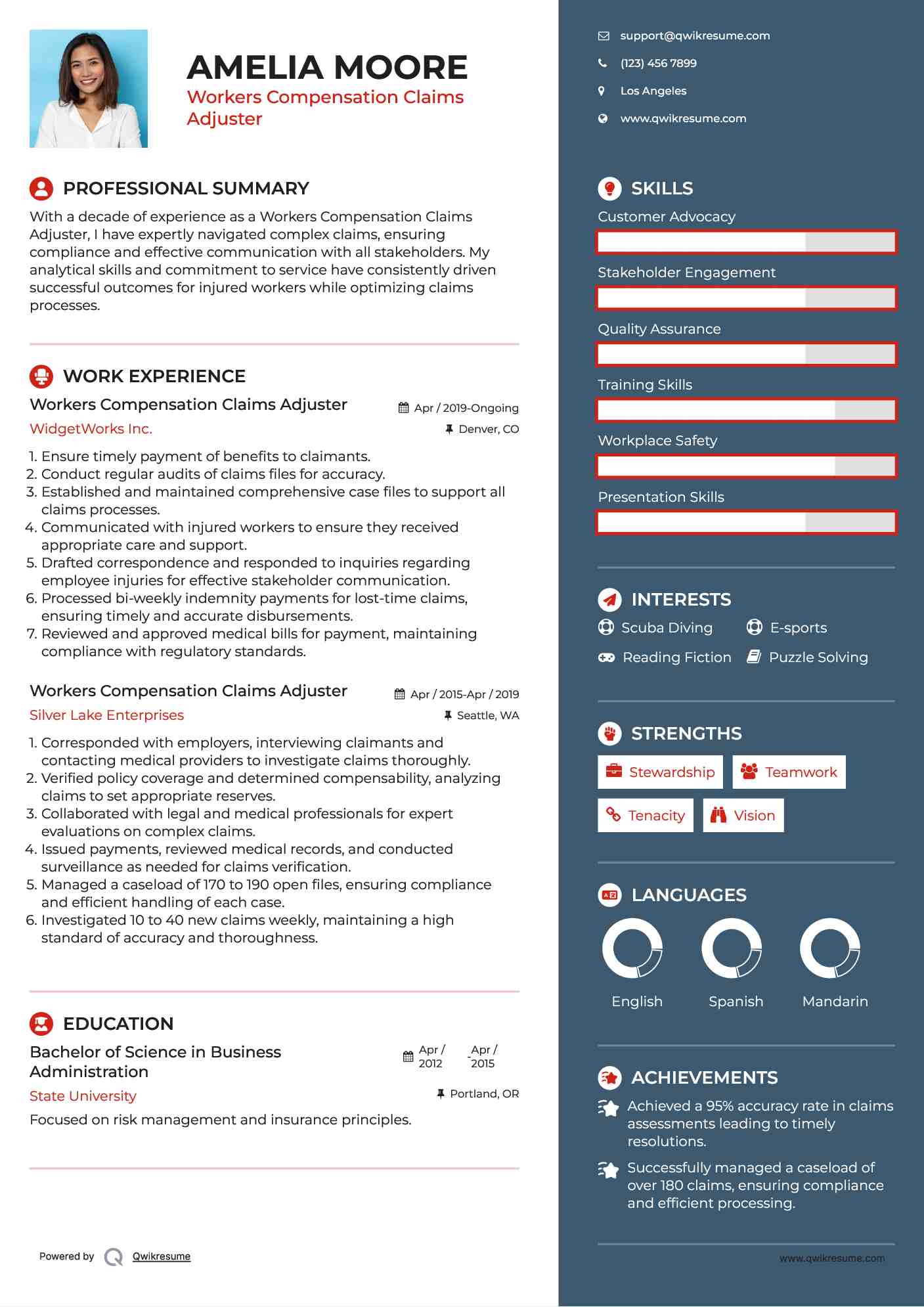
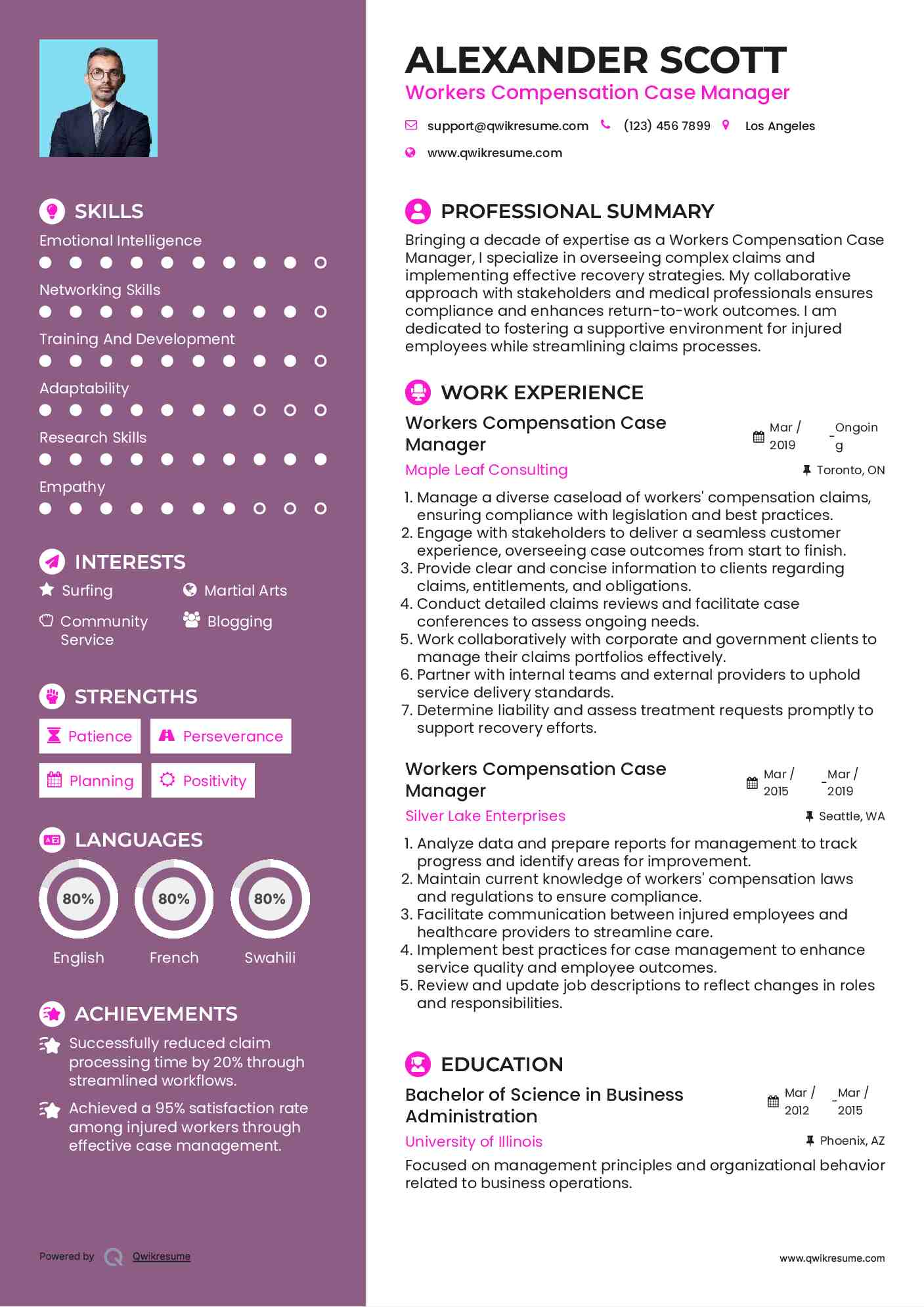
- Over-Formatting: Many online samples use columns or bars to show "Skill Levels" (e.g., a bar showing 80% proficiency in "Negotiation"). ATS software often fails to read these correctly, and human recruiters find them subjective and unhelpful.
- Using Outdated Terminology: Ensure the sample is current. For instance, if a sample still refers to old forms that were replaced in 2024 or 2025, using that terminology will make you look out of touch.
- Lack of Personality: While the language of insurance is technical, your resume should still reflect your professional approach. Are you an aggressive litigator? A compassionate case manager? Ensure your choice of verbs (e.g., "Spearheaded" vs. "Collaborated") reflects your style.
Recommended Formatting Standards for 2026
To ensure your resume stands out, follow these 2026 industry standards for workers' compensation professionals:
- Length: Two pages maximum for professionals with over five years of experience. One page for entry-level.
- File Type: Always save as a PDF unless specifically asked for a Word document. This preserves your formatting across different devices.
- The "Hybrid" Format: Use a hybrid resume format—one that begins with a robust "Core Competencies" section followed by a chronological work history. This satisfies both the ATS and the human recruiter who wants to see your career progression.
Frequently Asked Questions
Should I include my adjuster license numbers on my resume?
Yes, but you do not need to list every single one in the header. Include a dedicated section titled "Licenses and Certifications" at the bottom of the first page or top of the second page. List the state and the license number. For 2026, ensure you also include any certifications like the AIC (Associate in Claims) or ARM (Associate in Risk Management), as these remain high-value benchmarks.
How do I handle "gaps" in my employment on a workers' comp resume?
If you used a sample that shows a perfect chronological history, don't feel pressured to fake it. In 2026, recruiters are more understanding of career breaks. Use a brief, one-line explanation in your work history if necessary (e.g., "Professional Sabbatical for Skill Development" or "Family Leave"), and focus the rest of the document on your technical proficiency.
Can I use AI to help me customize a resume sample?
Yes, AI tools can be excellent for "translating" your experience into the keywords found in a sample. However, you must verify every claim. AI often hallucinates specific legal codes or software names. Always cross-reference AI-generated text with actual state statutes or your specific company’s software list.
How much weight is given to the "Education" section in 2026?
For most adjusters, experience and licensing outweigh the specific degree. However, if you are applying for a Claims Manager or Director role, your degree and any post-graduate work (like an MBA or JD) should be prominent. If your education is in a related field like Healthcare Administration or Criminal Justice, highlight how that background informs your claims-handling perspective.
Next Steps for Your Resume
After using a sample to draft your resume, the final step is verification. Read your resume through the lens of a "claims audit." If an auditor looked at your resume, could you prove every metric you’ve listed? If the answer is yes, you have successfully transformed a generic sample into a powerful professional tool. Your next action should be to tailor your cover letter to the specific carrier or TPA, mentioning their specific market niche (e.g., public entity, construction, or healthcare) to prove you understand their unique exposures.
Image Gallery