What Is Required to Cause Acceleration in Physics
To cause acceleration in physics, an unbalanced net external force must act upon an object with mass. According to Isaac Newton’s Second Law of Motion, acceleration is directly proportional to the net force applied and inversely propor...
To cause acceleration in physics, an unbalanced net external force must act upon an object with mass. According to Isaac Newton’s Second Law of Motion, acceleration is directly proportional to the net force applied and inversely proportional to the mass of the object, meaning that changing an object’s velocity—whether by speeding up, slowing down, or changing direction—requires a net force greater than zero.
Contents
Understanding what causes acceleration is a foundational concept in classical mechanics. It bridges the gap between kinematics, which merely describes how things move, and dynamics, which explains why they move. Whether analyzing a rocket launching into orbit, a car braking at a traffic light, or a satellite orbiting Earth, the underlying physical requirements for acceleration remain consistent. This guide explores the fundamental requirements, mathematical formulations, and real-world mechanisms that produce acceleration.
The Fundamental Principle: Net Force and Mass
In classical physics, acceleration ($a$) is defined as the rate of change of velocity with respect to time. Velocity is a vector quantity, possessing both magnitude (speed) and direction. Therefore, any change in speed, any change in motion path, or both simultaneously constitutes acceleration.
The universal requirement for this change is a net external force.
- The Core Requirement
- Net Force ($F_{\text{net}}$) $\neq$ 0 ==> Acceleration ($a$)
When multiple forces act on an object, they vectorially combine. If these forces cancel each other out completely, the net force is zero, and the object maintains a constant velocity (or remains at rest), a state known as dynamic equilibrium. To alter this state, an imbalance must occur.
Newton's Second Law of Motion
The relationship governing this requirement is expressed mathematically as:
$$F_{\text{net}} = m \cdot a$$
Where:
- $F_{\text{net}}$ is the net external force measured in Newtons ($\text{N}$ or $\text{kg}\cdot\text{m/s}^2$).
- $m$ is the inertial mass of the object measured in kilograms ($\text{kg}$).
- $a$ is the resulting acceleration measured in meters per second squared ($\text{m/s}^2$).
Rearranging the formula to solve for acceleration highlights how these variables interact:
$$a = \frac{F_{\text{net}}}{m}$$
This equation dictates two strict physical conditions:
- Force dependency: To increase acceleration, the net force must increase proportionally, assuming mass remains constant.
- Mass dependency: The greater an object's mass, the more resistance it offers to changes in its motion (inertia). Consequently, a heavier object requires a significantly larger net force to achieve the same rate of acceleration as a lighter object.
Types of Forces That Produce Acceleration
Forces do not need to be mechanical or direct contact-based to cause acceleration. Any interaction that pushes or pulls an object can serve as the net force.
1. Contact Forces
Contact forces occur when physical bodies interact directly with one another.
- Applied Force: A direct push or pull exerted by a person, engine, or mechanical actuator. For example, a car engine generates torque that turns the wheels, producing a friction-based forward force against the road that accelerates the vehicle.
- Friction and Drag: While often viewed as resistance, friction can also cause acceleration. When a car turns a corner, static friction between the tires and the pavement provides the centripetal force required to accelerate the vehicle toward the center of the turn.
- Tension: The pulling force transmitted axially through a string, rope, or cable when pulled tight by forces acting from opposite ends.
2. Non-Contact (Field) Forces
Field forces act across a distance without requiring physical contact between the objects.
- Gravitational Force: Mass attracts mass. Near the surface of Earth, gravity exerts a constant downward force on objects, causing free-falling bodies to accelerate downward at approximately $9.81\text{ m/s}^2$ (disregarding air resistance).
- Electromagnetic Force: Electric charges and magnetic fields exert forces on charged particles. Particle accelerators use powerful electromagnetic fields to accelerate subatomic particles close to the speed of light.
Types of Acceleration and Their Specific Requirements
Acceleration is a vector, meaning its direction matters just as much as its magnitude. Depending on how the velocity vector changes, acceleration is categorized into specific types, each with distinct physical triggers.
| Type of Acceleration | Nature of Velocity Change | Primary Physical Requirement | Real-World Example |
|---|---|---|---|
| Linear Acceleration | Change in speed along a straight path | A net force parallel (or anti-parallel) to the direction of motion | A sprinter bursting out of starting blocks |
| Deceleration | Reduction in speed (negative acceleration) | A net force directed opposite to the direction of motion | A commercial aircraft deploying thrust reversers upon landing |
| Centripetal Acceleration | Change in direction at a constant speed | A net force directed perpendicular to the velocity vector toward the center of curvature | A roller coaster looping through a vertical circle |
| Angular Acceleration | Change in rotational speed | A net torque acting on a rigid body about an axis of rotation | Spinning up a heavy industrial flywheel with a motor |
Linear and Directional Changes
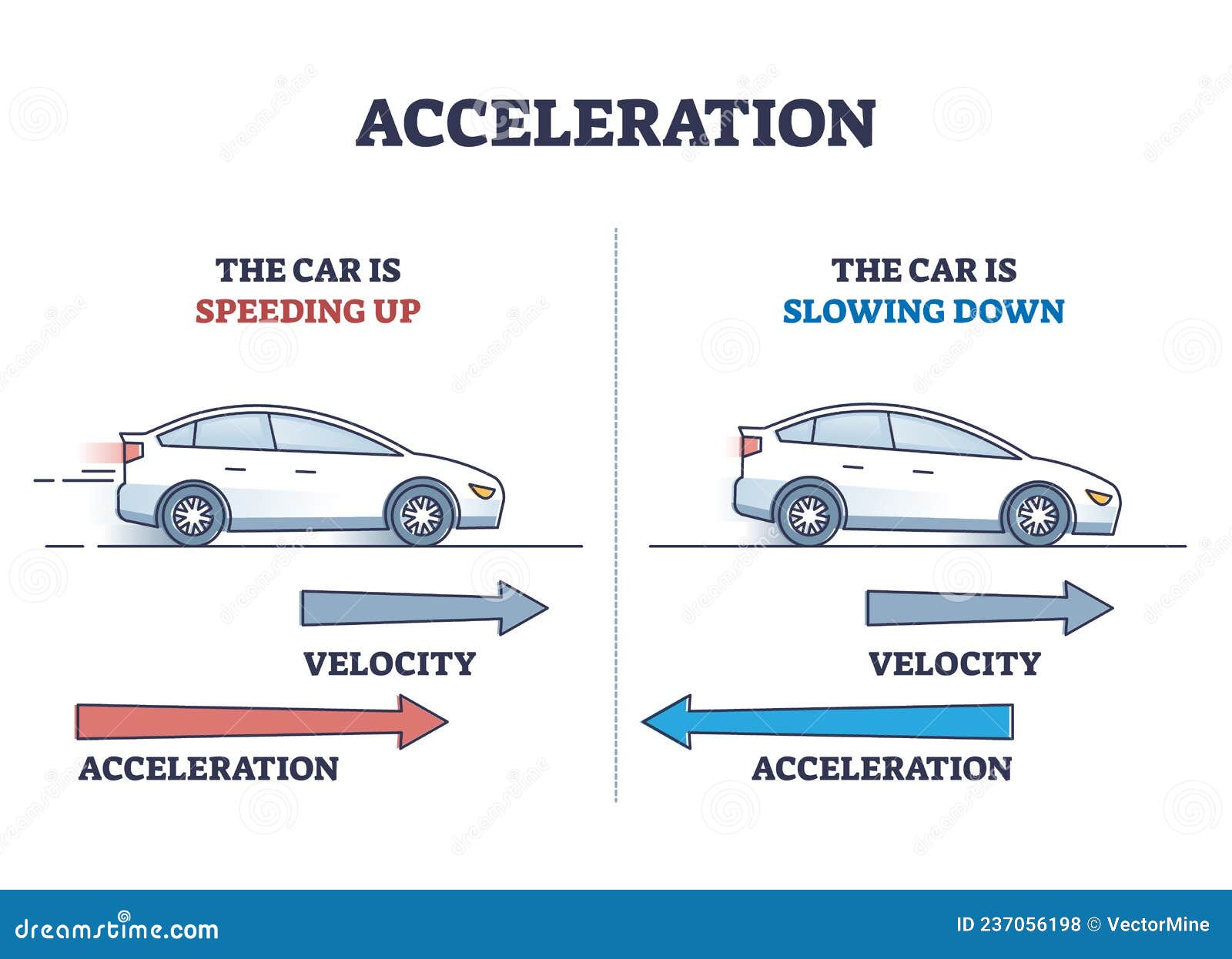
When you step on the gas pedal of a car, the net force acts in the same direction as the velocity vector, increasing speed. Conversely, applying the brakes creates a net force in the opposite direction, causing deceleration.
If the net force acts at an angle to the velocity vector, the object will experience both a change in speed and a change in direction simultaneously.
Inertial Frames of Reference and Apparent Acceleration
To measure or cause acceleration correctly, physicists must consider the frame of reference from which the observation takes place.
Inertial Reference Frames
Newton's laws hold true strictly within inertial reference frames—frames of reference that are either at rest or moving at a constant velocity (zero acceleration). In an inertial frame, any observed acceleration of an object can be directly traced back to a real, physical net external force acting upon it.
Non-Inertial Reference Frames and Fictitious Forces
If observations occur inside an accelerating reference frame—such as an elevator accelerating upward or a car making a sharp turn—observers experience fictitious forces (or inertial forces).
- When a car accelerates forward, passengers feel pushed back into their seats.
- This sensation is not caused by a physical backward force, but rather by the body’s inertia attempting to maintain its state of rest while the car accelerates around it.
To account for acceleration in non-inertial frames, physicists introduce mathematical corrections, but the fundamental requirement remains: real acceleration relative to an inertial framework always requires a genuine net external force.
Common Misconceptions About Acceleration
Misunderstandings regarding motion often stem from everyday intuition conflicting with Newtonian mechanics.
- "Velocity implies a force is required to keep going." According to Newton's First Law of Motion, an object in motion stays in motion with the same speed and in the same direction unless acted upon by an unbalanced force. Space probes moving through the deep vacuum of space maintain their velocity indefinitely without any engine thrust, because net external forces are virtually zero.
- "An object at its highest point of a vertical throw has zero acceleration." When a ball is thrown straight up, its velocity reaches zero at its peak height for a fraction of a second. However, gravity continues to act upon it constantly. Its acceleration remains downward at $9.81\text{ m/s}^2$ throughout the entire flight, including the exact moment it reverses direction.
- "Speed and acceleration are the same thing." An object can travel at an extremely high, constant speed (e.g., a spacecraft cruising in deep space) while experiencing zero acceleration. Conversely, an object can have a velocity of zero at a specific instant (like the peak of a thrown ball) while experiencing maximum acceleration.
Practical Steps to Calculate and Verify Acceleration
When analyzing physical systems in laboratory or engineering environments, determining whether acceleration will occur involves a systematic checklist.
- Identify the System and Boundaries: Define clearly which object or system of objects is being analyzed.
- Draw a Free-Body Diagram (FBD): Isolate the object and draw vector arrows representing every individual force acting upon it (gravity, normal force, friction, tension, applied thrust).
- Resolve Forces into Components: Break angled forces down into orthogonal $x$ and $y$ coordinate components using trigonometric functions ($\sin\theta, \cos\theta$).
- Calculate the Net Force: Sum the forces along each axis ($\sum F_x = m \cdot a_x$ and $\sum F_y = m \cdot a_y$). If the sum along an axis is non-zero, acceleration is mathematically guaranteed.
- Determine the Acceleration: Divide the net force by the object's mass to find the precise magnitude and direction of the acceleration vector.
Frequently Asked Questions
Can an object accelerate if its speed is constant?
Yes. Acceleration is defined as the rate of change of velocity, which is a vector quantity containing both magnitude (speed) and direction. If an object travels at a constant speed along a curved path—such as a car driving at $50\text{ km/h}$ around a circular track—its velocity vector is constantly changing direction. This requires a continuous centripetal force directed toward the center of the curve.
What happens to acceleration if mass increases while force stays constant?
According to Newton's Second Law ($a = F_{\text{net}} / m$), acceleration is inversely proportional to mass. If the net force applied to an object remains constant while its mass increases, the resulting acceleration will decrease proportionally. For example, pushing a loaded shopping cart requires significantly more force to achieve the same acceleration as an empty cart.
Is gravity considered an acceleration?
Gravity itself is a force field, but it produces an acceleration. Near Earth's surface, the force of gravity accelerates unsupported physical bodies downward at a standard rate of approximately $9.81\text{ m/s}^2$, commonly denoted by the symbol $g$.
Can acceleration occur in a vacuum?
Yes. Vacuum conditions eliminate air resistance and fluid drag, but they do not eliminate mass or force fields. Objects in a vacuum can still experience acceleration via gravitational fields, electromagnetic fields, or direct mechanical contact (such as a rocket engine firing in the vacuum of space). In fact, eliminating air resistance often makes calculating and achieving acceleration more predictable.
What is the difference between instantaneous and average acceleration?
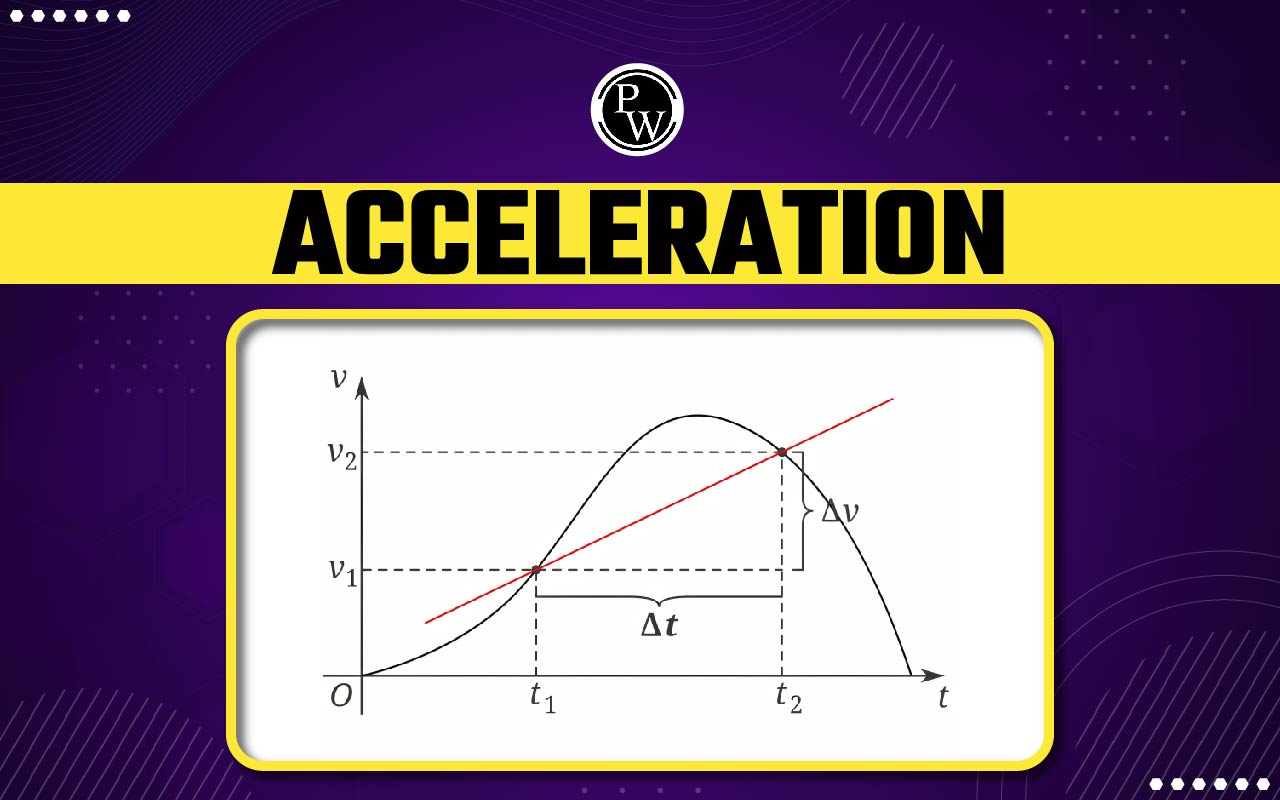
Average acceleration measures the total change in velocity divided by the total elapsed time interval over a broad duration. Instantaneous acceleration measures the exact rate of change of velocity at one specific, infinitesimally small moment in time, typically determined by finding the slope of the tangent line on a velocity-versus-time graph.
Conclusion
To cause acceleration in physics, an unbalanced net external force must act upon an object, overcoming its inherent inertia determined by its mass. Whether changing linear speed, altering direction along a curve, or managing complex multi-vector systems, the fundamental rules established by classical mechanics remain absolute. By identifying forces, constructing accurate free-body diagrams, and applying Newton's laws, physicists and engineers can precisely predict, control, and utilize acceleration across all branches of science and technology.
Image Gallery