The Main Differences Between Catholicism and Christianity
To understand the differences between Catholicism and Christianity, one must first recognize that Catholicism is the oldest and largest branch of Christianity. While all Catholics are Christians, not all Christians are Catholic. The pr...
To understand the differences between Catholicism and Christianity, one must first recognize that Catholicism is the oldest and largest branch of Christianity. While all Catholics are Christians, not all Christians are Catholic. The primary distinctions lie in the source of spiritual authority, the requirements for salvation, the role of Mary and the saints, and the nature of the sacraments.
Contents
Understanding the Relationship: Is Catholicism Christianity?
The question of how Catholicism differs from Christianity is technically a category error, as Catholicism is a subset of the broader Christian faith. Christianity is an Abrahamic monotheistic religion based on the life and teachings of Jesus Christ. It is composed of three major branches: Roman Catholicism, Eastern Orthodoxy, and Protestantism.
As of 2026, the Roman Catholic Church remains the largest single religious institution in the world, representing roughly half of the 2.5 billion Christians globally. When people ask for the "differences" between the two, they are typically seeking a comparison between the specific dogmas of the Roman Catholic Church and the various "non-Catholic" denominations, particularly those stemming from the Protestant Reformation.
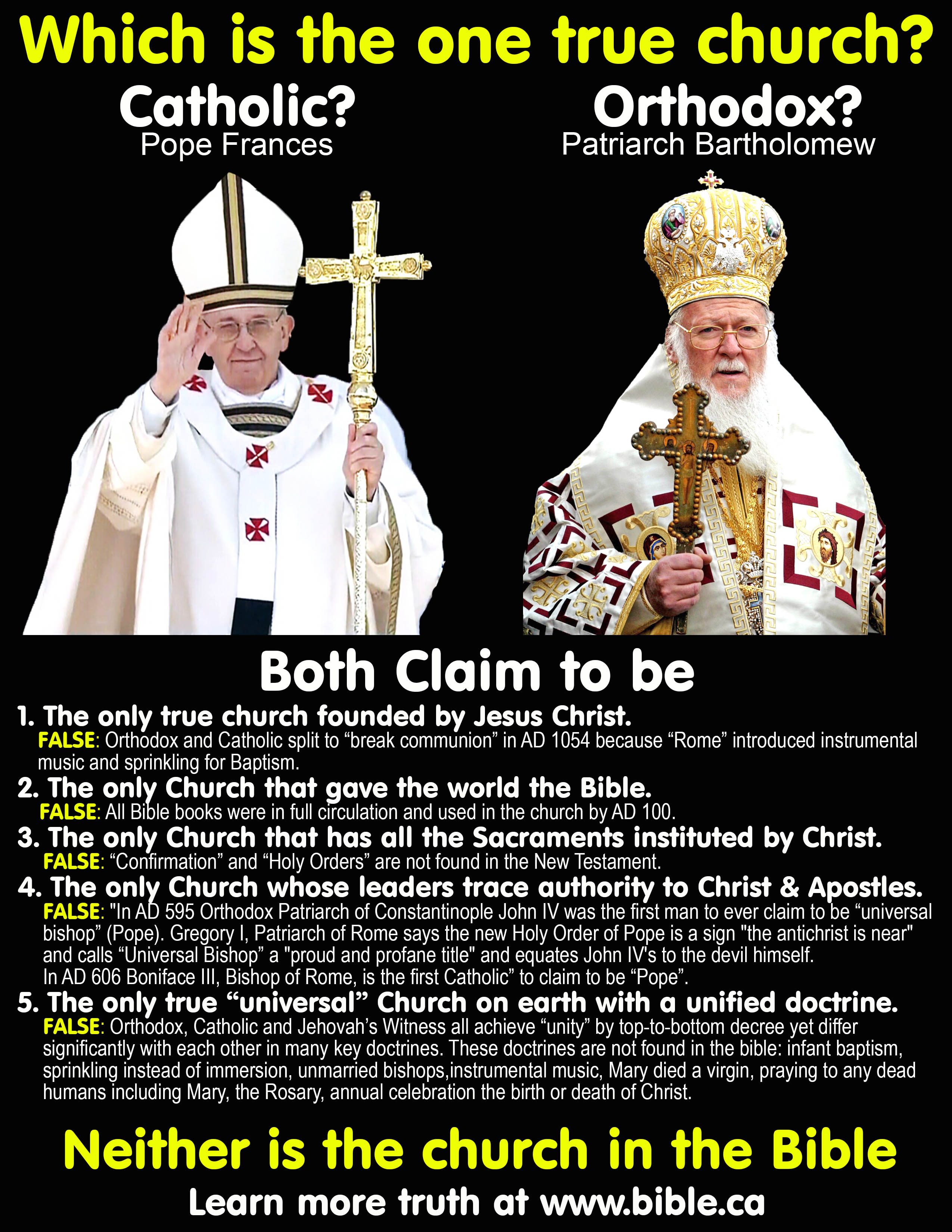
The rift began significantly in 1054 with the Great Schism between the East and West, and deepened during the 16th-century Protestant Reformation. These historical events solidified distinct theological frameworks regarding how a person is saved, who has the final say in matters of faith, and how the church should be structured.
Authority and the Papacy: The Seat of Peter
The most visible difference between Catholicism and other Christian denominations is the structure of church leadership and the concept of Apostolic Succession. Catholicism holds that Jesus Christ established a visible church and appointed the Apostle Peter as its first head. This authority is believed to have been passed down through an unbroken line of bishops to the current Pope.
In Catholic theology, the Pope serves as the "Vicar of Christ." This means he has supreme and universal power over the whole Church. A critical and often misunderstood doctrine is Papal Infallibility. This does not mean the Pope is sinless or that everything he says is perfect; rather, it means that when he speaks ex cathedra (from the chair) on matters of faith and morals to the entire Church, he is preserved from error by the Holy Spirit.
In contrast, most Protestant denominations reject the idea of a centralized earthly authority. They operate under a "priesthood of all believers," where each individual has direct access to God without the need for a hierarchical intermediary. While some groups, like the Anglicans or Methodists, have bishops, they do not recognize the Pope’s jurisdictional authority or his claim to infallibility.
The Source of Divine Truth: Sola Scriptura vs. Sacred Tradition
Another fundamental divergence concerns where divine revelation is found. This is often summarized by the Protestant pillar of Sola Scriptura (Scripture Alone).
The Protestant View
Protestants generally believe that the Bible is the sole, infallible rule of faith and practice. They argue that all things necessary for salvation and a godly life are contained within the pages of the Old and New Testaments. Any tradition or church teaching that cannot be explicitly found in or supported by the Bible is considered human tradition and is not binding on the believer’s conscience.
The Catholic View
The Catholic Church teaches that God’s revelation is transmitted through two distinct but closely related modes: Sacred Scripture and Sacred Tradition. Catholics believe that the Word of God was preached by the Apostles before it was written down. Therefore, the "living tradition" of the Church—interpreted by the Magisterium (the teaching office of the Church)—is equal in authority to the Bible. This allows for dogmas like the Assumption of Mary, which are not explicitly detailed in the Bible but are rooted in the oral tradition and early practice of the Church.
Salvation and Justification: Grace, Faith, and Works
The theological heart of the Protestant Reformation was the "Article of Justification." This addresses the question: How is a person made right with God?
Protestantism typically emphasizes Sola Fide (Faith Alone). This doctrine suggests that humans are justified—declared righteous by God—solely through faith in Jesus Christ's sacrifice on the cross. Good works are seen not as a requirement for salvation, but as the "fruit" or evidence of a genuine, saving faith.
Catholicism, conversely, views justification as a process that begins at baptism and continues throughout a person's life. While the Church agrees that salvation starts with God’s unmerited grace, it teaches that faith must be "informed by charity." In this view, salvation is a cooperative effort between God's grace and human response. Sacraments, such as Confession and the Eucharist, are necessary channels of grace that help the believer remain in a "state of grace." If a Catholic commits a mortal sin, they are believed to have lost that state of grace and must be reconciled through the Sacrament of Penance to regain their standing before God.
The Nature of the Sacraments and the Eucharist
While many Christian denominations practice some form of baptism and communion, the Catholic Church recognizes seven sacraments: Baptism, Confirmation, the Eucharist, Penance (Confession), Anointing of the Sick, Holy Orders, and Matrimony.
The most significant difference lies in the Eucharist. The Catholic Church adheres to the doctrine of Transubstantiation. This is the belief that during the Mass, the bread and wine actually become the literal Body and Blood of Jesus Christ, while retaining the outward appearances (accidents) of bread and wine. Consequently, the Mass is viewed as a "sacrifice"—a re-presentation of Christ’s sacrifice on Calvary.
Protestant views on the Eucharist (or the Lord's Supper) vary widely:
- Lutherans believe in the "Real Presence" (often called Consubstantiation), where Christ is present "in, with, and under" the elements.
- Baptists and Evangelicals generally view it as a memorial or a symbolic act of remembrance.
- Reformed (Calvinist) traditions believe in a spiritual presence but reject the physical change of the elements.
Veneration of Mary and the Saints
The role of Mary and the saints is a frequent point of contention. To many non-Catholic Christians, Catholic practices look like "worshiping" someone other than God. However, Catholic theology makes a sharp technical distinction between types of honor:
- Latria: Adoration and worship reserved for God alone.
- Dulia: Veneration and honor given to saints.
- Hyperdulia: A special level of veneration reserved for the Virgin Mary as the Mother of God.
Catholics believe in the "Communion of Saints," the idea that those in heaven are still part of the Church and can pray for those on earth. Therefore, Catholics do not "pray to" saints in the sense of worshiping them, but rather ask for their intercession, much like a Christian might ask a friend on earth to pray for them.
Most Protestants reject this practice, citing 1 Timothy 2:5, which states there is "one mediator between God and men, the man Christ Jesus." They believe that petitioning saints is at best unnecessary and at worst a violation of the command to worship God alone.
Summary of Key Differences
The following table provides a high-level comparison of the distinct positions held by the Roman Catholic Church versus general Protestant theology.
| Feature | Roman Catholicism | Protestantism (General) |
|---|---|---|
| Authority | The Bible + Sacred Tradition + Magisterium | The Bible Alone (Sola Scriptura) |
| Head of Church | The Pope (Successor of Peter) | No single earthly head; Jesus is the only head |
| Justification | Faith and works (grace-enabled) | Faith alone (Sola Fide) |
| The Bible | 73 books (includes Deuterocanon) | 66 books |
| The Eucharist | Transubstantiation (literal body/blood) | Symbol, memorial, or spiritual presence |
| Mary | Immaculate Conception; Sinless; Perpetual Virgin | Honored as Jesus' mother, but viewed as a sinner |
| Purgatory | A state of final purification after death | Generally rejected; immediate heaven or hell |
| Saints | Intercessors who can be petitioned | Fellow believers; only God is petitioned |
The Biblical Canon and Purgatory
The Catholic Bible is larger than the standard Protestant Bible. It contains seven additional books in the Old Testament: Tobit, Judith, 1 and 2 Maccabees, Wisdom, Sirach, and Baruch. These are known as the Deuterocanonical books. During the Reformation, Protestants moved these to a separate "Apocrypha" section or removed them entirely, arguing they were not part of the original Hebrew canon used by Jewish authorities.
Related to this is the doctrine of Purgatory. Catholicism teaches that some people die in a state of grace but still carry the "temporal punishment" for sins they committed. Purgatory is a process of purification to prepare the soul for the holiness of heaven. This concept is supported in Catholic theology by 2 Maccabees (from the Deuterocanon) and certain interpretations of 1 Corinthians 3. Most other Christians reject Purgatory as a "non-biblical" invention, maintaining that Christ’s sacrifice was sufficient to cleanse all sin immediately upon death.
Common Misconceptions
When discussing these differences in 2026, it is vital to clear up persistent myths that often cloud the dialogue:
- "Catholics aren't Christians": As established, Catholicism was the primary form of Christianity for over a thousand years before the Reformation. Catholics affirm the Trinity, the deity of Christ, and the Resurrection.
- "Catholics worship Mary": Official Catholic teaching (the Catechism) explicitly forbids worshiping Mary. The practice is "veneration," which is meant to honor God's work through her.
- "Protestants don't believe in the Sacraments": Most Protestants recognize at least two sacraments (Baptism and Communion), though they call them "ordinances" and view their efficacy differently.
- "Catholics can't read the Bible": While historically the Church was cautious about private interpretation, modern Catholicism strongly encourages Bible reading and study among the laity.
FAQs
Why do Catholics have a Pope and other Christians do not?
The Papacy is rooted in the Catholic interpretation of Matthew 16:18, where Jesus tells Peter, "You are Peter, and on this rock I will build my church." Catholics believe this established a permanent office of leadership. Protestants generally interpret "the rock" as Peter's confession of faith or Jesus himself, rather than Peter's person.
Do Catholics believe you have to "earn" your way to heaven?
No. The Catholic Church officially teaches that no one can merit the initial grace of forgiveness and justification. However, they believe that once a person is in a relationship with God, their "good works" performed in grace are necessary to grow in holiness and ultimately inherit eternal life.
What is the difference between a Catholic Bible and a Christian Bible?
The term "Christian Bible" is broad, but a "Protestant Bible" contains 66 books. The "Catholic Bible" contains 73 books. The seven extra books were part of the Septuagint (the Greek translation of the Old Testament) used by the early Church, which the Catholic Church continues to recognize as inspired.
Do all non-Catholic Christians agree with each other?
No. While many Protestants share the five "Sola" doctrines (Scripture alone, Faith alone, Grace alone, Christ alone, and Glory to God alone), they differ significantly on baptism (infant vs. believer), church government, and the end times. The Eastern Orthodox Church also differs from both Catholics and Protestants on several points, despite sharing the concept of Apostolic Succession with Catholics.
Can a non-Catholic receive communion in a Catholic Church?
Generally, no. Because the Catholic Church views the Eucharist as a sign of "real union" in faith and doctrine, only those who are in full communion with the Catholic Church and in a state of grace are permitted to receive. Most Protestant churches, however, practice "open communion," where all professing Christians are welcome.
Next Steps for Further Research
If you are exploring these differences for personal or academic reasons, the best course of action is to consult primary sources. For the Catholic perspective, the Catechism of the Catholic Church provides a comprehensive summary of all official dogmas. For the Protestant perspective, reading historical documents like the Augsburg Confession (Lutheran) or the Westminster Confession of Faith (Presbyterian) will provide clarity on why these reformers broke away from Rome. Understanding these distinctions requires looking beyond surface-level practices to the deep-seated theological convictions that have shaped Western history for two millennia.
Image Gallery