Good Hair Curlers: How to Choose the Right Tool for Every Hair Texture
Selecting good hair curlers requires matching the tool's barrel material, diameter, and temperature controls to your specific hair texture. Fine or damaged hair thrives with ceramic or tourmaline barrels at lower heat, while thick, coa...
Selecting good hair curlers requires matching the tool's barrel material, diameter, and temperature controls to your specific hair texture. Fine or damaged hair thrives with ceramic or tourmaline barrels at lower heat, while thick, coarse hair requires high-conductivity titanium tools with precise digital temperature controls to set long-lasting curls without unnecessary structural damage.
Contents
Understanding Hair Texture and Thermal Styling Requirements
Hair texture is determined by the natural diameter of individual strands, the density of hair on the scalp, and the integrity of the hair shaft's protective cuticle layer. Attempting to style fine, delicate hair with high heat can result in protein degradation and thermal breakage, whereas using an underpowered heat tool on coarse, resistant strands leads to flat, rapidly dropping waves. Selecting effective curling tools begins with identifying your specific hair profile and understanding how different textures respond to thermal manipulation.
Fine or Thin Hair
Fine hair features a smaller diameter per strand and often has a thinner cortex layer, making it extremely efficient at conducting heat. However, this high sensitivity means fine strands lose structural moisture rapidly. When choosing hot tools for fine hair, prioritize gentler heating elements with adjustable, low-temperature settings. Tools that produce far-infrared heat penetrate the hair shaft evenly without scorching the outer cuticle, preserving moisture and preventing brittle ends.
Medium or Normal Hair
Medium hair possesses a balanced structure with standard cortex thickness and a healthy cuticle layer. It holds styles relatively well without requiring extreme heat or delicate treatment. For medium hair, the primary considerations shift toward versatility, barrel sizing, and ergonomic design. Medium hair can tolerate standard styling temperatures between 325°F and 375°F, allowing users to experiment with a wide array of barrel materials and automated styling tools.
Thick, Coarse, or Resistant Hair
Coarse hair has a large strand diameter and often contains a dense cuticle structure, sometimes accompanied by a continuous inner medulla. This structure resists thermal penetration, meaning curls easily collapse if heat is applied unevenly or at insufficient temperatures. Coarse hair requires high-heat retention materials like solid titanium or advanced thermal alloys that maintain stable temperatures across the entire surface of the barrel when contacting dense sections of hair.
Naturally Curly, Coily, or Chemically Treated Hair
Textured, coily (Type 4), and chemically treated or bleached hair require elevated caution during thermal styling. Naturally curly and coily patterns feature irregular strand shapes with inherent structural weak points along the curves. Bleached or relaxed hair lacks structural keratin bonds and retains minimal natural moisture. For these delicate textures, moisture retention is paramount. Tools infused with ionic tech, tourmaline crystal coatings, or steam-assisted curling mechanisms help smooth lifted cuticles and lock in hydrated shape without stripping essential lipids.
Key Features of Hair Curlers: Materials, Barrel Sizes, and Tech
The construction of a curling iron directly affects heat distribution, friction levels, and curl longevity. Evaluating thermal beauty tools requires examining the raw materials of the barrel, the mechanical design of the tool, and the precision of its internal heating elements.
BARREL MATERIAL SELECTION GUIDE
- Ceramic / Tourmaline
- Gentle, far-infrared heat
- Emits negative ions to control frizz
- Ideal for Fine, Thin, or Color-Treated
- Titanium / Metal Alloys
- Rapid heat conductivity & retention
- Constant temperature under heavy load
- Ideal for Coarse, Thick, or Stubborn Hair
Barrel Materials Compared
- Ceramic: Ceramic heating elements provide uniform heat distribution across the surface of the barrel. Ceramic eliminates severe hot spots that cause hot tool burns on localized sections of hair. It generates far-infrared energy, which heats the hair shaft from the inside out, making it an ideal choice for fine, fragile, or color-treated textures.
- Tourmaline: Tourmaline is a gemstone silicate mineral ground into a fine powder and coated over ceramic barrels. When heated, tourmaline naturally releases a dense concentration of negative ions. These negative ions neutralize positive charges caused by static electricity, sealing the hair cuticle flat to lock in natural moisture and boost reflective shine.
- Titanium: Titanium is a lightweight, durable metal capable of reaching high temperatures quickly and sustaining them under heavy workloads. Unlike ceramic, which can lose surface temperature when wrapped in thick strands, titanium maintains steady heat conduction. This makes titanium the preferred material for thick, coarse, and highly curl-resistant hair types.
- Gold-Plated or Chrome Alloy: Common in entry-level styling tools, metallic-plated barrels heat up quickly but can develop localized hot spots as surface coatings wear down over time. While accessible, they require careful technique to prevent uneven thermal exposure on fragile hair.
Barrel Diameter and Curl Architecture
The physical diameter of the barrel dictates the tightness, shape, and longevity of the finished curl. Choosing the correct barrel size depends on hair length and desired style:
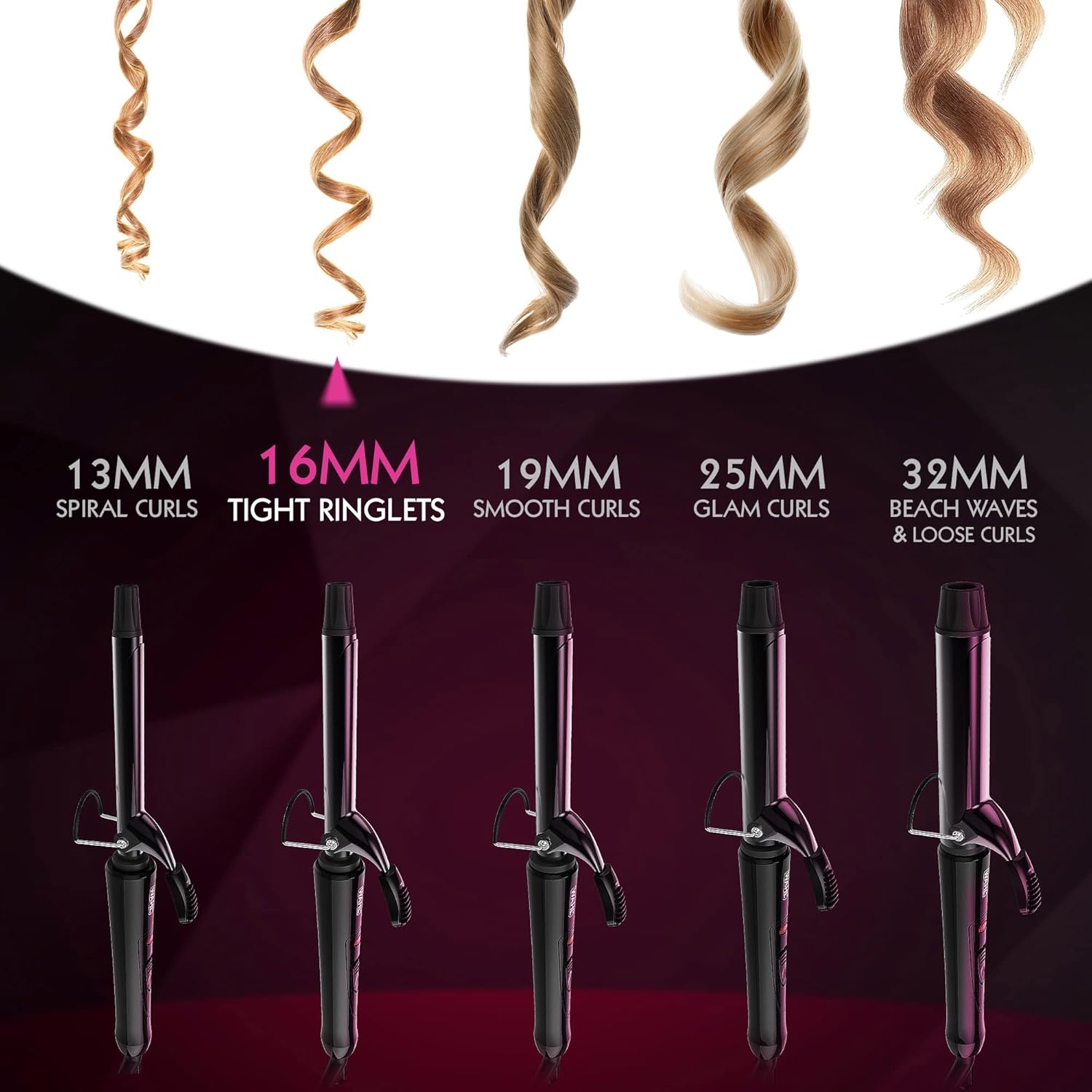
- 0.5-inch to 0.75-inch (13 mm – 19 mm): Designed for tight ringlets, corkscrew curls, and enhancing natural short curl patterns. Ideal for short to medium-length hair seeking defined, long-lasting texture.
- 1-inch (25 mm): The industry standard for versatile styling. Produces classic springy curls on medium lengths and soft wave patterns on shorter hair. Recommended for users seeking a single tool for multiple styles.
- 1.25-inch (32 mm): Ideal for medium-to-long hair to create full, voluminous body waves and relaxed beachy textures.
- 1.5-inch to 2-inch (38 mm – 50 mm): Best suited for long hair to add soft bend, polished end-flips, and crown volume rather than structured, tight ringlets.
Temperature Controls and Thermal Sensors
Precision heat setting is essential for maintaining hair health. Fixed-temperature tools that operate at a single setting (often exceeding 400°F) pose a high risk of thermal degradation for fine or compromised hair. Look for tools featuring digital microprocessors that monitor barrel temperatures hundreds of times per second. These sensors compensate immediately for heat lost to ambient air or cold hair strands, maintaining a stable temperature without overheating.
Types of Hair Curling Tools
Modern hair curlers extend beyond the classic spring-clamp iron. Each design offers specific advantages for user skill levels, hair lengths, and desired finishes.
| TOOL TYPE | PRIMARY FUNCTION & BEST USE CASE |
|---|---|
| Spring Clamp Iron | Traditional control; uniform curls from root to tip. |
| Marcel Iron | Professional manual control; precision styling by stylists. |
| Tapered Wand | Clamp-free wrapping; natural beach waves and modern curls. |
| Hot Rollers | Hands-free volume and long-lasting roots-to-ends body. |
| Air / Auto Curlers | Automated wrapping; consistent waves with reduced heat stress. |
Traditional Spring-Clamp Irons
Spring-clamp curling irons feature a spring-loaded lever that holds the ends of the hair against the barrel while rolling toward the root. They provide consistent tension, making them simple to operate for beginners. However, improper technique—such as catching the ends of the hair in the clip for too long—can lead to bent, creased, or fried ends.
Professional Marcel Irons
Marcel irons lack a internal spring mechanism. Instead, the stylist manually controls the clamp handle and barrel rotation. This design offers complete control over tension, direction, and heat application. While favored by professional session stylists, Marcel irons require significant manual dexterity and practice to prevent accidental scalp burns or uneven clamping.
Clamp-Free Curling Wands
Curling wands require manually wrapping hair sections directly around a bare cylinder or tapered rod, holding the end of the strand with a heat-resistant glove or protective grip. Because there is no clamp, wands create smooth, kink-free waves without pressing or flattening the hair strand. Tapered wands feature a wider base that narrows at the tip, allowing artists to customize curl dimensions within a single hair section.
Hot Rollers and Steam Curler Systems
Hot rollers use conductive heat or internal steam cores to set hair through gradual thermal transfer and cooling cycles. Hair is wrapped around pre-heated rollers, pinned in place, and left to cool completely. Because the heat dissipates gradually as the hair sets around the roller, this method offers superior hold and volume with minimal localized heat damage, making it suitable for fine, limp, or aging hair.
Automatic and Air-Styling Systems
Modern air-driven curlers use aerodynamic physical phenomena (such as the Coanda effect) to wrap hair around a barrel using high-velocity airflow rather than direct high-heat contact. Similarly, motorized automatic chamber curlers draw hair into a heated chamber to apply controlled thermal cycles. These tools lower the risk of thermal injury and simplify curling for users who struggle with manual wrapping techniques.
Tool Comparison by Hair Type and Heat Profile
The table below outlines technical specifications, material recommendations, and target thermal ranges across primary hair classifications.
| Hair Texture & Profile | Recommended Barrel Material | Optimal Temperature Range | Recommended Barrel Diameter | Primary Styling Goal |
|---|---|---|---|---|
| Fine, Thin, Bleached | Pure Ceramic / Tourmaline | 250°F – 300°F (120°C – 150°C) | 1.0 inch – 1.25 inch | Volumetric waves without cuticle scorching |
| Medium, Color-Treated | Ceramic / Tourmaline Blend | 300°F – 350°F (150°C – 175°C) | 1.0 inch – 1.5 inch | Smooth, long-lasting curls with cuticle sealing |
| Thick, Coarse, Dense | Titanium / Metal Alloy | 350°F – 400°F (175°C – 205°C) | 0.75 inch – 1.25 inch | Uniform heat transfer to overcome resistant cortex |
| Naturally Coily (Type 4) | Tourmaline Ceramic or Steam | 325°F – 375°F (160°C – 190°C) | 0.5 inch – 1.0 inch | Defined ringlets with moisture preservation |
| Short Hair (Above Shoulder) | Ceramic Wand or Small Clamp | 280°F – 340°F (135°C – 170°C) | 0.5 inch – 0.75 inch | Root lift and tight curl definition |
How to Style safely and Avoid Heat Damage
Even the highest-quality hair curler can damage hair if used incorrectly. Follow these step-by-step procedures to maintain hair health during thermal styling.
THERMAL STYLING PROTOCOL
- STEP 1: PREPARATION Ensure 100% dry hair; apply heat protectant up to 450°F.
- STEP 2: SECTIONING Divide hair into clean, manageable 1-to-2 inch sub-sections.
- STEP 3: APPLICATION & TIMING Select proper heat; hold for 5–10 seconds per strand maximum.
- STEP 4: COOLING & SETTING Allow curls to cool completely in hand or clip before brushing out.
1. Thorough Preparation and Heat Protection
Never apply thermal styling tools directly to damp or wet hair unless using a tool specifically designed for wet-to-dry airflow styling. Applying high-heat hot irons to wet hair turns internal water molecules into steam instantly, causing internal strand cavities known as "bubble hair," which permanently weakens the hair shaft.
Always coat hair with a silicone-based or polymer-based thermal protectant spray or cream. These formulas create a defensive barrier that slows heat transfer and reduces surface friction during wrapping.
2. Systematic Sectioning
Working with oversized, messy sections forces you to hold the curling barrel against the hair longer, exposing outer layers to excessive heat while inner layers remain under-styled.
Divide hair cleanly into four quadrants using sectioning clips. Take uniform sub-sections no wider than the width of the barrel:
- Use 1-inch sections for tight, structured curls.
- Use 1.5 to 2-inch sections for soft, loose body waves.
3. Calibrating Temperature and Dwell Time
Adjust your tool to the lowest effective temperature for your texture. Begin styling at lower settings and increase heat only if the curl fails to set after a single pass.
Maintain a consistent dwell time—the duration the tool contacts the hair strand:
- Fine or Damaged Hair: Hold for 3 to 5 seconds per section.
- Medium to Coarse Hair: Hold for 5 to 10 seconds per section.
Never allow a thermal barrel to remain clamped on a single section of hair for more than 10 to 12 seconds.
4. Cooling and Setting the Structure
Hair keratin is pliable when warm and locks into its new shape as it cools. Dropping a hot curl immediately allows gravity to stretch the pattern out before the hydrogen bonds re-form, causing the style to fall flat.
After releasing a section from the barrel, catch the hot curl in your palm, pin it against your head with a double-prong clip, and allow it to cool completely for 3 to 5 minutes before brushing out.
Troubleshooting Common Curling Problems
Problem: Curls Fall Flat Within an Hour
- Root Cause: The heat setting is too low for the hair's density, sections are too thick, or the hair was not allowed to cool completely before styling products were applied.
- Solution: Reduce section size to 1 inch, verify barrel material matches hair porosity (switch to titanium for coarse hair), and pin curls while cooling. Avoid heavy, oil-rich finishing products that weigh down delicate curl architecture.
Problem: Hair Feels Crunchy, Dry, or Smells Singed
- Root Cause: Excessive surface temperature, lack of heat protectant, or curling wet/damp hair.
- Solution: Immediately lower the iron's temperature below 320°F (160°C). Apply a high-grade thermal barrier product containing dimethicone or hydrolyzed wheat proteins to protect the cuticle layer.
Problem: Creases and Kinks at the Ends of Curls
- Root Cause: Clamping the tip of the hair strand backward against the curve of the barrel, or dragging a spring-clamp down the hair length with too much tension.
- Solution: Switch to a clamp-free curling wand or smooth out hair ends by gliding the open clamp down the strand before wrapping the length around the barrel.
Frequently Asked Questions
What is the safest curling iron material for fine or bleached hair?
Pure ceramic and tourmaline-coated ceramic barrels are the safest choices for fine or bleached hair. Ceramic supplies even, far-infrared heat that warms strands gently without scorching the outer cuticle. Tourmaline naturally releases negative ions that seal moisture into fragile hair shafts, reducing static and preventing heat-induced damage.
How do I choose between a 1-inch and a 1.25-inch curling iron barrel?
Choose a 1-inch barrel if your hair is collarbone-length or shorter, or if your hair has trouble holding a curl, as tighter initial loops drop into soft waves over time. Choose a 1.25-inch barrel if your hair extends past your shoulder blades and you prefer loose, voluminous beach waves rather than defined ringlets.
Is titanium or ceramic better for stubborn, hard-to-curl hair?
Titanium is significantly better for stubborn, dense, or coarse hair. Titanium acts as a high-efficiency heat conductor that transfers thermal energy quickly into thick hair shafts, maintaining a stable temperature even across dense strands. Ceramic may lose surface heat when applied to thick hair, resulting in uneven styling.
At what temperature should I set my curling iron to avoid heat damage?
For fine, thin, or color-treated hair, keep temperatures between 250°F and 300°F (120°C – 150°C). For medium or normal textures, style between 300°F and 350°F (150°C – 175°C). For thick, coarse, or highly resistant hair, use temperatures between 350°F and 390°F (175°C – 200°C). Avoid exceeding 400°F (204°C) unless instructed by a licensed professional.
Can automatic air curlers work effectively on thick or coarse hair?
Automatic air-styling systems can work on thick hair, but they require significantly smaller sub-sections to allow airflow to penetrate the strands completely. For dense or extremely coarse hair types, traditional titanium manual curling irons or high-heat wands remain more efficient for creating long-lasting style hold.
Practical Action Plan for Selecting Your Curler
To select the ideal hair curler, follow this step-by-step evaluation process:
- Assess Your Hair Profile: Classify your strand diameter (fine, medium, coarse) and evaluate current structural health (virgin, color-treated, compromised).
- Select the Primary Barrel Material:
- Choose ceramic or tourmaline for fine, fragile, or color-treated hair.
- Choose titanium for coarse, dense, or curl-resistant hair.
- Select the Barrel Size Based on Length and Style:
- 0.75-inch to 1-inch for short hair, tight ringlets, or longevity on hard-to-curl hair.
- 1.25-inch to 1.5-inch for long hair and relaxed beach waves.
- Verify Feature Requirements: Ensure the tool includes adjustable digital heat controls, auto-shoff safety timers, and ceramic micro-heaters to keep temperatures steady while styling.
- Pair with Protective Care: Always use a light, high-temperature thermal protectant spray before heating hair strands to preserve structural integrity over time.
Image Gallery