How to Find the Cheapest Full Coverage Car Insurance for Young Drivers
To find the cheapest full coverage car insurance for young drivers in 2026, you must compare quotes from multiple providers, maximize "good student" and telematics discounts, and remain on a parent’s policy whenever possible. Increasin...
To find the cheapest full coverage car insurance for young drivers in 2026, you must compare quotes from multiple providers, maximize "good student" and telematics discounts, and remain on a parent’s policy whenever possible. Increasing deductibles and choosing a vehicle with high safety ratings are also essential strategies to reduce high premiums.
Contents
Finding affordable "full coverage" is a significant hurdle for drivers under the age of 25. Because insurance companies use historical data to predict future risk, younger motorists—who statistically have higher rates of accidents and moving violations—are charged some of the highest premiums in the industry. However, by understanding how coverage is priced and which specific levers can be pulled to lower costs, young drivers and their families can secure comprehensive protection without overpaying.
Defining Full Coverage for the Young Driver
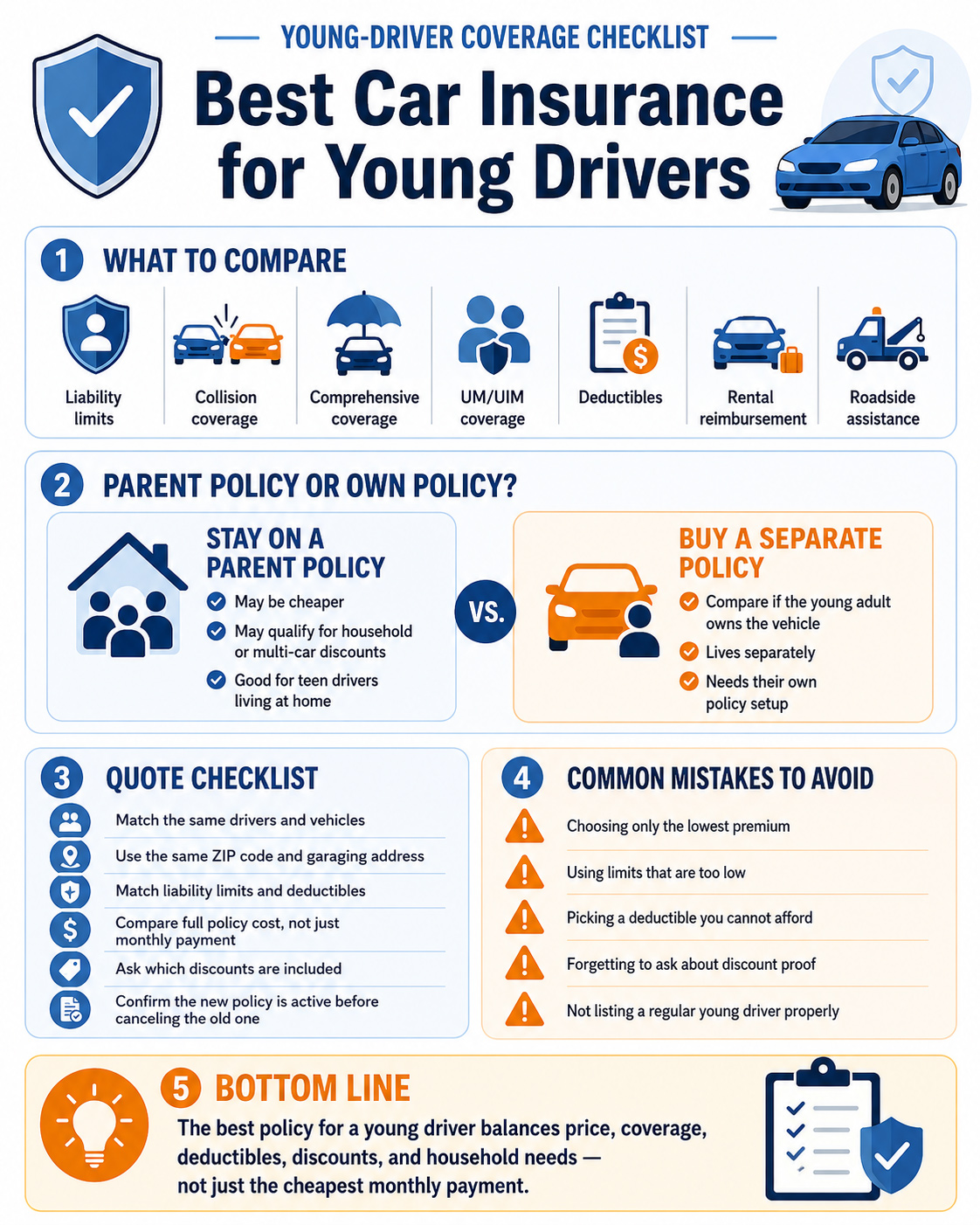
In the insurance industry, "full coverage" is not a specific policy type but a combination of several different protections. While most states only require liability insurance, lenders typically mandate full coverage if a vehicle is financed or leased. In 2026, the components of a standard full coverage policy generally include:
- Liability Insurance: Covers bodily injury and property damage that you cause to others in an accident. This is the legal minimum in most jurisdictions.
- Collision Insurance: Pays for repairs to your own vehicle after an accident, regardless of who was at fault.
- Comprehensive Insurance: Protects against non-collision events, such as theft, vandalism, fire, or weather-related damage.
- Uninsured/Underinsured Motorist Coverage: While sometimes optional, this is often bundled into full coverage packages to protect the driver if they are hit by someone without adequate insurance.
For a young driver, the "Collision" and "Comprehensive" portions of the bill are often the most expensive because they are tied directly to the value of the car and the likelihood of a claim.
Why Young Drivers Face Higher Premiums in 2026
Insurance pricing is rooted in actuarial science—the study of risk. Data from the National Highway Traffic Safety Administration (NHTSA) continues to show that drivers aged 16 to 24 have a higher rate of crashes per mile driven than any other age group.
Several factors contribute to these elevated costs:
- Lack of Driving History: Without a multi-year record of safe driving, insurers have no evidence that a young driver is a low risk.
- Inexperience: Inexperienced drivers are less likely to recognize hazardous situations or react correctly to avoid a collision.
- Distracted Driving Trends: Despite 2026’s advanced in-car safety technology, distracted driving remains a leading cause of accidents among younger demographics.
- Credit History: In many states, insurance companies use credit-based insurance scores. Many young drivers have thin credit files, which can lead to higher rates.
Strategies to Secure the Lowest Rates
Achieving the cheapest full coverage requires a proactive approach. It is rarely a matter of finding one "cheap" company; rather, it is about finding the company whose algorithm favors your specific profile.
Stay on the Family Policy
The most effective way to save money is to remain on a parent’s or guardian’s insurance policy. A multi-car policy is almost always cheaper than two separate policies. By piggybacking on a parent’s established insurance history and "loyalty" status, a young driver can save 20% to 50% compared to an individual policy.
Leverage Student Discounts
Insurance companies favor students who perform well academically, viewing them as more responsible and less likely to take risks behind the wheel.
- Good Student Discount: Most carriers offer a discount (often up to 15%) for full-time students who maintain a "B" average (3.0 GPA) or higher.
- Student Away at School: If a student is attending college more than 100 miles away from home and does not have a car on campus, parents can often receive a substantial discount while still keeping the student covered when they return for holidays.
Enroll in Telematics Programs
By 2026, usage-based insurance (UBI) has become a standard tool for rate reduction. Programs like Progressive’s Snapshot or State Farm’s Drive Safe & Save use a mobile app or a plug-in device to monitor driving habits.
- What they track: Hard braking, rapid acceleration, late-night driving, and total mileage.
- The benefit: Young drivers who practice safe habits can see immediate discounts, sometimes as high as 30%, which bypasses the "lack of history" penalty.
Choose the Right Vehicle
The car itself is a massive variable in the "full coverage" equation. A brand-new sports car will be exorbitantly expensive to insure for a 19-year-old. Conversely, a mid-sized sedan with high safety ratings and moderate repair costs will attract much lower premiums. Before purchasing a vehicle, it is wise to get an insurance quote for that specific VIN.
Comparison of Common Discounts for Young Drivers
| Discount Type | Average Potential Savings | Primary Requirement |
|---|---|---|
| Multi-Vehicle | 10% – 25% | Insuring more than one car on the same policy. |
| Good Student | 5% – 15% | Maintaining a 3.0 GPA or higher (verified by transcript). |
| Driver Training | 5% – 10% | Completion of an accredited defensive driving course. |
| Telematics (UBI) | 10% – 30% | Consistently safe driving data tracked via app. |
| Distant Student | 15% – 30% | Student resides >100 miles away without a vehicle. |
| Safe Driver | 10% – 20% | Remaining accident-free for a set period (usually 3 years). |
Adjusting Deductibles to Control Costs
A deductible is the amount you pay out of pocket before your insurance coverage kicks in. For full coverage policies, you will have separate deductibles for Collision and Comprehensive claims.
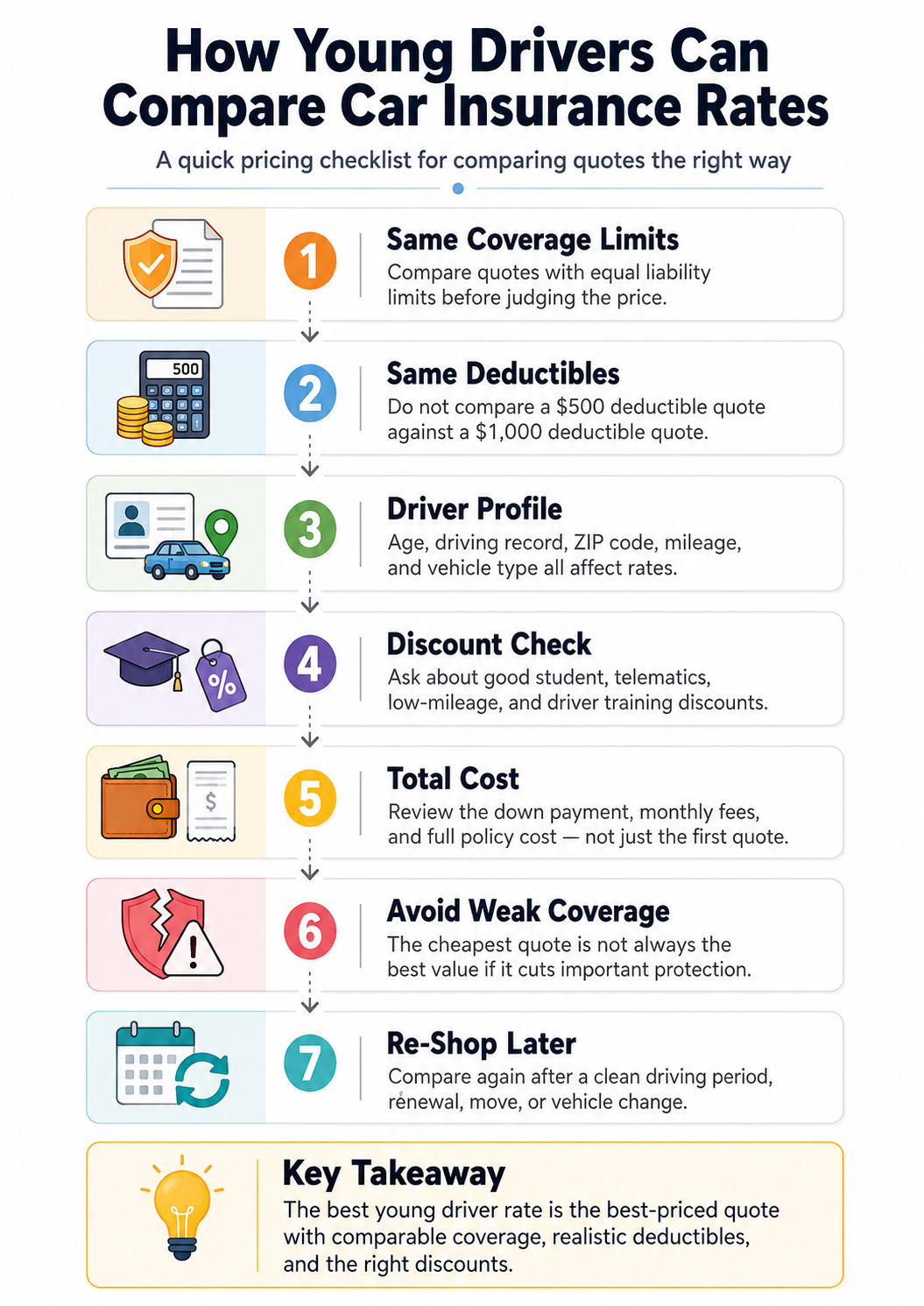
One of the fastest ways to lower a monthly premium is to increase the deductible. For example, moving from a $500 deductible to a $1,000 deductible can significantly reduce the annual cost of the policy. However, this strategy requires the driver (or their parents) to have that $1,000 readily available in an emergency fund. For many young drivers, a higher deductible is a calculated risk that pays off in lower fixed monthly expenses.
The Importance of Comparison Shopping
The insurance market is highly fragmented, and prices for the exact same coverage can vary by thousands of dollars between companies. In 2026, digital comparison tools make it easier than ever to aggregate quotes.
When shopping, it is vital to:
- Compare Apples to Apples: Ensure the liability limits and deductibles are identical across all quotes.
- Check Financial Ratings: Use sources like AM Best to ensure the company has the financial strength to pay out claims.
- Review Local Carriers: Sometimes regional insurers offer better rates for local residents than national giants.
Common Mistakes to Avoid
- Buying Only the State Minimum: While tempting for the low price, "liability-only" leaves the driver personally responsible for the cost of their own vehicle if it is totaled. For a young driver with limited savings, this can be a financial disaster.
- Failing to Update the Policy: As a driver turns 21, 24, and 25, or graduates from college, they should re-shop their policy. Rates often drop significantly at these milestones.
- Neglecting to Mention Safety Features: Ensure the insurer knows if the car has anti-theft devices, lane-assist, or automatic emergency braking, as these often trigger small but cumulative discounts.
Frequently Asked Questions
Which insurance company is cheapest for young drivers in 2026?
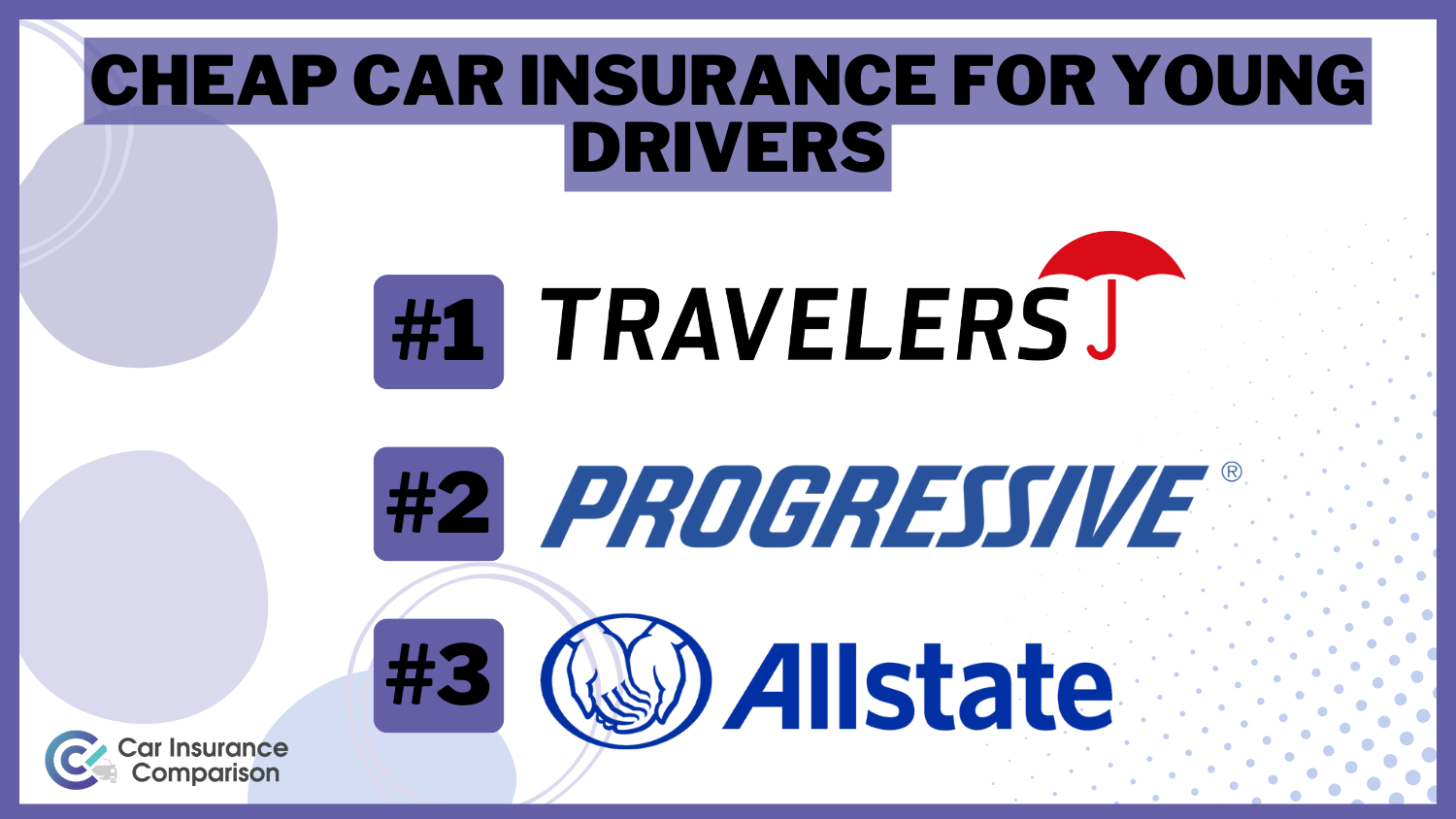
There is no single "cheapest" company for everyone, as rates are highly localized. However, USAA (for military families), Erie Insurance, and State Farm consistently rank among the most affordable for younger age groups. Progressive is often competitive for those willing to use telematics tracking.
Does the color of the car affect insurance rates for young drivers?
No, the color of a vehicle does not impact insurance premiums. Insurers focus on the make, model, year, safety features, and the cost of parts and labor for repairs. A red sedan will cost the same to insure as a white sedan of the same model.
Can a young driver get their own policy, or should they stay with parents?
A young driver can obtain their own policy if they own the vehicle title, but it is almost always more expensive. Individual policies lack the "multi-car" and "multi-policy" (bundling with homeowners insurance) discounts that parents typically possess.
How much does full coverage typically cost for an 18-year-old?
In 2026, the national average for an 18-year-old on an individual full coverage policy can range from $4,000 to $7,000 per year, depending on the state. On a parent's policy, this can often be reduced to $2,500 to $3,500.
At what age do car insurance rates start to go down?
Rates typically begin to decrease slightly at age 21, with a more significant drop occurring after age 25, provided the driver has maintained a clean driving record. Some insurers also offer rate reductions after three years of continuous coverage without an accident.
Practical Recommendation
To secure the best rate today, start by requesting a quote from your current family insurance provider to establish a baseline. Then, obtain at least three additional quotes from competitors, specifically asking about "Good Student" and "Telematics" programs. If the vehicle is older and its market value is less than ten times the annual premium, consider whether the "Collision" portion of full coverage is still financially necessary. Always verify the insurer's claims-handling reputation through the National Association of Insurance Commissioners (NAIC) before signing a new policy.
Image Gallery