How to Get Unique Content for Your Website
Securing unique content for your website requires a strategic combination of original reporting, proprietary data synthesis, expert interviews, and rigorous editorial oversight that moves beyond generic AI generation. By establishing s...
Securing unique content for your website requires a strategic combination of original reporting, proprietary data synthesis, expert interviews, and rigorous editorial oversight that moves beyond generic AI generation. By establishing structured workflows, leveraging primary sources, and implementing strict originality audits, site owners can build authoritative web pages that satisfy search engines and engage human readers effectively.
Contents
Creating a library of original material is essential for establishing authority and avoiding duplicate text penalties from search engines. Because search algorithms prioritize distinct, high-value information that directly answers user queries, replicating existing material or relying on unedited automated text generation harms visibility and conversion rates. This guide details the practical methodologies, verification steps, and operational workflows needed to source and publish genuinely distinct material for any digital property.
Understanding the Importance of Originality in Web Publishing
Original material serves as the foundation of sustainable search visibility and user trust. Search engines process billions of pages daily, deploying sophisticated algorithms designed to identify and filter out scraped, spun, or heavily derivative text. When a website features distinct insights, firsthand testing, or proprietary data, search algorithms recognize it as a valuable node in the information network.
Beyond algorithmic positioning, human visitors quickly bounce away from pages that offer recycled talking points found on dozens of competing domains. Establishing unique value requires looking at industry topics through a fresh lens. This might involve conducting original surveys, analyzing public datasets, interviewing industry practitioners, or sharing transparent case studies detailing actual operational outcomes.
The Risks of Derivative and Low-Quality Material
Publishing low-effort or heavily derivative material exposes a website to several severe operational risks:
- Algorithmic Suppression: Major search engines deploy quality-rating systems that demote thin, repetitive, or unoriginal pages, leading to a permanent decline in organic acquisition.
- Brand Erosion: Users seeking authoritative answers lose trust when encountering recycled generalities, factual errors, or content that feels engineered purely for keyword matching.
- Legal and Ethical Liabilities: Copying text or data without proper attribution or permission violates copyright law, risking formal takedown notices, penalties, or intellectual property disputes.
Step 1: Establish a Primary Research Framework
Obtaining truly unique material begins with gathering information that does not already exist in a neat summary online. Relying solely on secondary sources—reading other blogs to write a new blog—guarantees a derivative final product.
An effective research framework prioritizes primary sources, official documentation, and empirical data. For technical niches, this means consulting official API documentation, regulatory standards bodies, or peer-reviewed journals. For commercial or lifestyle topics, it involves conducting hands-on product testing, organizing focus groups, or surveying verified customers.
PRIMARY RESEARCH HIERARCHY
- Level 1: Proprietary Data & Firsthand Testing
- Surveys, original analytics, lab benchmarks
- Level 2: Expert Interviews & Industry Practitioners
- Direct quotes, specialized case studies
- Level 3: Official Documentation & Primary Records
- Government filings, regulatory statutes, APIs
- Level 4: Secondary Sources & Aggregated Reports (Use Sparingly)
Leveraging Subject Matter Experts (SMEs)
Interviewing recognized authorities injects unique perspectives, firsthand anecdotes, and authoritative quotes into your pages. To extract valuable insights:
- Prepare Targeted Questions: Avoid broad inquiries that yield generic answers. Ask specific questions about operational failures, emerging trends, or technical nuances within their domain.
- Record and Transcribe: Use reliable transcription tools to capture exact wording, ensuring technical accuracy when translating spoken expertise into written prose.
- Attribute Accurately: Clearly credit the expert with verifiable biographical details and credentials to enhance overall authority and transparency.
Step 2: Implement Advanced Content Sourcing Methods
Once the research framework is active, several production methods help transform raw data into polished, distinctive web pages. Selecting the right method depends on your budget, team size, and the specific search intent of your audience.
Conducting Proprietary Case Studies
Case studies represent one of the most effective ways to secure completely unique material. Documenting a real-world experiment, a marketing campaign audit, or a software implementation provides readers with actionable blueprints they cannot find elsewhere.
To build a compelling case study:
- Define a clear hypothesis or operational challenge.
- Document the step-by-step methodology used to address the challenge.
- Publish exact metrics, screenshots, charts, or raw data sets illustrating the results—both positive and negative.
Commissioning Original Visuals and Interactive Assets
Text is only one component of website uniqueness. Search algorithms and users heavily favor visual assets that cannot be replicated via standard stock photography libraries.
- Custom Diagrams and Flowcharts: Illustrate complex technical workflows or data hierarchies using clear, branded graphics.
- Original Photography and Video: Feature unboxed hardware, physical workspaces, or step-by-step video walkthroughs recorded by your internal team.
- Interactive Calculators and Tools: Embed lightweight calculators, assessment quizzes, or data lookup widgets that provide dynamic, user-specific outputs.
Step 3: Writing and Structuring for Originality
Drafting unique material requires careful attention to voice, structure, and depth. Even when covering well-trodden topics, your editorial approach can differentiate your pages.
Moving Beyond Surface-Level Summaries
Many content creators make the mistake of writing high-level introductions followed by superficial bullet points. To satisfy comprehensive search intent, every section must answer the underlying "Why" and "How" of a topic.
- Incorporate Granular Details: Include specific measurement standards, exact configuration steps, cost breakdowns, and potential operational bottlenecks.
- Address Edge Cases: Discuss rare exceptions, regulatory limits, or troubleshooting steps for scenarios that most generic articles ignore.
- Maintain an Objective Tone: Present balanced comparisons with clear pros and cons rather than exaggerated promises or promotional hype.
| Content Approach | Characteristics | Impact on Search & User Trust |
|---|---|---|
| Scraped / Spun Text | Automated re-phrasing of existing web pages; lacks factual verification. | High risk of algorithmic suppression; immediate user bounce. |
| Surface-Level Summary | General overviews compiled from top-ranking search results. | Low differentiation; struggles to rank for competitive terms. |
| Primary Research / Case Study | Built on proprietary data, expert quotes, and firsthand testing. | High authority; strong organic acquisition and sustained engagement. |
Step 4: Verification, Plagiarism Audits, and Quality Control
Ensuring uniqueness is not a one-time task; it requires systematic checks before and after publication. Unintentional duplication can occur even among honest writers, particularly when covering technical subjects with standardized terminology.
Plagiarism and Similarity Detection
Before publishing any draft, run the text through reputable plagiarism detection software to identify accidental overlaps with existing web pages.
- Review Semantic Overlaps: Look beyond exact-match phrasing to ensure your sentence structures and conceptual explanations do not mirror a single source too closely.
- Verify Citations: Ensure that any statutory references, statistical claims, or quoted material link directly to official sources or name the publisher explicitly.
- Perform Fact-Checking: Cross-reference technical specifications, pricing models, and historical dates against primary documentation to eliminate inherited errors from secondary sources.
Frequently Asked Questions
How can I ensure my content is unique if the topic has already been written about extensively?
You achieve uniqueness by adding primary research, proprietary data, expert commentary, or firsthand testing that competitors have not published. Instead of summarizing existing articles, approach the topic from a specific operational angle, such as conducting a multi-week case study or interviewing industry practitioners.
Can I use artificial intelligence tools to help create unique website content?
AI tools can assist with outlining, data organization, and drafting baseline text, but they should not be used to generate unedited, automated pages. AI models train on existing public data and tend to produce derivative summaries. To maintain originality, use AI strictly as an assistant while injecting human expertise, original data, and strict editorial oversight.
What is the difference between duplicate content and similar content?
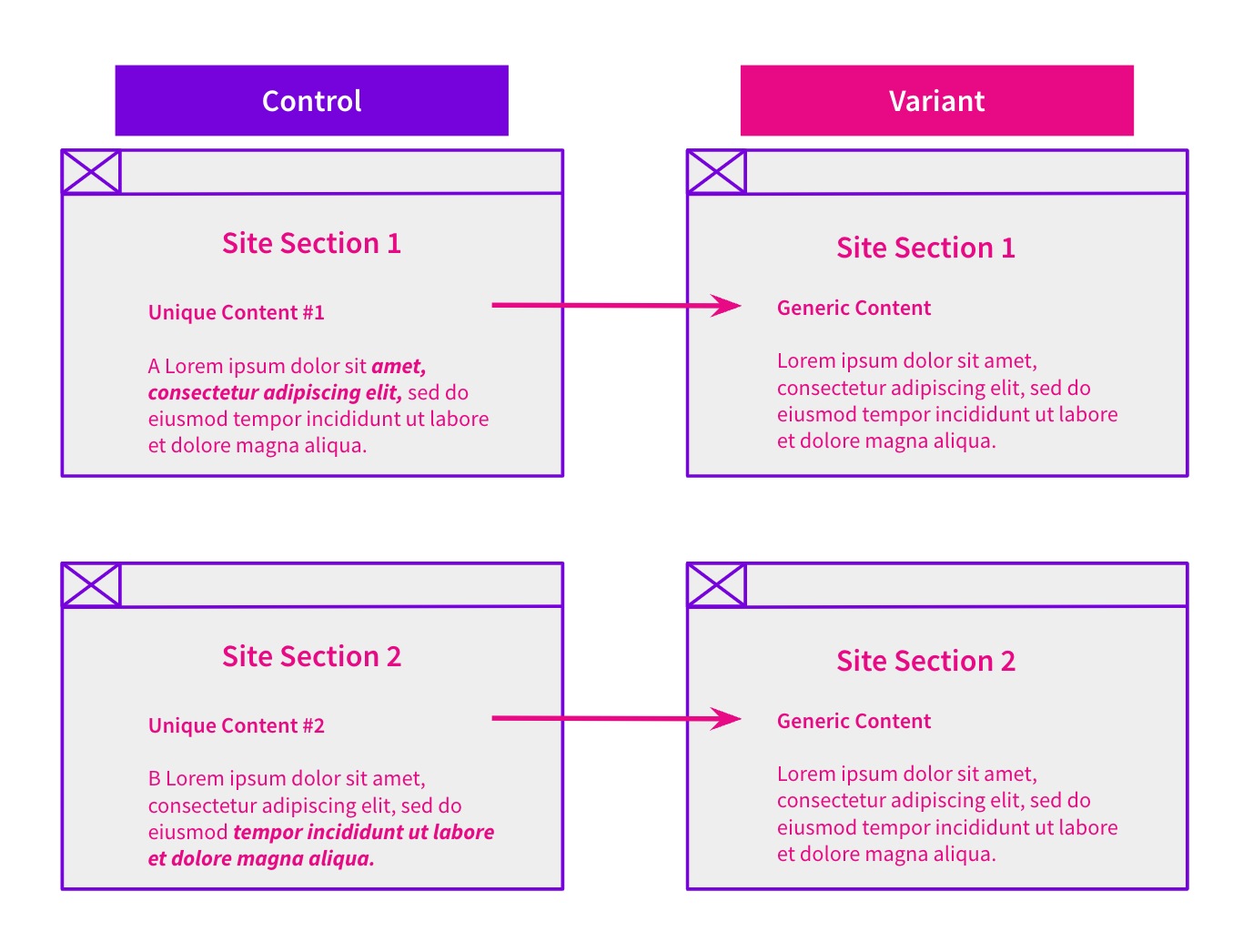
Duplicate content refers to identical blocks of text appearing across multiple URLs on the same site or across different domains. Similar content involves pages that cover the same topic using different wording. While search engines easily filter duplicate text via canonical tags, similar content can still rank if each page offers distinct value, unique data, or a different perspective.
How often should I audit my website for content originality?
Conduct comprehensive content audits at least twice a year. Review top-performing and underperforming pages to ensure external scraping has not occurred, outdated information has been updated, and your pages maintain a distinct value proposition relative to newly published competitor material.
Are stock photos and templates considered unique content?
Standard stock photos and generic website templates are not unique because thousands of other sites use them. While using them does not trigger an algorithmic penalty, they fail to build brand distinctiveness. Investing in custom graphics, original photography, and bespoke layouts significantly enhances perceived quality and user engagement.
Next Actions for Implementation
To systematically improve the uniqueness of your website, begin by auditing your current content inventory to identify underperforming or heavily derivative pages. Establish a standardized editorial workflow that requires primary research, expert sourcing, or proprietary data collection for every new piece commissioned. By prioritizing genuine substance over output volume, you will build a durable digital asset that withstands algorithmic shifts and provides lasting value to your audience.
Image Gallery