How to Get a Loan to Buy an Established Business
To get a loan to buy an established business, you must demonstrate the target company’s ability to generate sufficient cash flow to cover debt payments while proving your own management competency. Lenders typically require a debt serv...
To get a loan to buy an established business, you must demonstrate the target company’s ability to generate sufficient cash flow to cover debt payments while proving your own management competency. Lenders typically require a debt service coverage ratio (DSCR) of at least 1.25x, a down payment of 10% to 25%, and a solid personal credit profile. The process involves choosing the right loan vehicle—such as an SBA 7(a) loan or conventional financing—and completing a rigorous due diligence phase to verify the business’s financial health.
Contents
Understanding the Landscape of Acquisition Financing in 2026
Acquiring an existing business is often considered a lower-risk alternative to starting a new venture because the entity already possesses a proven product-market fit, an established customer base, and historical financial records. However, financing these "buy-then-build" opportunities requires a sophisticated approach to credit. In 2026, lenders have become increasingly data-driven, focusing heavily on the stability of the target’s earnings before interest, taxes, depreciation, and amortization (EBITDA) and the buyer's direct experience in the industry.
Unlike a mortgage for a home, where the property serves as the primary security, a business acquisition loan is secured by a combination of the business's assets, its future cash flows, and often the buyer’s personal guarantee. Because the failure rate of small businesses remains a concern for financial institutions, the burden of proof lies with the borrower to show that the transition of ownership will not jeopardize the company’s profitability.
Determining Your Eligibility as a Buyer
Before approaching a lender, you must assess your own "lendability." Banks do not just fund businesses; they fund the people who run them.
Personal Financial Profile
Your personal credit score remains a foundational element of the application. Most SBA-backed lenders and conventional banks look for a score of 700 or higher. A lower score doesn't automatically disqualify you, but it may require a larger down payment or higher interest rates to offset the perceived risk. Additionally, you will need to provide a Personal Financial Statement (PFS) detailing your assets (cash, real estate, investments) and liabilities (mortgages, student loans, credit card debt).
Industry Experience and "Transferable Skills"
Lenders are wary of "absentee owners" or buyers entering a complex industry with zero prior experience. If you are a software engineer trying to buy a manufacturing plant, you must articulate how your management skills transfer to the new environment or prove that the existing management team is staying on post-acquisition. In 2026, many lenders require a detailed resume and a narrative statement explaining why you are the right person to lead this specific business.
The Equity Injection (Down Payment)
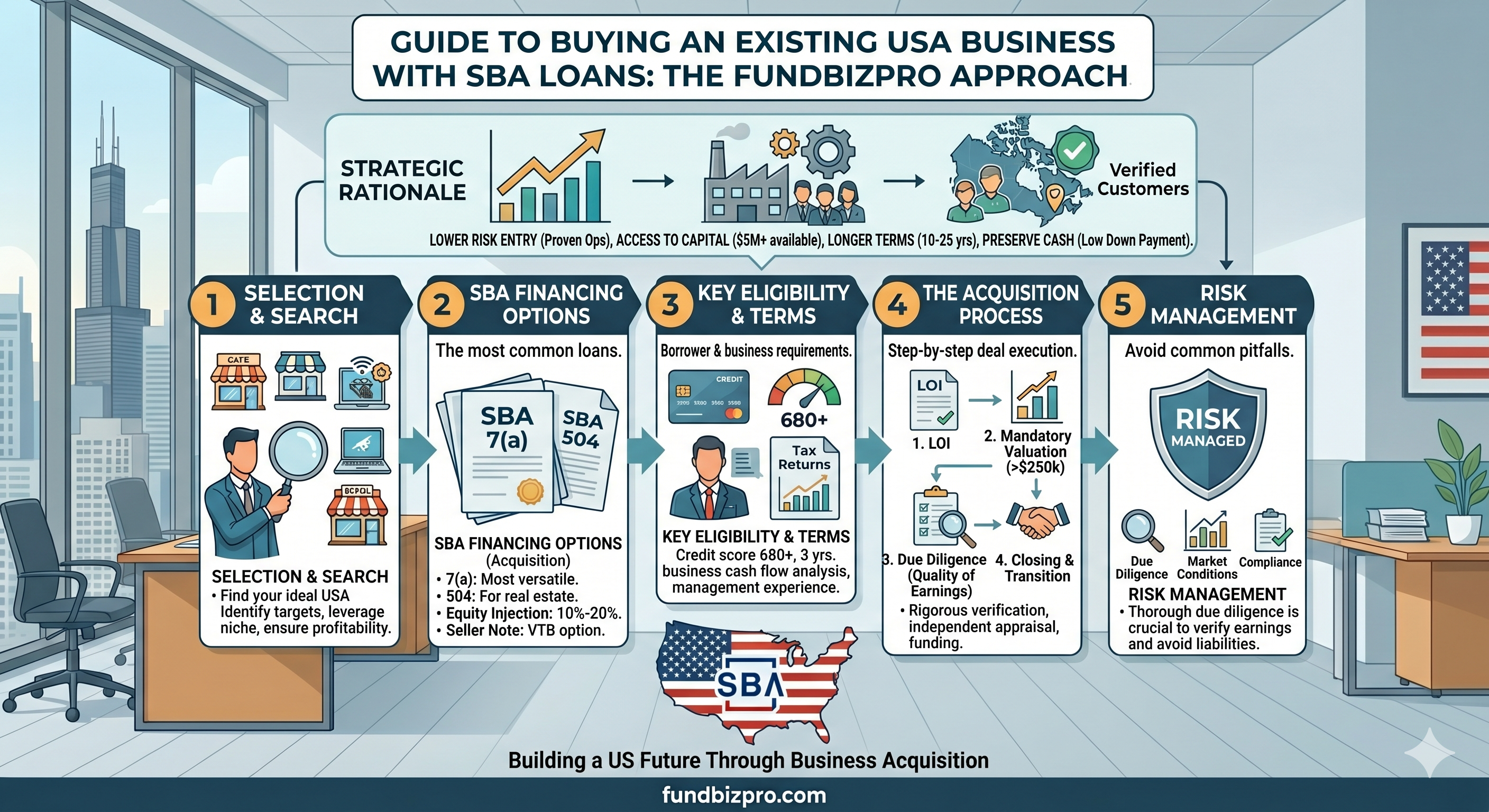
You will almost always need "skin in the game." For an SBA 7(a) loan, the minimum equity injection is typically 10% of the purchase price. Conventional loans may require 20% to 30%. This capital must be "unencumbered," meaning it cannot be another loan. Common sources include personal savings, 401(k) rollovers via a Rollover for Business Startups (ROBS) structure, or equity partners.
Evaluating the Target Business for Bankability
A business may look profitable on paper, but a lender will look at it through the lens of "debt serviceability."
The Debt Service Coverage Ratio (DSCR)
The DSCR is the most critical metric in acquisition financing. It is calculated by dividing the business’s annual net operating income by its total annual debt service (principal and interest payments).
- A DSCR of 1.0 means the business makes exactly enough to pay the loan, leaving no room for error.
- A DSCR of 1.25 or higher is the standard benchmark for most lenders in 2026. This provides a 25% "buffer" to cover unexpected expenses or economic downturns.
Quality of Earnings and "Add-Backs"
Business owners often use legal deductions to minimize their tax liability, which can make a company look less profitable than it actually is. To find the "true" cash flow, you and your lender will look at "add-backs." These include one-time expenses, the owner’s salary (above a market rate), and non-cash expenses like depreciation. However, lenders are increasingly skeptical of aggressive add-backs. If you cannot prove an expense was truly discretionary or one-time, the lender will likely exclude it from the cash flow calculation.
Asset Valuation vs. Goodwill
Lenders prefer businesses with "hard assets" (real estate, machinery, inventory) because they can be liquidated if the loan defaults. Many service-based businesses, however, are valued based on "goodwill"—their reputation and customer lists. If a large portion of the purchase price is goodwill, the lender may require a stronger personal guarantee or a longer history of stable earnings.
Primary Loan Options for Business Acquisitions
In 2026, several financing paths exist, each with distinct pros and cons.
| Loan Type | Typical Down Payment | Interest Rate (2026 Est.) | Term Length | Best For |
|---|---|---|---|---|
| SBA 7(a) Loan | 10% – 15% | Prime + 2.25% to 3% | 10 Years | Most small to mid-sized acquisitions; low down payment. |
| Conventional Bank Loan | 20% – 30% | 7% – 10% (Fixed/Var) | 5 – 7 Years | Buyers with high collateral and strong existing bank relationships. |
| Seller Financing | 10% – 50% | 6% – 9% | 3 – 5 Years | Closing the "gap" between the bank loan and the purchase price. |
| Asset-Based Lending | 0% – 20% | 8% – 12% | Varies | Businesses with heavy equipment, high inventory, or receivables. |
SBA 7(a) Loans: The Standard-Bearer
The Small Business Administration’s 7(a) program remains the most popular route for buying a business. Because the SBA guarantees a portion of the loan (usually 75%), banks are more willing to lend to buyers who might not meet strict conventional criteria. As of 2026, the SBA has streamlined the application process for loans under $500,000, though larger acquisitions still require extensive documentation.
Seller Financing: The "Gap" Filler
It is rare to find an acquisition in 2026 that doesn't involve some level of seller financing. This is where the seller agrees to accept a portion of the purchase price over time, essentially acting as a secondary lender. Banks love seller financing because it keeps the seller "tethered" to the business's success and reduces the bank's own risk. A common structure is a 70% bank loan, 10% buyer down payment, and 20% seller note.
The Step-by-Step Acquisition Loan Process
Securing a loan for an established business is a marathon, not a sprint. The process typically takes 60 to 90 days.
Step 1: Preliminary Review and Letter of Intent (LOI)
Once you find a business, you will sign a non-disclosure agreement (NDA) to review its tax returns and P&Ls. If the numbers work, you issue an LOI. This document outlines your offer price and the proposed financing structure. It is usually "contingent on financing," meaning you can back out if a bank refuses to lend.
Step 2: Lender Pre-Qualification
Before spending thousands on legal fees, take the business’s last three years of tax returns and your PFS to a lender. They will perform a "back-of-the-envelope" calculation to see if the deal is viable. If it is, they will issue a pre-qualification letter, which gives you credibility with the seller.
Step 3: Formal Underwriting and Due Diligence
This is the most intensive phase. The lender’s underwriting team will scrutinize every aspect of the business. You will be required to provide:
- Three years of business and personal tax returns.
- Year-to-date (YTD) financial statements (P&L and Balance Sheet).
- Accounts receivable and accounts payable aging reports.
- A detailed business plan and financial projections for the first two years of your ownership.
Step 4: Business Valuation and Appraisal
The lender will hire a third-party firm to conduct an independent valuation. If the appraiser values the business at $900,000 but your purchase price is $1,000,000, you have a "valuation gap." You must either negotiate the price down with the seller or increase your down payment to cover the $100,000 difference.
Step 5: Commitment Letter and Closing
Once underwriting is satisfied and the appraisal is back, the bank issues a formal commitment letter. This is a binding agreement to lend, provided certain conditions are met (e.g., proof of insurance, finalized lease assignments). At closing, funds are wired, the bill of sale is signed, and you officially take ownership.
Common Pitfalls to Avoid
Even profitable deals can fall through if the financing is handled poorly.
- Inaccurate Financials: If the seller’s tax returns do not match their internal QuickBooks records, lenders will often walk away. Always trust the tax returns over internal "pro-forma" statements.
- Customer Concentration: If 50% of the business’s revenue comes from a single client, the lender will view the deal as high-risk. If that client leaves after the sale, the business may fail.
- Lease Issues: If the business operates out of a leased space, the lease term must usually be as long as the loan term. If you have a 10-year loan but only 3 years left on the lease with no options to renew, the bank will not fund the deal.
- Underestimating Working Capital: Many buyers exhaust their cash on the down payment and forget that they need money to run the business on Day 1. Most SBA loans allow you to include "working capital" in the total loan amount—ensure you utilize this.
Professional Advice Limitation
This information is for educational purposes and does not constitute financial, legal, or tax advice. Loan programs, interest rates, and SBA guidelines are subject to change and vary by jurisdiction. Always consult with a certified public accountant (CPA), an M&A attorney, and a qualified commercial lender before entering into a binding purchase agreement.
Frequently Asked Questions
Can I buy a business with 0% down in 2026?
While "no money down" deals are popularized in some seminars, they are exceptionally rare in institutional lending. Most lenders require at least 10% equity. A 0% down deal usually requires the seller to carry 100% of the financing, which few sellers of high-quality businesses are willing to do.
How long do I need to be in business to get an acquisition loan?
Since you are buying an existing business, the company’s history (usually at least 3 years of operations) matters more than your "time in business." However, your personal career history should demonstrate stability and relevant management experience.
What is the difference between an asset purchase and a stock purchase for a loan?
In an asset purchase, you buy specific assets (equipment, brand, etc.) and leave the old liabilities behind. Lenders generally prefer this because it is cleaner. In a stock purchase, you buy the entire legal entity, including its history and potential hidden liabilities. Stock purchases are more complex for lenders and may require more intensive legal due diligence.
Does the SBA require a personal guarantee?
Yes. For any SBA loan, anyone owning 20% or more of the purchasing entity must provide a full, unconditional personal guarantee. This means your personal assets could be at risk if the business defaults on the loan.
Final Recommendation
Your first step should be to assemble a "deal team" consisting of a specialized business broker, a CPA, and a lender who specializes in SBA 7(a) acquisitions. Getting a "pre-flight" analysis of the target business’s tax returns by an experienced acquisition lender can save you months of wasted effort on unbankable deals.
Image Gallery