Cost of Level Term Life Insurance for a 66-Year-Old Smoker in 2026
For a 66-year-old smoker in 2026, the monthly cost for a $250,000 10-year level term life insurance policy typically ranges between $320 and $550. Rates vary significantly based on gender, specific health history, and the type of nicot...
For a 66-year-old smoker in 2026, the monthly cost for a $250,000 10-year level term life insurance policy typically ranges between $320 and $550. Rates vary significantly based on gender, specific health history, and the type of nicotine used, with smokers paying 200% to 400% more than non-smokers.
Contents
Level term life insurance is often the most cost-effective way to manage significant financial risks that have a defined expiration date, such as a mortgage, a business loan, or the remaining years of a spouse’s dependency on a pension. However, entering a new policy at age 66 while being a smoker presents unique challenges. In 2026, the insurance market has become more nuanced in how it evaluates "smoker" status, but the fundamental reality remains: nicotine use is the single most expensive rating factor outside of age and terminal illness.
The Financial Reality of Smoking at Age 66
When an actuary looks at a 66-year-old applicant who smokes, they are calculating the statistical probability of a claim within a relatively short window. According to the Centers for Disease Control and Prevention (CDC), smoking remains a leading cause of preventable death, contributing to heart disease, stroke, and respiratory illnesses—all of which see increased incidence in the late 60s.
For the policyholder, this translates into a "tobacco surcharge." This isn't a flat fee but a fundamental shift in the mortality table used to calculate your premium. At 66, you are already approaching the average life expectancy for a male smoker in the United States, which is often cited in the mid-to-late 70s. Consequently, an insurer providing a 10-year or 15-year level term policy is taking on a high-probability risk that the death benefit will be paid out before the term expires.
The "Level" in Level Term
The "level" aspect of this insurance is particularly valuable for a 66-year-old. It means that your premium is locked in for the duration of the term (e.g., 10, 15, or 20 years). Without a level guarantee, premiums for a 66-year-old smoker would rise exponentially every year as they age. By locking in a rate in 2026, you protect your budget from the massive price hikes that occur once you enter your 70s.
Estimated Monthly Premiums for 66-Year-Old Smokers (2026)
The following table provides estimated monthly premiums for a 10-year level term policy. These figures represent "Standard Smoker" rates for individuals with average health for their age, excluding major chronic conditions like diabetes or recent heart events.
| Coverage Amount | Monthly Cost (Male) | Monthly Cost (Female) | Comparison: Non-Smoker (Male) |
|---|---|---|---|
| $100,000 | $145 – $190 | $110 – $155 | $55 – $75 |
| $250,000 | $320 – $430 | $245 – $340 | $115 – $160 |
| $500,000 | $610 – $840 | $460 – $650 | $210 – $300 |
| $1,000,000 | $1,150 – $1,600 | $880 – $1,250 | $390 – $550 |
Note: Rates are estimates based on 2026 market trends. Individual quotes depend on medical underwriting and specific carrier guidelines.
Factors That Influence Your Specific Rate
While age and smoking status are the primary drivers, several other variables will dictate where you fall on the pricing spectrum.
1. Definition of "Smoker" in 2026
In 2026, the definition of a smoker is broader than it was a decade ago. Most insurance carriers categorize the following as tobacco/nicotine use:
- Traditional Cigarettes: Always triggers the highest smoker rates.
- Vaping and E-cigarettes: Most carriers still group these with cigarettes, though a few specialty insurers may offer "Standard" or "Non-Tobacco" rates if there is no actual tobacco leaf involved (though this is rare).
- Cigars: Occasional cigar users (e.g., one per month) may qualify for non-smoker rates if their lab tests show no cotinine (a nicotine byproduct).
- Nicotine Replacement Therapy (NRT): If you use patches or gum, most insurers still classify you as a smoker because the chemical nicotine is present in your system.
2. The Medical Underwriting Process
At age 66, most level term policies will require a "para-medical" exam. A technician will visit your home to take your blood pressure, height, weight, and samples of blood and urine.
- Cotinine Testing: The urine sample specifically tests for cotinine. This substance stays in your system for several days to a week after using nicotine. If it is detected, you are automatically rated as a smoker.
- Comorbidities: If you smoke and also have high blood pressure or high cholesterol (common at 66), the combination can "stack" your risk. This might move you from a "Standard Smoker" rating to a "Table Rating," which adds a percentage surcharge to the base smoker rate.
3. Term Length Limitations
At age 66, your options for term length begin to narrow. While a 10-year term is widely available, a 20-year term may be difficult to secure as a smoker, as it would cover you until age 86. Many carriers cap the expiry age for term products at 80 or 85. If you are a smoker, some carriers may limit you to a maximum of a 10-year or 15-year term to mitigate the long-term risk of smoking-related illness.
Strategies to Lower Costs for Seniors
Buying life insurance as a 66-year-old smoker is undeniably expensive, but there are ways to optimize the cost without sacrificing necessary coverage.
Adjust the Face Value
Many people default to a "round number" like $500,000. However, if your primary goal is to cover a mortgage that currently sits at $185,000, there is no need to pay the premium for a $250,000 policy. Use a calculator to determine the exact "burn-down" of your debts over the next 10 years and buy only what you need.
Consider "Smoker-Friendly" Carriers
Some insurance companies are more lenient toward specific types of tobacco use. For example, some carriers do not penalize occasional cigar smokers or those who use smokeless tobacco (chew/dip) as harshly as cigarette smokers. Working with an independent agent who has access to multiple carriers is essential at this age, as "captive" agents (those working for only one company) may not have the most competitive tobacco rates.
The "Quit and Reconsider" Strategy
If you intend to quit smoking, you should still buy the policy now to lock in your current age. Most insurance companies allow you to apply for a "reconsideration" of your rate after you have been 100% nicotine-free for 12 to 24 months. If you pass a new liquid sample test at that time, they can drop your premium to the non-smoker rate for the remainder of the term.
Comparing Level Term to Other Options at Age 66
Level term is not the only option, and for some 66-year-old smokers, it might not even be the best one.
Whole Life Insurance
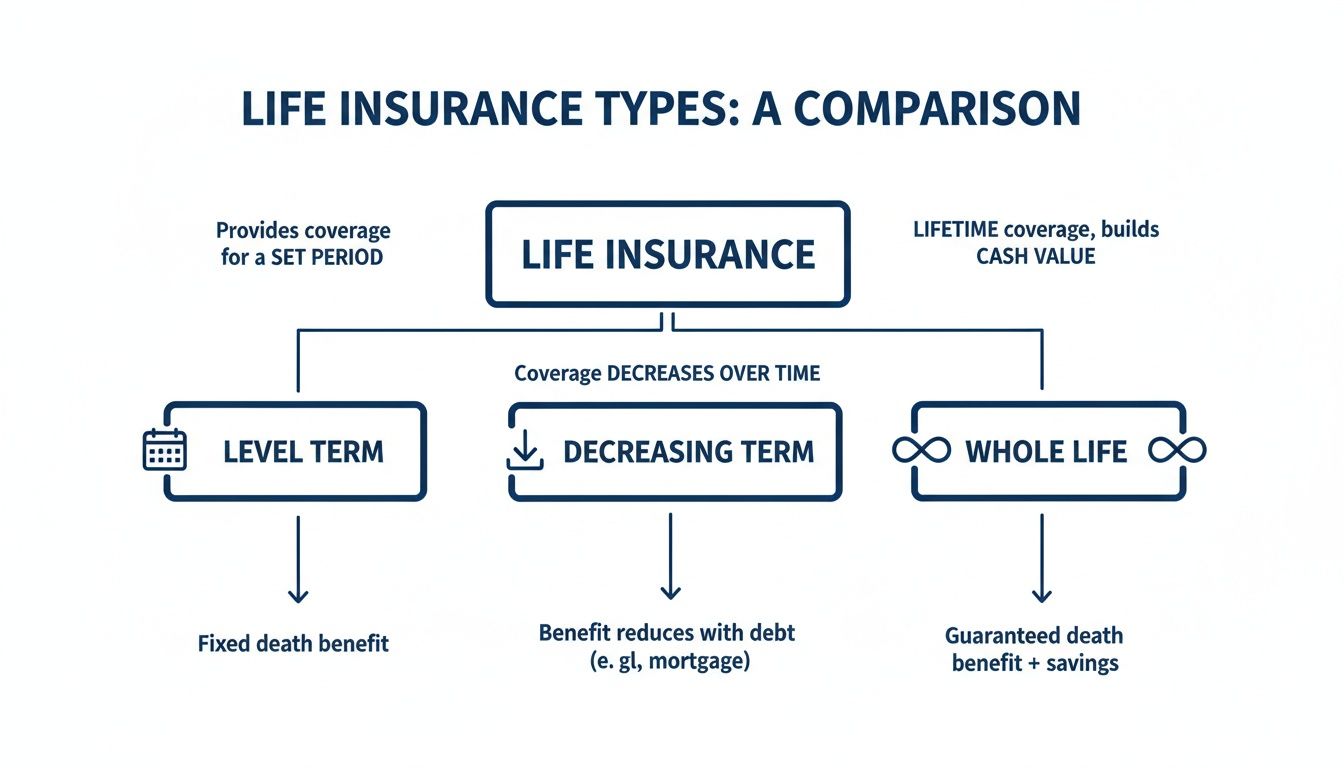
If you only need $10,000 to $25,000 for "final expenses" (funeral and burial costs), a small Whole Life policy may be better than a Level Term policy. While the monthly cost per thousand dollars of coverage is higher, the policy never expires. A 10-year term policy taken out at 66 will expire at 76; if you are still alive, you will have no coverage and will find it nearly impossible (or prohibitively expensive) to get a new policy at that age.
Guaranteed Issue Life Insurance
If your health is poor in addition to your smoking habit, you might be declined for traditional level term insurance. Guaranteed Issue policies require no medical exam and no health questions. However, the coverage amounts are usually capped at $25,000, and there is a "graded death benefit" (usually two years) where the full amount is not paid out if you die from natural causes shortly after buying the policy.
Decreasing Term Insurance
Though less common in 2026, some policies offer a decreasing death benefit. The premium stays the same (level), but the coverage amount drops every year. This can be a way for a smoker to keep premiums lower while still covering a mortgage that is also decreasing in balance.
Common Pitfalls to Avoid
- Lying About Smoking Status: This is considered insurance fraud. If you claim to be a non-smoker and die within the two-year "contestability period," the insurer can investigate. If they find evidence of smoking (via medical records or the original lab tests), they can legally deny the claim, leaving your beneficiaries with nothing but a refund of the premiums paid.
- Waiting to Buy: Every year you wait, the base price of insurance increases by 8% to 12% for seniors. Even if you plan to quit smoking next month, it is often better to secure a policy now and ask for a rate reduction later than to wait and apply as a 67 or 68-year-old.
- Ignoring the "Conversion Privilege": Ensure your level term policy has a conversion rider. This allows you to turn your term policy into a permanent (whole life) policy before the term ends, without having to take another medical exam. This is a vital safety net if you develop a chronic illness during the term that would make you otherwise uninsurable.
Frequently Asked Questions
Can I get a 20-year level term policy as a 66-year-old smoker?
It is possible but difficult. Most major carriers limit smokers to 10 or 15-year terms once they pass age 65. If you do find a 20-year term, expect the premium to be significantly higher—often double the 10-year rate—because the risk of death for a smoker increases dramatically between ages 76 and 86.
Does vaping count as smoking for life insurance in 2026?
Yes, in the vast majority of cases. Most insurers treat any nicotine delivery system (vapes, e-cigarettes, patches, or gum) as tobacco use. The actuarial data used by insurers in 2026 still links nicotine consumption to increased cardiovascular risk, regardless of the delivery method.
What happens if I quit smoking after the policy starts?
Most companies allow you to apply for a rate change after 12 to 24 months of being nicotine-free. You will likely have to undergo a new medical exam or at least provide a urine sample. If you pass, your premium will be lowered to the "Non-Tobacco" rate based on your age when you originally bought the policy.
Is level term better than "Final Expense" insurance for a smoker?
It depends on your goal. If you need a large sum ($100k+) to cover a debt or replace income for a spouse, level term is the only affordable way to get that much coverage. If you only want to ensure your children aren't burdened by funeral costs, a Final Expense (Whole Life) policy is more appropriate because it will last until you are 100 or older.
Are there "No-Medical Exam" options for 66-year-old smokers?
Yes, "Simplified Issue" policies exist that don't require a physical exam. However, they still ask health questions, including your smoking status. These policies are often more expensive than "fully underwritten" ones because the insurer is taking on more unknown risk.
Final Recommendation
If you are a 66-year-old smoker in 2026 looking for level term insurance, your first step should be to define your timeline. If your financial obligations (mortgage, debt, etc.) will be resolved within 10 years, a 10-year level term is the most logical and affordable choice.
Given the high costs associated with your age and smoking status, avoid applying to the first company you see online. Consult with an independent broker who specializes in "high-risk" or "senior" life insurance. They can "shop" your profile anonymously to various carriers to see which one offers the most favorable tobacco ratings. Finally, if you are healthy other than the smoking habit, opt for a fully underwritten policy (with a medical exam) rather than a no-exam policy; the transparency of the medical exam usually results in a lower premium for seniors.
Image Gallery