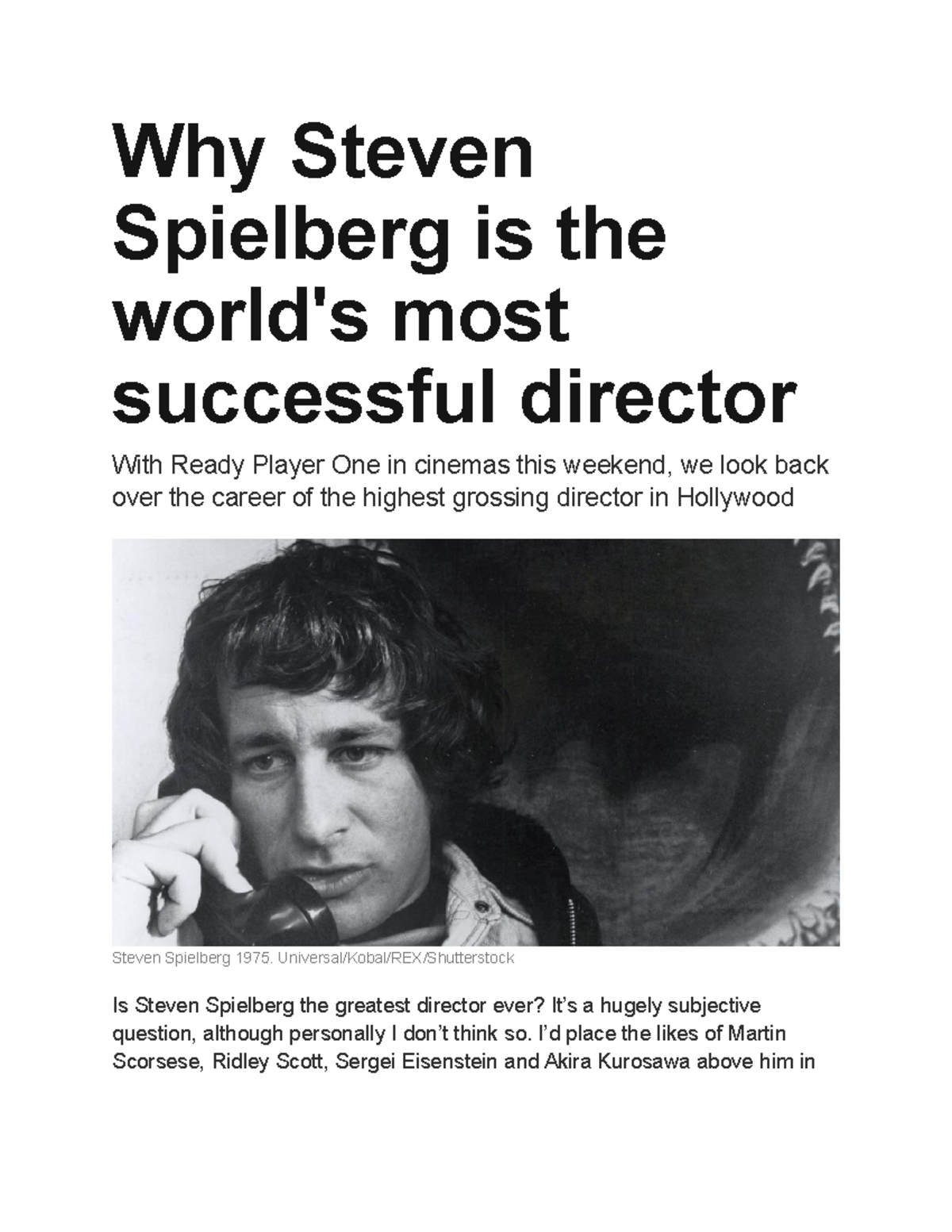
Why the Most Successful Directors Matter to Film Fans
The most successful directors matter to film fans because they provide a consistent artistic vision, emotional resonance, and structural innovation that turns individual movies into enduring cultural touchstones. By establishing a reco...
The most successful directors matter to film fans because they provide a consistent artistic vision, emotional resonance, and structural innovation that turns individual movies into enduring cultural touchstones. By establishing a recognizable signature across their filmography, these auteurs give audiences a reliable framework for exploring complex narratives, cinematic techniques, and thematic depths.
Contents
The Autograph of Cinema: Defining the Director’s Vision
To understand why celebrated filmmakers command intense loyalty from film enthusiasts, one must first recognize the concept of the director as an author—or auteur. In cinematic terms, a director's vision encompasses recurring motifs, distinct visual compositions, rhythmic pacing, and a consistent philosophical stance toward the human condition. While hundreds of crew members contribute to a major motion picture, the director serves as the central intelligence orchestrating every component.
When film fans follow a specific filmmaker, they are not merely watching isolated stories; they are tracking an evolving creative dialogue. This relationship transforms passive viewing into an active intellectual exercise. Fans look for visual cues, recurring thematic anxieties, and evolving technical experiments that bridge early independent works with later studio blockbusters. Consequently, the most successful directors matter because they elevate cinema from disposable entertainment to a cohesive, cumulative art form.
Consistency and Quality Control in an Oversaturated Market
In the contemporary media landscape, consumers face an unprecedented volume of content across theatrical releases and streaming platforms. This abundance often leads to decision fatigue and variable quality. Renowned directors act as trusted curators of the viewer's time and attention.
A strong track record of successful, critically acclaimed projects builds a bond of trust between the creator and the audience. While even the greatest filmmakers experience missteps, their baseline craftsmanship, rigorous script selection, and command of visual language ensure a minimum threshold of engagement. For film fans, investing time in a new release by a proven director reduces the risk associated with unproven talent or generic studio-driven products.
Comparative Impact of Auteur vs. Studio-Driven Filmmaking
| Feature | Auteur-Driven Filmmaking | Studio-Driven / Spec Work |
|---|---|---|
| Visual Style | Highly distinct, recurring motifs and framing choices | Flexible, optimized for broad commercial appeal |
| Narrative Control | Director retains final cut or strong creative autonomy | Producers and executives influence final narrative structure |
| Audience Engagement | Cultivates dedicated fan communities and deep analysis | Targets broad demographic spikes with shorter shelf-lives |
| Thematic Depth | Explores consistent personal or philosophical obsessions | Adapts to changing market trends and audience testing |
Innovation in Technique and Technological Adoption
Successful directors are rarely content with repeating past successes. The most influential figures in film history consistently push the boundaries of the medium through technical innovation. Whether pioneering new camera stabilization rigs, refining digital visual effects workflows, or experimenting with non-linear storytelling structures, these creators redefine what cinema can achieve technically and aesthetically.
For dedicated film fans, witnessing these technical evolutions firsthand offers a front-row seat to the history of art and technology intersecting. When a master filmmaker adopts a new format—such as shooting on large-format IMAX sensors, utilizing high-frame-rate projection, or exploring virtual production environments—they establish new benchmarks for the entire industry. Fans study these advancements to understand how physical limitations are transformed into creative opportunities.
Cultural Impact and Shared Cinematic Communities
Beyond the technical and artistic dimensions, successful directors serve as anchors for global fan communities. Cinema is inherently a communal experience, and shared enthusiasm for a particular director's body of work creates cultural touchstones. Discussions, debates, and analytical breakdowns of a filmmaker'sography forge connections among fans across geographical and generational divides.
Furthermore, major directors often act as cultural commentators. Their films reflect, critique, and shape public discourse on politics, ethics, and human psychology. By examining society through a distinct lens, these filmmakers give audiences a vocabulary to articulate complex emotions and social realities. The best directors matter because their work outlives its initial theatrical run, sparking ongoing academic study, retrospectives, and cultural re-evaluations for decades.
Frequently Asked Questions
What makes a film director truly successful?
Success in film direction is defined by a combination of critical acclaim, cultural longevity, technical mastery, and the ability to execute a distinct artistic vision while navigating commercial constraints. Financial box office returns matter, but true longevity comes from creating works that continue to influence subsequent generations of filmmakers and resonate with audiences long after release.
How does an auteur differ from a standard commercial director?
An auteur maintains a consistent personal style, recurring thematic concerns, and a high degree of creative control across their filmography, making their work instantly recognizable. A standard commercial director focuses primarily on executing assignments efficiently to meet studio guidelines and broad audience expectations without necessarily imposing a personal stamp.
Why do film fans obsess over director's cuts?
Director's cuts provide insight into the filmmaker's original intent before studio interference, budgetary constraints, or runtime limitations altered the project. Fans value these versions because they often reveal deeper narrative layers, altered pacing, and uncompromised artistic choices that change the meaning of the film.
Can a director be successful without having a recognizable style?
Yes. Many technically proficient directors excel at working across diverse genres, adapting to studio mandates, and delivering critically and commercially successful films without a signature aesthetic. However, these directors are rarely discussed in the context of auteur theory, which centers on personal vision and stylistic consistency.
How do modern streaming platforms affect the work of major directors?
Streaming platforms provide unprecedented budgets and creative freedom for established directors to pursue passion projects that traditional studios might reject. However, they also shift distribution models away from theatrical exclusivity, altering how audiences experience visual scale and communal viewing.
Next Steps for Film Enthusiasts
To deepen your appreciation of why successful directors matter, move beyond passive viewing and engage actively with film history. Select three acclaimed filmmakers whose styles differ significantly—such as Alfred Hitchcock, Wong Kar-wai, and Denis Villeneuve—and watch three major works from each in chronological order. Take note of how their visual motifs, narrative pacing, and thematic concerns evolve from their early features to their mature masterpieces. By analyzing these trajectories, you will develop a sharper critical eye for the mechanics of cinematic storytelling.
Image Gallery