What Are the End Time Prophecies? A Comprehensive Theological and Historical Guide
End time prophecies—known academically as eschatology (the study of the "last things")—are religious writings, visions, and oral traditions that detail the ultimate destiny of humanity, the physical universe, and divine creation. Roote...
End time prophecies—known academically as eschatology (the study of the "last things")—are religious writings, visions, and oral traditions that detail the ultimate destiny of humanity, the physical universe, and divine creation. Rooted primarily in Abrahamic faiths, these prophecies outline cosmic trials, divine judgment, the arrival of a messianic figure, and the ultimate restoration of peace or creation.
Contents
Core Definitions: Understanding Eschatology and End Time Prophecies
The term eschatology originates from the Greek words eschatos ("last" or "furthest") and logos ("study" or "discourse"). Across major world religions, end time prophecies address fundamental questions about human history: Does history move toward a definite conclusion, or is it cyclical? What is the final fate of evil, suffering, and mortality?
Apocalyptic literature forms the primary textual genre for end time prophecies. Unlike standard prophetic texts that address immediate ethical, social, or political repentance, apocalyptic texts rely heavily on symbolic visions, heavenly messengers, dramatic cosmic upheavals, and dualistic battles between divine forces and adversarial powers. Understanding these prophecies requires distinguishing between literal predictions of empirical events and symbolic, allegorical, or historical frameworks used by different religious traditions over millennia.
Major Religious Traditions of End Time Prophecies
While apocalyptic themes exist across various traditions—including Nordic mythology (Ragnarök) and Hinduism (the transition from Kali Yuga to Satya Yuga)—the phrase "end time prophecies" most frequently refers to the detailed prophetic systems found within Judaism, Christianity, and Islam.
Christian Eschatology: The Biblical Arc
Christian eschatology forms the most widely referenced system of end time prophecy in Western culture. It spans both the Hebrew scriptures (Old Testament) and the New Testament, culminating in a sequence of events leading to the return of Jesus Christ (the Parousia).
- Old Testament Foundations: The Hebrew prophets established key foundational themes. The Book of Daniel introduces apocalyptic visions of worldly empires represented by beasts, a final period of trial, and the figure of "one like a son of man" who receives an everlasting kingdom. Ezekiel describes cosmic conflicts (such as the battle of Gog and Magog) and the restoration of a new Temple, while Isaiah envisions a "new heavens and a new earth" where suffering and death are conquered.
- The Olivet Discourse: Recorded in Matthew 24, Mark 13, and Luke 21, Jesus responds to his disciples' questions regarding the destruction of the Jerusalem Temple and the end of the age. He outlines specific "birth pains" preceding the end, including false messiahs, wars, rumors of wars, famines, earthquakes, and widespread persecution, followed by his visible return in cosmic power.
- Pauline Epistles: In letters such as 1 Thessalonians and 2 Thessalonians, the Apostle Paul discusses the resurrection of believers, the sudden appearance of the "Day of the Lord," and the unveiling of a figure referred to as the "man of lawlessness" who opposes God before being defeated at Christ’s arrival.
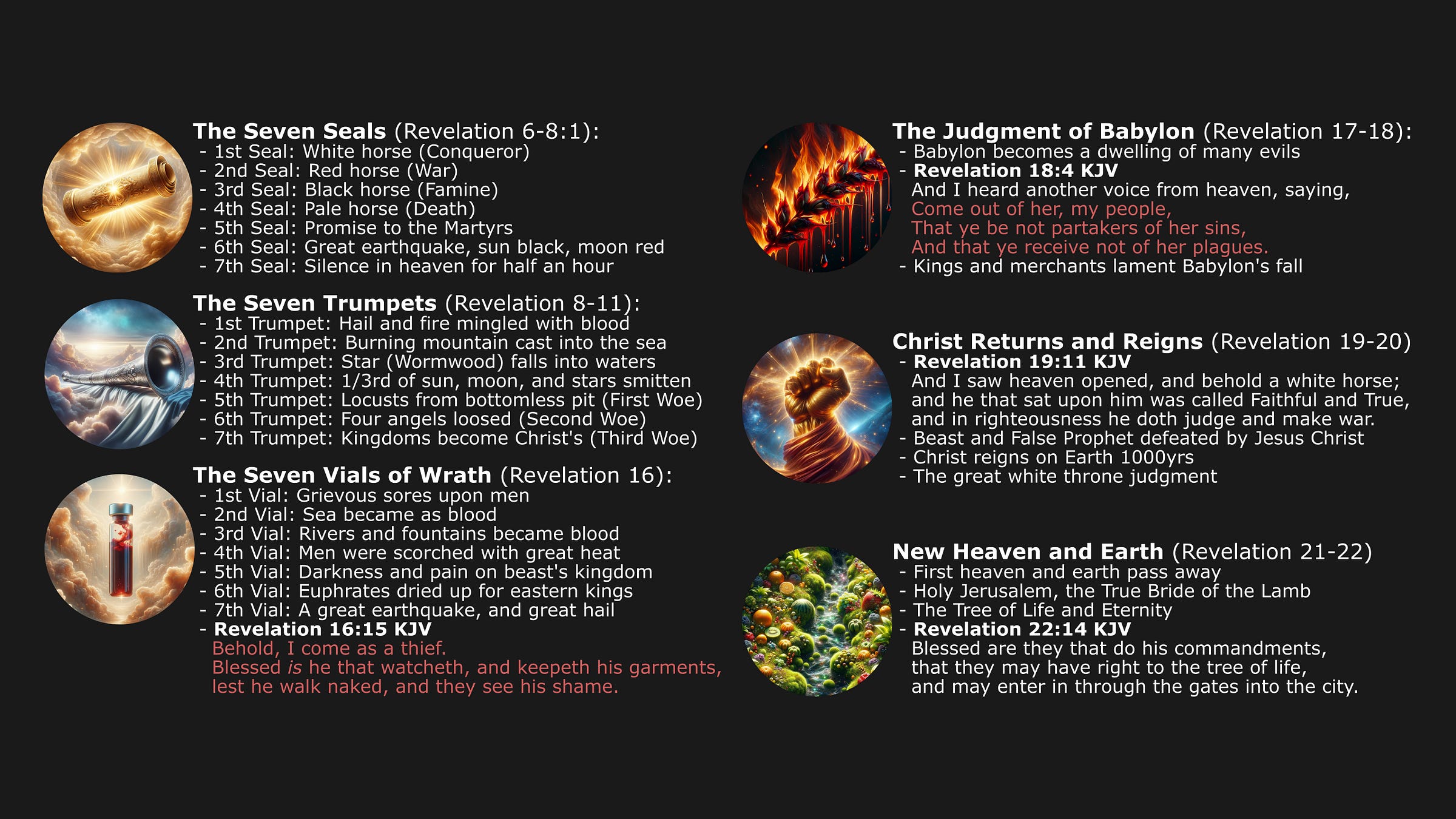
- The Book of Revelation (The Apocalypse of John): Written near the end of the first century CE, Revelation is the definitive Christian apocalyptic text. It uses vivid imagery—such as the Seven Seals, Seven Trumpets, and Seven Bowls of judgment—to portray severe earthly tribulation, the rise of a tyrannical world power (the Beast or Antichrist), the fall of metaphorical Babylon, the final Battle of Armageddon, the thousand-year reign (Millennium), the Final Judgment, and the descent of the New Jerusalem.
Islamic Eschatology: Yawm al-Qiyamah
In Islam, belief in Yawm al-Qiyamah (the Day of Resurrection) and Yawm ad-Din (the Day of Judgment) is one of the six fundamental articles of faith (Iman). Islamic eschatology, drawn from the Qur'an and extensive collections of Hadith (traditions of the Prophet Muhammad), divides the end times into Minor Signs (Al-Alamat al-Sughra) and Major Signs (Al-Alamat al-Kubra).
- Minor Signs: These are moral, social, and natural indicators that occur gradually over time. They include the decline of religious knowledge, widespread dishonesty, public corruption, competition in constructing tall buildings, and social upheaval.
- Major Signs: These are extraordinary, consecutive events that signal the immediate onset of the Final Hour:
- The emergence of the Mahdi (the guided leader), who restores justice and righteousness to the world.
- The appearance of Al-Masih ad-Dajjal (the False Messiah or Deceiver), a single-eyed figure who performs deceptive miracles to lead people astray.
- The descent of Isa ibn Maryam (Jesus, son of Mary), who returns to defeat the Dajjal, establish true faith, and bring peace.
- The breach of the barrier containing Ya'juj and Ma'juj (Gog and Magog), releasing vast hordes that cause widespread destruction.
- Cosmic shifts, including the sun rising from the west, the appearance of the Beast of the Earth (Dabbat al-Ard), and a sweeping fire that gathers humanity for judgment.
Jewish Eschatology: Acharit ha-Yamim
Jewish end time prophecies, rooted in the Tanakh (Hebrew Bible) and further developed in Rabbinic literature and the Talmud, focus on Acharit ha-Yamim ("the End of Days"). Unlike some apocalyptic systems focused primarily on global destruction, Jewish eschatology emphasizes national restoration, moral redemption, and physical renewal on Earth.
- The Messianic Era (Yemot HaMashiach): The central expectation is the arrival of an anointed human king (Mashiach) descended from King David. The Messiah will rebuild the Temple in Jerusalem, gather Jewish exiles back to the land of Israel, and establish world peace without war or oppression.
- Universal Knowledge and Peace: Prophetic texts like Isaiah 2:4 ("they shall beat their swords into plowshares") describe a transformed world where all nations recognize the one God, ending international conflict and social injustice.
- World to Come (Olam HaBa) and Resurrection (Tchiyat HaMetim): Jewish tradition anticipates a bodily resurrection of the dead and the inauguration of Olam HaBa, the ultimate spiritual and physical state of perfected creation following the Messianic Era and divine judgment.
Major Interpretive Frameworks in Christian Eschatology
Because biblical apocalyptic language relies heavily on symbolism, Christian theologians throughout history have developed four major interpretive frameworks to make sense of end time prophecies.
- APPROACHES TO BIBLICAL PROPHECY
- Futurist (Events ahead)
- Preterist (Events direct 1st C.)
- Historicist (Events unfold through History)
- Idealist (Symbolic/ Spiritual Struggle)
- Futurism: Interprets the majority of prophecies in Daniel, the Olivet Discourse, and Revelation (chapters 4–22) as literal events that will occur at the very end of history. Futurism is common in modern evangelical Protestantism, particularly within Dispensational Premillennialism, which expects a secret "Rapture" of the Church prior to a seven-year Tribulation.
- Preterism: Argues that most end time prophecies were already fulfilled in the first century CE during the Jewish-Roman War, culminating in the destruction of Jerusalem and the Second Temple in 70 CE. Partial preterists hold that while historical judgments occurred in 70 CE, the physical Second Coming and Final Judgment remain future events.
- Historicism: Views prophetic texts as a continuous, chronological timeline of church history from the first century through the end of time. Historicists historically identified symbols like the Beast or Antichrist with specific political empires or institutions across late antiquity and the Middle Ages.
- Idealism (Spiritual View): Treats apocalyptic texts as non-literal allegories representing the timeless, spiritual struggle between good and evil, truth and falsehood, and God and rebellion. Idealists assert these symbols apply to every era of history rather than one specific set of historical calendar dates.
Comparative Matrix: Major Theological Perspectives
The following table compares how key theological frameworks interpret the central elements of end time prophecy:
| Interpretive System | Primary Focus / Target Era | Primary Role of Messiah | Key End Time Events | Ultimate World State |
|---|---|---|---|---|
| Dispensational Premillennialism | Future (Literal 7-Year Tribulation) | Returns after Tribulation to rule physically on Earth | Pre-Tribulation Rapture, rise of Antichrist, Armageddon | 1,000-year earthly kingdom, followed by New Jerusalem |
| Amillennialism / Postmillennialism | Current Church Era / Symbolically Fulfilled | Rules spiritually now; returns at the final end of history | Gradual growth of Kingdom, final rebellion, public return of Christ | General resurrection, immediate transition to Eternal State |
| Preterism (Partial) | 1st Century CE (70 CE destruction of Jerusalem) | Judged 1st-century Israel; returns physically at history's end | Destruction of Second Temple fulfilled major tribulation texts | Physical resurrection of all humans and finalized New Creation |
| Islamic Eschatology | Future historical events prior to Judgment | Jesus returns as a righteous judge alongside the Mahdi | Rise of Dajjal, descent of Isa, Gog/Magog release, Sun rising west | Final Judgment (Yawm al-Qiyamah), eternal Paradise or Hell |
| Jewish Eschatology | Future Messianic Era (Yemot HaMashiach) | Human Davidic king who establishes peace and gathers exiles | Ingathering of exiles, rebuilding Third Temple, world peace | Resurrection (Tchiyat HaMetim) and World to Come (Olam HaBa) |
Recurring Themes Across Apocalyptic Literature
Despite differences in doctrine and historical origin, end time prophecies across cultures and traditions share several core structural themes:
1. Cosmic and Moral Breakdown
Apocalyptic narratives consistently depict the end era as a period marked by severe instability. Natural disasters (earthquakes, eclipses, famines) parallel social decay, characterized by betrayal, lawlessness, the breakdown of family units, and pervasive deception.
2. The Rise of a Tyrannical Deceiver
A central figure of falsehood typically emerges to challenge divine order. In Christianity, this is the Antichrist or Beast; in Islam, Al-Masih ad-Dajjal. These figures are portrayed as wielding political or supernatural power to demand worship and mislead nations.
3. A Time of Great Testing (Tribulation)
Prophecies frequently describe a period of intense trial for the faithful. This period serves both as a refining process for believers and a divine judgment upon corrupt global systems.
4. Decisive Divine Intervention
Human history does not merely fade away; it is brought to a dramatic, decisive halt by divine power. Whether through the return of Jesus Christ, the arrival of the Mahdi, or direct divine judgment, human political systems are overthrown.
5. Universal Judgment and Cosmic Renewal
The ultimate destination of apocalyptic literature is restorative rather than destructive. End time prophecies culminate in the resurrection of the dead, individual accountability before God, the destruction of evil, and the creation of a perfected state of existence free from suffering and mortality.
Common Misconceptions and Failed Date-Setting
Throughout human history, end time prophecies have frequently been misapplied, leading to widespread misunderstandings:
- Date-Setting vs. Scriptural Warnings: Numerous individuals and movements have attempted to predict specific calendar dates for the end of the world. Canonical scriptures in Christianity explicitly warn against date-setting; for example, Matthew 24:36 states that "concerning that day and hour no one knows, not even the angels of heaven, nor the Son, but the Father only."
- Literality vs. Genre Specifics: Readers often treat apocalyptic literature as modern news reporting or literal technical manuals. Apocalyptic writing relies heavily on hyperbole, Old Testament echoes, and symbolic numbers (such as 7 representing completeness, 12 representing divine structure, or 666 representing human imperfection and imperial tyranny).
- Confusing "End of the World" with "End of the Age": Translators often render the Greek word aion as "world," when it more accurately means "age" or "epoch." Many prophecies describe the end of a corrupt historical epoch rather than the literal obliteration of the planet Earth.
Historically, events like the Millerite Movement of 1844 (the "Great Disappointment") and various millennial panics illustrate how misinterpreting prophetic genre can lead to profound psychological and social disruption.
Frequently Asked Questions
What is the difference between general prophecy and apocalyptic prophecy?
General prophecy in scriptural texts often focuses on immediate ethical calls for social justice, moral repentance, and local historical warnings (e.g., the Book of Jonah or Amos). Apocalyptic prophecy, by contrast, uses vivid symbolic visions, angelic interpreters, cosmic scale imagery, and dualistic battles to reveal God's ultimate resolution of human history.
Is the "Rapture" mentioned explicitly in the Bible?
The term "Rapture" comes from the Latin translation (rapiemur) of the Greek verb harpagesometha, used in 1 Thessalonians 4:17 ("caught up together"). While the concept of believers being gathered to meet Christ at his return is a traditional Christian doctrine, the specific belief in a secret, pre-tribulation rapture that removes the Church years before the Second Coming was popularized primarily in the 19th century by John Nelson Darby and Dispensationalism.
Does the Book of Revelation predict modern geopolitical events?
Futurist interpreters believe Revelation predicts future global political alliances, modern military technologies, and economic systems. However, Preterist and Idealist scholars argue that Revelation was written to encourage first-century Christians facing Roman persecution under emperors like Nero or Domitian, using symbolic language that transcends any single modern political map.
Do Islam and Christianity share the same end time figures?
Islam and Christianity share several figures in their end time narratives, most notably Jesus (Isa), who plays a central role in both traditions' apocalyptic events. However, their theological roles differ: Christianity views Jesus as the divine Son of God returning as King of Kings, whereas Islam views Jesus as a revered human prophet and messenger of Allah who returns to defeat the False Messiah (Dajjal) and establish Islamic law.
Why do end time prophecies continue to influence modern society?
End time prophecies provide a comprehensive framework for understanding suffering, injustice, and human destiny. They reassure believers that evil is temporary, history is directed by divine purpose, and ultimate justice will prevail. Additionally, apocalyptic narratives continue to shape modern literature, cinema, political discourse, and cultural commentary.
Recommended Next Steps for Academic Study
To gain a scholarly understanding of end time prophecies without falling into speculative interpretations, consider the following methodological steps:
- Analyze Literary Genre: Study the historical context and apocalyptic conventions of the ancient Near East and Greco-Roman world. Understanding symbols as ancient literary devices prevents over-literalizing poetic texts.
- Compare Primary Sources: Read foundational texts directly—such as Daniel, Ezekiel, the Olivet Discourse, Revelation, key Hadith collections, and Rabbinic commentaries—to distinguish canonical descriptions from modern interpretations.
- Explore Historical Contexts: Examine how historical events, such as the Babylonian Exile or the Destruction of Jerusalem in 70 CE, influenced the composition and initial reception of prophetic literature.
- Consult Academic Eschatology Resources: Utilize critical commentaries and theological references from academic institutions, such as the Oxford Handbook of Eschatology, to understand how different denominations and faith traditions categorize the end times.
Image Gallery