The Atomic Nucleus Explained: Structure, Forces, and Nuclear Dynamics
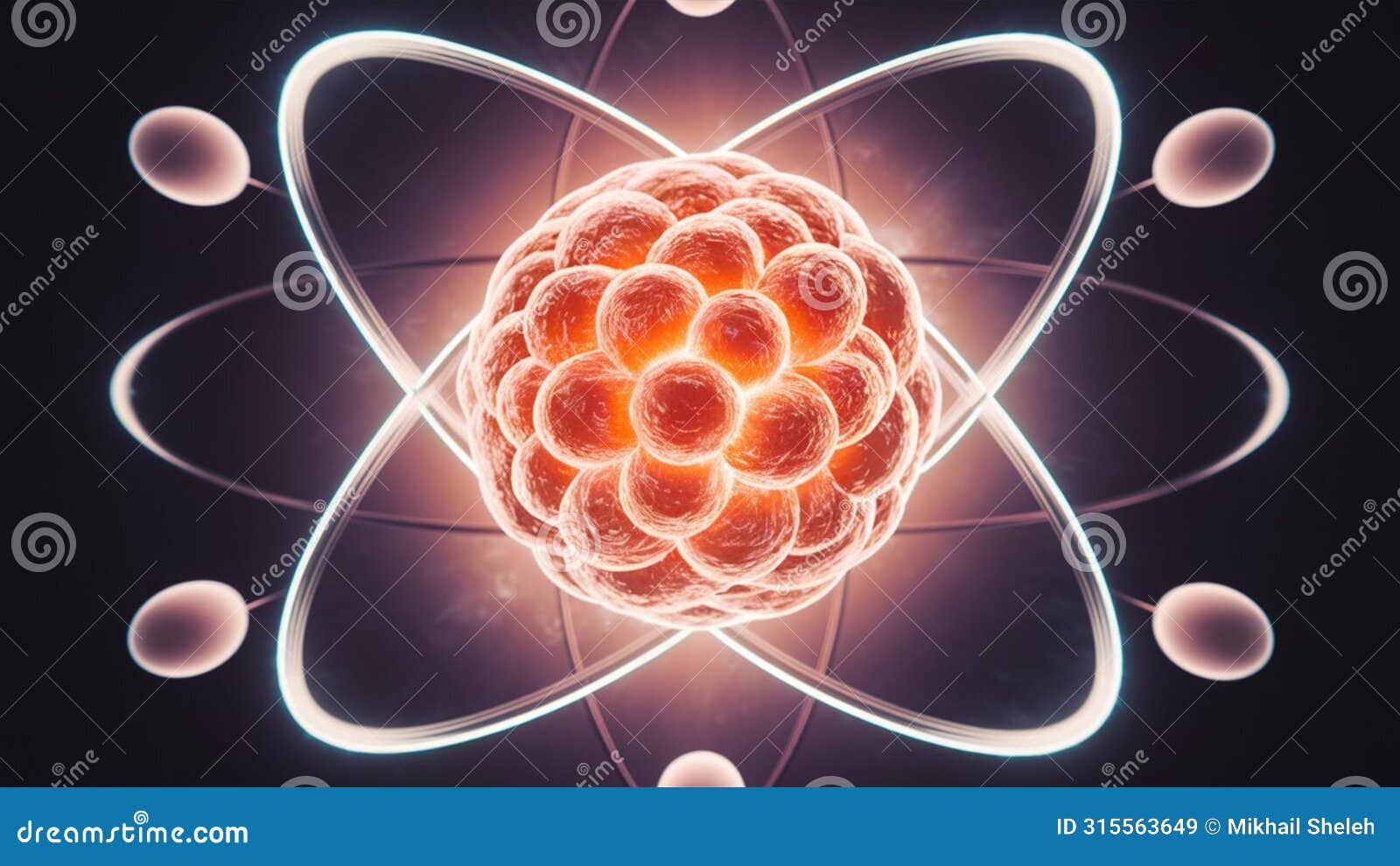
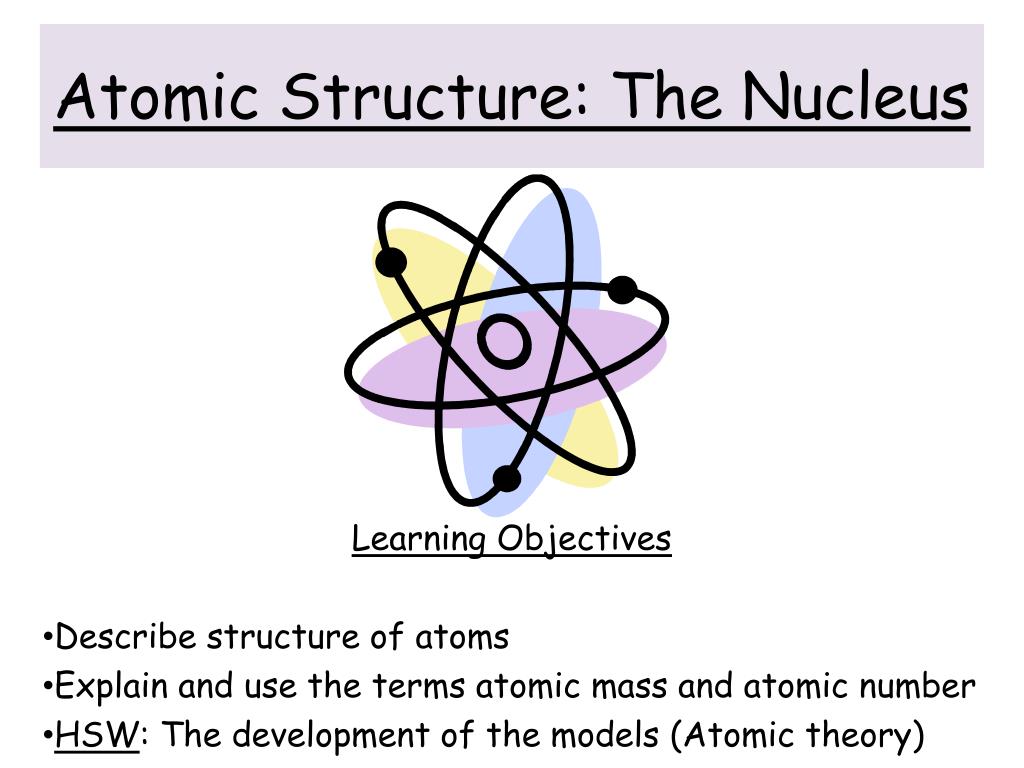
The atomic nucleus is the extremely dense, positively charged core located at the center of an atom. Composed primarily of protons and neutrons—collectively known as nucleons—the nucleus contains more than 99.9% of an atom's total mass...
The atomic nucleus is the extremely dense, positively charged core located at the center of an atom. Composed primarily of protons and neutrons—collectively known as nucleons—the nucleus contains more than 99.9% of an atom's total mass while occupying less than one-trillionth of its total volume. It is held together by the strong nuclear force.
Contents
What Is the Atomic Nucleus?
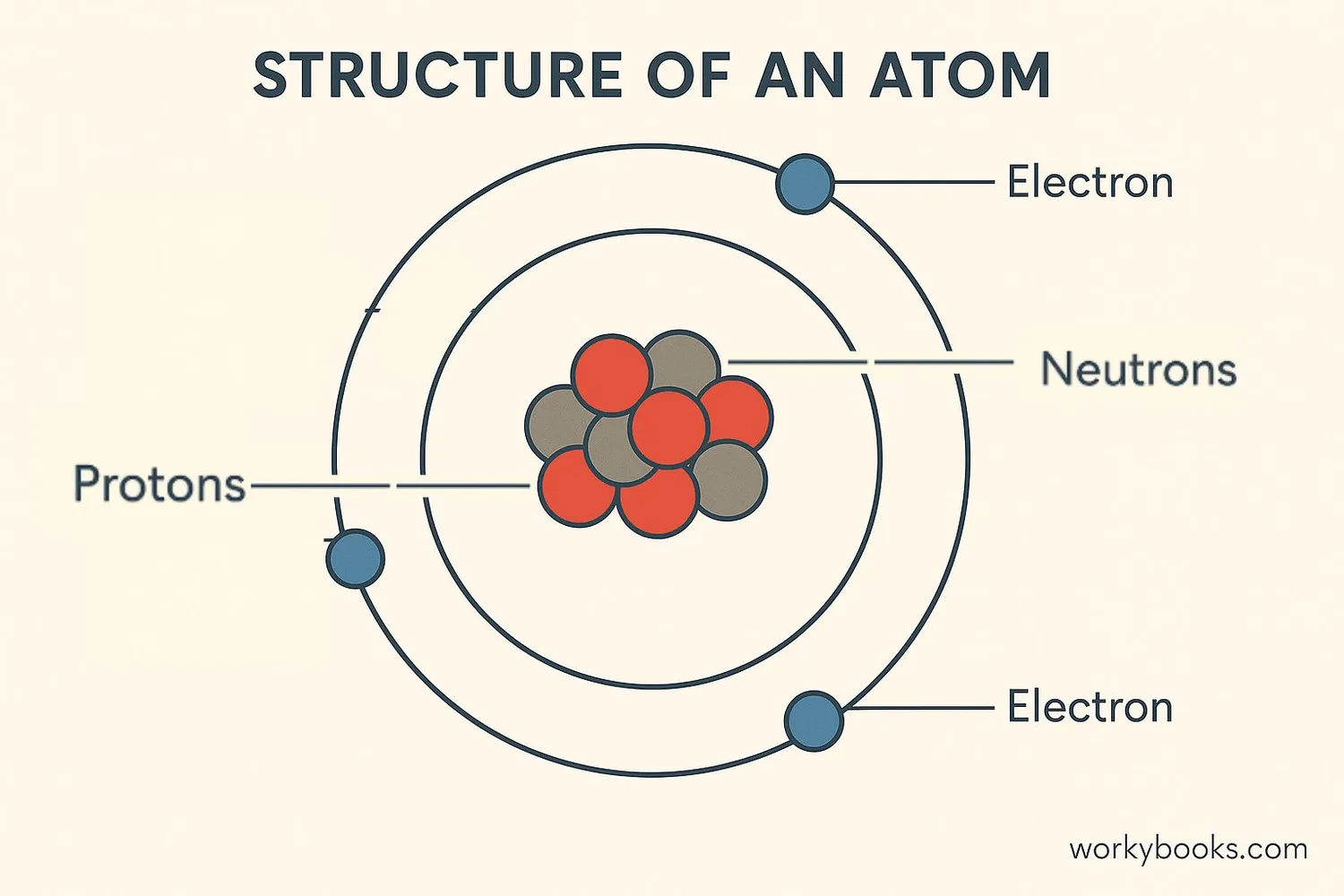
To understand matter at its most fundamental level, one must examine the atomic nucleus. While electrons orbit in cloud-like regions around the core, the nucleus serves as the central anchor of the atom. The number of protons inside the nucleus defines the chemical identity of an element (its atomic number, designated as Z), while the combined total of protons and neutrons determines its mass number (A).
Despite its tiny size relative to the electron cloud surrounding it, the nucleus dictates whether an atom is stable, radioactive, capable of undergoing nuclear fusion, or prone to nuclear fission. If an atom were enlarged to the size of a professional sports stadium, the nucleus would be roughly the size of a marble resting on the 50-yard line, yet that marble would contain almost all the stadium's mass.
Historical Breakthroughs: Discovering the Dense Core
Our modern understanding of the atomic nucleus developed through a series of key experimental breakthroughs in the early 20th century.
- 1904: Thomson's Plum Pudding Model
- Electrons embedded in a diffuse sphere of (+) charge
- 1911: Rutherford's Gold Foil Experiment
- Discovers dense, positively charged central core
- 1932: Chadwick Discovers the Neutron
- Explains missing nuclear mass without extra charge
Rutherford's Gold Foil Experiment (1911)
Before 1911, the prevailing theory was J.J. Thomson’s "plum pudding" model, which suggested that negatively charged electrons were evenly scattered throughout a uniform sphere of positive charge. Ernest Rutherford, along with Hans Geiger and Ernest Marsden, tested this model by firing positively charged alpha particles at an extremely thin sheet of gold foil.
While most alpha particles passed straight through as expected, a tiny fraction deflected at sharp angles, and some even bounced directly backward. Rutherford famously remarked that it was as if you fired a 15-inch shell at a piece of tissue paper and it came back and hit you. This led to the conclusion that positive charge and mass are concentrated in a tiny central region: the nucleus.
Chadwick's Discovery of the Neutron (1932)
For two decades after Rutherford's discovery, scientists struggled to explain why an atom's mass number was often more than double its atomic number. In 1932, British physicist James Chadwick conducted experiments bombarding beryllium with alpha particles, releasing an uncharged radiation that could knock protons out of paraffin wax. Chadwick demonstrated that this radiation consisted of neutral particles with roughly the same mass as a proton—the neutron. This completed the basic building-block model of the nucleus.
Fundamental Building Blocks: Protons, Neutrons, and Quarks
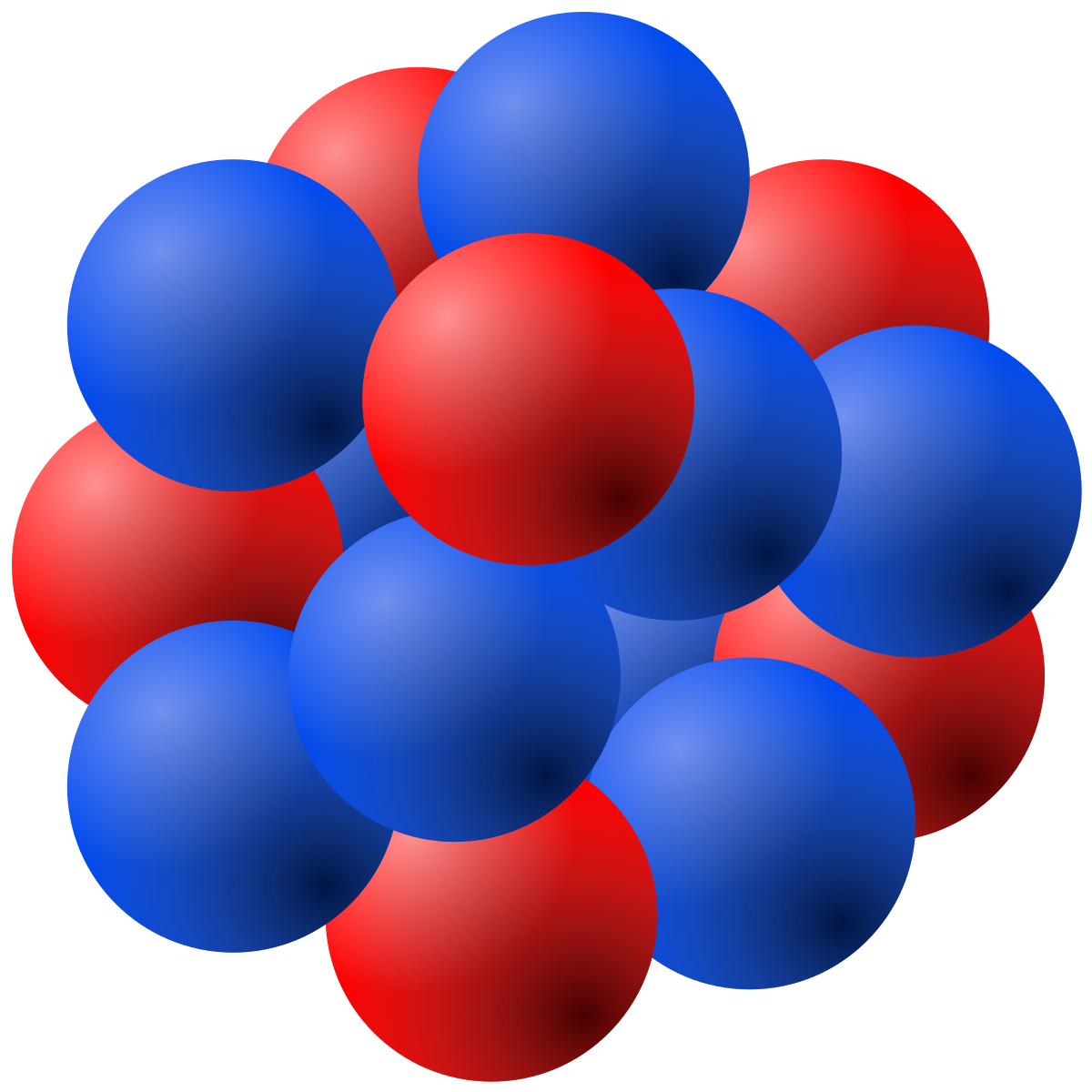
The subatomic particles residing inside the nucleus are known as nucleons. Although protons and neutrons were once thought to be fundamental, particle physics has revealed that they are composite structures made of smaller elementary particles called quarks.
- Protons & Neutrons (Nucleons)
- Proton (p)
- Charge: +1 e
- Quarks: Up + Up + Down (+2/3 +2/3 -1/3 = +1)
- Neutron (n)
- Charge: 0
- Quarks: Up + Down + Down (+2/3 -1/3 -1/3 = 0)
- Proton (p)
Protons
A proton carries a positive elementary charge ($+1e$, or $+1.602 \times 10^{-19}$ Coulombs) and has a mass of approximately $1.007276$ atomic mass units ($\text{u}$). Protons consist of three valence quarks: two up quarks (each with a charge of $+2/3$) and one down quark (with a charge of $-1/3$). The net sum of these fractional charges yields the $+1$ charge of the proton.
Neutrons
A neutron carries no net electric charge ($0e$) and has a slightly larger mass than the proton, at approximately $1.008665\text{ u}$. Neutrons consist of one up quark ($+2/3$) and two down quarks (each $-1/3$), yielding a net charge of zero. Free neutrons outside a nucleus are unstable and decay via weak interaction into a proton, an electron, and an electron antineutrino with a half-life of roughly 14.5 minutes.
Gluons and the Strong Force
Quarks inside a nucleon are held together by elementary particles called gluons, which mediate the strong interaction through a property known as color charge. The force holding protons and neutrons together inside the nucleus is a residual spillover of this fundamental force, often called the residual strong force or nuclear force.
The Four Fundamental Forces in the Nucleus
To understand how a nucleus remains intact despite containing many positively charged protons that repel one another, we must examine how the fundamental forces operate at subatomic scales.
| Force | Role inside the Nucleus |
|---|---|
| Residual Strong Force | Overcomes proton repulsion; binds nucleons together. |
| Electromagnetic Force | Causes protons to repel each other via Coulomb force. |
| Weak Nuclear Force | Controls radioactive beta decay & nucleon conversion. |
| Gravitational Force | Negligible at subatomic scales (infinitesimally weak). |
1. The Residual Strong Force
The strong force is the most powerful of the four fundamental forces in physics, roughly 100 times stronger than electromagnetism at short ranges. However, its effective range is extremely limited—operating only over distances of about $1$ to $3$ femtometers ($1\text{ fm} = 10^{-15}\text{ meters}$). Beyond this distance, the force drops off rapidly to zero. Within its short range, it acts like an attractive nuclear glue that binds protons and neutrons together.
2. Electromagnetic (Coulomb) Force
Because like charges repel, protons within a nucleus exert a strong repulsive electrostatic force on one another. Unlike the strong force, the electromagnetic force has an infinite range, decreasing with the square of the distance ($1/r^2$). In small nuclei, the strong attraction easily overcomes electrostatic repulsion. However, as the nucleus grows larger, electrostatic repulsion accumulates across all protons, eventually outstripping the short-range strong attraction between adjacent nucleons. This explains why heavy elements require extra neutrons for stability and why very large nuclei become unstable.
3. The Weak Nuclear Force
The weak force operates at even shorter distances ($10^{-18}\text{ meters}$) and is responsible for flavor-changing interactions in quarks. It allows a neutron to transform into a proton (or vice versa), driving processes like beta decay. Without the weak interaction, essential nuclear reactions inside stars—such as the fusion of hydrogen into helium—could not occur.
4. Gravitational Force
While gravity dictates the behavior of stars and planets, its relative strength at subatomic scales is negligible—roughly $10^{-36}$ times the strength of the strong force. Consequently, gravitational effects are omitted when calculating nuclear structure and interaction energies.
Nuclear Mass Defect and Binding Energy
One of the most surprising features of atomic nuclei is that the total mass of a bound nucleus is always less than the sum of the individual masses of its isolated constituent protons and neutrons. This missing mass is called the mass defect ($\Delta m$).
Albert Einstein's Formula ($E = mc^2$)
When individual protons and neutrons come together to form a nucleus, a fraction of their mass is converted into energy and released. According to Albert Einstein's mass-energy equivalence principle:
$$E = \Delta m \cdot c^2$$
Where:
- $E$ is the nuclear binding energy,
- $\Delta m$ is the mass defect,
- $c$ is the speed of light in a vacuum ($2.998 \times 10^8\text{ m/s}$).
Binding Energy Per Nucleon
Dividing the total nuclear binding energy by the total number of nucleons ($A$) gives the binding energy per nucleon. This metric measures how tightly bound a nucleus is:
- Nuclei with low mass numbers (like Deuterium) have relatively low binding energy per nucleon.
- Binding energy per nucleon increases rapidly up to elements like Iron-56 ($^{56}\text{Fe}$) and Nickel-62 ($^{62}\text{Ni}$), which have the highest binding energy per nucleon (around $8.8\text{ MeV}$ per nucleon), making them exceptionally stable.
- Beyond Iron, binding energy per nucleon gradually decreases for heavier elements like Uranium-238, making heavy elements candidates for energy release through fission, while light elements release energy through fusion.
Models of the Nucleus
Because the nucleus exhibits both liquid-like collective properties and quantum particle properties, physicists rely on complementary theoretical models to describe its structure.
- Nuclear Models
- Liquid Drop Model
- Treats core like fluid
- Explains total binding
- Predicts nuclear fission
- Nuclear Shell Model
- Quantum energy levels
- Predicts "Magic Numbers"
- Explains stability gaps
- Liquid Drop Model
The Liquid Drop Model
First proposed by George Gamow and expanded by Niels Bohr and John Archibald Wheeler, the Liquid Drop Model treats the nucleus as an incompressible fluid of nucleons bound together by short-range surface forces, similar to surface tension in a drop of liquid. This model accounts for overall binding energy trends and accurately describes how a heavy nucleus distorts, forms a "neck," and splits during nuclear fission.
The Nuclear Shell Model
Developed independently by Maria Goeppert Mayer and J. Hans D. Jensen (who shared the 1963 Nobel Prize in Physics), the Nuclear Shell Model applies quantum mechanics to individual nucleons. Just as electrons fill discrete energy shells around an atom, nucleons fill quantum energy states within potential wells inside the nucleus.
Nuclei containing specific numbers of protons or neutrons—known as magic numbers (2, 8, 20, 28, 50, 82, and 126)—exhibit exceptional stability, high binding energies, and lower neutron-capture cross-sections. Nuclei with magic numbers of both protons and neutrons (such as Lead-208, with 82 protons and 126 neutrons) are called "doubly magic" and are exceptionally stable.
Isotopes, Stability, and Radioactive Decay
Not all combinations of protons and neutrons form stable nuclei. Variations in the neutron count of an element produce different isotopes.
The Band of Stability
If you plot the number of neutrons ($N$) against the number of protons ($Z$) for all known nuclides, stable isotopes form a narrow region called the band of stability (or belt of stability):
- For light elements ($Z < 20$), stable nuclei maintain a roughly 1:1 ratio of neutrons to protons ($N/Z \approx 1$).
- As $Z$ increases, additional neutrons are required to offset the increasing electromagnetic repulsion among protons. For heavy stable elements like Lead-208, the $N/Z$ ratio increases to roughly 1.5:1.
- Beyond $Z = 83$ (Bismuth), all isotopes are unstable and undergo radioactive decay over time.
Modes of Radioactive Decay
When an unstable nucleus (a radionuclide) attempts to reach a lower energy, more stable state, it transforms by emitting particles or electromagnetic radiation.
- Alpha Decay (α): [ Parent Nucleus ] yields [ Daughter (Z-2, A-4) ] + ⁴₂He²⁺
- Beta-minus (β⁻): [ Neutron ] yields [ Proton ] + Electron (e⁻) + Antineutrino
- Beta-plus (β⁺): [ Proton ] yields [ Neutron ] + Positron (e⁺) + Neutrino
- Gamma Emission (γ): [ Excited Nucleus ] yields [ Relaxed Nucleus ] + High-Energy Photon
- Alpha Decay ($\alpha$): A heavy, unstable nucleus ejects an alpha particle—which consists of 2 protons and 2 neutrons (a Helium-4 nucleus, $^{4}\text{He}^{2+}$). This decreases the parent nucleus's atomic number by 2 and its mass number by 4.
- Beta Decay ($\beta$):
- Beta-minus ($\beta^-$) decay: A neutron converts into a proton, emitting a high-speed electron ($\beta^-$ particle) and an electron antineutrino. This increases the atomic number by 1 while keeping the mass number constant.
- Beta-plus ($\beta^+$) decay (Positron Emission): A proton converts into a neutron, emitting a positron ($\beta^+$ particle) and an electron neutrino, decreasing the atomic number by 1.
- Gamma Decay ($\gamma$): Following alpha or beta decay, the daughter nucleus is often left in an excited quantum state. It releases surplus energy by emitting a high-energy photon (gamma ray) without altering its proton or neutron count.
Comparison of Fundamental Nuclear Components and Forces
The following reference table summarizes the key properties of the subatomic constituents and forces operating within the atomic nucleus:
| Subatomic Entity / Force | Nature / Type | Charge ($e$) | Approx. Rest Mass ($\text{MeV}/c^2$) | Primary Function / Influence Range |
|---|---|---|---|---|
| Proton | Composite Baryon ($uud$) | $+1$ | $938.27\text{ MeV}$ | Determines chemical element identity; subject to strong, weak, and electromagnetic forces. |
| Neutron | Composite Baryon ($udd$) | $0$ | $939.57\text{ MeV}$ | Provides attractive nuclear force without adding charge; stabilizes larger nuclei. |
| Up Quark | Elementary Fermion | $+2/3$ | $\sim 2.16\text{ MeV}$ | Fundamental constituent of nucleons. |
| Down Quark | Elementary Fermion | $-1/3$ | $\sim 4.67\text{ MeV}$ | Fundamental constituent of nucleons. |
| Residual Strong Force | Fundamental Force | N/A | Infinite range for gluons; $\approx 1\text{ fm}$ for residual | Binds nucleons together; overcomes electrostatic proton repulsion at short distances ($<2\text{ fm}$). |
| Electromagnetic Force | Fundamental Force | N/A | Infinite range | Causes electrostatic repulsion between positively charged protons ($1/r^2$ decay). |
| Weak Force | Fundamental Force | N/A | Extremely short ($\approx 10^{-18}\text{ m}$) | Mediates flavor changes (e.g., converting neutrons to protons during beta decay). |
Harnessing Nuclear Energy: Fission vs. Fusion
Understanding nuclear binding energy has enabled humanity to extract enormous amounts of energy through two distinct nuclear processes: fission and fusion.
- NUCLEAR ENERGY EXTRACTION
- Nuclear Fission (Splitting Heavy Nuclei)
- Example: ²³⁵U + n yields Products
- Used in nuclear power plants
- Produces long-lived waste
- Nuclear Fusion (Fusing Light Nuclei)
- Example: ²H + ³H yields ⁴He + n
- Powers stars (including the Sun)
- Minimal long-lived radioactive waste
- Nuclear Fission (Splitting Heavy Nuclei)
Nuclear Fission
In nuclear fission, a heavy, unstable nucleus (such as Uranium-235 or Plutonium-239) absorbs a neutron, destabilizes, and splits into two smaller daughter nuclei, releasing additional free neutrons and energy. Because the mass of the resulting fission products is less than the mass of the original heavy nucleus, the missing mass turns into kinetic energy and gamma rays.
Commercial electricity production relies on controlled nuclear fission chain reactions inside light water reactors, monitored by bodies like the International Atomic Energy Agency.
Nuclear Fusion
In nuclear fusion, two light atomic nuclei (such as deuterium and tritium, which are isotopes of hydrogen) combine under extreme temperatures and pressures to form a single heavier nucleus (such as helium-4). Because the bound helium nucleus has a higher binding energy per nucleon than the isolated hydrogen isotopes, mass is lost and released as energy. Fusion powers the Sun and stars. Research institutions worldwide continue working toward commercial fusion power, targeting cleaner, high-yield energy generation.
Frequently Asked Questions
Why don't the positively charged protons in a nucleus push each other apart?
Protons do exert a strong repulsive electrostatic force on one another. However, at subatomic distances of less than 2 femtometers, the residual strong nuclear force between nucleons is roughly 100 times stronger than electrostatic repulsion, holding the nucleus together.
What is an isotope?
Isotopes are variants of the same chemical element that have an identical number of protons (same atomic number) but a different number of neutrons (different mass number). For example, Carbon-12 has 6 protons and 6 neutrons, while Carbon-14 has 6 protons and 8 neutrons.
Why are heavy elements more prone to radioactive decay?
As a nucleus grows larger, its diameter exceeds the short range of the strong nuclear force (1–2 femtometers). Meanwhile, the long-range repulsive electrostatic force between all protons continues to accumulate across the entire volume of the nucleus. Eventually, the repulsive force dominates, making large nuclei ($Z > 83$) unstable.
What are "magic numbers" in nuclear physics?
Magic numbers (2, 8, 20, 28, 50, 82, 126) represent specific quantities of protons or neutrons that completely fill quantum nuclear shells. Nuclei with these exact numbers of nucleons possess higher binding energies, enhanced stability against decay, and lower probabilities of capturing additional neutrons.
What is the difference between atomic weight and mass number?
Mass number ($A$) is an integer representing the exact count of protons plus neutrons in a specific nucleus. Atomic weight (or atomic mass) is the weighted average mass of all naturally occurring isotopes of an element, taking into account their relative natural abundances.
Key Takeaways and Next Steps
The atomic nucleus is a complex system governed by fundamental forces operating at subatomic scales. From Rutherford's initial gold foil discovery to modern quantum models, understanding the core of the atom has clarified the behavior of elements, the mechanisms of radioactive decay, and the processes behind nuclear energy.
To deepen your understanding of nuclear physics and atomic structure, consider exploring these foundational subtopics:
- Quantum Chromodynamics (QCD): Study how quarks and gluons interact inside nucleons via color charge.
- Radiometric Dating Applications: Examine how unstable isotopes like Carbon-14 and Uranium-238 are used to calculate the age of geological and archaeological artifacts.
- Stellar Nucleosynthesis: Research how stars synthesize heavier elements from hydrogen and helium through fusion cycles.
Image Gallery