Why Do I Keep Procrastinating? Understanding the Science and Solutions
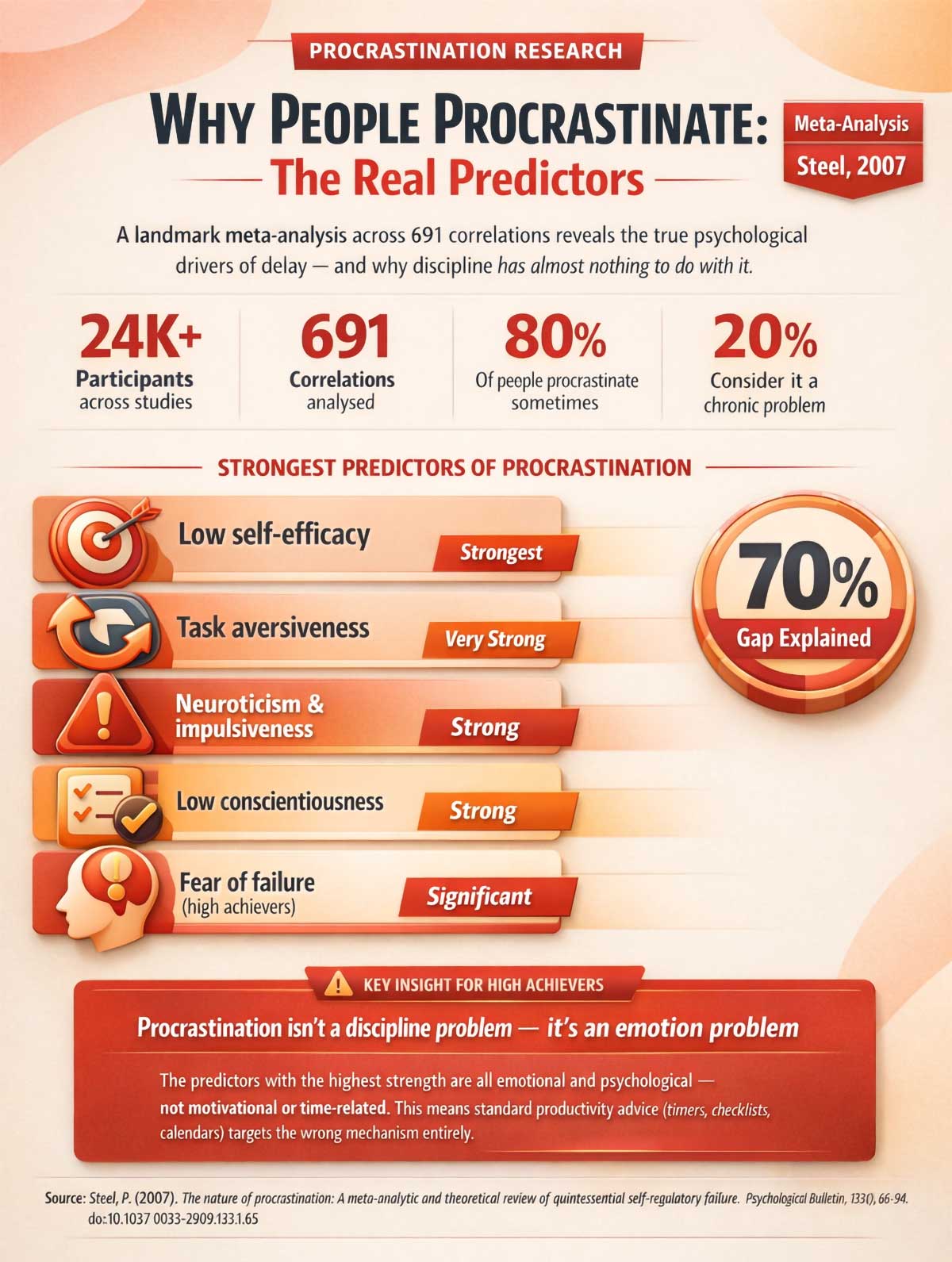
Procrastination is fundamentally an issue of emotional regulation, not a lack of time management or willpower. You keep procrastinating because your brain prioritizes "mood repair"—the immediate relief of avoiding a stressful or boring...
Procrastination is fundamentally an issue of emotional regulation, not a lack of time management or willpower. You keep procrastinating because your brain prioritizes "mood repair"—the immediate relief of avoiding a stressful or boring task—over the long-term rewards of completing it. This occurs due to a biological conflict between the limbic system, which seeks instant gratification, and the prefrontal cortex, which handles rational planning.
Contents
The Biological Conflict: Why Your Brain Chooses Avoidance
To understand why you keep procrastinating, you must first look at the neurobiology of the human brain. In 2026, cognitive neuroscience has further solidified the "dual-process" theory of procrastination. Your brain is essentially a battlefield between two distinct systems: the limbic system and the prefrontal cortex.
The limbic system is one of the oldest and most dominant parts of the brain. It is responsible for our "fight or flight" response and seeks immediate survival and pleasure. When you face a task that feels daunting, boring, or anxiety-inducing, the amygdala—the limbic system's emotional processing center—perceives that task as a genuine threat. To protect you from the discomfort, it triggers an urge to flee, which manifests as checking your phone, cleaning your desk, or starting a different, easier task.
The prefrontal cortex is a much newer part of the brain, located right behind your forehead. This is the "executive" center responsible for logic, planning, and long-term goals. Unlike the limbic system, the prefrontal cortex does not function automatically; it requires conscious effort and energy. When you are tired, stressed, or overwhelmed, the prefrontal cortex loses its grip, allowing the limbic system to take over. This is why you may know exactly what you need to do, yet find yourself physically unable to start.
The Psychological Root: It Is Not About Laziness
One of the most common misconceptions is that procrastination is synonymous with laziness. However, laziness is a lack of desire to act, whereas procrastination is a struggle to act despite having the desire. In 2026, psychologists emphasize "Affect Regulation" as the primary driver of procrastination. We procrastinate to manage negative moods such as anxiety, boredom, insecurity, frustration, or self-doubt.
Perfectionism and the Fear of Failure
Many chronic procrastinators are actually high achievers or perfectionists. If you tie your self-worth to the quality of your output, a difficult task becomes a threat to your identity. By delaying the task, you protect yourself from the possibility of failing or producing mediocre work. If you "run out of time" and the work isn't perfect, you can tell yourself, "I didn't have enough time," rather than "I wasn't good enough."
Low Self-Efficacy
Self-efficacy is the belief in your own ability to complete tasks and reach goals. When you face a project that feels beyond your current skill level, your brain views it as a high-risk endeavor. Low self-efficacy creates a feedback loop: you avoid the task because you doubt yourself, and the act of avoiding it further erodes your confidence, making it even harder to start the next time.
Temporal Discounting and the "Future Self" Disconnect
Evolutionarily, humans are wired to value immediate rewards more than future ones. This is known as temporal discounting. Furthermore, fMRI studies have shown that when people think about their "future self," the brain processes it similarly to how it thinks about a complete stranger. When you say, "I'll do this tomorrow," your brain feels like it is passing the burden to someone else, providing you with a hit of dopamine in the present.
The Cost of the Procrastination Cycle
Procrastination is rarely a victimless habit. While it provides temporary relief, the long-term consequences are cumulative and often severe. Understanding these impacts is crucial for building the motivation to change.
- Increased Cortisol Levels: Constant delays lead to "stress spikes" as deadlines approach. Chronic procrastination is linked to higher levels of cortisol, which can lead to cardiovascular issues and a weakened immune system.
- The "Zeigarnik Effect": This psychological phenomenon states that people remember uncompleted or interrupted tasks better than completed ones. This means that as long as you procrastinate, the task is "running" in the back of your mind, consuming cognitive energy and causing mental fatigue.
- Reduced Performance: Even if the work gets done, it is rarely of the same quality as work produced with adequate time for reflection and revision.
- Relationship Strain: In professional and personal settings, chronic procrastination is often perceived as unreliability or a lack of respect for others' time, damaging trust.
Categorizing the Procrastination Experience
Not all procrastination looks the same. Identifying which "style" you default to can help you choose the right intervention strategy.
| Procrastinator Type | Primary Driver | Behavioral Pattern | Recommended Solution |
|---|---|---|---|
| The Perfectionist | Fear of Failure | Stalling to avoid being judged or making mistakes. | Focus on "B-minus" work to lower the stakes. |
| The Dreamer | Overwhelm | Planning extensively but never taking the first step. | The 2-Minute Rule (start for only two minutes). |
| The Defier | Need for Autonomy | Resisting tasks perceived as forced or "boring." | Reframing "I have to" into "I choose to." |
| The Crisis Maker | Adrenaline Seeking | Believing they only work well under pressure. | Artificial deadlines and "pre-crastination" sprints. |
| The Overdoer | Poor Prioritization | Doing "productive" but low-priority tasks first. | Eisenhower Matrix for task categorization. |
Proven Strategies to Stop the Cycle
To stop procrastinating, you must address both the emotional trigger and the neurological hurdle. Here are the most effective strategies supported by behavioral science in 2026.
1. The Practice of Self-Compassion
Contrary to popular belief, "beating yourself up" does not prevent procrastination; it fuels it. Research published in journals like Self and Identity indicates that students who forgave themselves for procrastinating on the first exam actually procrastinated less on the second. By reducing the guilt and shame associated with a task, you lower the emotional "threat" level, making it easier for the prefrontal cortex to stay in control.
2. Task Slicing and the "Entry Point"
Large projects are intimidating because they are abstract. "Write a business report" is a threat; "Open a blank document and type a title" is a manageable action. By "slicing" a task into the smallest possible components, you reduce the amygdala's response. The goal is to make the first step so easy that it is harder to skip it than to do it.
3. Implementation Intentions
Vague goals like "I'll work on this later" are easy for the limbic system to override. Instead, use "If-Then" planning. For example: "If it is 10:00 AM and I am at my desk, then I will spend 15 minutes drafting the introduction." This removes the need for willpower at the moment of action by pre-deciding the behavior.
4. Environmental Design
In 2026, our digital environments are optimized for distraction. If your phone is next to you, your brain is constantly using energy to not check it. This "cognitive load" depletes your prefrontal cortex. Practice "choice architecture" by placing your phone in another room or using application blockers during deep-work sessions.
Frequently Asked Questions
Is procrastination a symptom of ADHD?
While not everyone who procrastinates has ADHD, chronic procrastination is a core symptom of Executive Function Disorder, which is central to ADHD. People with ADHD often have lower levels of dopamine in the prefrontal cortex, making it significantly harder to engage with tasks that do not provide immediate interest or reward. If procrastination is pervasive across all areas of your life and accompanied by impulsivity or distractibility, consulting a professional for an evaluation is recommended.
Why do I procrastinate even on things I enjoy?
This is often called "lifestyle procrastination." It usually stems from the fear of completion or the pressure of high expectations. If you love a hobby, finishing a project in that hobby means it is now open for judgment. Additionally, if you are tired, your brain may choose "passive" enjoyment (like scrolling social media) over "active" enjoyment (like painting or coding) because the latter requires more executive energy.
Can social media use actually change my brain to procrastinate more?
Yes. Short-form video content and infinite scroll interfaces are designed to trigger frequent, small hits of dopamine. Over time, this can recalibrate your brain's reward system to expect instant gratification. This makes the "slow" rewards of meaningful work feel less satisfying by comparison, increasing the urge to procrastinate on anything that requires sustained attention.
What is "productive procrastination"?
Productive procrastination involves doing beneficial but lower-priority tasks to avoid a single high-priority, high-anxiety task. Examples include cleaning the entire kitchen instead of doing your taxes. While the kitchen gets clean, the primary source of stress (the taxes) remains, meaning you are still stuck in the emotional avoidance cycle.
Does "working better under pressure" actually work?
Usually, no. While the "stress response" of a looming deadline can provide a burst of adrenaline that overcomes the limbic system's resistance, it rarely results in superior work. Most people who claim to "work better under pressure" are actually just "only able to work under pressure." The cost is higher error rates, increased burnout, and significant mental strain.
Practical Recommendation: The Next Step
To break the habit of procrastination today, do not attempt to overhaul your entire personality. Instead, select one task you have been avoiding and apply the "Five-Minute Rule." Commit to working on that task for exactly five minutes, with the explicit permission to stop once the timer goes off.
This technique works because it bypasses the amygdala's fear response. The "threat" of a five-minute task is negligible. Most often, once the "entry friction" is overcome, the Zeigarnik Effect kicks in, and you will find it easier to continue than to stop.
Image Gallery