Understanding Warranty in Health and Life Insurance: Legal Requirements and Policyholder Obligations
In the context of health and life insurance, a warranty is a strictly binding promise made by the policyholder that specific facts are true or that certain conditions will be maintained. Unlike a general representation, a breach of war...
In the context of health and life insurance, a warranty is a strictly binding promise made by the policyholder that specific facts are true or that certain conditions will be maintained. Unlike a general representation, a breach of warranty can allow an insurer to deny claims or void the policy entirely, regardless of whether the breach caused the specific loss.
Contents
What is a Warranty in the Context of Insurance?
In common parlance, a "warranty" often refers to a guarantee on a consumer product, like a television or a car. However, in the insurance industry, the term carries a much more technical and legally significant meaning. An insurance warranty is a condition precedent to the insurer’s liability. It is a statement of fact or a promise of future conduct provided by the insured that forms the very "basis of the contract."
When an applicant applies for life or health insurance, the insurer must assess the risk they are taking on. To do this, they rely on the information provided by the applicant. If a statement is designated as a "warranty," the law historically required it to be strictly and literally true. As of 2026, while consumer protection laws in many jurisdictions have softened the harshness of traditional warranties, they remain a foundational element of how risk is quantified and managed in the private insurance market.
Warranties are generally categorized into two types:
- Affirmative Warranties: These relate to facts existing at the time the policy is issued. For example, an applicant "warrants" that they have never been diagnosed with a chronic heart condition.
- Promissory (Continuing) Warranties: These are promises that a certain state of affairs will continue for the duration of the policy. In health insurance, this might involve a warranty to notify the insurer of any change in smoking status or high-risk occupational activities.
Warranties vs. Representations: Crucial Differences
Understanding the distinction between a warranty and a representation is vital for any policyholder. While both involve providing information to an insurer, their legal consequences vary significantly.
The Nature of Representations
A representation is a statement made by the applicant to the insurer during the negotiation process to induce the insurer to accept the risk. Under modern standards, representations only need to be "substantially true." If a representation is slightly inaccurate but the inaccuracy is not "material"—meaning it wouldn't have changed the insurer's decision to provide cover or the premium charged—the policy usually remains valid.
The Strictness of Warranties
A warranty, by contrast, is a condition that must be complied with exactly. Historically, under the "basis of contract" clause, any misstatement in a warranty, however minor or irrelevant to the eventual claim, gave the insurer the right to repudiate the contract. For instance, if a life insurance applicant warranted their height was 5'10" when they were actually 5'9", a strict interpretation of insurance law could allow the insurer to void the policy upon the individual's death, even if the death was caused by an unrelated accident.
In 2026, most jurisdictions (such as the UK under the Insurance Act 2015 and various US states through the National Association of Insurance Commissioners (NAIC) guidelines) have prohibited or limited these "basis of contract" clauses for consumer policies. Instead, they focus on whether the policyholder took "reasonable care" not to make a misrepresentation.
The Role of Warranties in Life Insurance
In life insurance, warranties primarily center on the applicant’s health history, lifestyle, and high-risk behaviors. Because life insurance contracts often span decades, the initial "warranted" facts are the only tools the insurer has to set premiums for the long term.
Smoking and Lifestyle Declarations
The most common application of a warranty in life insurance relates to tobacco and nicotine use. Most insurers require a warranty regarding smoking status over the previous 12 to 24 months. If an individual warrants they are a non-smoker to secure lower premiums but is later found to have been a regular smoker at the time of application, the insurer may treat this as a breach of warranty. In many 2026 policies, this results in a "void ab initio" status, meaning the policy is treated as if it never existed, and the death benefit is withheld.
Health History and "Clean Slate" Warranties
Applicants are often asked to warrant that they have not sought medical advice for specific symptoms in a set period. In "Guaranteed Issue" life insurance, these warranties are minimal. However, in "Fully Underwritten" policies, the warranty acts as a legal shield for the insurer. If an applicant warrants they have no history of cancer, but medical records later show a prior diagnosis that was withheld, the breach is considered material.
Warranties in Health and Medical Insurance
Health insurance relies heavily on the "duty of fair presentation." While the term "warranty" is used less frequently in the marketing of health plans than in life insurance, the legal mechanics are identical in the fine print of the policy document.
Pre-existing Conditions
In many private health insurance markets, the policyholder warrants that they have disclosed all pre-existing conditions. Under a "moratorium" underwriting style, the insurer doesn't ask for a full history upfront but includes a warranty-like clause stating that no claims will be paid for conditions that existed in the five years prior to the policy start date. If a claim is made, and the insurer discovers the condition was pre-existing and not disclosed where required, the claim is denied based on the breach of these terms.
Occupational and Recreational Hazards
Private health and disability insurance often include promissory warranties regarding high-risk activities. If a policyholder warrants that they do not engage in "hazardous sports" (such as skydiving or deep-sea diving) to obtain a standard rate, but then sustains an injury during such an activity, the insurer may invoke the breach of warranty to refuse payment for the resulting medical bills.
Legal Consequences of Breaching a Warranty
As of 2026, the consequences of a breach of warranty have been modified by legislation to be more equitable, but they remain severe.
- Discharge of Liability: In traditional insurance law, a breach of warranty automatically discharges the insurer from liability as of the date of the breach. The insurer does not need to prove that the breach was related to the loss.
- Suspensive Conditions: Under modern reforms like the UK Insurance Act 2015, warranties often act as "suspensive conditions." This means that if a policyholder breaches a warranty (e.g., failing to keep a health monitoring device active as promised), the insurer's liability is merely suspended until the breach is remedied. If a claim occurs during the period of the breach, it is not covered.
- Voiding the Policy: For life insurance, if the breach occurs at the application stage (an affirmative warranty), the insurer can void the policy from the start. They may or may not return the premiums, depending on whether the misrepresentation was fraudulent or merely negligent.
Comparison of Legal Terms in Insurance Contracts
The following table summarizes the differences between warranties and other contractual obligations in health and life insurance policies as of 2026.
| Feature | Warranty | Representation | Condition Precedent |
|---|---|---|---|
| Definition | A strict promise that a fact is true or a state of affairs will be maintained. | A statement of fact made to induce the insurer to enter the contract. | A requirement that must be met before a claim can be paid (e.g., notifying the insurer within 30 days). |
| Standard of Accuracy | Literal and strict accuracy required. | Substantial accuracy (must be "true in substance"). | Must be fulfilled as specified in the policy. |
| Materiality | Traditionally, any breach allows voidance, regardless of materiality. | Only "material" misrepresentations allow the insurer to void the policy. | Failure to meet the condition allows the insurer to deny that specific claim. |
| Remedy for Breach | Policy may be voided or liability suspended. | Insurer can seek to avoid the policy or adjust the payout. | The specific claim is rejected, but the policy usually continues. |
| Current Regulation | Heavily restricted in consumer insurance to prevent unfair claim denials. | Governed by "reasonable care" and "fair presentation" standards. | Standardized by regulators to ensure they are not used as "hidden" warranties. |
Regulatory Changes and Consumer Protections in 2026
The landscape of 2026 insurance law is defined by a shift toward "consumer fairness." For many years, insurers used warranties as a "technicality" to avoid paying legitimate claims. This led to significant regulatory intervention.
The Shift from "All or Nothing" to Proportionate Remedies
In jurisdictions following modern insurance principles, if a policyholder breaches a warranty or makes a misrepresentation that is not fraudulent, the insurer cannot simply walk away from the policy. Instead, they must apply a "proportionate remedy."
- If the insurer would have charged a 20% higher premium had they known the truth, they may pay out only 80% of the claim.
- If the insurer would have included an exclusion clause for a specific condition, they can treat the policy as if that exclusion had always been there.
The "Contestability Period" (Life Insurance)
In the United States and several other regions, life insurance policies include a "contestability period," usually lasting two years from the policy's inception. During this window, the insurer has the right to investigate warranties and representations. If the policyholder dies within these first two years, the insurer will rigorously verify the application data. Once this period passes, the insurer generally cannot contest the policy based on non-fraudulent misstatements in the warranties.
Common Pitfalls and How to Avoid Them
Navigating warranties requires transparency and diligence. Policyholders often run into trouble not because they intend to defraud the insurer, but because they do not realize the weight of the statements they are making.
- Avoid "Guessing" on Applications: If a health insurance application asks for the date of a last medical check-up or a specific blood pressure reading, do not estimate. Consult your medical records. An "estimated" warranty is still a warranty.
- Update Your Insurer on Life Changes: If your policy includes a continuing warranty (such as remaining a non-smoker or not engaging in specific hobbies), notify the insurer immediately if your circumstances change. It is better to pay a slightly higher premium than to have a million-dollar life insurance claim denied later.
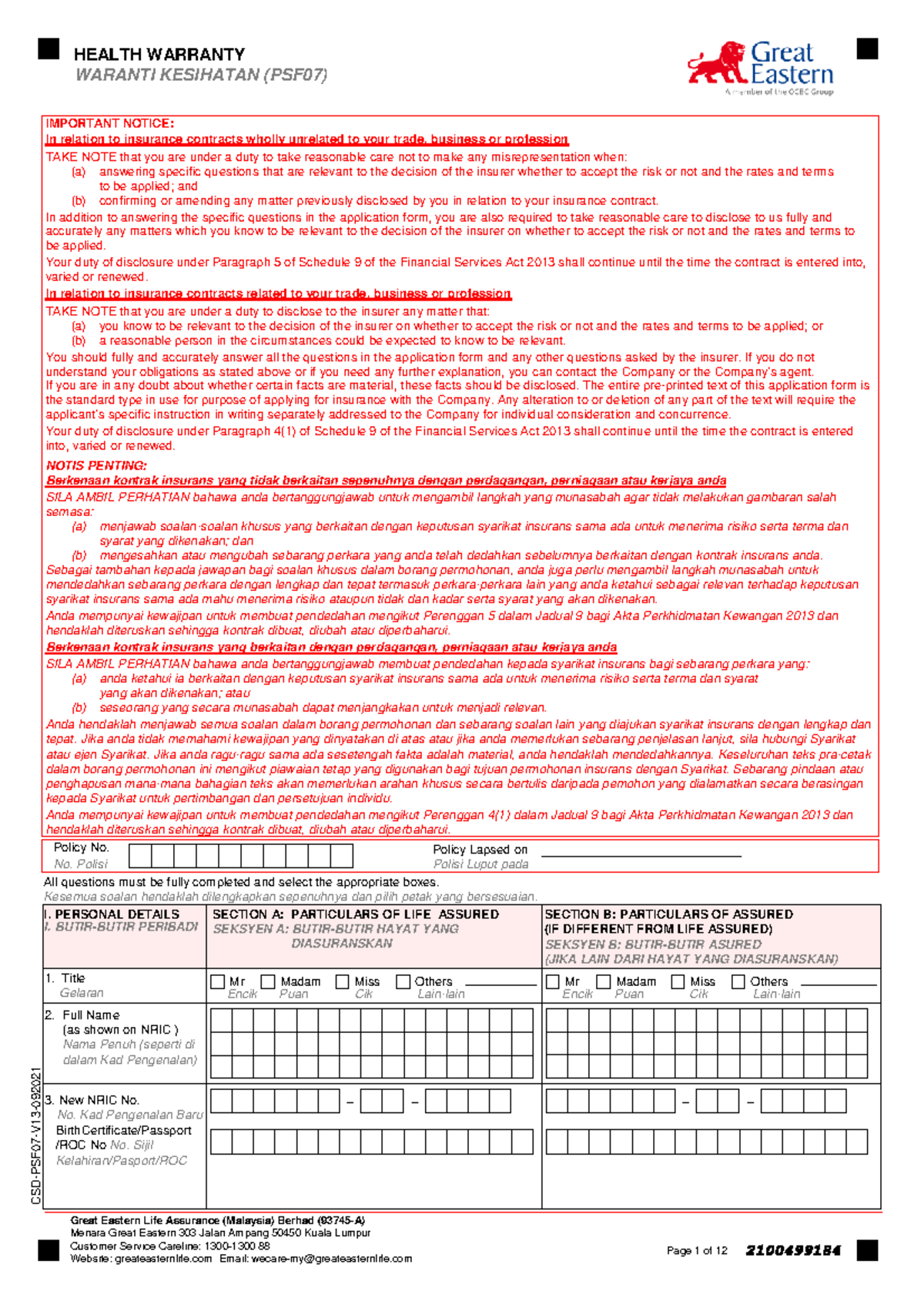
- Read the "Declaration" Carefully: Before signing an insurance application, there is usually a section that states, "I warrant that the above information is true..." Treat this as the most important part of the document.
- Understand "Social" vs. "Regular" Habits: In 2026, many insurers have strict definitions for terms like "occasional smoker" or "social drinker." Ensure your definition aligns with theirs to avoid a breach of warranty.
Frequently Asked Questions
Can an insurer void my life insurance policy for a minor typo?
In 2026, no. Most modern regulations prevent insurers from voiding policies for "immaterial" errors or honest mistakes that do not affect the risk profile. However, if the "typo" hides a significant health risk (like writing "1990" instead of "1980" for a birth year), it could still be grounds for adjusting the benefit or voiding the policy if the error was intentional.
What happens if I start smoking after I've taken out a life insurance policy?
This depends on whether your policy has a "promissory warranty." Most standard life insurance policies in 2026 lock in your status at the time of application. However, if you have a "reviewable" policy or a specific health-incentive plan, you may be under a continuing warranty to disclose changes in smoking status. Always check your specific policy wording regarding "change in circumstances."
Is a "Pre-existing Condition" clause the same as a warranty?
They are related but different. A warranty is your statement that you don't have a condition. A "Pre-existing Condition Exclusion" is a policy term that says the insurer won't pay for a condition regardless of what you said. If you warrant you have no heart issues, but you actually do, you have breached a warranty. If your policy simply excludes heart issues, the insurer won't pay for them, but your policy remains valid for other claims.
Does the "Duty of Utmost Good Faith" still apply in 2026?
Yes. The principle of uberrimae fidei (utmost good faith) remains the cornerstone of insurance. Both the insurer and the insured must act honestly. While laws have evolved to protect consumers from harsh "warranties," the requirement for the applicant to be truthful and provide a "fair presentation" of risk is still legally enforceable.
Can an insurer use a warranty to deny a claim unrelated to the breach?
Under traditional law, yes. Under 2026 consumer laws in most developed nations, no. If you breached a warranty regarding your cholesterol levels, but died in a plane crash, modern laws generally require the insurer to pay the claim because the breach was not relevant to the loss.
Practical Recommendation
When dealing with warranties in health and life insurance, the safest path is absolute disclosure. If you are unsure whether a piece of medical history or a lifestyle habit is relevant, disclose it anyway. In the 2026 insurance market, insurers have access to vast data-sharing networks and prescription databases; they are likely to discover discrepancies during the claims process. By being transparent at the outset, you ensure that the "warranty" you provide is robust, protecting your beneficiaries from the devastating financial consequences of a denied claim.
Image Gallery