Westborough Mold Remediation Company Services and Standards
Professional mold remediation in Westborough, Massachusetts, requires adherence to ANSI/IICRC S520 standards to safely isolate, remove, and clean fungal contamination from residential and commercial structures. Qualified contractors us...
Professional mold remediation in Westborough, Massachusetts, requires adherence to ANSI/IICRC S520 standards to safely isolate, remove, and clean fungal contamination from residential and commercial structures. Qualified contractors use negative air containment, HEPA filtration, and structural drying to eliminate active microbial colonies and return indoor environments to a normal fungal ecology (Condition 1).
Contents
Central Massachusetts experiences broad seasonal humidity swings, heavy winter snowfall, and periodic severe storms. In Westborough—where historic colonials near the town center stand alongside modern commercial facilities along the Route 9 and Interstate 495 corridors—these climatic factors frequently contribute to hidden moisture accumulation in basements, attics, and building envelopes. Understanding industry-standard protocols ensures property owners can distinguish between cosmetic surface cleanups and true, permanent environmental remediation.
Technical Standards Governing Mold Remediation
Legitimate remediation companies do not treat mold simply as a surface stain to be sprayed with bleach. Reliable remediation relies on consensus-based engineering controls and occupational safety standards established by independent regulatory and certifying bodies.
The ANSI/IICRC S520 Standard
The primary standard of care in the restoration industry is the ANSI/IICRC S520 Standard for Professional Mold Remediation, published by the Institute of Inspection, Cleaning and Restoration Certification. The S520 categorizes indoor environmental conditions into three distinct states:
- Condition 1 (Normal Fungal Ecology): An indoor environment that reflects normal background fungal populations, with species and concentrations typical of unimpacted indoor spaces in the same geographic region.
- Condition 2 (Settled Spores): An indoor environment containing settled mold spores, fungal fragments, or traces that are not actively growing, often resulting from dispersion during nearby remediation or water intrusions.
- Condition 3 (Actual Growth): An indoor environment with active microbial growth, visible colonies, or fungal contamination concealed within wall cavities, under subfloors, or beneath building materials.
The explicit goal of every certified remediation project is to bring an affected area from Condition 3 or Condition 2 back to Condition 1.
EPA and OSHA Guidelines
Remediation protocols also incorporate guidelines from the U.S. Environmental Protection Agency (EPA) publication Mold Remediation in Schools and Commercial Buildings, as well as worker safety regulations under the Occupational Safety and Health Administration (OSHA). OSHA Standard 29 CFR 1910.134 dictates respiratory protection requirements for remediation technicians, ensuring personal protective equipment (PPE)—such as half-face or full-face respirators equipped with N95 or P100 HEPA filters, nitrile gloves, and disposable Tyvek coveralls—is used appropriately during demolition and cleaning.
The End-to-End Professional Remediation Workflow
When a reputable Westborough remediation firm is engaged, work proceeds through a rigorous, multi-stage engineering protocol designed to prevent the cross-contamination of unaffected living or working areas.
- Initial Inspection & Diagnostics
- Containment Setup
- Air Filtration (Negative Pressure)
- Source Removal & Demolition
- Micro-Cleaning & Sanitization
- Drying & Moisture Control
- Post-Remediation Verification (PRV)
1. Initial Assessment and Moisture Diagnostics
Before disturbing any materials, technicians evaluate the extent of visible and hidden contamination. Moisture mapping tools—including non-invasive pinless moisture meters, invasive pin-type meters, and forward-looking infrared (FLIR) thermal imaging cameras—detect cold spots caused by evaporative cooling where moisture hides behind drywall, beneath floorboards, or inside ceiling plenums.
2. Critical Containment and Engineering Controls
To prevent airborne spores from migrating into clean parts of the building, technicians establish physical containment barriers:
- Isolation Barriers: Construction of 6-mil polyethylene sheeting secured with tension poles and heavy-duty tape to isolate the contaminated work zone.
- Airlocks and Decontamination Chambers: Two-chamber or single-chamber zippering entryways that allow workers to enter and exit, strip off contaminated gear, and stage waste without letting spores escape.
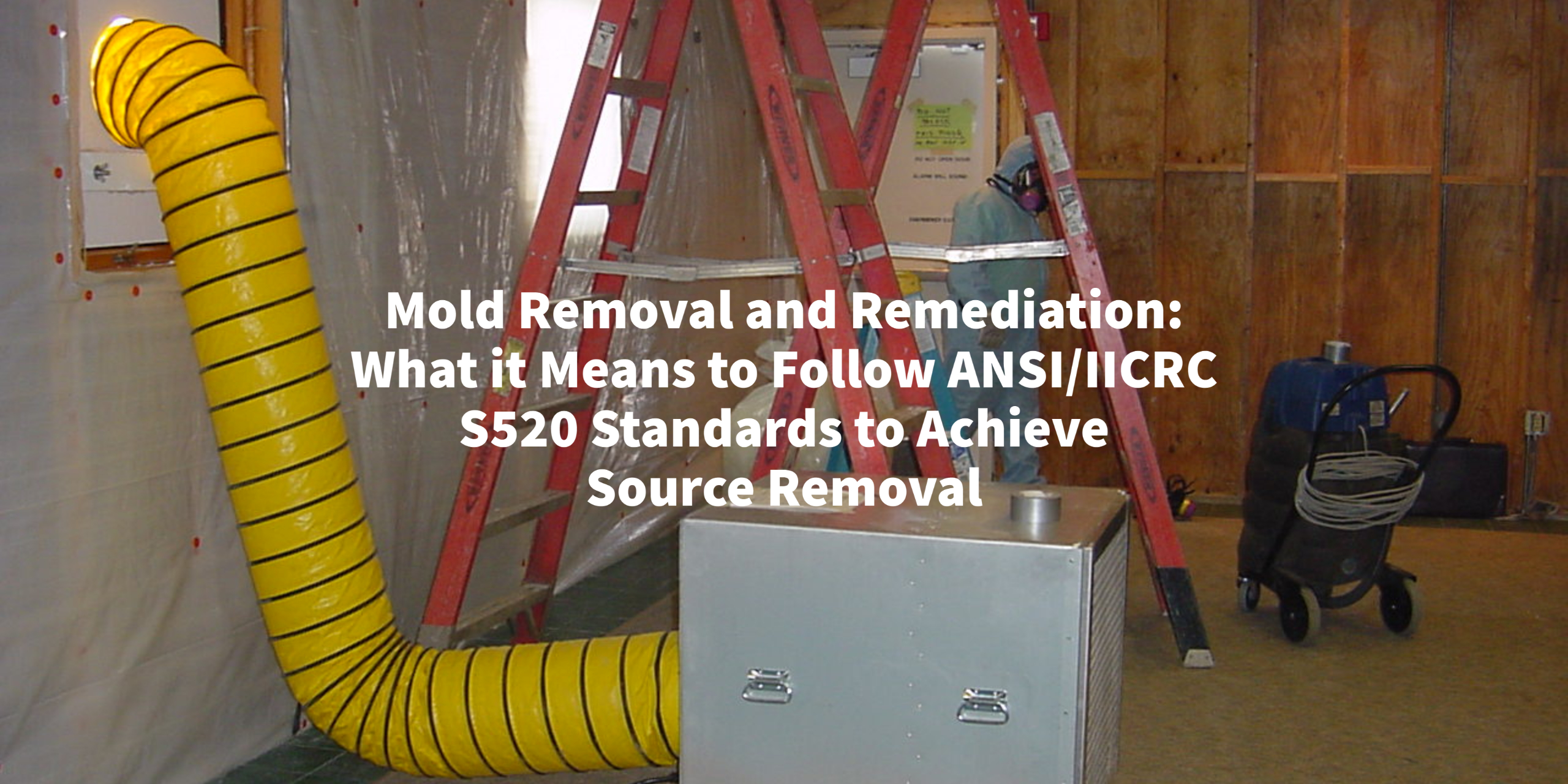
- Negative Air Pressure: Negative air machines fitted with true High-Efficiency Particulate Air (HEPA) filters vent air outside the structure through flexible ductwork. This creates a pressure differential that continuously pulls clean air into the containment zone and prevents contaminated air from leaking into adjacent rooms.
3. Controlled Demolition and Physical Removal
Chemical sprays alone cannot neutralize the health hazards posed by non-viable spores and mycotoxins; the physical biomass must be completely removed.
- Porous Materials: Drywall, fiberglass insulation, acoustic ceiling tiles, and carpet pads with active colonization cannot be salvaged. Technicians carefully cut out and bag these materials inside 6-mil poly bags, wipe the exterior of the bags, and transport them through containment routes to avoid contamination.
- Semi-Porous Materials: Structural framing, joists, subflooring, and masonry can often be preserved. Technicians use physical agitation methods such as HEPA-vacuuming, wire-brushing, media blasting (e.g., dry-ice or soda blasting), or manual sanding to physically sever the fungal hyphae embedded in wood grain.
- Non-Porous Materials: Metal, hard plastics, and glass are thoroughly scrubbed with EPA-registered botanical or quaternary ammonium antimicrobials and detergent solutions.
4. HEPA Air Scrubbing and Micro-Cleaning
Once demolition and heavy scraping conclude, workers execute a meticulous cleaning sequence known as "HEPA sandwiching":
- Vacuum all exposed surfaces using industrial vacuums certified to capture 99.97% of particles down to 0.3 microns.
- Damp-wipe all horizontal and vertical structural surfaces with microfiber cloths and an EPA-registered disinfectant.
- Execute a second pass of HEPA vacuuming once surfaces have dried.
Continuous air scrubbing runs during and after this phase, completing multiple air changes per hour (ACH) to remove airborne particulates suspended during physical disruption.
Comparison of Remediation Methods Across Common Building Assemblies
Different materials present unique challenges based on porosity, location, and structural integrity. The following matrix illustrates the standard operating procedures applied across residential and commercial settings:
| Substrate / Location | Typical Moisture Source | Applicable Standard Method | Preservation Feasibility | Waste Disposal Requirements |
|---|---|---|---|---|
| Drywall & Plaster | Pipe leaks, roof intrusions, high basement humidity | Controlled cutting minimum 12–24 inches past visible water/mold line | Non-salvageable if fungal hyphae penetrate paper backing | Double-bagged in 6-mil poly bags; standard construction waste |
| Structural Timbers (Joists/Studs) | Foundation seepage, attic condensation | Sanding, wire brushing, or dry ice blasting, followed by HEPA vacuuming | Highly salvageable; structure retained unless rot compromises load rating | Solid wood debris bagged; HEPA vac collection disposed as solid waste |
| Fiberglass / Cellulose Insulation | Attic roof leaks, crawlspace moisture | Total extraction via vacuum hose or manual bagging | Non-salvageable; particulate binding prevents effective cleaning | Bagged inside containment to prevent spore drift across living areas |
| Poured Concrete / Masonry Blocks | Ground hydrostatic pressure, efflorescence seepage | Mechanical scrubbing, alkaline detergent wash, antimicrobial application | Salvageable; substrate is non-porous or semi-porous mineral | Wash effluent handled per local wastewater/municipal standards |
| Subfloor (Plywood / OSB) | Appliance line failure, delayed flood response | Sanding top layers if localized; extraction and replacement if OSB swells | Variable; OSB delaminates quickly and requires replacement more often than plywood | Cut out in manageable sections; bagged or wrapped before removal |
Massachusetts Regulatory Context, Local Housing Stock, and Insurance
Property owners in Westborough face distinct operational and financial considerations driven by Massachusetts state guidance and local regional infrastructure.
Regulatory and Health Standards in Massachusetts
The Commonwealth of Massachusetts does not maintain an individual state licensing board specifically for mold remediation contractors, unlike asbestos or lead abatement programs. However, the Massachusetts Department of Public Health (DPH) Indoor Air Quality Program sets authoritative guidance regarding mold evaluation and building moisture.
Because the state does not issue mold licenses, consumer protection depends on contractor credentials issued by recognized accreditation organizations. Property owners must ensure contractors hold verified credentials from:
- The Institute of Inspection, Cleaning and Restoration Certification (IICRC) (e.g., Applied Microbial Remediation Technician - AMRT; Water Restoration Technician - WRT).
- The American Council for Certified Qualification (ACAC) (e.g., Certified Microbial Remediation Supervisor - CMRS).
Regional Structural Challenges in Westborough
Westborough properties experience moisture issues tailored to specific architectural eras:
- Historic and Mid-Century Properties: Neighborhoods with older construction often feature fieldstone foundations or uninsulated crawlspaces. Hydrostatic pressure pushes ground moisture through fieldstone mortar, creating chronic, elevated relative humidity (>60%) that feeds Aspergillus and Penicillium growth on floor joists.
- Modern Construction and Commercial Centers: Highly insulated, tightly sealed buildings along commercial corridors can experience trapped condensation if HVAC systems lack proper energy recovery ventilators or balanced dehumidification. In winter, inadequate attic ventilation combined with ice damming creates seasonal attic mold on roof sheathing.
Navigating Property Insurance and Mold Coverage
Standard Massachusetts homeowners and commercial property policies frequently cap mold remediation coverage at $5,000 to $10,000 unless a specific endorsement has been purchased. Most policies explicitly exclude mold resulting from long-term humidity, unaddressed seepage, or maintenance neglect. Coverage is generally approved only when microbial growth results directly from a covered "sudden and accidental" peril, such as a burst plumbing line or an abrupt mechanical equipment failure.
Contractors operating in Westborough frequently produce itemized estimates formatted in industry-standard software (such as Xactimate) to provide line-item documentation to independent insurance adjusters.
Ensuring Quality: Third-Party Clearance Testing (PRV)
A critical conflict of interest occurs when the same contractor that performs remediation also conducts the clearance testing to confirm the work is complete. Legitimate industry standards dictate a strict separation of duties:
- [Contractor A] Detects, Contain, Demolishes & Cleans
- [Independent Third-Party Industrial Hygienist] Collects Air & Surface Samples
- [Accredited Laboratory] Analyzes Culturable/Non-Culturable Spores
- Clearance Passed
- Containment Dismantled
- Reconstruction Begins
Post-Remediation Verification (PRV), also known as clearance testing, must be conducted by an independent indoor environmental professional (IEP) or certified industrial hygienist (CIH). The IEP enters the containment zone while negative air machines are operating (or after a settled rest period, depending on the agreed sampling protocol) and conducts:
- Visual Inspection: Confirming complete removal of visible mold, dust, debris, and damp building materials.
- Moisture Testing: Verifying that structural components have dried to an equilibrium moisture content (typically below 15% wood moisture equivalent).
- Air and Surface Sampling: Taking calibrated non-viable spore trap samples (such as Air-O-Cell cassettes) inside the containment zone, outside the containment zone, and outdoors.
A remediation project is deemed successful only when indoor air samples exhibit lower total spore counts than outdoor baseline samples, with an absence of indicator species associated with active water damage, such as Stachybotrys chartarum, Chaetomium, and elevated Aspergillus/Penicillium.
Frequently Asked Questions
Can professional mold remediation be performed without cutting out drywall?
Only if the mold is purely superficial and the drywall core remains undamaged and dry. Fungal hyphae quickly penetrate the porous paper facing and gypsum core of drywall. If moisture testing confirms water has penetrated the wall cavity, or if fungal growth has established deep colonization, the drywall must be removed to remediate the cavity framing safely.
How long does a standard residential mold remediation take in Westborough?
A standard residential project typically requires between one and three days. Small containment jobs (such as a single bathroom or localized corner of a basement) can be completed in 24 to 48 hours, whereas full attic restorations or multi-room basement remediation projects often take three to five business days to allow sufficient run-time for continuous air scrubbing.
Why is bleach ineffective for mold remediation on structural wood?
Bleach (sodium hypochlorite) is diluted in water. When applied to porous materials like dimensional lumber or plywood, the chlorine evaporates quickly on the surface, while the water carrier absorbs into the wood grain. This provides residual moisture that can stimulate dormant fungal roots beneath the surface. Standards-compliant remediation uses mechanical agitation to extract hyphae alongside registered biocides or antimicrobials.
What should happen if a containment barrier fails during remediation?
If negative pressure drops or a barrier tears, work must stop immediately. Technicians must reseal the barrier, verify the integrity of the HEPA exhaust ducting, and run air scrubbers in the uncontained adjacent spaces to capture any escaped spores before resume demolition.
Do I need to vacate my home during mold remediation?
Occupants can often remain in the home if the affected area is small, isolated, and outside primary living spaces (such as an attic, crawlspace, or sealed basement zone). However, if remediation involves the primary HVAC system, central living corridors, or if residents have severe respiratory conditions, temporary relocation during active demolition is recommended.
Actionable Next Steps for Property Owners
If you suspect active mold contamination in a Westborough property, take these immediate, measured steps:
- Stop the Water Source: Identify and correct active plumbing failures, roof leaks, or ground-water entry points before commencing any remediation.
- Isolate the Space: Turn off forced-air heating or air-conditioning systems if vents run through the affected area to avoid spreading spores through ductwork.
- Hire an Independent Assessor: Contact a certified indoor environmental professional (IEP) without ties to a remediation company to outline a detailed remediation protocol.
- Engage a Certified Contractor: Solicit written, itemized proposals from contractors holding valid IICRC AMRT or ACAC CMRS credentials. Require explicit confirmation that work will follow ANSI/IICRC S520 guidelines, utilize HEPA-filtered containment, and conclude with independent third-party Post-Remediation Verification.
Image Gallery