Alpha, Beta, and Gamma Decay Equations Explained
Nuclear decay is the fundamental process by which an unstable atomic nucleus loses energy by emitting radiation. This transformation, known as radioactive decay, changes the identity of the original atom, resulting in a new element or...
Nuclear decay is the fundamental process by which an unstable atomic nucleus loses energy by emitting radiation. This transformation, known as radioactive decay, changes the identity of the original atom, resulting in a new element or a more stable state of the same element. To understand how these transitions occur, physicists use balanced nuclear equations that track the conservation of mass and atomic numbers.
Contents
Understanding the Nuclear Notation
Before analyzing the specific decay equations, it is essential to understand the notation used to represent isotopes. An atom is represented as $^A_Z X$, where $X$ is the chemical symbol, $Z$ is the atomic number (number of protons), and $A$ is the mass number (sum of protons and neutrons). In nuclear equations, the total mass number and the total atomic number must remain balanced on both sides of the reaction arrow.
Alpha Decay Equations
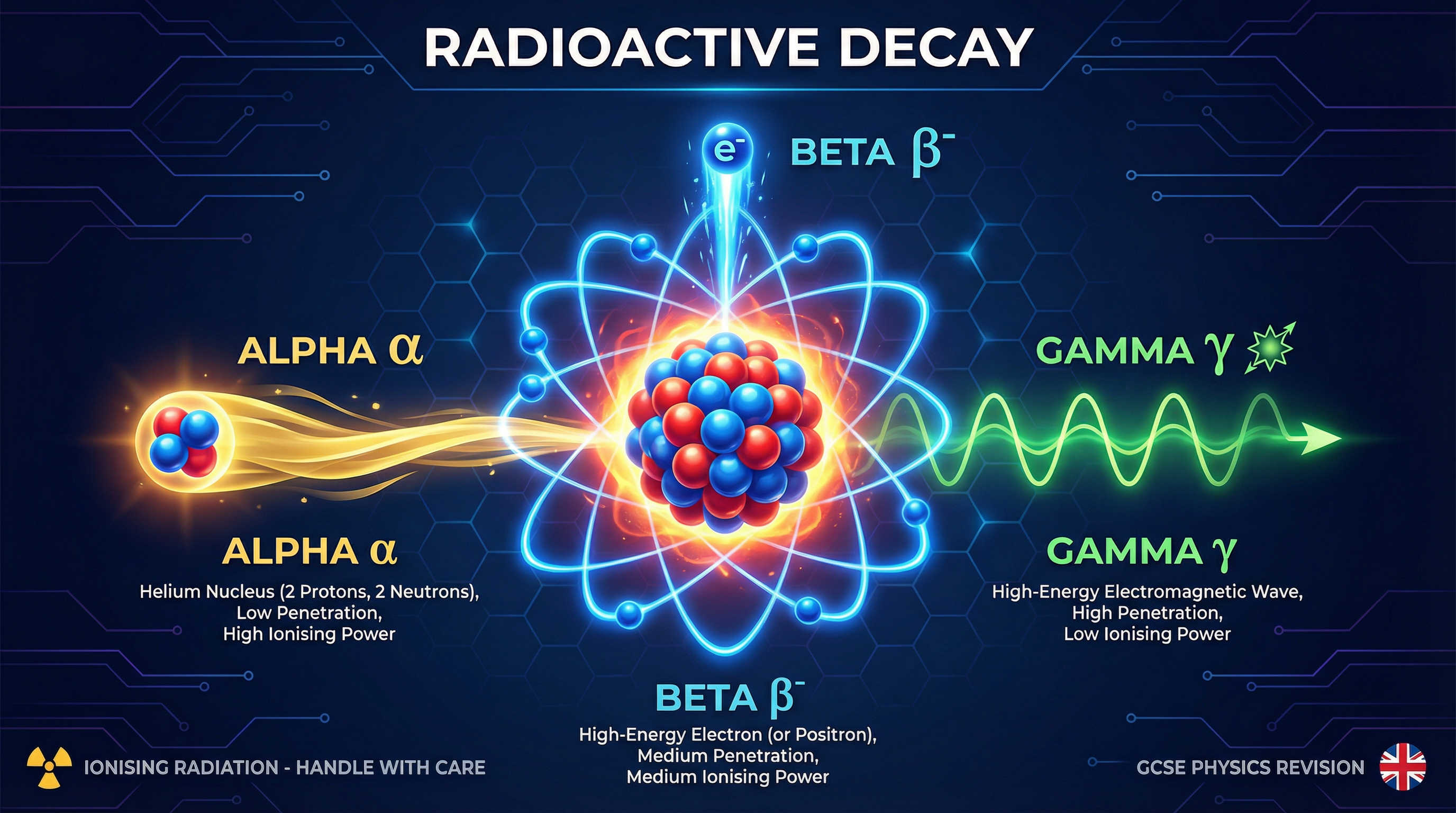
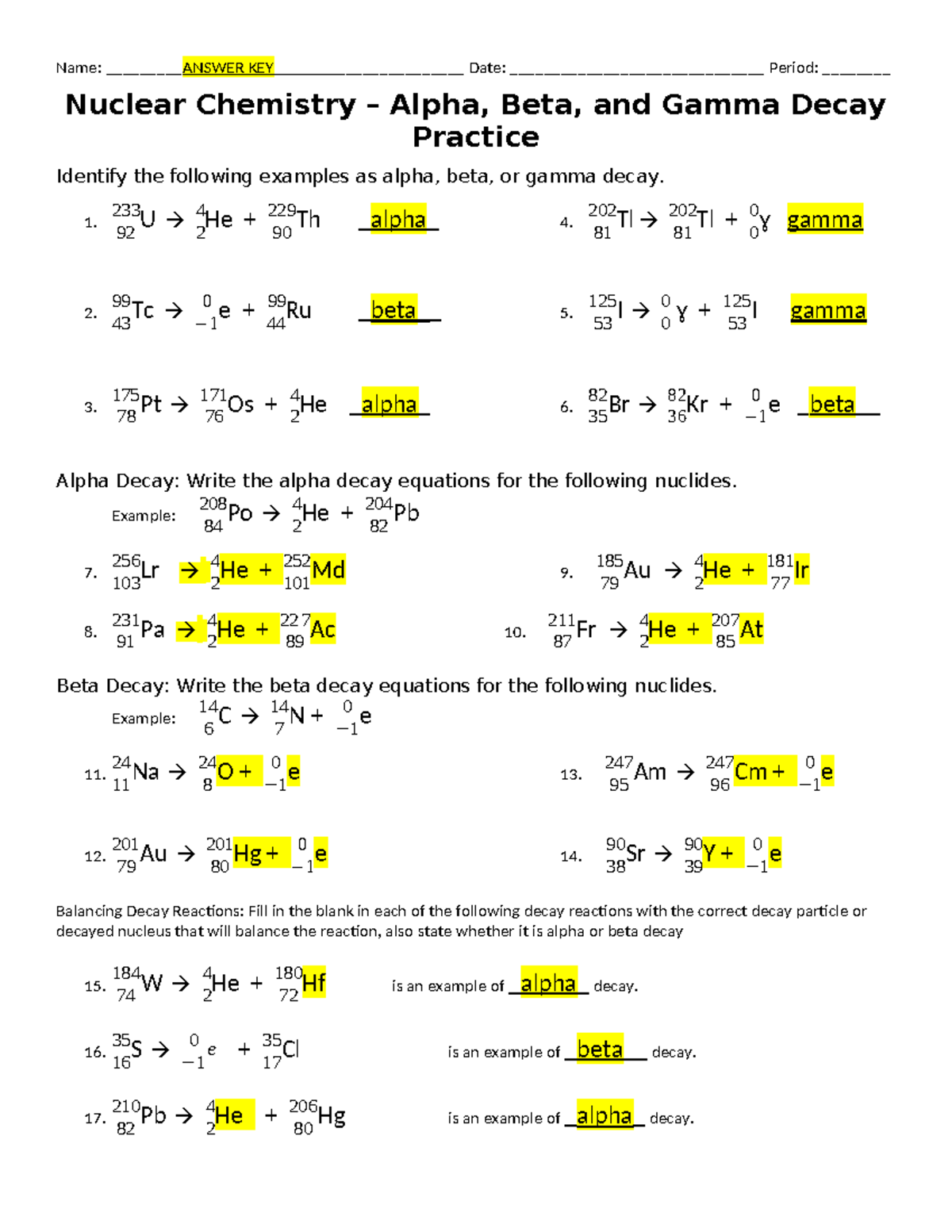
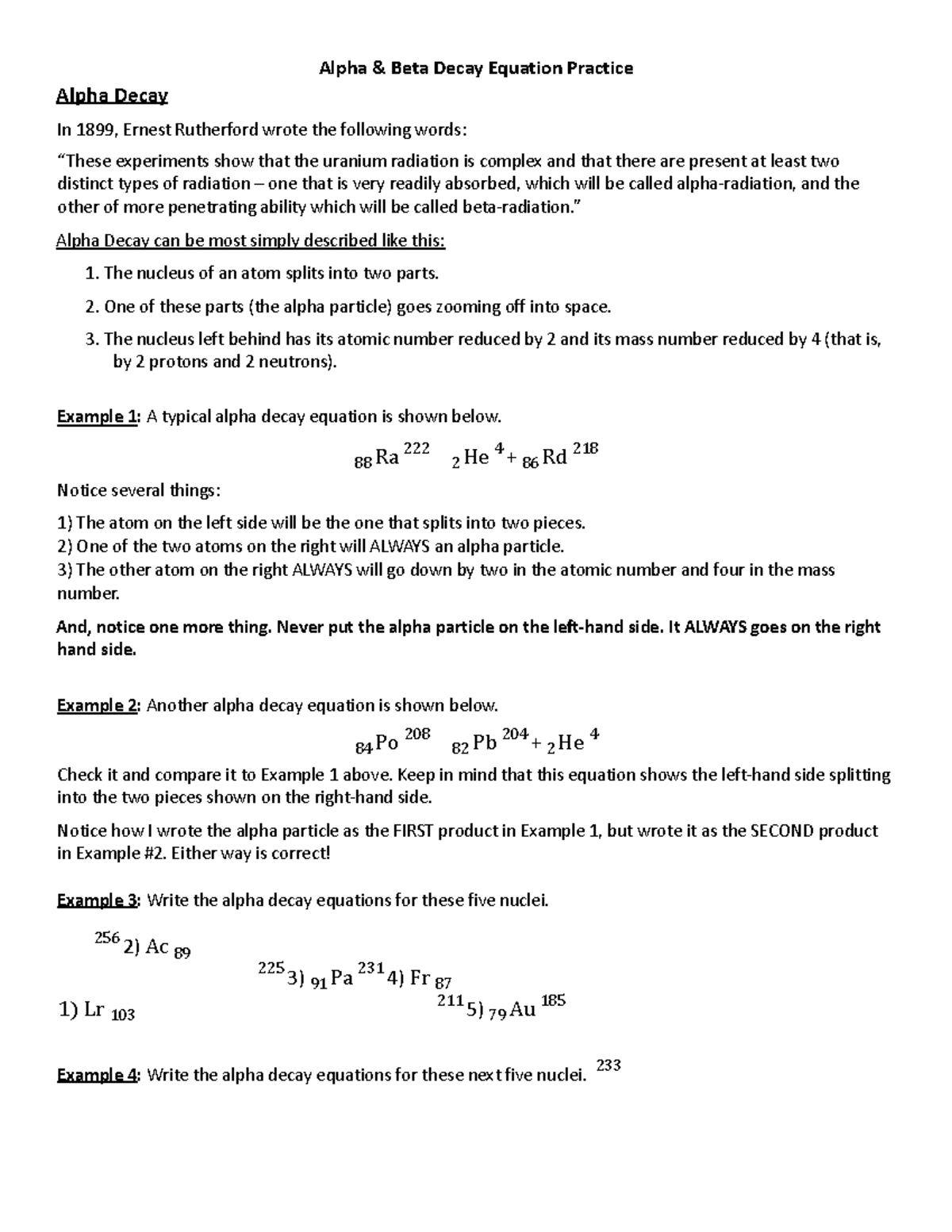
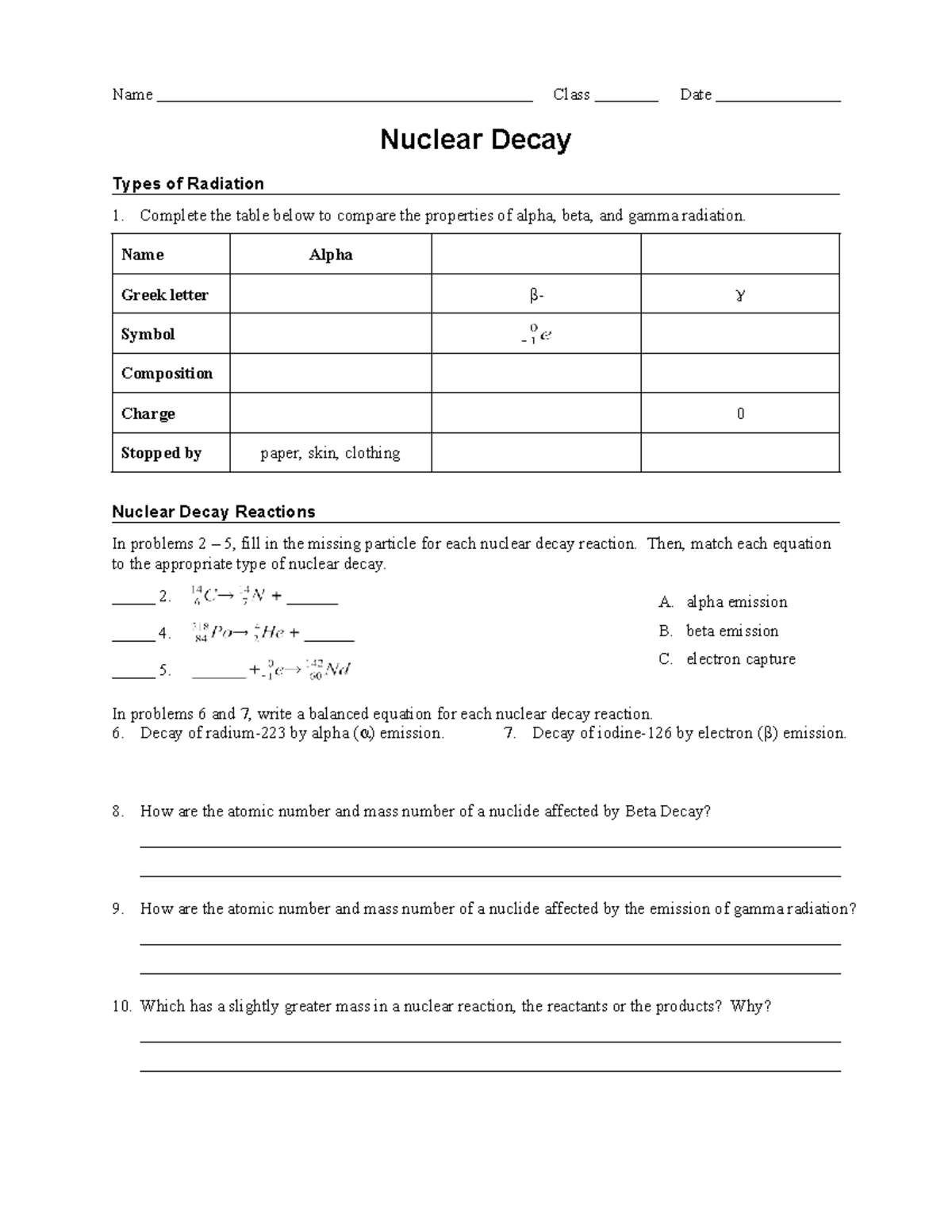
Alpha decay occurs when an unstable nucleus emits an alpha particle, which consists of two protons and two neutrons—identical to a helium nucleus ($^4_2\text{He}$). This process typically happens in heavy, neutron-rich nuclei that are attempting to achieve stability.
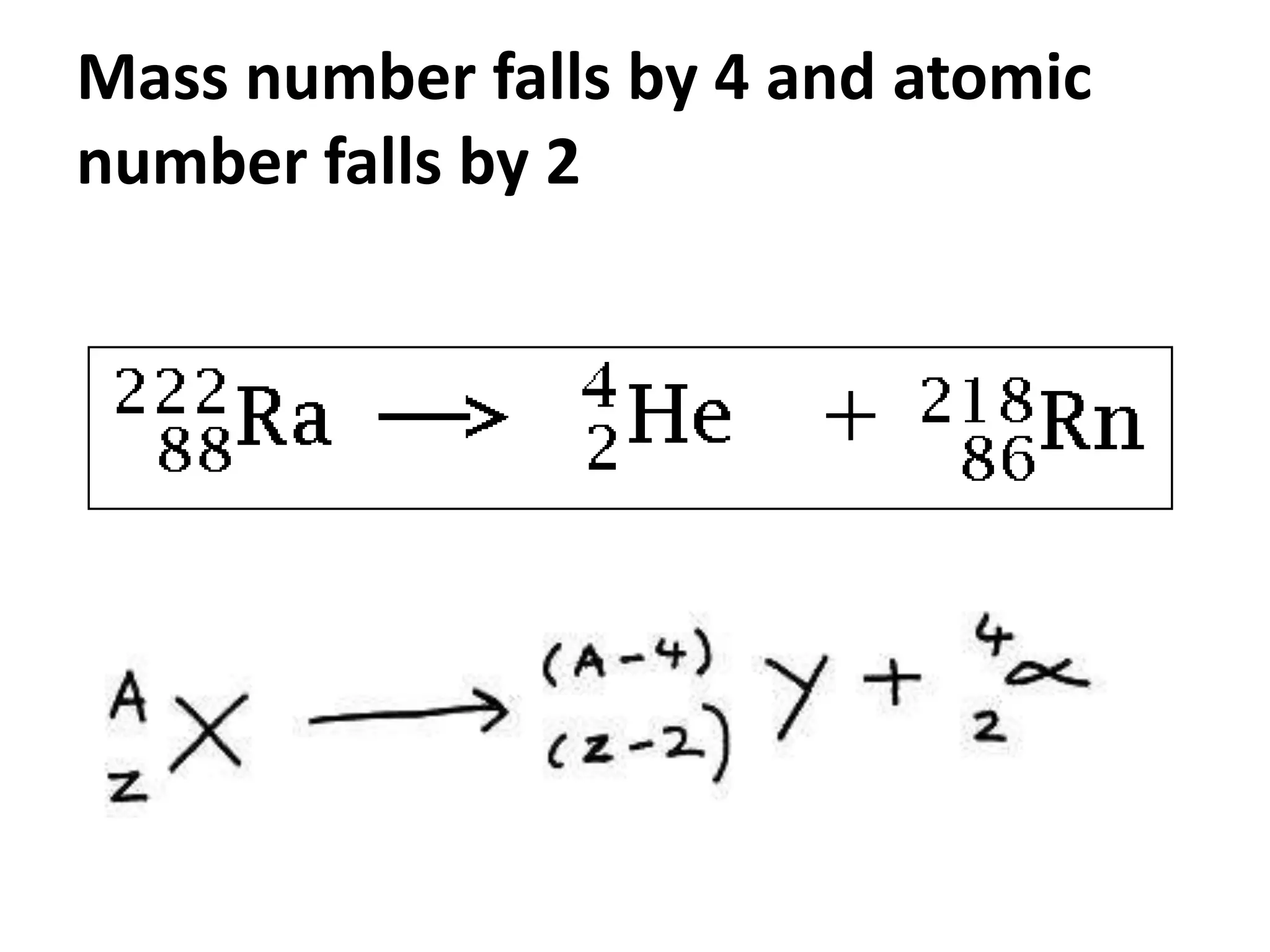
When a parent nucleus emits an alpha particle, the daughter nucleus has an atomic number reduced by 2 and a mass number reduced by 4.
The general equation for alpha decay is: $^A_Z X \rightarrow ^{A-4}_{Z-2} Y + ^4_2\text{He}$
For example, when Uranium-238 undergoes alpha decay to become Thorium-234: $^{238}{92}\text{U} \rightarrow ^{234}{90}\text{Th} + ^4_2\text{He}$
In this equation, note that $92 = 90 + 2$ and $238 = 234 + 4$. The conservation laws are satisfied, confirming the identity of the daughter product.
Beta Decay Equations
Beta decay is more complex than alpha decay because it involves the conversion of a subatomic particle within the nucleus. There are two primary forms: beta-minus ($\beta^-$) and beta-plus ($\beta^+$, also known as positron emission).
Beta-Minus Decay ($\beta^-$)
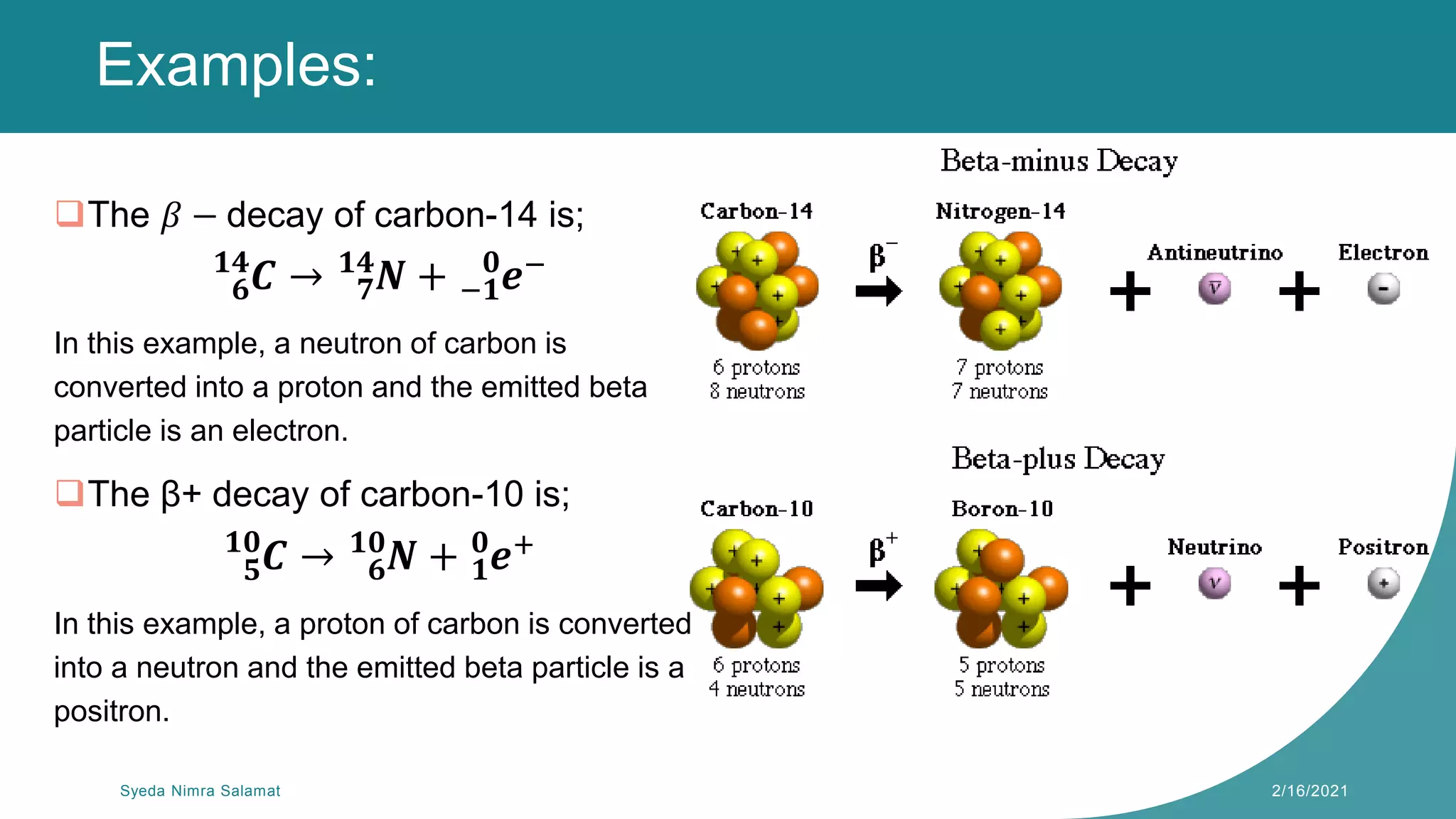
Beta-minus decay occurs when a neutron in the nucleus converts into a proton and an electron. The electron (the beta particle) is ejected from the nucleus. Consequently, the atomic number increases by 1, but the mass number remains unchanged.
The general equation is: $^A_Z X \rightarrow ^A_{Z+1} Y + ^0_{-1}e + \bar{\nu}_e$
In this notation, $^0_{-1}e$ represents the beta particle (electron), and $\bar{\nu}_e$ is an antineutrino, which carries away excess energy. An example is the decay of Carbon-14 into Nitrogen-14: $^{14}_6\text{C} \rightarrow ^{14}7\text{N} + ^0{-1}e + \bar{\nu}_e$
Beta-Plus Decay ($\beta^+$)
In beta-plus decay, a proton converts into a neutron, emitting a positron (a positively charged electron) and a neutrino. This results in the atomic number decreasing by 1.
The general equation is: $^A_Z X \rightarrow ^A_{Z-1} Y + ^0_{+1}e + \nu_e$
Gamma Decay Equations
Gamma decay is distinct because it does not change the number of protons or neutrons in the nucleus. Instead, it is a mechanism for an "excited" nucleus—often resulting from a previous alpha or beta decay—to shed excess energy. This energy is released as high-frequency electromagnetic radiation known as a gamma ray ($\gamma$).
The general equation is: $^A_Z X^* \rightarrow ^A_Z X + \gamma$
The asterisk ($^*$) indicates that the nucleus is in an excited state. Since the mass and atomic numbers do not change, the element remains the same; it simply transitions to a lower energy state.
Comparison of Decay Characteristics
| Decay Type | Emitted Particle | Change in Atomic Number ($Z$) | Change in Mass Number ($A$) |
|---|---|---|---|
| Alpha | Helium Nucleus ($^4_2\text{He}$) | Decreases by 2 | Decreases by 4 |
| Beta-minus | Electron ($^0_{-1}e$) | Increases by 1 | No change |
| Beta-plus | Positron ($^0_{+1}e$) | Decreases by 1 | No change |
| Gamma | Photon ($\gamma$) | No change | No change |
Practical Considerations and Safety
When analyzing these equations in laboratory or industrial settings, it is vital to account for the energy released (Q-value) and the half-life of the isotope. These equations describe the "what" of the decay, but they do not describe the "when." The rate at which these transformations occur is governed by the specific half-life of the radioisotope, which is the time required for half of the radioactive nuclei in a sample to decay.
Safety protocols for handling materials undergoing these decay processes depend heavily on the type of radiation:
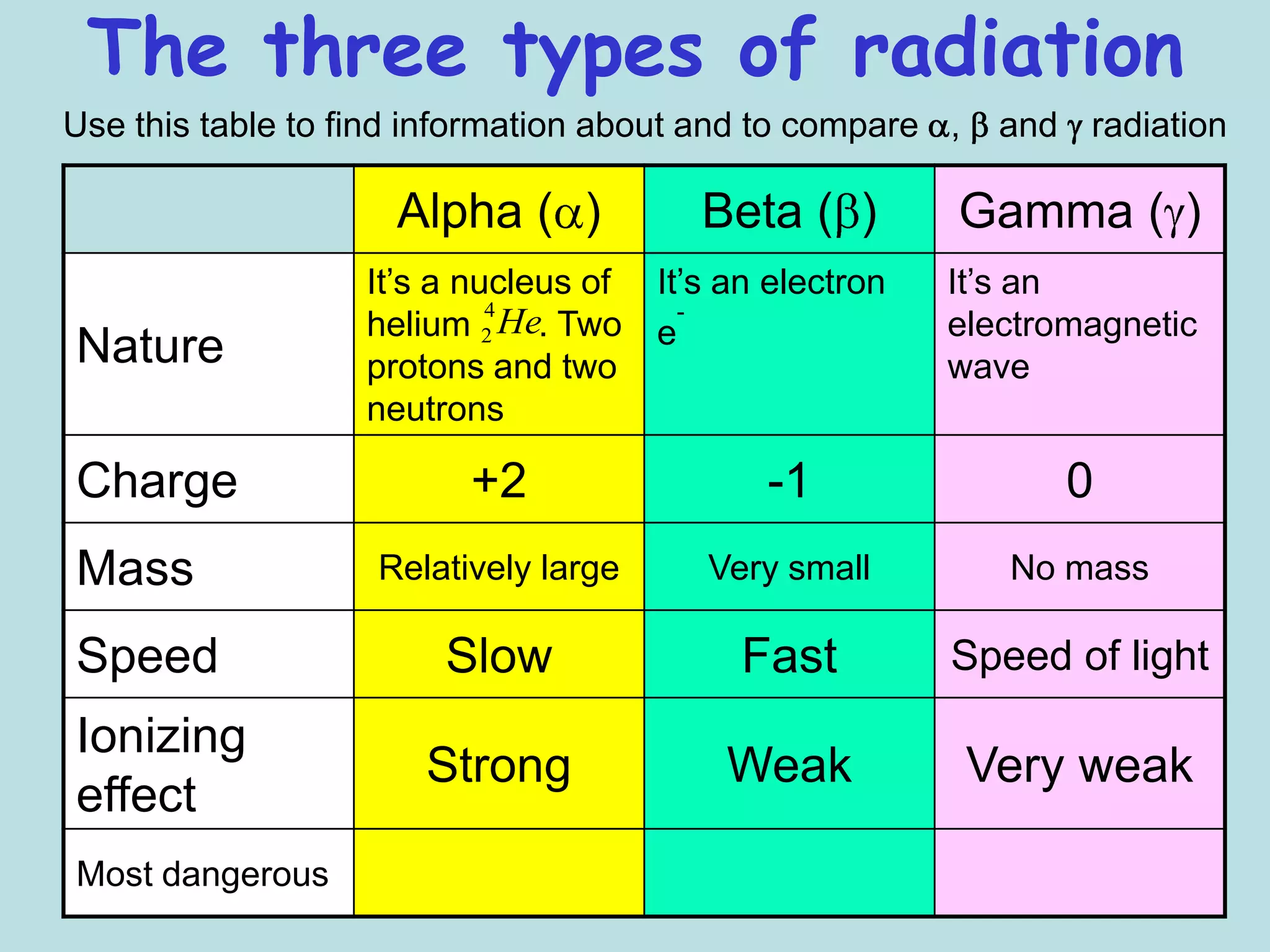
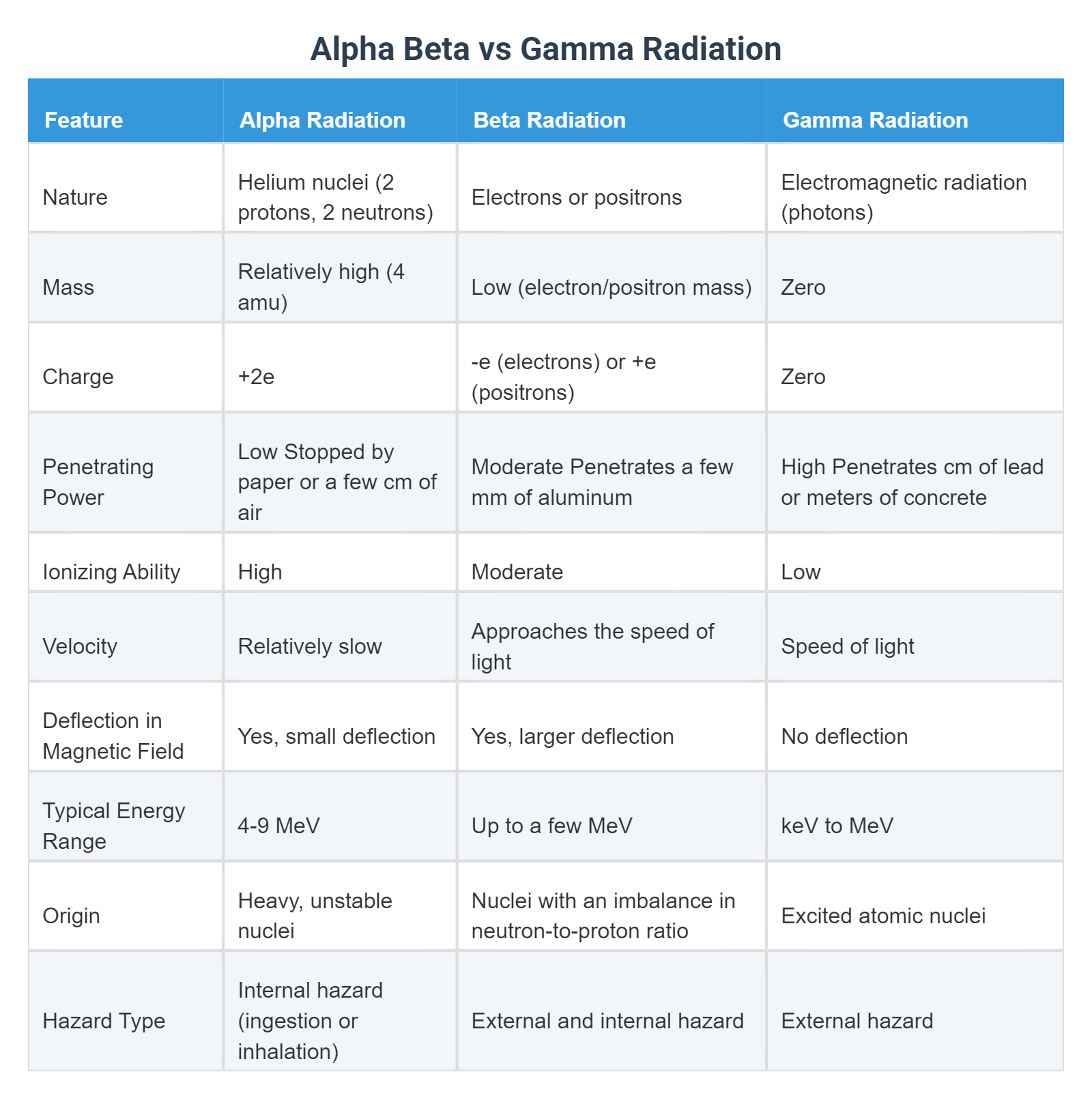
- Alpha particles have low penetration and are stopped by a sheet of paper or the outer layer of human skin; however, they are extremely hazardous if inhaled or ingested.
- Beta particles have moderate penetration and may require plastic or light metal shielding.
- Gamma rays have high penetration and require dense shielding, such as thick lead or concrete, to attenuate the radiation to safe levels.
Always consult professional safety guidelines and regulatory standards when working with radioactive sources. These processes are strictly governed by nuclear safety bodies to ensure the protection of personnel and the environment.
Frequently Asked Questions
Why does the mass number remain unchanged during beta decay? The mass number stays the same because beta decay involves the transformation of a neutron into a proton (or vice versa). Since the total number of nucleons (protons + neutrons) remains constant, the mass number does not change.
What is the role of neutrinos in beta decay equations? Neutrinos and antineutrinos are essential for conserving angular momentum and energy in the decay process. They are near-massless, neutral particles that escape the nucleus alongside the beta particle.
Can an atom undergo multiple types of decay? Yes. Some isotopes decay into a daughter nucleus that is itself unstable. This creates a "decay chain," where a parent isotope transitions through various states (e.g., alpha followed by beta) until reaching a stable, non-radioactive isotope, often lead.
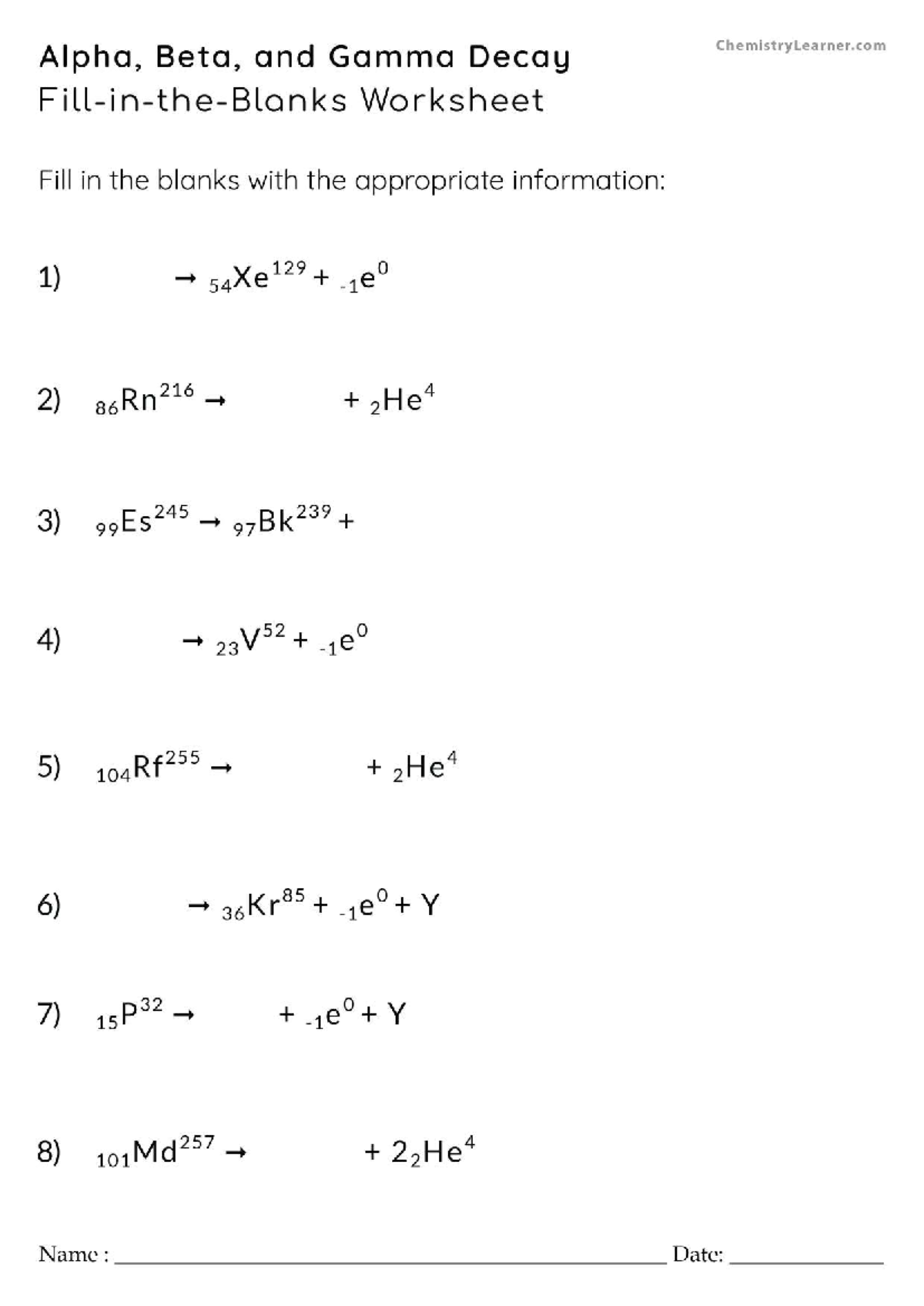
How do I balance a nuclear equation if I am missing the daughter product? To balance the equation, ensure that the sum of the atomic numbers on the left equals the sum on the right, and do the same for the mass numbers. The difference between these totals will define the missing element's $A$ and $Z$ values.
Next Steps for Students and Researchers
To master these equations, practice identifying the type of decay based on the change in $Z$ and $A$ values. If you are preparing for coursework or research, utilize standard periodic tables to verify atomic numbers and look up specific isotope properties in the Nuclear Data Sheets or official databases managed by the International Atomic Energy Agency (IAEA).
Image Gallery