Demystifying the ICD-10 Code for Benign Hypertension: Clinical Documentation, Coding Guidelines, and Specificity
The official medical billing and classification system uses code category I10 to represent essential primary hypertension, which encompasses historical terms like benign hypertension. Medical coders and healthcare providers must map cl...
The official medical billing and classification system uses code category I10 to represent essential primary hypertension, which encompasses historical terms like benign hypertension. Medical coders and healthcare providers must map clinical documentation to current classification standards to ensure accurate reimbursement, support epidemiological tracking, and maintain compliance.
Contents
Understanding the Evolution of "Benign Hypertension" in Modern Coding
In historical clinical documentation and older editions of the International Classification of Diseases, the term "benign hypertension" was widely used to describe sustained high blood pressure that did not present with rapid, malignant acceleration or immediate, catastrophic end-organ damage. However, modern clinical cardiology and healthcare policy have largely moved away from the word "benign" because elevated blood pressure is inherently a major risk factor for cardiovascular disease, renal failure, and cerebrovascular accidents.
When searching for an icd 10 code for benign hypertension, practitioners often discover that the ICD-10-CM classification system does not maintain a direct, isolated code utilizing the exact modifier "benign." Instead, official coding guidelines aggregate these clinical presentations under the broader category of essential (primary) hypertension. Recognizing how legacy terminology translates into contemporary billing frameworks prevents claim rejections and ensures patient health records reflect accurate physiological risk profiles.
The Primary ICD-10 Code for Essential Hypertension
The definitive code corresponding to essential hypertension, which covers cases formerly diagnosed as benign or primary hypertension, is I10.
| ICD-10 Code | Clinical Description |
|---|---|
| I10 | Essential (primary) hypertension |
Scope and Inclusion Criteria for Code I10
Code I10 applies to high blood pressure specified as primary, systemic, or idiopathic. When a physician documents primary hypertension, systemic arterial hypertension, or benign essential hypertension without mentioning secondary causes or malignant features, the record maps directly to code I10.
Conditions Excluded from Code I10
Medical coders must exercise caution to distinguish simple essential hypertension from secondary hypertension or cases involving hypertensive heart or chronic kidney disease. The following conditions require different code assignments:
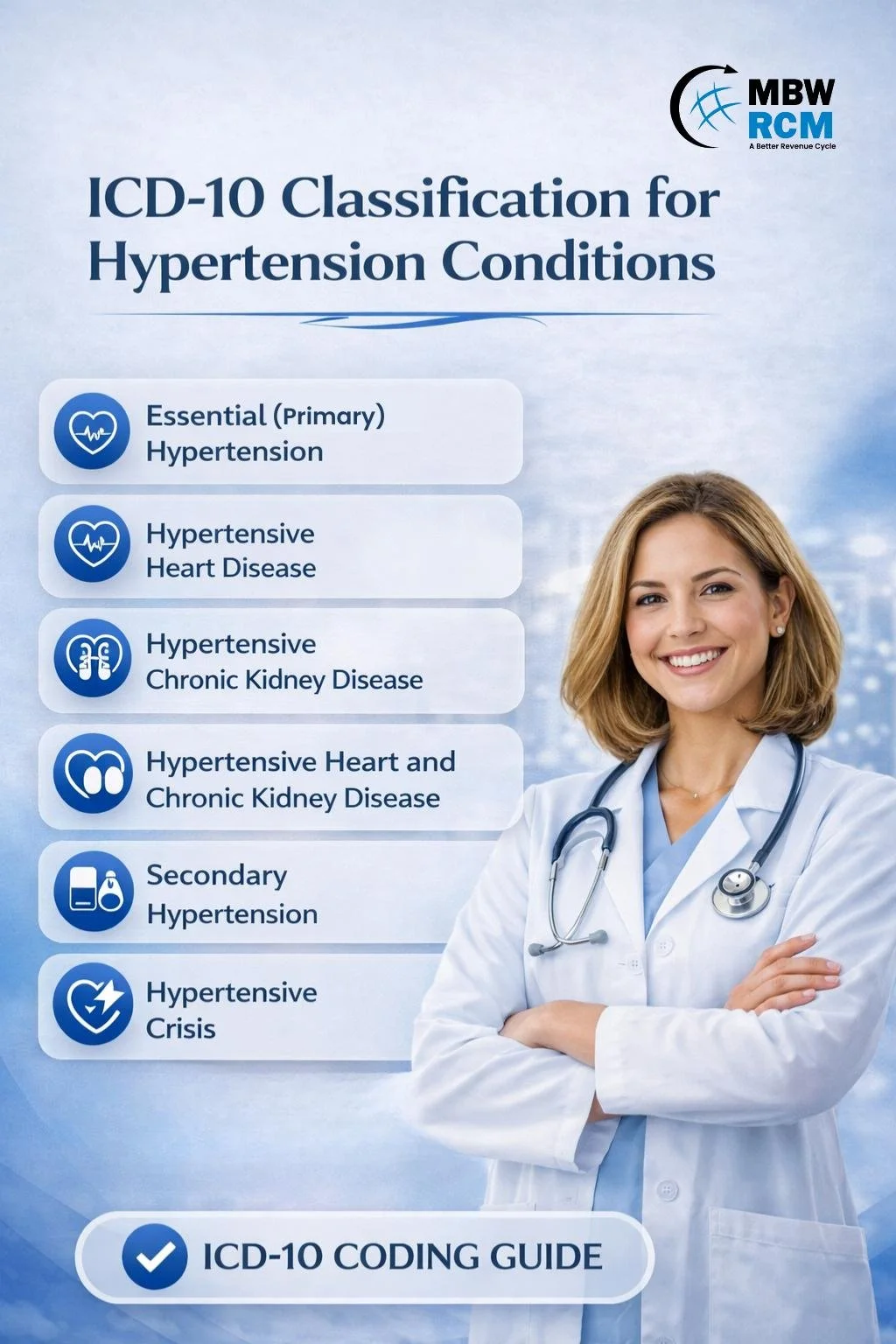
- Hypertensive heart disease (codes in category I11)
- Hypertensive chronic kidney disease (codes in category I12)
- Hypertensive heart and chronic kidney disease (codes in category I13)
- Secondary hypertension (codes in category I15), which results from an underlying identifiable pathology such as renal artery stenosis or endocrine disorders.
Clinical Documentation Requirements for Accurate Coding
Accurate medical coding depends entirely on the clarity and thoroughness of physician documentation in the electronic health record (EHR). Merely noting a history of high blood pressure is insufficient for capturing the complete clinical picture under modern documentation standards.
Essential Data Points Required in the Chart
To support code assignment and justify medical necessity, documentation should consistently capture:
- Blood Pressure Readings: Specific systolic and diastolic measurements recorded during the encounter.
- Chronicity: Whether the condition is newly diagnosed or an established, chronic diagnosis.
- Treatment Plan: Active pharmacological interventions, lifestyle modifications, and dietary restrictions.
- Comorbidities: Documentation of related conditions such as diabetes mellitus, hyperlipidemia, or stable coronary artery disease.
Failing to document these parameters can lead to lower specificity, missed hierarchical condition category (HCC) risk adjustments, and potential challenges during retrospective medical record audits by insurance payers.
Coding Guidelines and Sequencing Best Practices
Applying hypertension codes correctly requires adherence to official ICD-10-CM coding guidelines, particularly regarding sequencing and combination coding.
The Causal Relationship Rule
A critical guideline in ICD-10-CM dictates that heart conditions classified as hypertensive (categories I11, I13, and I15) are presumed to be related to hypertension unless the physician explicitly documents a different cause. Coders do not need an explicit statement linking the hypertension to the heart condition if the provider notes both diagnoses in a patient with a known history of high blood pressure.
Sequencing for Hypertensive Disease with Heart or Kidney Involvement
When coding for hypertensive heart disease or hypertensive chronic kidney disease, the coder must use the appropriate combination code from categories I11, I12, or I13 rather than reporting code I10 alongside a separate cardiac or renal code. Furthermore, if the patient also presents with chronic kidney disease alongside hypertensive heart disease, code category I13 must be deployed, followed by the appropriate secondary code from category N18 to specify the exact stage of the chronic kidney disease.
Comparison of Hypertensive ICD-10 Categories
To navigate billing selections effectively, healthcare administrative staff frequently reference structured comparisons of related hypertensive codes.
| Category | Clinical Focus | Required Additional Codes | Primary Use Case |
|---|---|---|---|
| I10 | Essential (primary) hypertension | None (excludes heart/kidney involvement) | Routine essential or legacy benign hypertension |
| I11 | Hypertensive heart disease | Use additional code for heart failure (if present) | Hypertension with cardiac enlargement or failure |
| I12 | Hypertensive chronic kidney disease | Must code stage of CKD (N18.1–N18.9) | Hypertension causing renal impairment |
| I13 | Hypertensive heart and chronic kidney disease | Must code heart failure and CKD stage | Combined cardiac and renal hypertensive disease |
Frequently Asked Questions
Is there a specific ICD-10 code for benign hypertension?
No. The ICD-10-CM classification system does not have a distinct code labeled "benign hypertension." Legacy documentation utilizing this term is coded under I10 for essential (primary) hypertension, provided there is no malignant acceleration or documented end-organ damage.
Can I code I10 if the patient has hypertension caused by another medical condition?
No. Code I10 is strictly reserved for essential or primary hypertension. If the hypertension is secondary to another condition, such as renal artery stenosis, the coder must assign a code from category I15 (Secondary hypertension) and code the underlying etiology first.
How do I code hypertension when it occurs alongside heart failure?
When a physician documents hypertensive heart disease with heart failure, you must select a code from category I11 (Hypertensive heart disease) and append an additional code from category I50 (Heart failure) to specify the exact type of heart failure.
Does code I10 cover elevated blood pressure readings without a formal diagnosis?
No. If a patient presents with elevated blood pressure readings but has not received a formal diagnosis of hypertension from the treating physician, coders should reference category R03.0 (Elevated blood pressure reading without diagnosis of hypertension) rather than coding active hypertension.
What should I do if the medical record is ambiguous regarding the type of hypertension?
Coders should query the attending physician for clarification. Accurate classification depends on distinguishing between essential, secondary, and complicated hypertensive presentations to ensure compliance and proper reimbursement.
Practical Next Steps for Clinical Documentation Improvement
Healthcare facilities and physician practices should establish regular training programs for clinical documentation improvement (CDI) specialists and billing teams. Ensuring that physicians record specific blood pressure parameters, associated organ involvement, and treatment efficacy minimizes claim denials and protects the integrity of institutional health data. Medical practices should audit their coding workflows periodically to verify that legacy terms like "benign hypertension" are systematically translated into accurate, contemporary code selections under I10 or its complicated counterparts.
Image Gallery