How to Get SR-22 Insurance in Washington State: A Complete 2026 Guide
To get SR-22 insurance in Washington State, you must contact an insurance provider authorized to do business in the state and request a "Financial Responsibility Certificate." The insurer will file this form electronically with the Was...
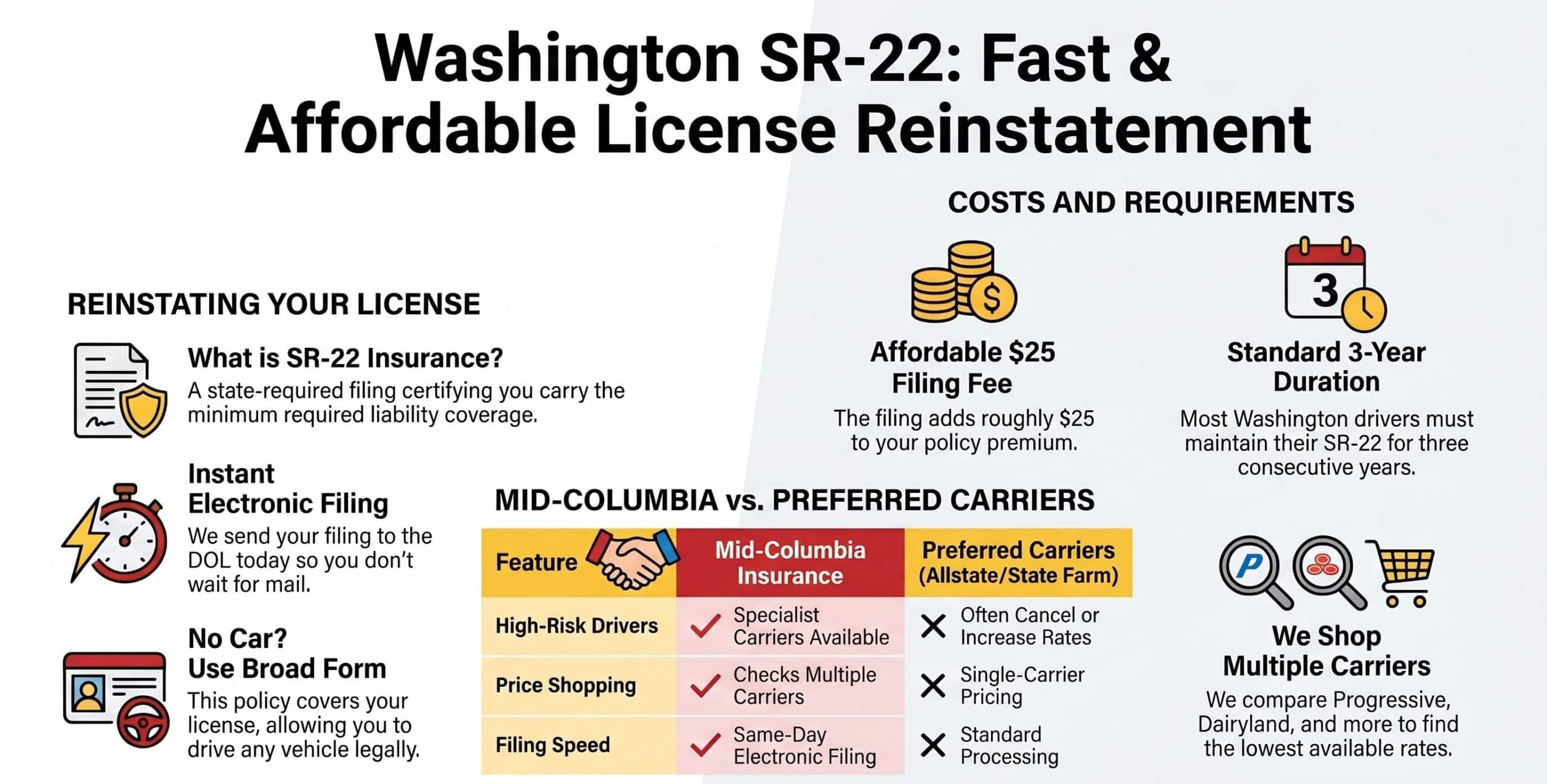
To get SR-22 insurance in Washington State, you must contact an insurance provider authorized to do business in the state and request a "Financial Responsibility Certificate." The insurer will file this form electronically with the Washington Department of Licensing (DOL). Once the DOL processes the filing, your driving privileges can be reinstated.
Contents
The term "SR-22 insurance" is technically a misnomer; an SR-22 is not an insurance policy but a certificate of financial responsibility attached to an existing auto insurance policy. In Washington, this certificate serves as a guarantee to the state that you are maintaining the mandatory minimum liability coverage. For drivers in 2026, navigating the requirements of the Washington Department of Licensing (DOL) requires a clear understanding of the legal triggers, the filing process, and the long-term financial implications of high-risk classification.
Understanding the SR-22 Requirement in Washington
In Washington State, the SR-22 is governed by the state’s Mandatory Auto Insurance and Financial Responsibility laws. When the DOL suspends or revokes a driver's license due to specific high-risk behaviors, they often require the driver to prove they have the financial means to cover damages in future accidents. This proof is the SR-22 form.
Once the requirement is triggered, you are legally obligated to carry this certificate for a continuous period—typically three years from the date you are eligible for reinstatement. If at any point during this period the policy is cancelled or lapses, the insurance company is legally required by RCW 46.29.500 to notify the DOL via an SR-26 cancellation form, which results in the immediate suspension of your driving privileges.
Primary Triggers for SR-22 Filings
Not every traffic violation leads to an SR-22 requirement. In 2026, the Washington DOL mandates these filings primarily for:
- DUI or Physical Control Convictions: Driving under the influence of alcohol or drugs.
- Reckless Driving: Especially if the charge was reduced from a DUI.
- Driving Without Insurance: Being involved in an accident while uninsured or receiving multiple citations for failing to provide proof of insurance.
- Habitual Traffic Offenders: Accumulating a specific number of moving violations within a set timeframe.
- Unsatisfied Judgments: Failing to pay for damages resulting from an accident where you were at fault.
Step-by-Step Guide to Obtaining an SR-22 in 2026
The process of securing an SR-22 is structured to ensure that only verified, state-admitted insurers provide the certification. Follow these steps to ensure your filing is handled correctly.
1. Verify Your Reinstatement Requirements
Before shopping for insurance, check your status with the Washington Department of Licensing. Use the "License eXpress" portal to view your driving record. This will confirm the exact date your suspension ends and whether an SR-22 is the only requirement remaining for reinstatement. You may also owe reinstatement fees, which are separate from insurance costs.
2. Identify an Authorized Insurance Carrier
Not all insurance companies provide SR-22 filings. Some "preferred" carriers may decline to cover drivers with high-risk profiles or may cancel your existing policy if you require an SR-22. You must find a "non-standard" or high-risk insurance provider authorized to operate in Washington. When contacting agents, explicitly state that you need a "Washington SR-22 filing."
3. Select the Minimum Liability Coverage
To satisfy the SR-22 requirement in 2026, your policy must meet or exceed Washington’s mandatory minimum liability limits:
- $25,000 for bodily injury or death of one person in any one accident.
- $50,000 for bodily injury or death of any two or more persons in any one accident.
- $10,000 for injury to or destruction of property of others in any one accident.
While these are the minimums, agents often recommend higher limits to protect your personal assets, though this will increase the premium.
4. Pay the Filing Fee and Premium
Most insurers charge a one-time filing fee, usually ranging from $15 to $50, to process the SR-22. However, the primary cost increase comes from the premium itself. Because you are now classified as a high-risk driver, your base rate may increase by 40% to 100% compared to a standard policy.
5. Confirmation of Filing
Ensure the insurer files the form electronically. While paper filings were common in previous decades, the Washington DOL in 2026 prioritizes electronic data interchange (EDI) for faster processing. Once the DOL receives the filing, it usually takes 24 to 72 business hours to update your driving record.
Non-Owner SR-22 Insurance: Solutions for Drivers Without Cars
If you do not own a vehicle but need to reinstate your license, you must purchase a Non-Owner SR-22 policy. This is a common scenario for individuals whose vehicles were impounded, sold, or totaled during the incident that led to the suspension.
A non-owner policy provides liability coverage when you drive a vehicle owned by someone else (as long as it is not a vehicle you use regularly or one owned by a household member). This policy is generally more affordable than a standard owner's policy because it does not include comprehensive or collision coverage for a specific vehicle. It satisfies the DOL requirement because it ensures that you are covered regardless of whose car you are operating.
| Feature | Standard SR-22 Policy | Non-Owner SR-22 Policy |
|---|---|---|
| Vehicle Ownership | Required (policy tied to a specific VIN) | Not Required (covers the driver) |
| Average Cost | High (includes vehicle physical damage) | Lower (liability only) |
| Coverage Scope | Covered vehicle + permissive use | Secondary liability on non-owned cars |
| DOL Compliance | Yes | Yes |
| Household Vehicles | Usually covered | Usually excluded |
The Financial Impact: Costs and Considerations
In 2026, the financial burden of an SR-22 in Washington is twofold: the administrative cost and the risk-based premium hike.
Filing Fees vs. Premiums
The filing fee itself is the smallest part of the expense. The significant cost is the "risk surcharge." Insurance companies use actuarial data to determine that drivers requiring an SR-22 are statistically more likely to file a claim. Consequently, you lose "good driver" discounts and are moved into a higher-priced tier.
Factors Influencing Your Rate
- The Nature of the Violation: A DUI generally results in a higher premium increase than a lapse in insurance coverage.
- Location: Drivers in high-traffic areas like Seattle, Tacoma, or Spokane may pay more than those in rural Eastern Washington.
- Credit History: Washington law allows insurers to use credit-based insurance scores in certain calculations, though its impact on high-risk policies is often secondary to the driving record itself.
Maintaining Compliance to Avoid Further Suspensions
The most critical aspect of having an SR-22 is continuous coverage. In Washington, if your policy expires—even for a single day—your insurance company is legally bound to notify the DOL.
The SR-26 Form
When an insurer sends an SR-26 to the DOL, your license is typically suspended immediately. To fix this, you often have to start your three-year filing period all over again. If you were two years and eleven months into your requirement and let your policy lapse, the "clock" may reset, requiring another full three years of filing.
Renewal Strategies
To prevent accidental lapses, it is highly recommended to:
- Set up Autopay: Ensure the premium is deducted automatically.
- Renew Early: Renew your policy at least 15 days before the expiration date.
- Monitor Your Mail: Insurance companies must send a notice of intent to cancel; do not ignore these communications.
Reinstating Your License with the DOL
Filing the SR-22 is only one part of getting back on the road. After the DOL receives your certificate, you must complete the following:
- Pay Reinstatement Fees: These fees vary depending on the reason for suspension (e.g., DUI reinstatement fees are higher than those for general suspensions).
- Resolve Other Issues: Ensure there are no outstanding tickets, child support holds, or other legal encumbrances on your license.
- Application for Reissuance: In some cases, you may need to apply for a new physical license if yours has expired or been revoked for a long duration.
Frequently Asked Questions
How long do I need to keep an SR-22 in Washington?
Most drivers are required to maintain an SR-22 for three consecutive years. However, for certain serious offenses or multiple violations, the court or the DOL may extend this period. It is vital to check your specific "Requirements to Reinstate" letter from the DOL to confirm your timeline.
Can I change insurance companies while I have an SR-22?
Yes, you can switch providers, but you must ensure there is no gap in coverage. The new insurer must file their SR-22 certificate before the old insurer files the SR-26 cancellation form. It is best to have the new policy active and the filing confirmed by the DOL before cancelling your previous coverage.
Does an SR-22 cover my vehicle for damages?
No, the SR-22 itself is just a filing of liability insurance. It only covers damages or injuries you cause to others. To cover your own vehicle, you must add comprehensive and collision coverage to your policy, which will further increase your monthly premium.
What happens if I move out of Washington?
If you move to another state, you must still fulfill your Washington SR-22 requirement to keep your driving privileges valid nationally. You will need to find an insurance company in your new state that can file an out-of-state SR-22 with the Washington DOL. Failure to do so will result in a suspension that will likely be honored by your new state via the Driver License Compact.
Can I use an SR-22 from another state in Washington?
If you are moving to Washington and have an active SR-22 requirement from another state, you must maintain that filing. However, if the Washington DOL requires the filing for a Washington-based incident, the filing must be made by a company authorized to write insurance specifically in Washington.
Final Recommendation for Washington Drivers
If you are required to obtain an SR-22 in 2026, the most effective strategy is to compare quotes from high-risk specialists rather than standard carriers. Because the SR-22 filing makes you a "hard-to-place" risk, shopping around can save you thousands of dollars over the three-year mandatory period. Once your policy is active, prioritize timely payments above all else; a single day of lapsed coverage can reset your legal requirements and lead to further legal complications with the Washington Department of Licensing.
Image Gallery