The Symbol for Rational Numbers: Origins, Usage, and Mathematical Significance
In mathematics, the symbol for the set of all rational numbers is $\mathbb{Q}$, typically rendered in blackboard bold typeface. This notation derives from the Italian word quoziente, meaning "quotient," which signifies that any rationa...
In mathematics, the symbol for the set of all rational numbers is $\mathbb{Q}$, typically rendered in blackboard bold typeface. This notation derives from the Italian word quoziente, meaning "quotient," which signifies that any rational number can be expressed as the ratio or quotient of two integers where the divisor is not zero.
Contents
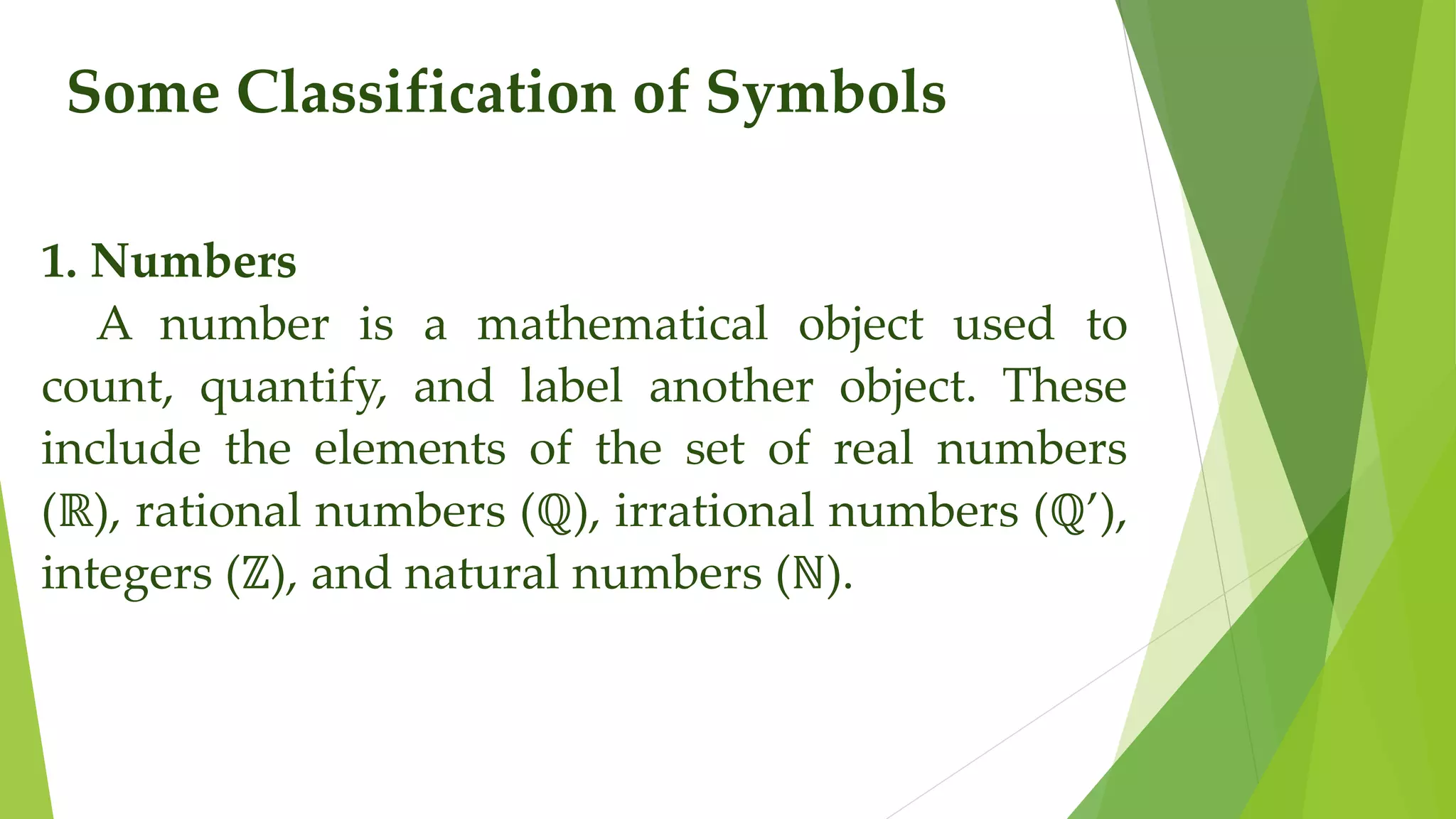
The classification of numbers is a cornerstone of modern mathematics, providing the framework upon which algebra, calculus, and number theory are built. Among these classifications, the set of rational numbers—represented by the symbol $\mathbb{Q}$—occupies a vital middle ground between the simpler integers ($\mathbb{Z}$) and the more complex real numbers ($\mathbb{R}$). As of 2026, understanding this notation remains essential for students, computer scientists, and engineers who rely on precise numerical definitions for algorithmic stability and theoretical proofs.
The Definition of the Set $\mathbb{Q}$
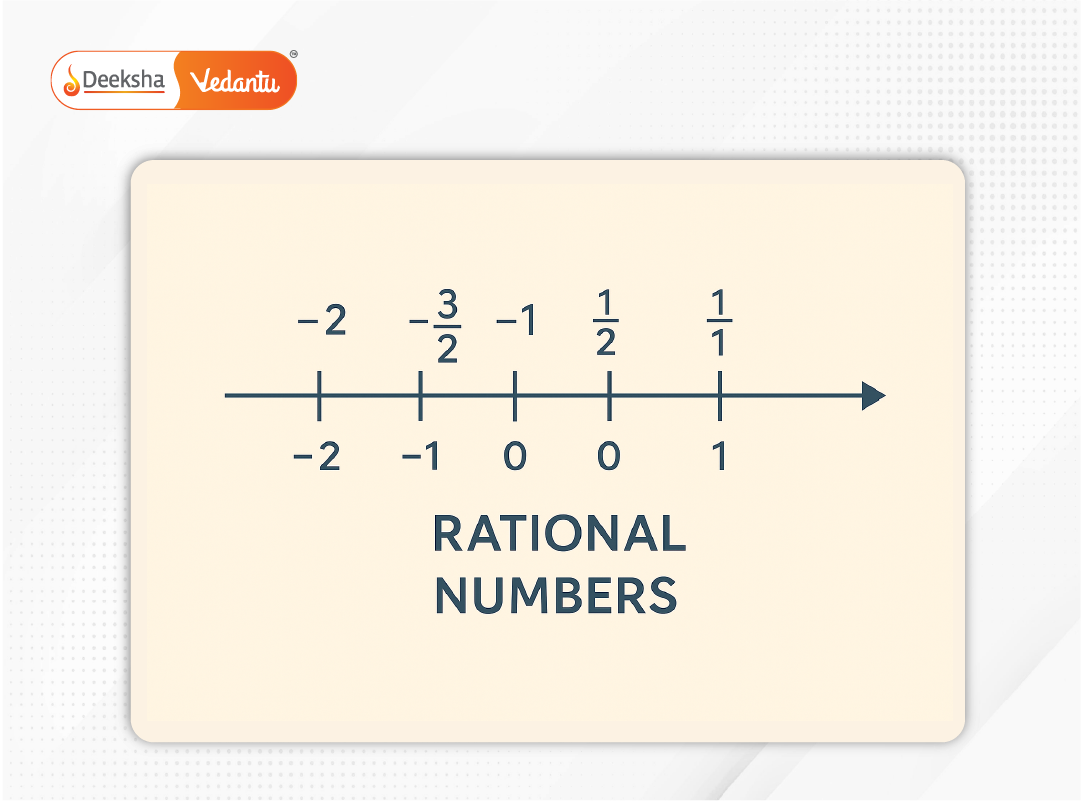
To understand the symbol, one must first understand the set it represents. Formally, a rational number is defined as any number that can be expressed in the form $p/q$, where $p$ and $q$ are integers, and $q$ is not equal to zero ($q \neq 0$). The symbol $\mathbb{Q}$ encompasses all such numbers, including positive and negative fractions, terminating decimals, and repeating decimals.
The formal set-builder notation for rational numbers is: $$\mathbb{Q} = \left{ \frac{p}{q} : p \in \mathbb{Z}, q \in \mathbb{Z}, q \neq 0 \right}$$
In this definition, $p$ is the numerator and $q$ is the denominator. Because any integer $n$ can be written as $n/1$, the set of integers ($\mathbb{Z}$) is a proper subset of the rational numbers ($\mathbb{Q}$). This hierarchy is fundamental to the structure of the number system, ensuring that operations performed within the set of rationals—such as addition, subtraction, multiplication, and division (except by zero)—always result in another rational number. This property is known as closure.
The Etymology and History of the Symbol $\mathbb{Q}$
The choice of the letter "Q" is not arbitrary, nor does it originate from the English word "quotient," although the English term shares the same Latin root. The symbol was first introduced by the Italian mathematician Giuseppe Peano in 1895. In his work Formulaire mathématique, Peano utilized "Q" to represent quoziente.
Before the standardization of $\mathbb{Q}$, mathematicians used various notations or simply wrote out the description of the set. The "blackboard bold" style ($\mathbb{Q}$) that we recognize today became prevalent in the mid-20th century. This specific typographic style originated from professors writing on chalkboards; to distinguish a set symbol from a standard variable, they would double the vertical lines of the letter. This practice was eventually codified by the Bourbaki group, a collective of mathematicians who sought to reform and standardize mathematical notation in the 20th century.
While $\mathbb{R}$ for real numbers and $\mathbb{N}$ for natural numbers are somewhat intuitive in English and French, the use of $\mathbb{Q}$ remains a specific historical marker of the Italian influence on foundational logic and set theory.
Comparative Hierarchy of Number Sets
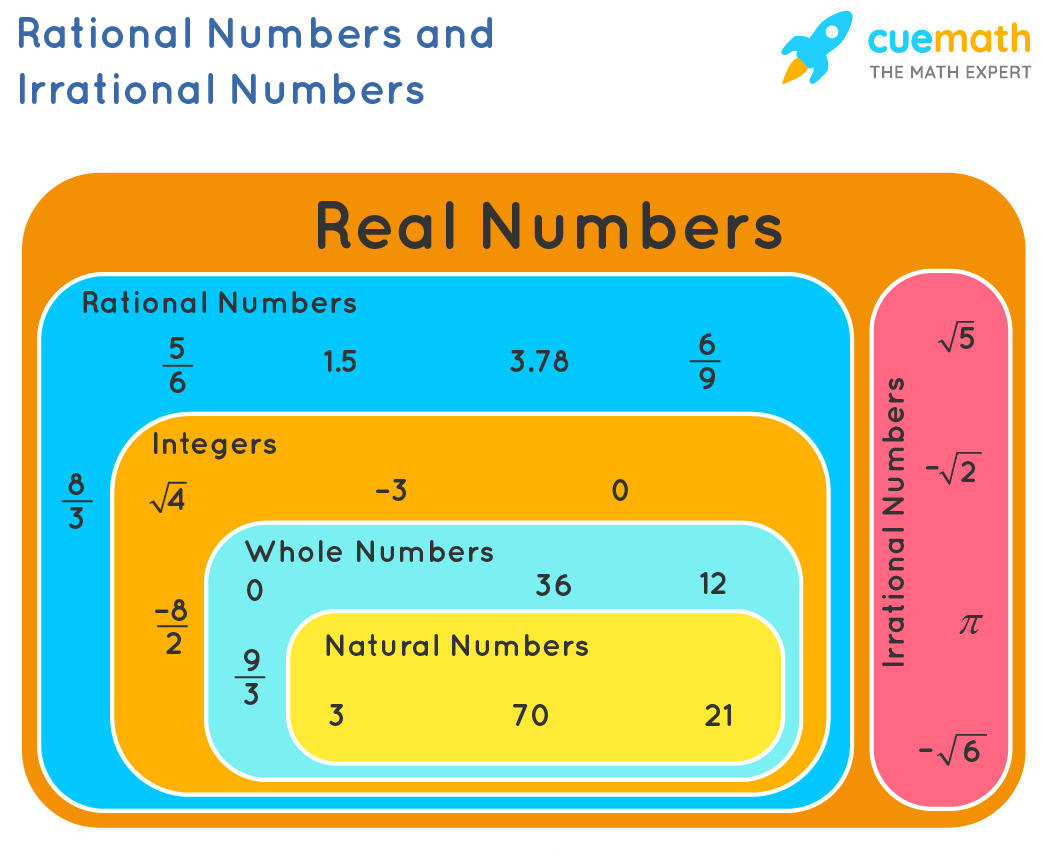
The symbol $\mathbb{Q}$ exists within a nested hierarchy of number systems. Understanding where $\mathbb{Q}$ sits in relation to other symbols is crucial for correctly identifying the domain of mathematical functions and equations.
| Symbol | Set Name | Description | Example Members |
|---|---|---|---|
| $\mathbb{N}$ | Natural Numbers | Counting numbers starting from 0 or 1. | 1, 2, 3, 45 |
| $\mathbb{Z}$ | Integers | Whole numbers, including negative and zero. | -5, 0, 42 |
| $\mathbb{Q}$ | Rational Numbers | Numbers expressible as a ratio of integers. | 1/2, -0.75, 4.333... |
| $\mathbb{R}$ | Real Numbers | All rational and irrational numbers. | $\pi$, $\sqrt{2}$, 1.5 |
| $\mathbb{C}$ | Complex Numbers | Numbers with real and imaginary parts. | $3 + 2i$, $i$ |
As seen in the table above, $\mathbb{Q}$ is a subset of $\mathbb{R}$, but it contains $\mathbb{Z}$ and $\mathbb{N}$. In mathematical notation, this relationship is expressed as: $$\mathbb{N} \subset \mathbb{Z} \subset \mathbb{Q} \subset \mathbb{R} \subset \mathbb{C}$$
Mathematical Properties of the Set $\mathbb{Q}$
The set $\mathbb{Q}$ possesses unique properties that distinguish it from the sets of integers and real numbers. These properties are essential for higher-level mathematics, including limits and continuity in calculus.
1. Countability (Denumerability)
Despite there being an infinite number of rational numbers, the set $\mathbb{Q}$ is "countable." This is a counterintuitive concept proven by Georg Cantor. It means that there is a one-to-one correspondence between the set of natural numbers ($\mathbb{N}$) and the set of rational numbers ($\mathbb{Q}$). In contrast, the set of real numbers ($\mathbb{R}$) is "uncountable," meaning it represents a "larger" infinity than $\mathbb{Q}$.
2. Density
The rational numbers are dense on the real line. This means that between any two distinct rational numbers, there is always another rational number. For example, between $1/2$ and $1/3$, you can find $5/12$. This property implies that rational numbers are packed infinitely close together, yet they still leave "gaps" where irrational numbers (like $\pi$ or $\sqrt{2}$) reside.
3. Field Properties
In abstract algebra, $(\mathbb{Q}, +, \times)$ is a field. This means it satisfies the axioms of commutativity, associativity, distributivity, and the existence of identities and inverses for both addition and multiplication (excluding division by zero). The fact that $\mathbb{Q}$ is the smallest field containing the integers makes it the "field of fractions" for $\mathbb{Z}$.
Representing the Symbol in Digital Systems
In 2026, mathematical communication is predominantly digital. Correctly rendering the symbol for rational numbers requires specific encoding or markup to ensure it appears as the double-struck $\mathbb{Q}$ rather than a standard italicized Q.
LaTeX and MathML
For academic papers and technical documentation, LaTeX is the standard. The command to produce the symbol is:
\mathbb{Q}
This requires the amsfonts or amssymb package. In environments using MathML, the variant is used to ensure accessibility for screen readers.
Unicode and HTML
In standard web text, Unicode provides a specific character for the rational number symbol.
- Unicode: U+211A
- HTML Entity:
ℚor&double-bar; - Appearance: ℚ
Programming Languages
In modern programming, particularly in languages supporting symbolic mathematics like Python (via SymPy) or Julia, the symbol is often used in REPL environments or within documentation strings to specify type constraints for variables that must be rational.
Common Misconceptions and Distinctions
A frequent point of confusion is the distinction between the rational number symbol $\mathbb{Q}$ and symbols for other sets that look similar or are related.
- $\mathbb{Q}$ vs. $\mathbb{P}$ or $\mathbb{I}$: There is no single universally accepted symbol for "Irrational Numbers." Often, they are represented as $\mathbb{R} \setminus \mathbb{Q}$ (Real numbers "minus" Rational numbers). Occasionally, $\mathbb{P}$ or $\mathbb{I}$ is used, but $\mathbb{Q}$ is the only one of the two that is globally standardized.
- The "Quotient" Confusion: Some learners assume $Q$ stands for "Quotient" in English. While linguistically related, it is important to remember the Italian origin (quoziente) to understand why the symbol persists across different languages and cultures.
- Repeating Decimals: A common mistake is thinking that a repeating decimal like $0.333...$ is irrational because it doesn't "end." However, because $0.333...$ can be written exactly as $1/3$, it is a member of $\mathbb{Q}$. Only non-terminating, non-repeating decimals fall outside of $\mathbb{Q}$.
Frequently Asked Questions
Why is the symbol for rational numbers a Q instead of an R?
The letter R was already reserved for the set of Real numbers ($\mathbb{R}$). To avoid ambiguity, Giuseppe Peano selected Q for quoziente (quotient). Using Q accurately describes the nature of the numbers in the set, which are all results of the division of two integers.
Is zero considered a part of the set $\mathbb{Q}$?
Yes, zero is a rational number. It can be expressed as $0/1$, $0/5$, or any fraction where the numerator is zero and the denominator is a non-zero integer. Therefore, $0 \in \mathbb{Q}$.
What does the symbol $\mathbb{Q}^*$ or $\mathbb{Q} \setminus {0}$ mean?
The notation $\mathbb{Q}^*$ (or sometimes $\mathbb{Q}_0$) typically refers to the set of rational numbers excluding zero. This is often used in contexts where division by the variable is required, as division by zero is undefined. Similarly, $\mathbb{Q}^+$ refers only to positive rational numbers.
How is $\mathbb{Q}$ used in computer science?
In computer science, "floating-point" numbers are often used to approximate rationals, but they have precision limits. The symbol $\mathbb{Q}$ is used when discussing Arbitrary-precision arithmetic or "rational data types," where the computer stores the numerator and denominator separately to maintain perfect precision without rounding errors.
Who standardized the "Blackboard Bold" version of the symbol?
The blackboard bold style was popularized by the Bourbaki group in the mid-20th century. Their series of textbooks, Éléments de mathématique, aimed to create a rigorous and unified framework for all mathematics, leading to the widespread adoption of symbols like $\mathbb{N, Z, Q, R,}$ and $\mathbb{C}$.
Practical Recommendation
When writing or studying mathematics, always use the blackboard bold $\mathbb{Q}$ to refer to the set of rational numbers. This prevents confusion with variables named $Q$, which might represent heat in physics or a generic set in logic. If you are producing digital content, ensure you use the Unicode character U+211A or LaTeX \mathbb{Q} to maintain professional standards and accessibility for automated tools and screen readers. For those advancing into higher mathematics, mastering the properties of $\mathbb{Q}$—specifically its density and countability—is an essential prerequisite for understanding the construction of the real number system.
Image Gallery