Solar Farm Land Requirements for Developers in 2026
To qualify for utility-scale solar development, land must typically offer at least 20 to 30 contiguous, flat acres with a slope of less than 5% and proximity to high-voltage transmission lines or substations. Developers prioritize site...
To qualify for utility-scale solar development, land must typically offer at least 20 to 30 contiguous, flat acres with a slope of less than 5% and proximity to high-voltage transmission lines or substations. Developers prioritize sites with minimal environmental encumbrances, favorable "General Industrial" or "Agricultural" zoning, and high solar irradiance to ensure project bankability.
Contents
The transition toward renewable energy has accelerated significantly through 2026, driven by aggressive decarbonization targets and the continued maturation of battery energy storage systems (BESS). For developers, identifying the right parcel of land is no longer just about finding an empty field; it is a complex exercise in balancing geography, electrical engineering, and regulatory compliance. As the "low-hanging fruit" of prime land is increasingly claimed, understanding the granular technical requirements for solar farm site selection is critical for project success.
Acreage and Configuration Standards
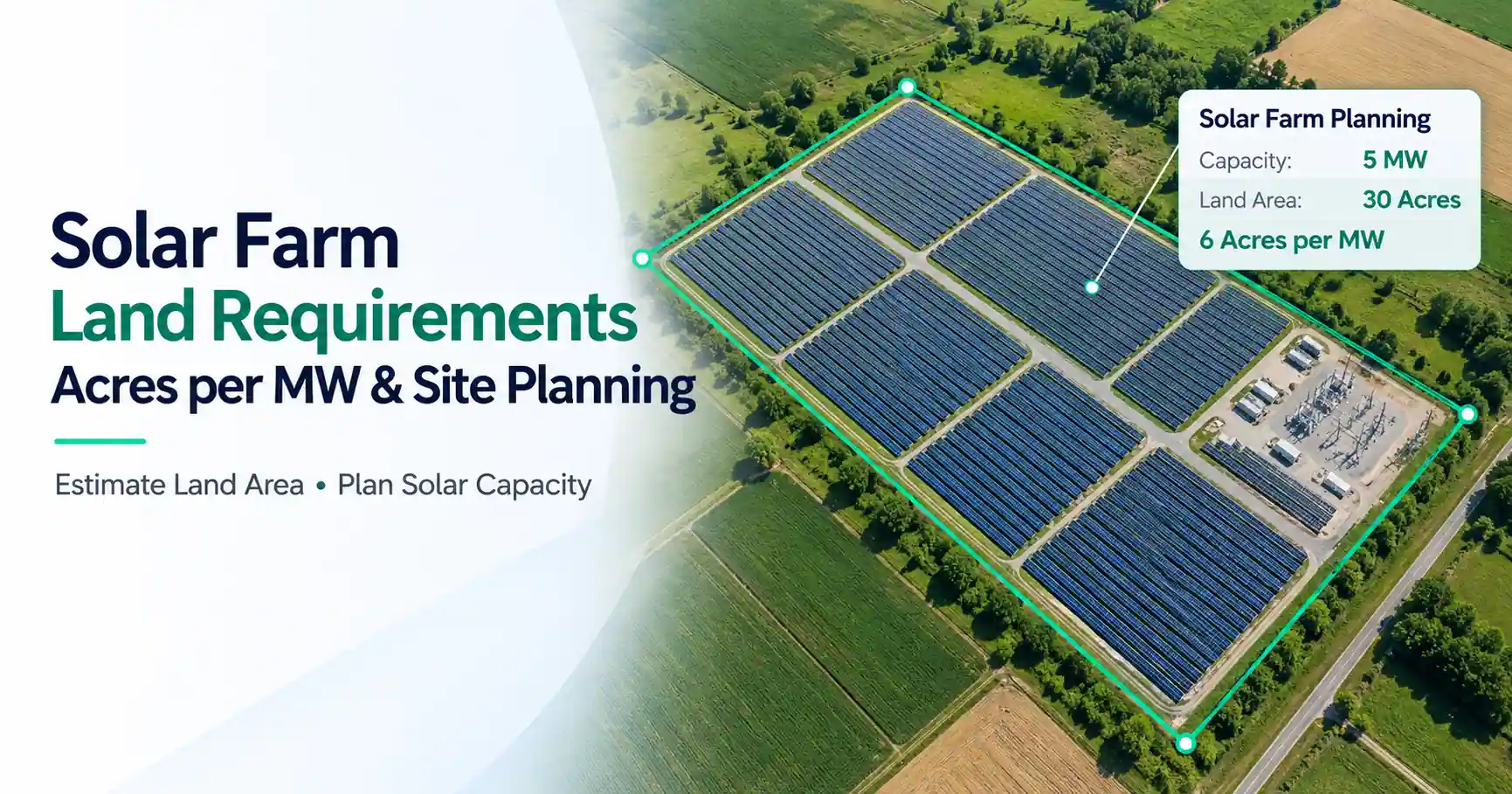
The primary requirement for any solar developer is sufficient space. While small-scale community solar projects might exist on as little as 5 acres, utility-scale developments typically demand significantly more. In 2026, the industry standard for land-to-power ratio remains approximately 5 to 8 acres per megawatt (MW) of installed capacity. This ratio accounts not only for the solar panels themselves but also for the spacing required to prevent inter-row shading, the installation of inverters, battery storage housing, and required setbacks from property lines.
Contiguity and Shape
A developer’s preference is always for a single, contiguous parcel. Fragmented land—parcels bisected by public roads, protected streams, or existing utility easements—increases the "balance of system" (BoS) costs. Every time a developer has to "jump" a road or a creek, they incur additional expenses for underground boring and specialized wiring. A rectangular or square shape is ideal because it allows for the most efficient layout of racking systems, minimizing wasted space and reducing the total length of expensive copper or aluminum cabling.
Buffers and Setbacks
Developers must account for local zoning ordinances that require setbacks. It is common for local jurisdictions to mandate that solar arrays be placed 50 to 100 feet away from property lines and even further from residential dwellings. When calculating the "usable acreage," a developer will often subtract 10% to 15% of the total parcel size to account for these buffers and internal access roads.
Topography and Geotechnical Suitability
The physical state of the land dictates the cost of construction. While modern tracking systems (which tilt panels to follow the sun) have become more adaptable to uneven terrain, there are strict limits to what is economically viable.
- Slope and Grade: Ideally, land should be flat or have a slope of less than 5%. Slopes exceeding 10% often require extensive "grading" (earthmoving), which is expensive and frequently triggers stricter environmental runoff regulations. South-facing slopes are a major bonus in the northern hemisphere, as they naturally increase the solar gain of the panels.
- Soil Composition: Developers perform geotechnical studies to determine if the soil can support the steel piles that hold the racking systems. Rocky soil may require pre-drilling, which adds significant cost. Conversely, very soft or "highly expansive" clay soils may require deeper, more expensive foundations.
- Hydrology and Flooding: Land located within a 100-year floodplain is generally avoided. If a developer chooses to build there, they must elevate sensitive electrical equipment (inverters and transformers) above the base flood elevation, which complicates engineering and increases insurance premiums.
Grid Connectivity and Interconnection Proximity
The most technically perfect piece of land is worthless for a solar farm if it cannot "plug in" to the electrical grid. Proximity to infrastructure is often the deciding factor in whether a project proceeds.
The Proximity Rule
As of 2026, the goal for most developers is to find land within two miles of a substation or an existing high-voltage transmission line (typically 69kV to 230kV). The cost of building a "gen-tie" line (the line connecting the solar farm to the grid) can exceed $1 million per mile. If the land is too far from an interconnection point, the infrastructure costs will quickly outweigh the revenue generated by power sales.
Capacity and the Interconnection Queue
Even if a substation is next door, it must have the "hosting capacity" to take the electricity the solar farm produces. Many regional grids are currently congested. Developers must submit an interconnection request to the regional transmission organization (RTO) or the local utility. This process involves a series of studies to determine if the existing grid needs upgrades—such as new circuit breakers or larger transformers—to handle the new load. In 2026, these studies and the subsequent upgrades are often the longest part of the development timeline, sometimes taking three to five years.
Zoning, Land Use, and Permitting
Securing "site control" (a lease or purchase agreement) is only the beginning. The land must be legally permitted for solar use. While some states have implemented "Solar-Ready" zoning, many projects still require a Conditional Use Permit (CUP) or a Special Use Permit (SUP).
Agricultural vs. Industrial Zoning
Much of the land suitable for solar is currently zoned for agriculture. Developers often face resistance regarding "loss of prime farmland." To mitigate this, many 2026 projects are incorporating agrivoltaics—the dual use of land for both solar power and agriculture, such as sheep grazing or shade-tolerant crop production. This approach helps satisfy local planning boards that are hesitant to see land taken out of production.
Local Ordinances and Public Perception
NIMBYism (Not In My Backyard) remains a significant hurdle. Developers look for land that is naturally screened from view by existing timber or topography. If the land is highly visible to neighbors, the developer may be required to plant expensive vegetative screening (hedgerows or trees) to mask the facility, which must be factored into the initial site assessment.
Environmental and Cultural Constraints
Modern developers use sophisticated GIS (Geographic Information Systems) mapping to identify "red flags" before even visiting a site. A parcel that appears perfect on Google Earth might be undevelopable due to hidden environmental constraints.
- Wetlands and Waters of the U.S.: The presence of wetlands significantly restricts development. Under the Clean Water Act, filling or disturbing wetlands requires federal permits from the U.S. Army Corps of Engineers, which are difficult and expensive to obtain.
- Endangered Species: Developers must conduct "Phase I" environmental site assessments. If the land is a habitat for a protected species (such as the Indiana Bat or certain migratory birds), construction may be restricted to specific months, or the project may be blocked entirely.
- Cultural Resources: Land with historical significance or known archaeological sites (such as indigenous burial grounds or colonial ruins) is generally off-limits. Most states require a cultural resource survey before a shovel hits the ground.
Comparison of Solar Land Suitability Metrics
| Feature | Ideal Specification | Marginal/Challenging | Project Deal-Breaker |
|---|---|---|---|
| Total Acreage | 50+ contiguous acres | 15–20 fragmented acres | <5 acres (for utility-scale) |
| Terrain Slope | 0% to 3% | 5% to 10% | >15% or North-facing |
| Grid Distance | Under 1 mile | 2 to 5 miles | >10 miles |
| Flood Zone | Outside 500-year plain | Within 100-year plain | Active wetlands/marsh |
| Zoning | Industrial or Solar Overlay | Agricultural/Rural | High-density Residential |
| Access | Paved public road access | Unpaved/Gravel easements | Landlocked / No legal access |
Financial Requirements: Solar Irradiance and Leasing
From a developer’s perspective, the "fuel" for the solar farm is the sun. This is measured as Global Horizontal Irradiance (GHI). While solar technology has improved to the point that projects are viable in less sunny regions (like the Pacific Northwest or the Northeast), the GHI of a site directly impacts the lease rate a developer can offer.
In 2026, land lease rates for solar farms generally range from $800 to $2,500 per acre per year, depending on the state’s incentives and the site’s proximity to high-priced energy markets. Developers typically look for 20-to-30-year lease terms with multiple five-year extension options. Landowners should be aware that developers will usually ask for an "option period" of 2 to 4 years to conduct due diligence and secure interconnection before the high-value "construction period" payments begin.
FAQs
How many acres do I need for a 1 MW solar farm?
In 2026, you generally need between 5 and 8 acres for 1 megawatt (MW) of solar capacity. While the panels themselves occupy less space, you must account for spacing to prevent shading, inverter pads, access roads, and required property setbacks. If the land is irregularly shaped or has steep slopes, the required acreage per MW will increase.
Does the land need to be perfectly flat?
No, but the flatter the land, the better. Most modern racking systems can handle a slope of up to 5% without significant earthmoving. If the slope is between 5% and 10%, costs increase significantly. Anything over 10% usually requires "grading," which can lead to soil erosion issues and higher permitting costs, making the project less attractive to developers.
What is the most important factor in land selection?
While acreage and slope are important, grid proximity is the most critical factor. Being three miles away from a substation versus one mile away can cost a developer an extra $2 million to $3 million in infrastructure. If the local substation is already at capacity, the project cannot proceed regardless of how perfect the land is.
Can solar farms be built on forested land?
Yes, but it is less common and more expensive. Clearing trees adds to the upfront capital expenditure and often triggers "compensatory mitigation" requirements, where the developer must pay to protect or plant trees elsewhere. In 2026, many local jurisdictions have also passed "forest conservation" ordinances that make it harder to clear-cut land for solar.
Is brownfield land better than greenfield land for solar?
Developers and the Environmental Protection Agency (EPA) often prefer "brownfields" (former industrial sites or landfills) because they are already disturbed and often have existing utility infrastructure. There are frequently federal and state tax incentives for building on these sites. However, the engineering for landfills is more complex because you cannot penetrate the "cap" of the landfill with traditional racking piles.
Next Steps for Landowners and Developers
For developers, the next step is a Preliminary Desktop Due Diligence report using GIS tools to overlay topography, wetlands, and transmission maps. This identifies fatal flaws before investing in a field visit.
For landowners interested in leasing their land, the first action should be to identify the nearest substation. If a substation is within three miles of your property, your land has significantly higher potential. You should gather your latest property survey and any existing utility easement documents to present to potential developers. It is highly recommended to consult with a land use attorney familiar with renewable energy leases to ensure that "decommissioning bonds" are included in any contract, ensuring the land is returned to its original state at the end of the project's life.
Image Gallery