The Game of Thrones Lineage Chart Explained: A Complete Guide to Westeros Bloodlines
The Game of Thrones lineage chart is a complex map of ancestral claims, secret parentage, and political alliances that determine who has the "right" to sit on the Iron Throne. At its core, the chart tracks the descendants of House Targ...
The Game of Thrones lineage chart is a complex map of ancestral claims, secret parentage, and political alliances that determine who has the "right" to sit on the Iron Throne. At its core, the chart tracks the descendants of House Targaryen, the usurping House Baratheon, and the ancient House Stark, revealing that power in Westeros is often a mix of blood inheritance and the strength of one's army.
Contents
Understanding the family trees in George R.R. Martin’s "A Song of Ice and Fire" and the subsequent HBO adaptations requires more than a passing glance at a list of names. In the world of Westeros, a single name—or a single lie about a father—can spark a continent-wide war. As of 2026, with the expansion of the franchise through various prequels, the lineage chart has become even more essential for fans trying to connect the dots between the era of dragons and the fall of the Night King.
The Foundation of Power: Why Lineage Dictates the Game
In Westeros, lineage is the primary currency of legitimacy. The political structure is built on feudalism, where land and titles are passed down through bloodlines, typically following the rule of agnatic-cognatic primogeniture. This means that the eldest male heir inherits first, followed by his brothers, then his daughters, and finally his uncles.
The struggle for the Iron Throne is essentially a series of legal and martial arguments over whose bloodline is "purest" or most senior. When Robert Baratheon took the throne by force, he didn't just rely on his hammer; he relied on the fact that his grandmother was Rhaelle Targaryen, giving him a distant but verifiable "blood claim" to justify his rule. The lineage chart is not just a family tree; it is a legal document used to justify reign or rebellion.
House Targaryen: The Blood of Old Valyria
The Targaryen lineage is the most storied and volatile in the series. Known for their silver-gold hair and violet eyes, they ruled Westeros for nearly 300 years after Aegon the Conqueror united the Seven Kingdoms. Their chart is characterized by centuries of internal marriage to keep their "dragonblood" pure, a practice that led to both greatness and madness.
The Successors of the Dragon
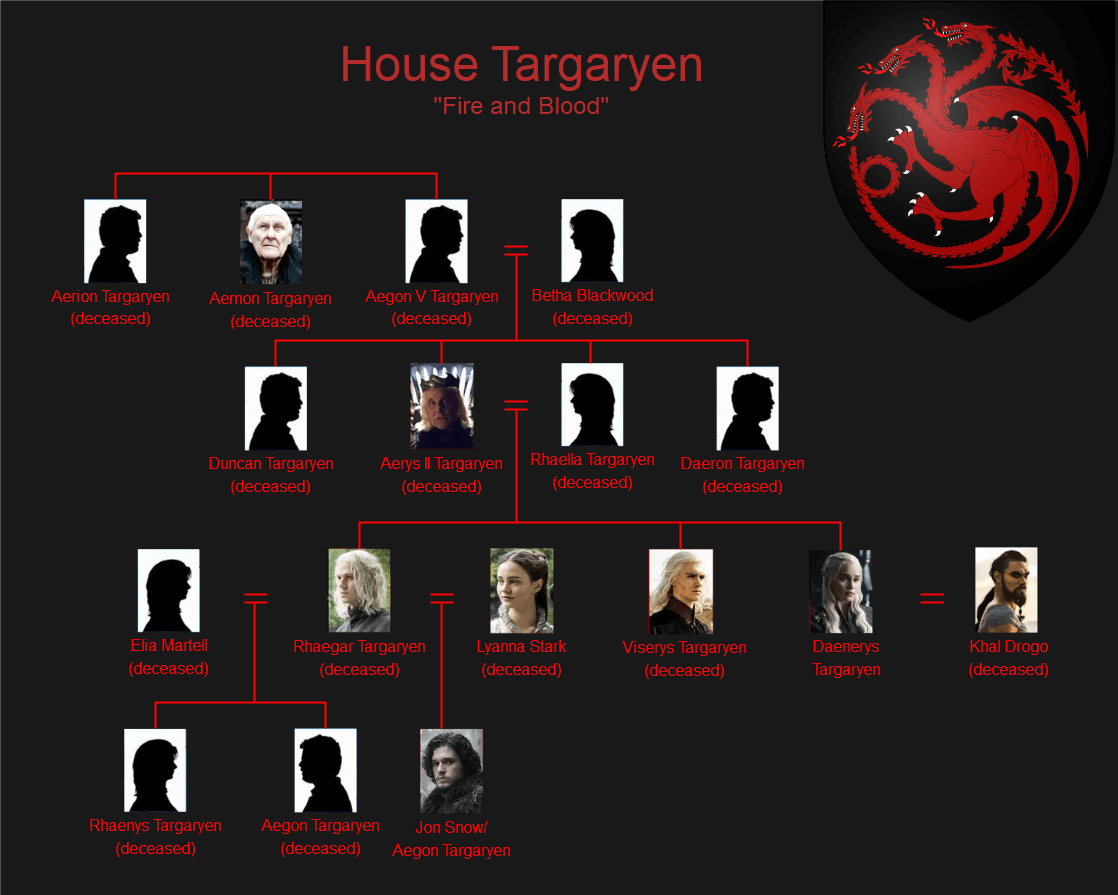
The chart begins with Aegon I and his sisters, Visenya and Rhaenys. Moving down to the events of the main series, the lineage focuses on the children of the "Mad King" Aerys II.
- Rhaegar Targaryen: The eldest son and Prince of Dragonstone. His "abduction" of Lyanna Stark was the catalyst for Robert's Rebellion.
- Viserys Targaryen: The "Beggar King" who sought to reclaim the throne through an alliance with the Dothraki.
- Daenerys Targaryen: The "Mother of Dragons," whose journey from exile to conqueror forms a primary arc of the story.
The Targaryen tree is unique because it includes significant branches revealed in prequels like House of the Dragon. These histories explain the "Dance of the Dragons," a civil war that decimated the family’s dragon population and complicated the line of succession for generations.
House Stark: The Kings in the North
House Stark’s lineage is one of the oldest in Westeros, tracing back over 8,000 years to the First Men and Brandon the Builder. Unlike the Targaryens, the Starks prioritize honor and survival in the harsh North.
The Modern Stark Family
The chart for House Stark at the beginning of the series is straightforward:
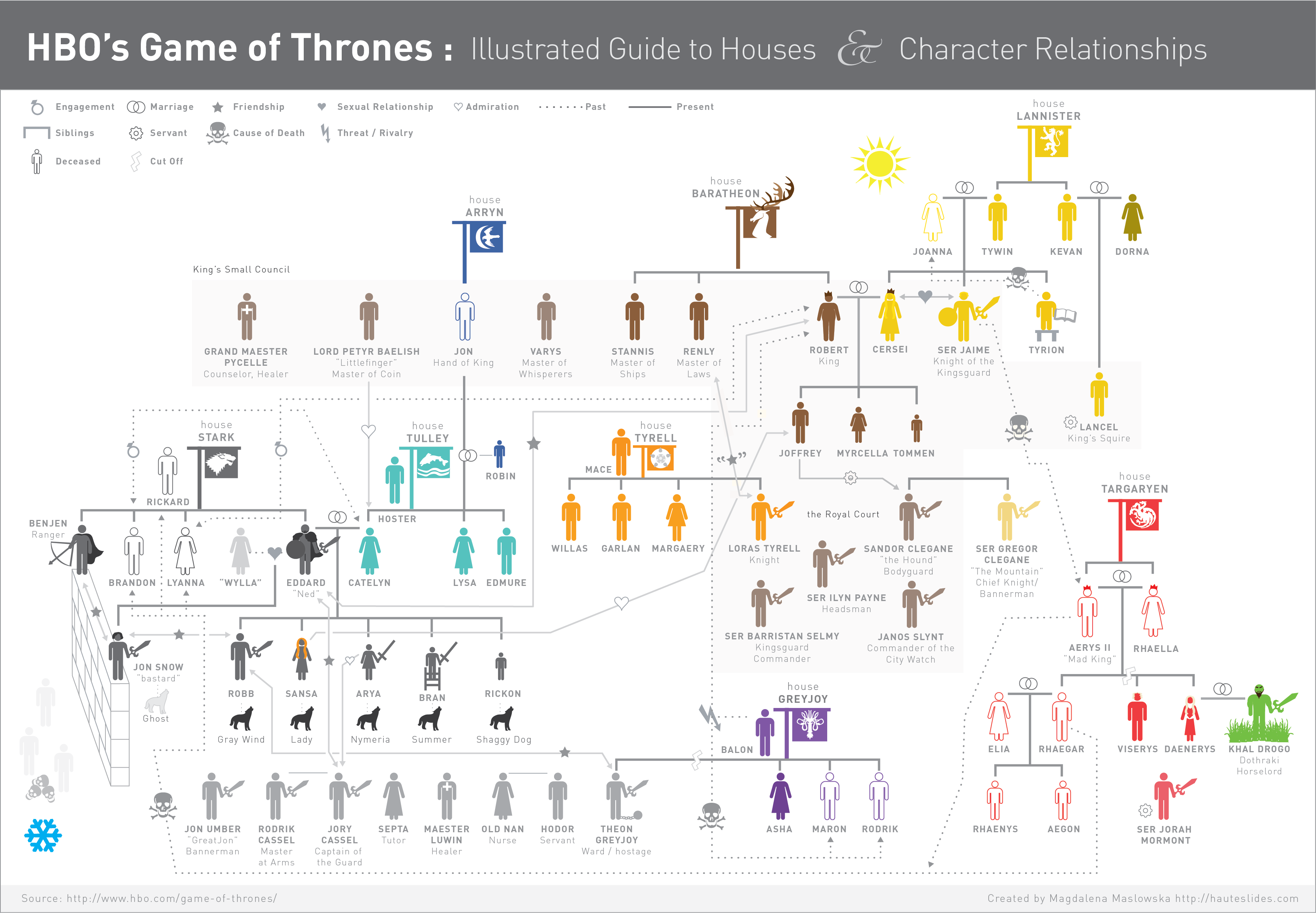
- Eddard (Ned) Stark: Warden of the North, married to Catelyn Tully.
- Robb, Sansa, Arya, Bran, and Rickon: The legitimate children of Ned and Catelyn.
- Jon Snow: Originally introduced as Ned’s bastard son, Jon’s placement on the lineage chart is the most significant "spoiler" and pivot point in the entire saga.
The North follows different customs, and the Stark lineage emphasizes the "King in the North" title, a sovereignty separate from the Iron Throne. Their bloodline is rumored to have mystical connections to the Old Gods and the Direwolves, distinguishing them from the Andal-descended houses of the south.
House Baratheon: The Stag and the Secret
House Baratheon’s lineage chart is the site of the series' greatest scandal. When Robert Baratheon won the throne, his lineage became the standard of the realm. However, the legitimacy of his "heirs" was a lie that fueled the War of the Five Kings.
The Baratheon Brothers
- Robert Baratheon: The King, whose death triggers the succession crisis.
- Stannis Baratheon: The middle brother and the legal heir once Robert’s "children" are proven to be illegitimate.
- Renly Baratheon: The youngest brother, who claims the throne based on popularity and military might rather than strict lineage.
The Lannister Subversion
The lineage chart shows Joffrey, Myrcella, and Tommen as Robert's children. However, the "true" chart reveals they are 100% Lannister, the product of incest between Cersei and Jaime Lannister. Because they have no Baratheon blood, their claim to the throne is legally void, a fact discovered by Jon Arryn and later Ned Stark by comparing the physical traits (black hair vs. golden hair) recorded in the lineages of the Great Houses.
Comparative Overview of Major House Lineages
| House | Primary Seat | Notable Ancestor | Succession Style | Status of Lineage (End of Series) |
|---|---|---|---|---|
| Targaryen | Dragonstone | Aegon the Conqueror | Absolute Primogeniture (historically) | Extinct (Main Line) |
| Stark | Winterfell | Brandon the Builder | Agnatic-Cognatic | Surviving via Sansa and Arya |
| Lannister | Casterly Rock | Lann the Clever | Agnatic-Cognatic | Surviving via Tyrion |
| Baratheon | Storm's End | Orys Baratheon | Agnatic | Surviving via Gendry (Legitimized) |
| Greyjoy | Pyke | The Grey King | Kingsmoot (Elective) | Surviving via Yara |
The R+L=J Reveal: Resolving the Lineage Mystery
The most critical moment for any Game of Thrones lineage chart is the resolution of Jon Snow’s parentage. For years, fans speculated on the "R+L=J" theory, which posits that Jon is not the bastard son of Ned Stark, but the legitimate son of Rhaegar Targaryen and Lyanna Stark.
The Impact on the Chart
When this was confirmed, Jon Snow’s place on the chart shifted from a Northern bastard to the rightful heir to the Iron Throne, Aegon Targaryen (Sixth of His Name). This revelation creates a conflict with Daenerys Targaryen’s claim. In the strict laws of Westeros lineage:
- The son of the Crown Prince (Jon/Aegon) comes before the sister of the Crown Prince (Daenerys).
- Therefore, Jon’s claim is technically superior to Daenerys’s, despite her having the dragons and the army.
This specific detail in the lineage chart explains the tragic friction between the two characters in the final stages of the story, as the truth of Jon’s bloodline undermined Daenerys’s lifelong mission to reclaim her "birthright."
Bastardy and Legitimation in Westeros
Lineage charts in Westeros are often complicated by "bastards"—children born out of wedlock. These individuals are given specific surnames based on their region (Snow in the North, Sand in Dorne, Flowers in the Reach, etc.).
A bastard has no claim to their father's lands or titles unless they are legitimized by a royal decree. For example, Ramsay Snow became Ramsay Bolton only after a decree from the King. In the lineage chart, a bastard is typically represented by a dotted line or a separate branch until legitimized, at which point they are integrated into the main family tree. This is vital for understanding how characters like Gendry Baratheon eventually became the Lord of Storm’s End.
Common Mistakes When Interpreting the Lineage
- Confusing Book vs. Show Lineages: In the books, there is a character named "Young Griff" who claims to be Aegon Targaryen (the son of Rhaegar who was thought dead). The show omits this, simplifying the Targaryen chart.
- Overlooking the Female Line: While males inherit first, the female line is often used to claim titles when no males remain. This is how the Martells of Dorne operate, as they practice absolute primogeniture (the eldest child, regardless of gender, inherits).
- The "Barney" Problem: Many viewers confuse the Baratheon and Lannister lines due to the children's surnames. While they are named Baratheon, their biological lineage is purely Lannister.
Frequently Asked Questions
Is Jon Snow a Stark or a Targaryen?
Jon Snow is biologically both. His mother was Lyanna Stark and his father was Rhaegar Targaryen. On a formal lineage chart, he is a Targaryen because his parents were married in a secret ceremony, making him legitimate. However, he carries the "Blood of the First Men" from his Stark side.
How are the Baratheons related to the Targaryens?
House Baratheon was founded by Orys Baratheon, who was rumored to be the bastard half-brother of Aegon the Conqueror. Later, the families intermarried when Rhaelle Targaryen married Ormund Baratheon. This makes Robert Baratheon and Rhaegar Targaryen second cousins.
Why does Gendry have a claim to the throne?
Gendry is the biological son of Robert Baratheon. While he was born a bastard, his legitimation by Daenerys Targaryen (ironically) made him the legal heir to House Baratheon. In the absence of other Baratheon heirs, he holds the primary claim to the Stormlands and a tertiary claim to the Iron Throne.
What happened to House Tyrell's lineage?
In the television adaptation, House Tyrell's main line was extinguished with the deaths of Mace, Loras, and Margaery Tyrell at the Great Sept of Baelor. In the books, the lineage is more extensive, with other cousins and siblings (like Willas and Garlan Tyrell) ensuring the family survives.
Who is the current head of House Stark in 2026 lore?
Following the events of the series finale, Sansa Stark is the Queen in the North and the head of House Stark. While Bran Stark is the King of the Six Kingdoms, he has abdicated his claims to Winterfell, and Arya Stark has chosen a life of exploration.
Final Recommendation for Lore Enthusiasts
To fully grasp the "Game of Thrones" lineage, one should reference the "Appendix" sections of the A Song of Ice and Fire novels or the official World of Ice and Fire compendium. These sources provide the most granular detail on minor houses and historical figures. When viewing a lineage chart, always look for the "gold" and "black" hair indicators in the first season's plot, as this remains the most elegant example of how genealogy can be used as a weapon of war.
Image Gallery