How to Play Fruit Merge: A Comprehensive Guide to Mastering the Puzzle Mechanics
Fruit Merge is an addictive puzzle game where players drop and combine identical fruits in a confined container, aiming to create larger fruit types without overflowing the top boundary. Success requires spatial awareness, physics pred...
Fruit Merge is an addictive puzzle game where players drop and combine identical fruits in a confined container, aiming to create larger fruit types without overflowing the top boundary. Success requires spatial awareness, physics prediction, and strategic placement to trigger high-scoring chain reactions.
Contents
Introduction to the Fruit Merge Phenomenon
Puzzle games that center around physics-based merging mechanics have captured a massive global audience across web browsers and mobile devices. Among these titles, Fruit Merge stands out for its deceptive simplicity and surprising tactical depth. At first glance, the premise appears straightforward: drop various types of fruit into a vertical box, watch them tumble under gravity, and tap the screen to release the next item. However, players quickly discover that mindless dropping leads to a rapid overflow and a game-over screen.
Mastering how to play Fruit Merge requires an understanding of how objects settle, roll, and interact upon impact. Because the container is narrow and forces are constantly at play, every placement permanently alters the internal geometry of the puzzle space. This guide explores the core mechanics, the evolution sequence of the fruits, advanced tactics for managing space, and troubleshooting strategies to help you consistently achieve high scores.
Understanding the Core Rules and Objective
The fundamental objective of Fruit Merge is to prevent the container from filling up while continually combining identical fruit types to score points. Each time two fruits of the exact same kind touch each other inside the box, they merge into a single, larger fruit of the next tier up. This merging action yields points and instantly frees up vital physical space within the container.
The game ends immediately when any fruit crosses or rests above the danger line at the top of the container for a brief, designated grace period. There is no time limit forcing rapid moves, which allows players to carefully evaluate their next drop. However, physics wait for no one; once a fruit leaves your control, it reacts immediately to the sloped piles and rounded surfaces of the items already settled below.
The Lifecycle of a Drop
Every turn begins with a preview of the upcoming fruit displayed near the top of the screen. Players can drag horizontally to position the spawn point along the X-axis, aligning the drop with gaps or strategic targets below. Releasing the hold triggers the drop, subjecting the item to gravity and collisions with the container walls and other fruits.
Understanding momentum is critical during this phase. A fruit dropped from a high position onto a rounded surface will bounce, roll, or slide unpredictably. Controlling the velocity and point of entry helps prevent unwanted scattering that disrupts your overall stack management.
The Fruit Evolution Chain
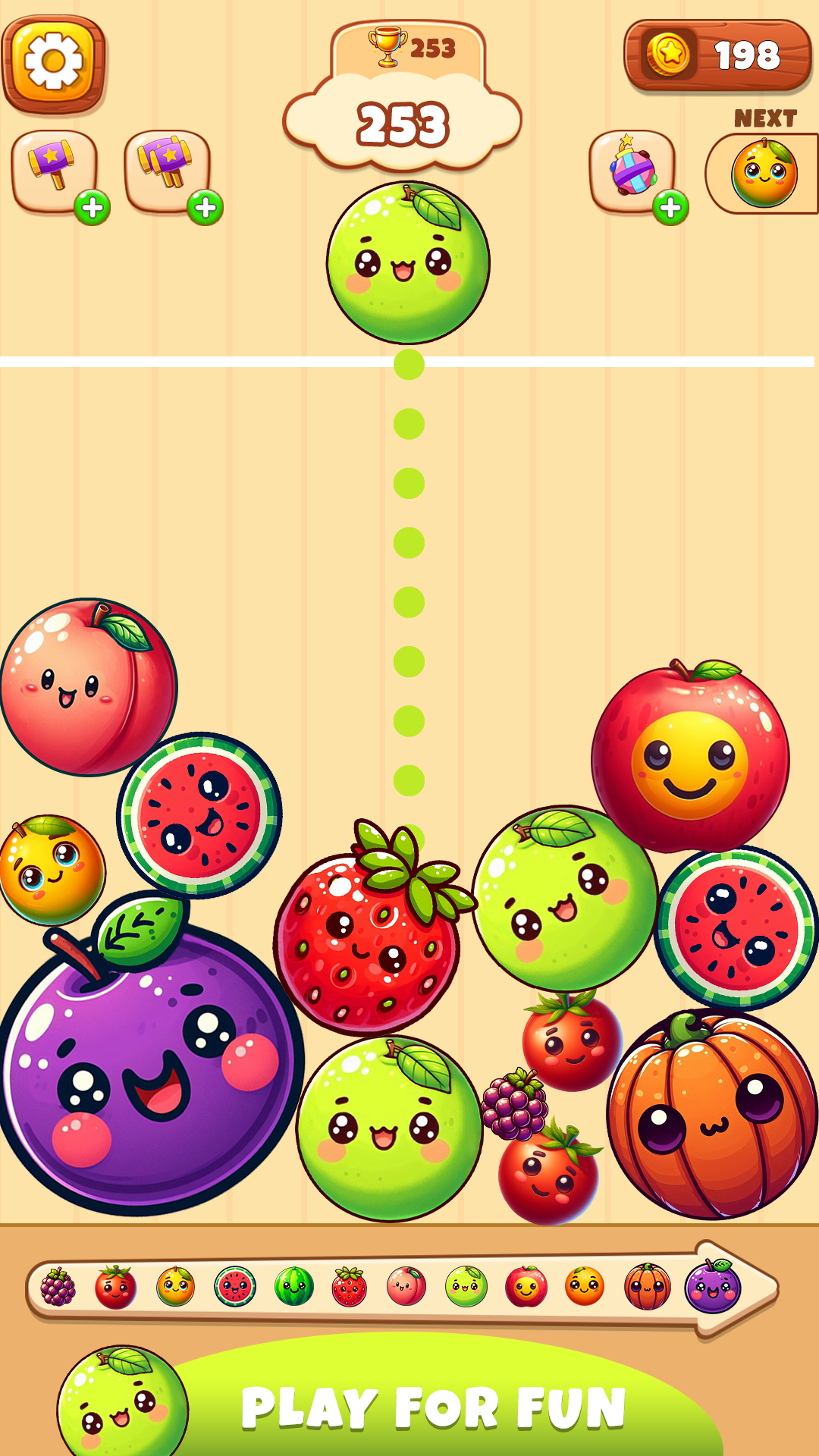
A comprehensive grasp of the fruit hierarchy is essential for effective planning. While exact art styles and specific fruit names can vary across different web implementations or mobile adaptations of the genre, the fundamental size and progression order remain largely consistent. Below is the standard evolutionary sequence, starting from the smallest foundational units up to the ultimate target.
| Evolution Tier | Fruit Name | Relative Size | Strategic Function |
|---|---|---|---|
| Tier 1 | Cherry | Tiny | Fills small gaps; building blocks for early combos |
| Tier 2 | Strawberry | Very Small | Pairs easily; helps level up base items |
| Tier 3 | Grape | Small | Bridges small height discrepancies |
| Tier 4 | Dekopon / Mandarin | Medium-Small | Settles into moderate structural pockets |
| Tier 5 | Persimmon | Medium | Forms stable mid-level weight points |
| Tier 6 | Apple | Medium-Large | Clears minor clutter when merged |
| Tier 7 | Pear | Large | Creates heavy anchor points |
| Tier 8 | Peach | Very Large | Takes up significant volume; requires caution |
| Tier 9 | Pineapple | Huge | Acts as a structural divider in the box |
| Tier 10 | Melon | Massive | Consolidates large areas of space |
| Tier 11 | Watermelon | Maximum | The ultimate goal; clears massive space upon merging |
Strategic Placement and Board Management
Achieving high scores in Fruit Merge requires thinking several steps ahead rather than reacting solely to the current drop. The primary enemy in this game is structural disorganization, which creates dead pockets where fruits cannot reach each other.
The Side-to-Side Sorting Method
One of the most reliable structural strategies is organizing your fruits by size across the horizontal axis of the container. Professional players typically maintain larger fruits—such as pears, peaches, and pineapples—on one specific side of the container (for example, the far left or right wall), while channeling smaller fruits (cherries, strawberries, grapes) toward the opposite side.
This sorting prevents medium-sized items from trapping tiny items underneath them permanently. When small fruits are kept segregated, you can easily drop matching pairs into their designated zone to trigger cascading upgrades that roll back toward your larger anchor items.
Managing the Center Peak
As fruits merge and grow, they naturally form mounds or peaks in the center of the container due to the physics engine pulling items downward from the drop zone. Allowing a sharp peak to form directly under the spawn area is dangerous because newly dropped items will roll off unpredictably, landing in random locations and ruining your layout.
To counter this, use medium-sized drops to level off uneven areas. If a large fruit settles awkwardly on a slope, try dropping a matching medium fruit nearby to force a merge, flattening the mound and restoring a stable baseline.
Advanced Tactics for Chain Reactions
High-scoring runs do not rely on single, isolated merges; they depend on domino-effect chain reactions. A chain reaction occurs when one merge creates a new, larger fruit that immediately rolls into contact with another matching fruit, triggering a second merge, and potentially a third or fourth.
- Trigger Positioning: Place nearly-complete pairs near each other underneath a stationary large fruit. When the lower pair merges, the resulting upward bump or spatial shift can nudge the upper fruit into its own match.
- Wall Utilization: Use the vertical walls of the container to stabilize rolling items. Dropping a fruit directly against a wall limits its bounce arc, making precise placement much easier to calculate.
- Controlled Waiting: If you receive a small fruit that does not fit your current layout, look for minor gaps at the very bottom of the pile where it can slide in without disrupting your major stacks.
Common Mistakes to Avoid
Even experienced players occasionally fall victim to habits that lead to rapid game-overs. Recognizing these pitfalls helps preserve your container space.
- Chasing Immediate Merges: Focusing exclusively on the next available two-point match often ruins long-term structural integrity by burying small items under massive obstacles.
- Ignoring the Preview Window: Failing to look at the upcoming fruit prevents you from preparing a proper landing zone, forcing panic drops that ruin your board layout.
- Overcrowding the Top: Letting multiple unmerged items pile up near the danger line drastically reduces your margin for error when handling unexpected bounces.
Troubleshooting Physics Quirks and Bad Bounces
Physics-based puzzle games occasionally introduce unpredictable outcomes due to collision detection edges or micro-bounces. If your fruit lands awkwardly and rolls away from your intended target, do not panic. Avoid dropping a large replacement item on top of the mistake immediately. Instead, evaluate whether a smaller subsequent drop can nudge the wayward fruit back into alignment, or accept the layout shift and adjust your sorting side accordingly.
Frequently Asked Questions
What happens when two watermelons touch each other?
When two watermelons—the largest tier in the standard game—touch, they merge and disappear entirely from the board. This clears a massive amount of space at the bottom of the container and awards a massive point bonus, which is often the key to setting personal high score records.
Can I rotate the fruits before dropping them?
No, standard versions of Fruit Merge do not feature a rotation mechanic. Fruits always drop in a fixed orientation, though their spherical shapes mean they will roll and settle naturally upon impact depending on the surface topography below them.
Is there a time limit for making a move?
There is no active timer or countdown clock forcing you to drop a fruit. You can take as much time as necessary to analyze the container, check the upcoming fruit preview, and plan your next placement carefully.
What is the best strategy for beginners?
Beginners should focus on keeping larger fruits gathered toward one side of the container while feeding smaller fruits into the opposite side. This prevents random scattering and creates clear zones for predictable merging.
Why do my fruits keep bouncing out of place?
Bouncing usually occurs when dropping a heavy or round fruit onto a steep, cluttered mound. To minimize erratic movement, drop fruits closer to flat surfaces or utilize the container walls to absorb momentum.
How do chain reactions work?
Chain reactions happen when one merge generates a larger fruit that immediately touches another matching fruit, creating a consecutive sequence of automated merges that clear space and award bonus points rapidly.
Conclusion and Next Actions
Mastering Fruit Merge requires patience, spatial discipline, and an understanding of physics-based momentum. By organizing your container by size, avoiding central structural peaks, and setting up multi-tier chain reactions, you can transform chaotic drops into controlled, high-scoring runs. Launch a game today, focus on keeping your stacks low, and apply the side-sorting method to watch your score climb steadily.
Image Gallery