Aliya Mustafina Net Worth and Career Highlights: A Detailed Gymnastics Legacy
Aliya Mustafina holds a legendary status in the world of artistic gymnastics, known for her unmatched tenacity, exquisite execution, and remarkable resilience throughout a high-pressure international career. While her precise net worth...
Aliya Mustafina holds a legendary status in the world of artistic gymnastics, known for her unmatched tenacity, exquisite execution, and remarkable resilience throughout a high-pressure international career. While her precise net worth is not publicly disclosed in official financial records—as is common for many elite Olympic athletes outside of major commercial team sports—her career earnings, international prize money, state-awarded athletic bonuses, coaching income, and commercial sponsorships establish her financial standing securely within the realm of sports-related wealth. Her legacy extends far beyond monetary figures, defined instead by an extensive collection of Olympic medals, World Championship titles, and pioneering routines on the uneven bars.
Contents
Evaluating the life and career of a sporting icon requires looking closely at both the economic realities of elite gymnastics and the milestones that built her reputation. From her early dominance in junior competitions to her status as a multi-time Olympic medalist competing through two major knee surgeries, Mustafina’s trajectory offers a fascinating look at modern sports history. Understanding her journey involves examining how elite gymnasts generate revenue, the structure of Russian sports funding during her active years, her post-competitive transition into coaching, and the enduring influence she left on the sport.
Early Life, Athletic Development, and Junior Rise
Born on October 24, 1994, in Yegoryevsk, Russia, Aliya Mustafina inherited a strong athletic pedigree. Her father, Farhat Mustafin, was a bronze medalist in Greco-Roman wrestling at the 1976 Summer Olympics, while her younger sister, Nailya Mustafina, also competed as an elite gymnast. Recognizing her early flexibility and spatial awareness, her parents enrolled her in a local gymnastics section when she was just six years old.
Under the guidance of her initial coaches, Mustafina quickly progressed through the rigorous Russian sports school system. Her talent caught the attention of the national coaching staff, eventually leading her to train under renowned coach Alexander Alexandrov. Alexandrov played a pivotal role in refining her technique and managing her competitive temperament, which was occasionally marked by fierce independence and uncompromising perfectionism.
During her junior years, Mustafina established herself as a formidable competitor on the European and international stage. She won multiple medals at the 2008 European Junior Championships in Clermont-Ferrand, signaling to the gymnastics world that she would be a key pillar for the Russian senior national team in the upcoming Olympic cycle. Her progression from a promising regional talent to a dominant senior competitor laid the groundwork for a lucrative and historically significant athletic career.
Career Highlights and Major Gymnastics Achievements
Mustafina’s senior international career is defined by extraordinary consistency at the highest levels of the sport, despite enduring severe injuries that would have ended the careers of lesser athletes. She debuted on the senior international circuit in 2010, immediately making a powerful statement by capturing the all-around gold medal at the World Artistic Gymnastics Championships in Rotterdam, Netherlands. This victory made her the first Russian woman to win the World all-around title since Svetlana Khorkina in 2003.
Her performance at the 2012 London Olympic Games cemented her legendary status. Despite having torn her anterior cruciate ligament (ACL) just a year prior in April 2011, Mustafina recovered through intensive rehabilitation to lead the Russian team. In London, she earned four medals:
- Gold on the uneven bars, executing a technically demanding routine that neutralized her competitors.
- Silver in the team competition alongside teammates Victoria Komova, Anastasia Grishina, Aliya Mustafina, and Maria Paseka.
- Bronze in the individual all-around competition.
- Bronze in the floor exercise final.
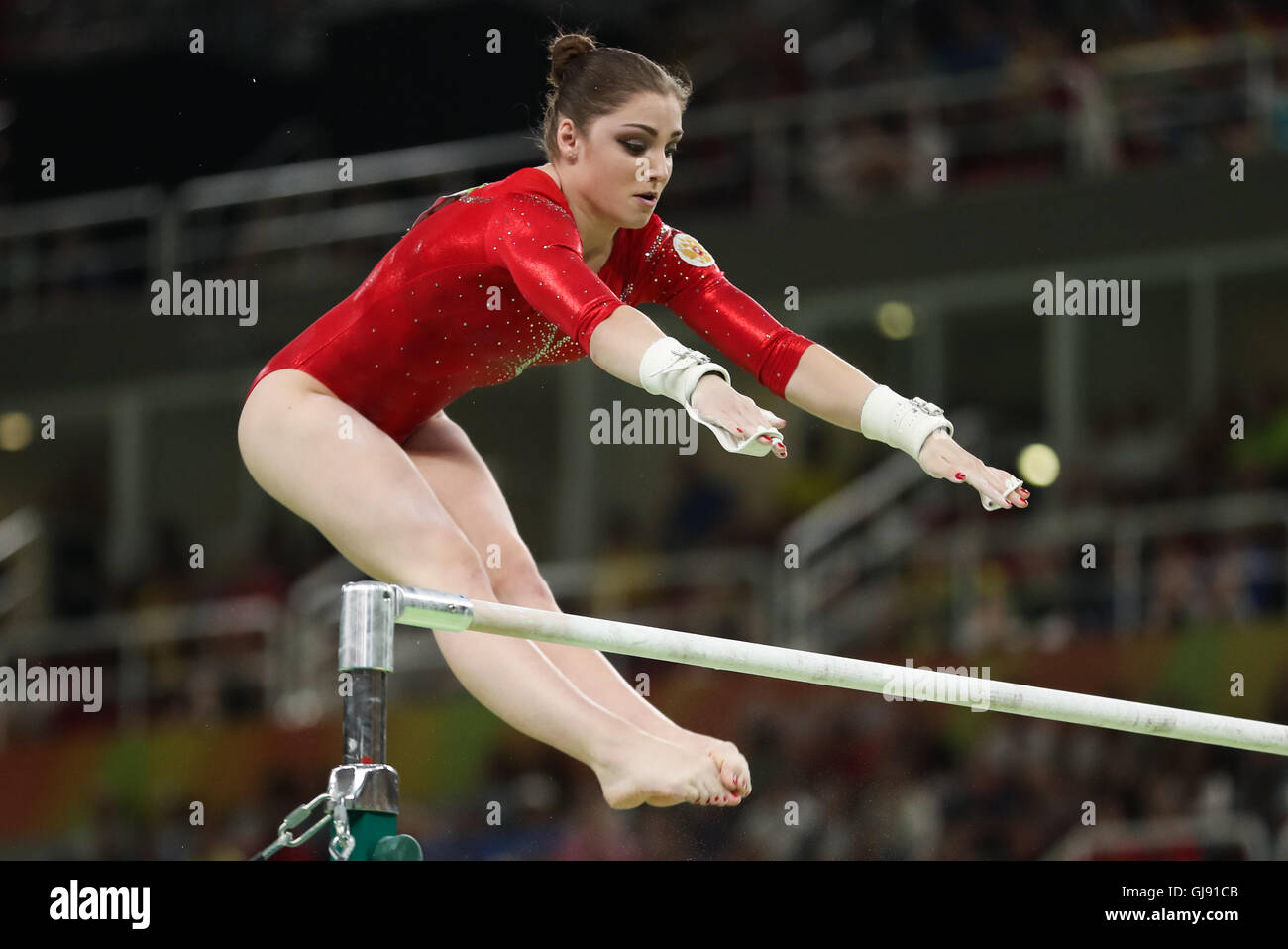
She repeated her resilience ahead of the 2016 Rio de Janeiro Olympic Games. Battling chronic knee pain and having given birth to her first child shortly after the Rio cycle, she remained the anchor of the Russian squad. In Rio, she successfully defended her Olympic title on the uneven bars, winning gold for the second consecutive time. She also secured a silver medal in the team all-around and a bronze medal in the individual all-around, bringing her total Olympic medal count to seven.
| Competition Year | Event | Location | Medals Won |
|---|---|---|---|
| 2010 | World Championships | Rotterdam, Netherlands | Gold (All-Around, Team), Silver (Vault, Uneven Bars, Floor) |
| 2012 | Olympic Games | London, United Kingdom | Gold (Uneven Bars), Silver (Team), Bronze (All-Around, Floor) |
| 2013 | European Championships | Moscow, Russia | Gold (All-Around, Uneven Bars), Bronze (Balance Beam) |
| 2014 | World Championships | Nanning, China | Gold (Team), Bronze (All-Around, Uneven Bars) |
| 2015 | European Championships | Montpellier, France | Silver (Uneven Bars), Bronze (All-Around) |
| 2016 | Olympic Games | Rio de Janeiro, Brazil | Gold (Uneven Bars), Silver (Team), Bronze (All-Around) |
Financial Profile: Understanding Mustafina's Net Worth
Determining the exact net worth of Aliya Mustafina requires contextualizing how elite gymnasts are compensated. Unlike athletes in professional football, basketball, or tennis, artistic gymnasts have limited windows for substantial commercial earnings. Gymnastics lacks a continuous, high-paying professional league structure, meaning financial stability depends heavily on international prize money, government sports stipends, state-sponsored medal bonuses, and occasional brand endorsements.
During her active years, Russian Olympic medalists received substantial financial rewards directly from the Russian government, as well as regional sports ministries and corporate sponsors associated with the Russian Olympic Committee. For instance, following the London 2012 and Rio 2016 Olympic Games, gold and medal-winning athletes were awarded cash prizes, luxury vehicles, and honorary military or civil titles, which often carried financial stipends.
Furthermore, elite Russian athletes frequently hold formal employment positions within state sports structures, such as the Central Sports Club of the Army (CSKA) or Dynamo, receiving a regular salary, military or civil service rank, and associated retirement benefits. Mustafina held the rank of major in the Russian Armed Forces through her affiliation with CSKA, providing a stable, long-term financial foundation.
| Revenue Source | Description / Mechanism | Estimated Financial Impact |
|---|---|---|
| State Olympic Bonuses | Cash payouts from the government and regional funds for Olympic medals | Substantial lump sums per medal in 2012 and 2016 |
| Military / Sports Stipends | Monthly salary and rank benefits via CSKA (Central Sports Club of the Army) | Consistent baseline income throughout her career and retirement |
| International Prize Money | FIG World Cup and World Championship podium earnings | Moderate supplementary income |
| Coaching and Federation Roles | Salaries from positions within the Russian national team coaching staff | Ongoing professional earnings post-retirement |
Post-Competitive Career and Transition to Coaching
Following her retirement from active competition, Aliya Mustafina transitioned smoothly into coaching and sports administration. Retiring from elite competition allowed her to remain closely tied to the discipline that defined her youth. She took on roles within the Russian gymnastics federation, eventually joining the coaching staff of the Russian national youth and senior teams.
This transition ensured both a continuous income stream and the preservation of her influence within the sport. Coaching elite-level athletes requires deep technical knowledge, psychological management, and an understanding of the ever-evolving Fédération Internationale de Gymnase (FIG) Code of Points—areas where Mustafina’s extensive competitive background proved invaluable. Her presence in the training gym provides younger generations of gymnasts with direct access to mentorship from a multi-time Olympic champion.
In addition to coaching, Mustafina has occasionally participated in exhibition tours, gala performances, and media appearances. These engagements, common among retired Olympic champions, supplement her income and maintain her public profile within the global gymnastics community.
Legacy and Impact on Artistic Gymnastics
Aliya Mustafina’s legacy in artistic gymnastics goes far beyond financial measurements and medal counts. She competed during an era of significant transition in the sport, bridging the gap between the older 10.0 judging system mindset and the open-ended Code of Points that rewarded extreme difficulty paired with artistic execution.
Her uneven bars routines were particularly influential. Mustafina popularized complex release combinations and difficult transitions that set a benchmark for difficulty in international competition. Her competitive demeanor—often described as icy, focused, and unflappable under pressure—became her trademark. While some gymnasts thrived on crowd interaction, Mustafina approached her apparatuses with clinical precision, earning the respect of judges, coaches, and rivals worldwide.
Her ability to recover from major knee surgeries twice and return to the Olympic podium stands as one of the most remarkable stories of athletic grit in modern sports history. For gymnastics fans and historians, her career represents a masterclass in longevity, tactical intelligence, and sheer determination.
Frequently Asked Questions
What is Aliya Mustafina's net worth?
Aliya Mustafina's exact net worth is not publicly disclosed, as elite gymnasts outside of commercial team sports rarely publish personal financial statements. Her wealth is derived from government Olympic medal bonuses, military sports salaries through her association with the Russian Armed Forces (CSKA), coaching income, and occasional sponsorships. Estimates from sports analysts generally place her financial standing comfortably within the typical range of decorated European Olympic athletes.
How many Olympic medals did Aliya Mustafina win?
Aliya Mustafina won a total of seven Olympic medals across two Olympic Games (London 2012 and Rio de Janeiro 2016). Her collection includes two gold medals (both on the uneven bars), two silver medals (both in the team all-around), and three bronze medals (all in the individual all-around, plus one in the floor exercise).
Is Aliya Mustafina still competing in gymnastics?
No, Aliya Mustafina is officially retired from competitive gymnastics. She concluded her active competitive career following the Rio 2016 Olympic cycle and subsequent attempts to prepare for the delayed Tokyo 2020 Olympics. She has since transitioned into coaching roles within the Russian national gymnastics program.
What are Aliya Mustafina's signature apparatuses?
While she was a strong all-around competitor who medaled on every apparatus throughout her career, Mustafina was most famous for her excellence on the uneven bars. She won consecutive Olympic gold medals on this apparatus in 2012 and 2016, showcasing exceptional swing, difficult release moves, and precise execution.
What military rank does Aliya Mustafina hold?
Aliya Mustafina held an affiliation with the Central Sports Club of the Army (CSKA) in Russia, through which elite athletes are frequently integrated into military structures. She achieved the rank of major in the Russian Armed Forces, which provides ongoing professional recognition and state-backed financial benefits.
Conclusion and Next Actions
Aliya Mustafina’s journey from a young gymnast in Yegoryevsk to a multi-time Olympic champion illustrates the profound dedication required to reach the pinnacle of artistic gymnastics. While her net worth remains a private matter, her career highlights, state-awarded honors, and ongoing role as a national team coach secure her financial stability and lasting legacy. For readers interested in further exploring gymnastics history, examining the evolution of the FIG Code of Points or reviewing archival footage of the 2012 and 2016 Olympic uneven bars finals offers valuable context into the mastery that defined her career.
Image Gallery