Understanding GST Number: Identifying and Deciphering the Tax ID in India
A GST Number, officially known as the Goods and Services Tax Identification Number (GSTIN), is a unique 15-digit alphanumeric identifier assigned to every business entity registered under the GST regime in India. It serves as a consoli...
A GST Number, officially known as the Goods and Services Tax Identification Number (GSTIN), is a unique 15-digit alphanumeric identifier assigned to every business entity registered under the GST regime in India. It serves as a consolidated tax identity, replacing previous identifiers like VAT, Service Tax, and Excise registration numbers to streamline tax administration and tracking.
Contents
The introduction of the Goods and Services Tax (GST) in 2017 marked a paradigm shift in India's fiscal landscape, moving from a fragmented tax structure to a "One Nation, One Tax" system. As of 2026, the GSTIN has become the fundamental bedrock for business operations in India. It is not merely a number for tax filing; it is a prerequisite for opening business bank accounts, applying for loans, engaging in interstate trade, and, most importantly, claiming Input Tax Credit (ITC). Understanding the composition and significance of this 15-digit code is essential for business owners, accountants, and consumers alike.
The Anatomy of a GSTIN: Deciphering the 15-Digit Code
The GSTIN is not a random sequence of characters. It is a structured identifier where each segment provides specific information about the taxpayer. This logic allows tax authorities and businesses to verify the authenticity of a tax ID instantly.
1. The State Code (First Two Digits)
The first two digits of a GSTIN represent the state code as per the Indian Census 2011. For example, a business registered in Maharashtra will have a GSTIN starting with '27', while one in Delhi will start with '07'. This geographic identifier is crucial because India follows a dual GST model where both the Center and States levy taxes simultaneously (CGST and SGST).
2. The PAN (Next Ten Digits)
The third to the twelfth digits are the Permanent Account Number (PAN) of the business entity or the individual proprietor. By embedding the PAN within the GSTIN, the government ensures a seamless link between direct and indirect tax systems. This integration makes it significantly easier for the Central Board of Direct Taxes (CBDT) and the Central Board of Indirect Taxes and Customs (CBIC) to track income discrepancies and tax evasion.
3. The Entity Code (Thirteenth Digit)
The thirteenth digit represents the number of registrations a legal entity has within a specific state under the same PAN. It is alphanumeric (1-9 and then A-Z). If a business has only one registration in a state, this digit will be '1'. If the same business opens a second vertical or a separate business unit in the same state and opts for a separate GSTIN, the thirteenth digit will be '2'.
4. The Default Digit (Fourteenth Digit)
The fourteenth digit is currently the letter 'Z' by default for all registrations. It has been reserved by the government for future use or potential expansion of the coding logic as the taxpayer base grows.
5. The Check Code (Fifteenth Digit)
The final digit is a check code used for detecting errors in data entry. It can be a number or a letter. This digit is calculated using a checksum algorithm, ensuring that if a single character is mistyped during a transaction or filing, the system can flag the GSTIN as invalid.
Why Identifying the GST Number is Critical for Businesses
Identifying and verifying a GSTIN is not just a regulatory formality; it has direct financial implications for every business transaction.
Securing Input Tax Credit (ITC)
In the GST framework, a business can reduce the tax it has already paid on inputs from the tax it must pay on output. This is known as Input Tax Credit. However, a buyer can only claim ITC if the supplier has a valid GSTIN and has accurately reported the transaction in their GST returns. If you transact with a business using a fake or cancelled GSTIN, your ITC claim will be rejected, directly increasing your cost of operations.
Legal Compliance and Invoicing
Under the GST Act, every registered taxpayer must display their GSTIN on their business signboards and mention it clearly on all tax invoices, debit notes, and credit notes. Failure to do so can lead to penalties. By 2026, the integration of e-invoicing has become mandatory for most turnover slabs, making the accuracy of the GSTIN even more vital as invoices are authenticated in real-time by the Goods and Services Tax Network (GSTN).
Facilitating Interstate Trade
To move goods across state borders, businesses often require an E-way bill if the consignment value exceeds a specific threshold (generally ₹50,000). A valid GSTIN is a prerequisite for generating an E-way bill. Without it, logistics become a bottleneck, and goods are liable to be seized by mobile tax squads.
Thresholds for GST Registration in 2026
Not every small shop or freelancer is required to have a GSTIN. The government provides "Threshold Exemptions" to reduce the compliance burden on micro-enterprises. As of 2026, the general criteria for mandatory registration remain categorized by the nature of the business and the location:
- Goods Suppliers: Businesses dealing exclusively in goods are generally required to register if their annual aggregate turnover exceeds ₹40 Lakhs.
- Service Providers: For those providing services, the mandatory registration threshold is ₹20 Lakhs.
- Special Category States: In certain North-Eastern and hill states (such as Manipur, Mizoram, Nagaland, and Tripura), the threshold is lower, typically ₹10 Lakhs, to account for smaller regional economies.
- Compulsory Registration: Regardless of turnover, certain entities must obtain a GSTIN. This includes e-commerce operators, non-resident taxable persons, and those engaged in interstate outward supplies.
How to Obtain a GST Number: The Registration Process
The process for obtaining a GSTIN is entirely digital and handled through the official GST Portal.
- Part A (Temporary Reference Number): The applicant provides their PAN, mobile number, and email address on the portal. After OTP verification, a Temporary Reference Number (TRN) is generated.
- Part B (Application Submission): Using the TRN, the applicant fills in business details, including the constitution of the business (Proprietorship, Partnership, Pvt Ltd), principal place of business, and commodity details.
- Document Upload: Essential documents such as proof of business address (electricity bill or rent agreement), bank account details, and photographs of promoters are uploaded.
- Verification and ARN: Once submitted, the application is verified via an Application Reference Number (ARN). If the tax officer is satisfied, or if no clarification is sought within the stipulated period (usually 7 working days), the GST Registration Certificate (Form REG-06) containing the GSTIN is issued.
| GSTIN Segment | Position | Character Type | Description |
|---|---|---|---|
| State Code | 1-2 | Numeric | Based on 2011 Census (e.g., 09 for Uttar Pradesh) |
| PAN | 3-12 | Alphanumeric | Permanent Account Number of the entity |
| Entity Code | 13 | Alphanumeric | Order of registration under the same PAN in a state |
| Reserved | 14 | Alphabet | Defaulted to 'Z' for current registrations |
| Check Code | 15 | Alphanumeric | Checksum digit for error detection |
How to Verify a GST Number Online
With the rise in tax-related fraud, verifying a GSTIN before entering into a contract or paying an invoice is a best practice. The CBIC and the GSTN provide tools for public verification.
- Navigate to the Search Taxpayer tab on the official GST Portal.
- Select "Search by GSTIN/UIN."
- Enter the 15-digit GSTIN provided by the vendor.
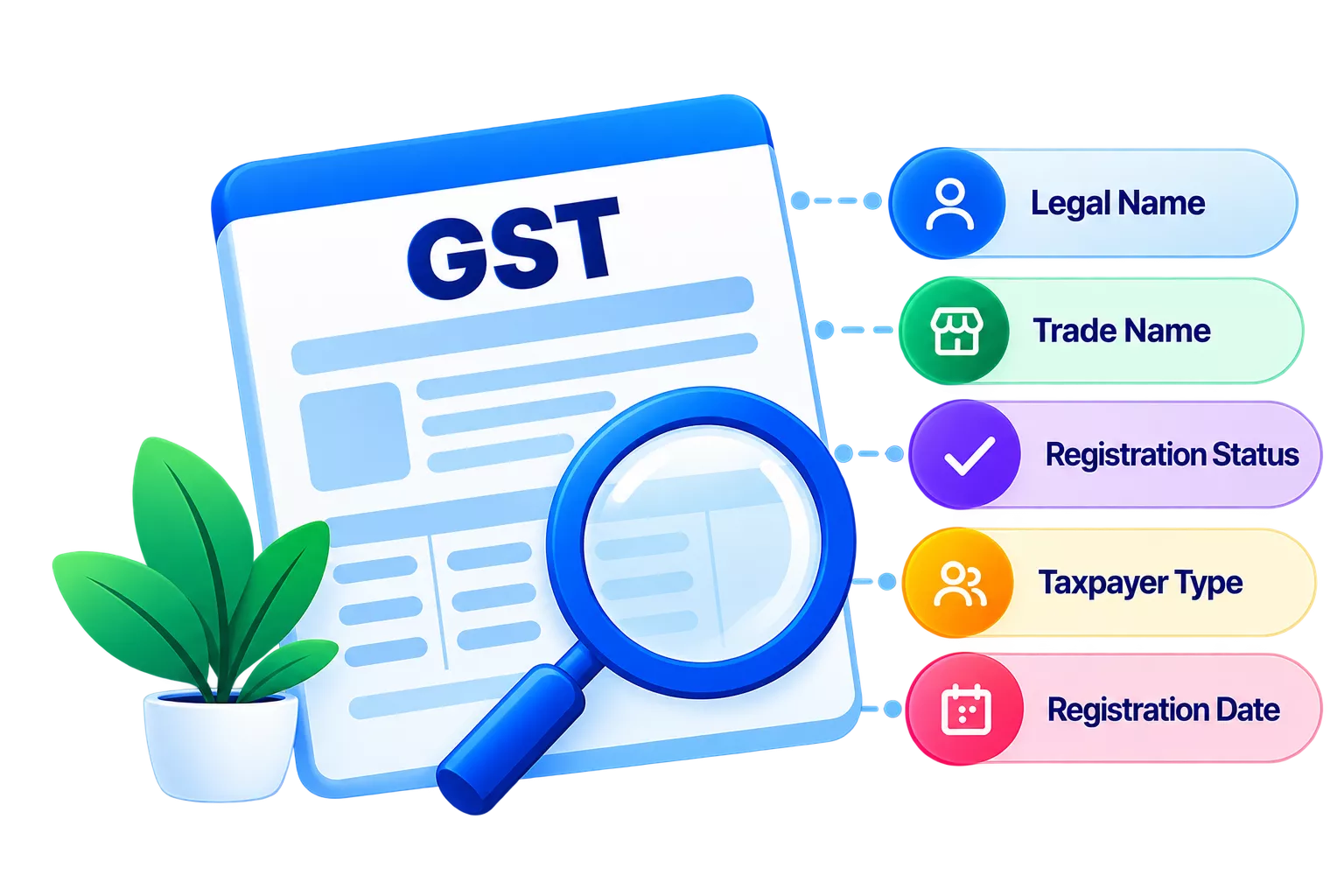
- The system will display the legal name of the business, its registration date, its status (Active, Suspended, or Cancelled), and its taxpayer type (Regular or Composition).
Pro-Tip: Check the "Filing Table" at the bottom of the search results. It shows whether the business has been regular in filing its GSTR-3B and GSTR-1 returns. A business that fails to file returns for six consecutive months is a high-risk vendor, as your ITC may be blocked.
Common Issues: Suspended or Cancelled GSTINs
A GST number can be "Identified" as invalid if its status is not "Active." Understanding these statuses is vital:
- Suspended: This usually happens when there are discrepancies in the returns filed or if the taxpayer has applied for cancellation. During suspension, the business cannot issue tax invoices or move goods.
- Cancelled: This means the GSTIN is no longer valid. Cancellation can be voluntary (business closed) or initiated by the tax department (suo-moto) due to non-compliance or fraud.
- Inactive/Migration Pending: This is rarer in 2026 but may appear for very old entities that failed to complete the transition from the pre-2017 tax regime.
Frequently Asked Questions
Can I have more than one GST number?
Yes. A business can have multiple GST numbers if it operates in different states (registration is state-wise) or if it has multiple business verticals within the same state and chooses to register them separately for accounting clarity.
Is there a fee for obtaining a GSTIN?
The Government of India does not charge a fee for GST registration through the official portal. However, businesses often hire chartered accountants or consultants to handle the documentation, which may involve professional service fees.
Does a GST number expire?
For regular taxpayers, the GSTIN does not have an expiry date and remains valid as long as the business is a "going concern" and complies with filing requirements. However, GSTINs for Casual Taxable Persons or Non-Resident Taxable Persons are issued for specific periods (usually 90 days) and must be renewed.
What is a UIN compared to a GSTIN?
A Unique Identity Number (UIN) is a special category of tax ID issued to foreign diplomatic missions and UN agencies that are not liable to pay taxes in India. It allows these organizations to claim refunds on the GST they pay on Indian purchases.
Can I change my PAN linked to a GSTIN?
No. Since the GSTIN is built upon the PAN, you cannot change the PAN without cancelling the existing GST registration and applying for a new one. This typically occurs when a business changes its legal structure, such as converting a sole proprietorship into a private limited company.
Practical Recommendation for 2026
As we navigate the business environment of 2026, the "Search Taxpayer" tool should be your first stop when onboarding any new supplier. Always ensure the GSTIN is prominently displayed on your premises and your website to build trust with both customers and regulators. If you encounter a GSTIN that appears "Suspended," withhold payments involving tax components until the vendor provides proof of restoration to avoid losing your Input Tax Credit.
Image Gallery