Comcast Holding Corp Net Worth: Market Capitalization, Stockholders' Equity, and Financial Analysis
Comcast Corporation (historically registered as Comcast Holdings Corporation) maintains a net worth measured by a market capitalization of approximately $150 billion to $180 billion and a balance sheet stockholders' equity (book value)...
Comcast Corporation (historically registered as Comcast Holdings Corporation) maintains a net worth measured by a market capitalization of approximately $150 billion to $180 billion and a balance sheet stockholders' equity (book value) exceeding $80 billion. These figures vary based on stock market fluctuations, corporate debt levels, and quarterly financial reporting on NASDAQ (CMCSA).
Contents
Evaluating the financial standing of a corporate conglomerate like Comcast requires distinguishing between three distinct definitions of "net worth": market value, balance sheet equity, and enterprise value. As one of the largest telecommunications, media, and entertainment companies in the world, Comcast operates a multi-faceted business model spanning broadband internet, cable television, NBCUniversal media networks, Universal theme parks, and Sky media services.
Understanding how Comcast's balance sheet is constructed—and how Wall Street values its operational assets—provides clear insight into the firm's overall solvency, debt burden, and underlying shareholder equity.
Defining Corporate Net Worth: Market Cap vs. Book Value
When assessing a private individual, net worth is simply total personal assets minus total personal liabilities. For a publicly traded multinational enterprise like Comcast Corporation, financial analysts evaluate net worth through complementary metrics tailored to stock markets and corporate balance sheets.
- Market Capitalization (Share Price x Shares Outstanding)
- Equity value determined daily by stock exchange trading.
- Stockholders' Equity / Book Value (Total Assets - Total Liabilities)
- Accounting net worth reported in GAAP SEC Form 10-K filings.
- Enterprise Value (Market Cap + Total Debt - Cash & Equivalents)
- Theoretical total acquisition cost for the complete entity.
Stockholders' Equity (GAAP Net Assets)
From an accounting perspective, Comcast's true balance sheet net worth is recorded as Stockholders' Equity under Generally Accepted Accounting Principles (GAAP). Found on the quarterly SEC Form 10-Q and annual Form 10-K balance sheets, this metric subtracts total corporate liabilities (including long-term debt, lease obligations, and deferred tax liabilities) from total consolidated assets (including physical infrastructure, spectrum licenses, goodwill, and intangible assets). Comcast consistently maintains a total book value ranging from $80 billion to $95 billion, representing the residual interest belonging to shareholders if all assets were liquidated and all liabilities settled at book value.
Market Capitalization (Equity Value)
In public finance, market capitalization reflects what investors collectively pay to purchase the entire share float of the business. Calculated by multiplying the current trading price of Comcast's Class A common stock (NASDAQ: CMCSA) by its total shares outstanding, Comcast's market cap historically fluctuates between $140 billion and $220 billion depending on macro market dynamics, prevailing interest rates, and investor sentiment regarding cable subscriber retention and streaming performance.
Enterprise Value (EV)
Because telecommunications and media platforms require substantial capital deployment for fiber-optic networks, wireless infrastructure, and film production, Comcast carries significant long-term debt. Enterprise Value (EV) accounts for this capital structure by adding total debt and subtracting cash and short-term investments from the market capitalization. Comcast’s enterprise value frequently exceeds $230 billion to $270 billion, offering institutional investors a complete picture of total operational asset value.
Financial Metrics and Valuation Breakdown
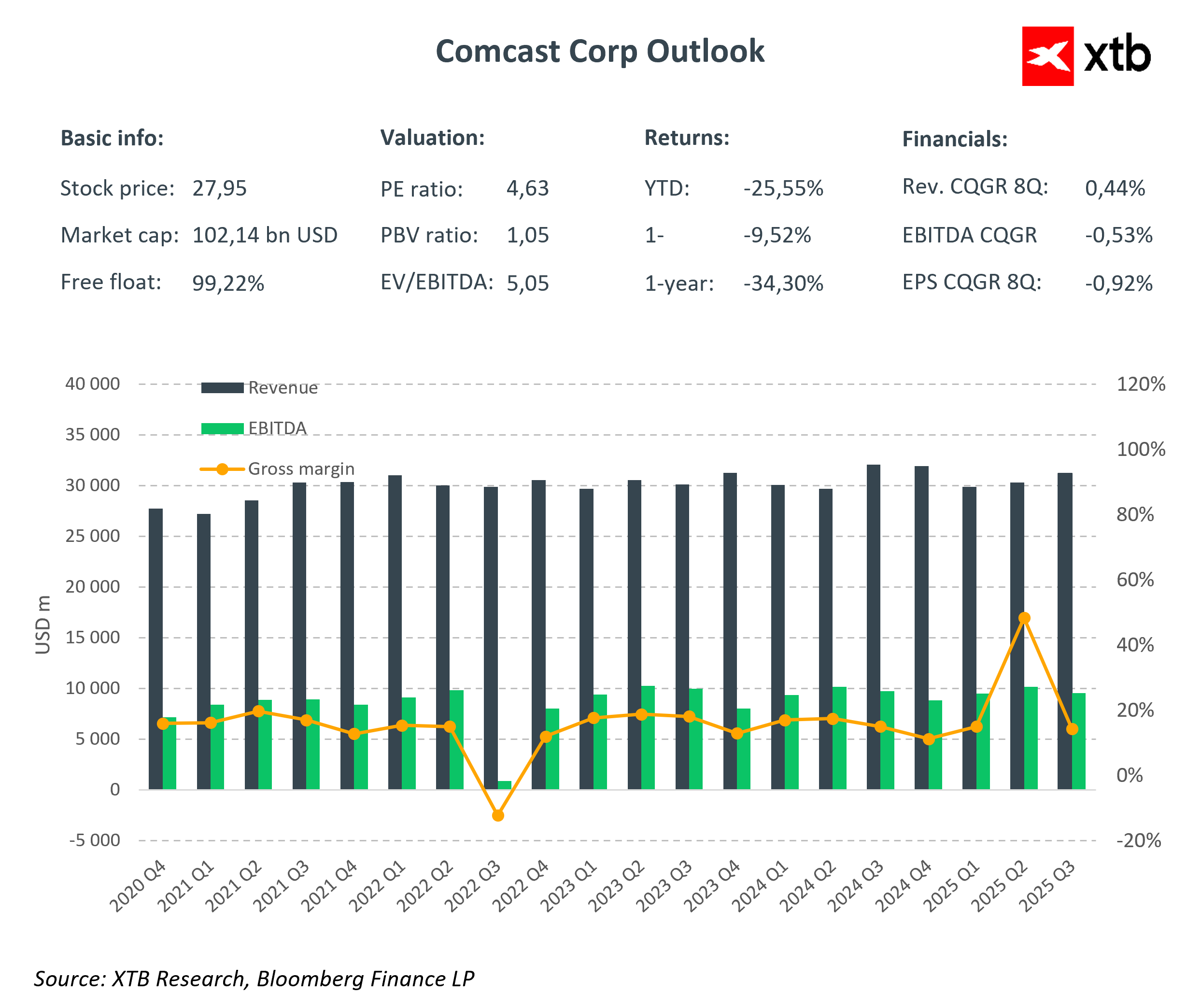
To analyze Comcast’s capital strength and enterprise financial position, the table below summarizes the key financial metrics derived from annual reporting and stock market valuations.
| Valuation & Accounting Metric | Approximate Value / Range | Primary Driver / Description |
|---|---|---|
| Market Capitalization | $150B – $180B | Daily total equity value calculated via NASDAQ: CMCSA shares |
| Stockholders' Equity (Book Value) | $80B – $95B | GAAP net assets (Total Consolidated Assets minus Total Liabilities) |
| Enterprise Value (EV) | $240B – $270B | Combined market value of equity plus net debt load |
| Annual Revenue | $120B – $125B | Gross revenue from Connectivity, NBCUniversal, and Sky operations |
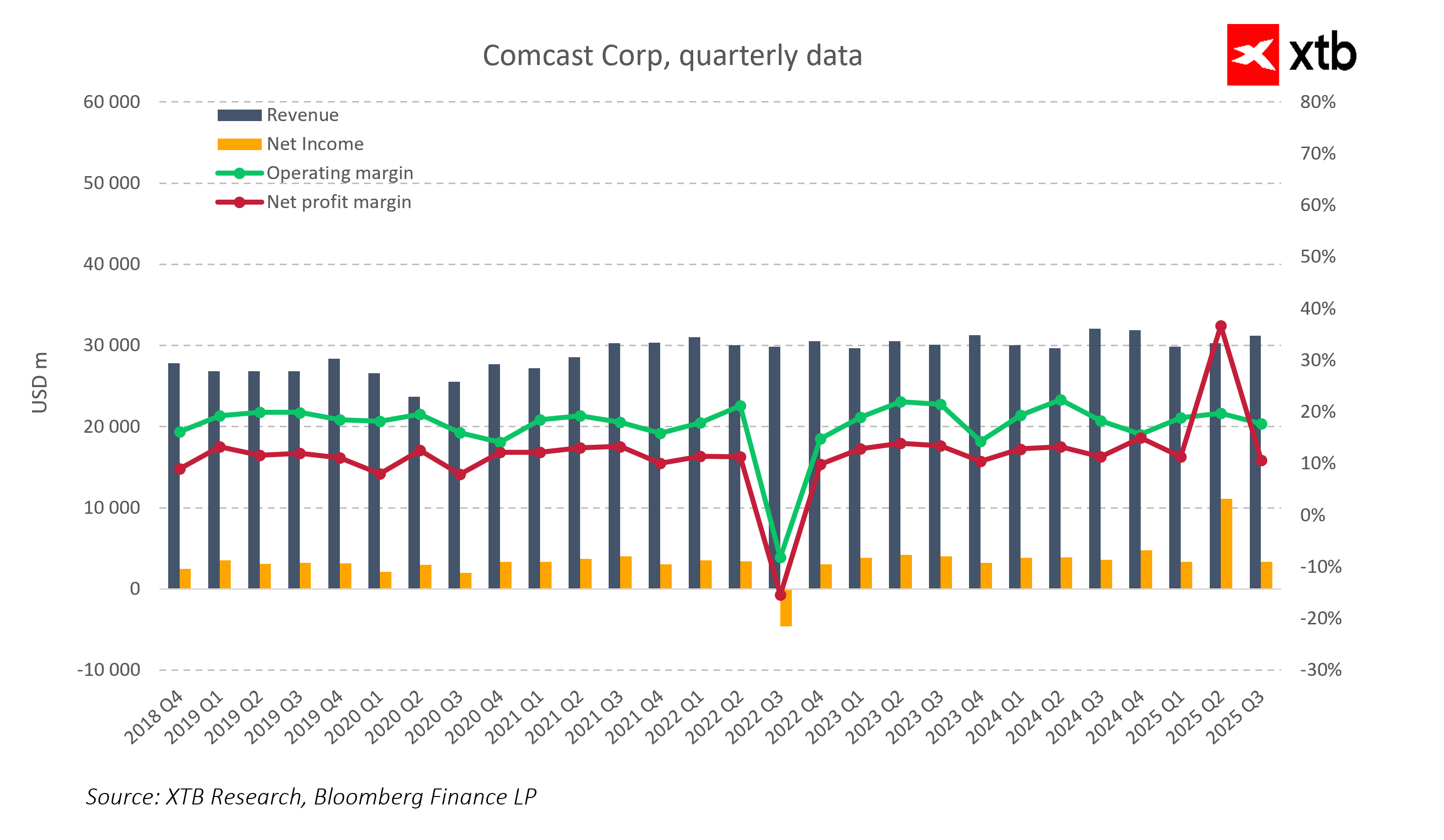
| Consolidated Net Income | $14B – $16B | GAAP annual profit after taxes, interest, and operating costs |
| Free Cash Flow (FCF) | $13B – $17B | Operating cash flow minus capital expenditures (network builds/upgrades) |
| Total Assets | $250B – $260B | Physical cable plant, real estate, theme parks, goodwill, and intangibles |
| Total Liabilities & Debt | $160B – $175B | Long-term debt obligations, leases, accounts payable, and tax liabilities |
Key Core Drivers of Comcast's Financial Standing
Comcast's consolidated valuation is generated across three major operating segments, each contributing differently to recurring cash flow, earnings before interest, taxes, depreciation, and amortization (EBITDA), and debt coverage.
- Connectivity & Platforms
- Xfinity Broadband
- Xfinity Mobile
- Business Services
- NBCUniversal Media
- Universal Studios
- Peacock Streaming
- Theme Parks & Resorts
- Sky Group
- UK/Europe Pay
- International Broadband
1. Connectivity & Platforms (Xfinity Broadband and Mobile)
The primary financial engine driving Comcast's underlying balance sheet strength is its Connectivity & Platforms division (formerly Cable Communications). High-margin residential broadband internet, commercial business services, and mobile connectivity generate the vast majority of cash flow.
Although traditional linear cable television subscriptions have faced steady decline due to cord-cutting, Comcast offset video sub losses by increasing average revenue per user (ARPU) on high-speed internet packages, expanding fiber-coaxial network capabilities, and scaling its Xfinity Mobile wireless business through its Mobile Virtual Network Operator (MVNO) agreement with Verizon.
2. NBCUniversal (Content, Streaming, and Theme Parks)
Acquired fully in 2013 from General Electric, NBCUniversal provides asset diversification and substantial brand equity. NBCUniversal contributes to corporate net worth across three main areas:
- Media & Entertainment: NBC broadcast network, cable networks (USA, CNBC, MSNBC), and sports rights licenses.
- Direct-to-Consumer (Peacock): Comcast's flagship streaming platform, which requires ongoing capital investment to compete in subscriptions and advertising revenue.
- Parks & Experiences: Universal Destinations & Experiences, including Universal Studios Hollywood, Universal Orlando Resort (enhanced by major investments like Epic Universe), and international parks in Japan and Beijing. Theme parks represent capital-intensive physical real estate assets yielding high operating cash flows.
3. Sky Group (European Media and Telecommunications)
Comcast acquired UK-based Sky plc in 2018 for approximately $39 billion. Sky provides satellite television, broadband internet, mobile services, and premium sports coverage across key European markets including the United Kingdom, Germany, and Italy. While the acquisition added significant long-term debt to Comcast's balance sheet, Sky provides international geographical diversification and extensive direct-to-consumer relationships across Europe.
Capital Allocation, Debt Load, and Shareholder Yield
A complete evaluation of Comcast's financial health requires examining how management balances capital expenditure requirements against debt repayment, share repurchases, and dividend payouts.
Debt Management and Credit Ratings
Telecommunications companies typically leverage low-cost long-term debt to fund extensive physical network buildouts and acquisitions. Comcast maintains an investment-grade corporate credit rating (typically BBB+ / A3 from major rating agencies), allowing it to refinance maturing debt at competitive interest rates. Management actively targets a net-debt-to-Adjusted-EBITDA leverage ratio of roughly 2.4x to 2.5x to balance growth investments with capital stability.
- Free Cash Flow Generation ($13B - $17B annually)
- Network Infrastructure & Theme Park Capex
- Debt Servicing & Credit Rating Maintenance
- Common Share Dividends (Yielding ~3% to 4%)
- Opportunistic Share Buybacks (Reducing Share Float)
Dividend Growth and Share Buyback Programs
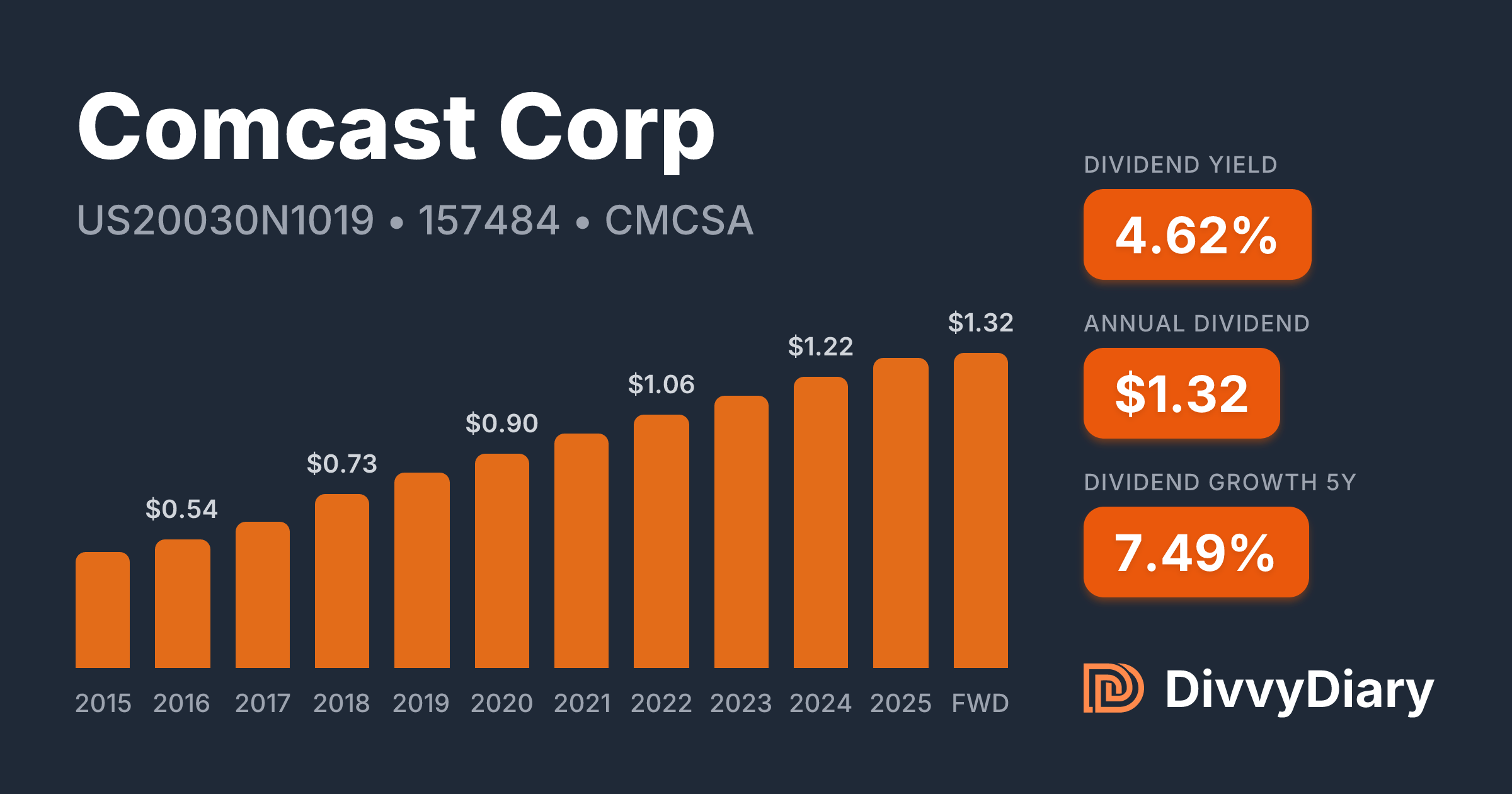
Comcast has established a track record as a dependable dividend growth stock, annually increasing its common stock dividend for over a decade. By returning billions of dollars directly to equity holders through cash dividends and share repurchases, Comcast systematically reduces its total share count over time. Reducing shares outstanding concentrates future net income and earnings per share (EPS) across a smaller pool of stock, providing structural support to market capitalization metrics over long timeframes.
Executive Leadership and Controlling Ownership Structure
While discussing corporate net worth, investors often inquire about executive compensation and voting rights within Comcast's corporate governance structure.
Brian L. Roberts' Net Worth and Class B Voting Rights
Brian L. Roberts, Chairman and Chief Executive Officer of Comcast Corporation, holds an estimated personal net worth of $1.5 billion to $2.2 billion, derived primarily from his historical holdings of Comcast equity, executive stock options, and salary compensation.
- Class A Common Stock (NASDAQ: CMCSA)
- Held by public retail & institutional investors
- Represents economic ownership and majority economic value
- Class B Common Stock (Unlisted)
- Held exclusively by the Roberts Family Trust / Brian L. Roberts
- Entitled to a non-dilutive 33.33% total voting power
Comcast operates under a dual-class share structure established by founder Ralph J. Roberts. While Class A shares (NASDAQ: CMCSA) are held by the public and institutional investors (such as Vanguard and BlackRock), Class B common shares carry a non-dilutive 33.33% total voting power. This structure ensures that Brian L. Roberts retains decisive voting control over major corporate transactions, board elections, and strategic decisions, despite holding a minority of total economic equity.
Evaluating Comcast's Long-Term Financial Stability
For investors, creditors, and market analysts, Comcast's enterprise value and financial position present clear structural strengths alongside ongoing operational challenges.
Financial Strengths
- Predictable Recurring Revenue: Millions of residential and business broadband connections provide steady, subscription-based cash flow less vulnerable to immediate macroeconomic downturns.
- Diversified Media Assets: Combined cable, streaming, news, sports, and international distribution hedge against single-market downturns.
- Substantial Free Cash Flow: Generating $13B to $17B in annual free cash flow provides liquidity for network upgrades (such as DOCSIS 4.0 implementation) without compromising dividend obligations.
Risk Factors and Constraints
- High Infrastructure Depreciation: Upgrading hybrid fiber-coaxial networks and expanding fiber connectivity requires annual capital expenditures running into billions of dollars.
- Cord-Cutting Acceleration: Ongoing declines in traditional pay-TV bundle subscriptions strain legacy cable network revenues and retransmission fee growth.
- Competitive Fiber Expansion: Regional fiber-to-the-home (FTTH) builders and fixed-wireless access (FWA) offered by cellular carriers challenge residential broadband growth.
Frequently Asked Questions
What is Comcast Holding Corp's total net worth?
Comcast's financial net worth is evaluated either as balance sheet stockholders' equity (book value) of approximately $80 billion to $95 billion or as market capitalization (equity value determined by public investors) ranging between $150 billion and $180 billion.
What is the difference between Comcast Corporation and Comcast Holdings Corporation?
Comcast Holdings Corporation is a historic legal entity and subsidiary structure within the broader corporate organization. Today, the publicly traded parent enterprise is Comcast Corporation, listed on the NASDAQ exchange under the ticker symbol CMCSA.
How much net worth does Comcast CEO Brian L. Roberts have?
Comcast CEO Brian L. Roberts has an estimated personal net worth of $1.5 billion to $2.2 billion. His wealth is predominantly held in Comcast equity, stock options, and family trust assets tied to the company's Class B controlling stock.
How does debt impact Comcast’s overall corporate value?
Comcast carries significant long-term debt incurred from strategic acquisitions like NBCUniversal and Sky, as well as ongoing physical network buildouts. As a result, its Enterprise Value (EV)—which accounts for net debt—exceeds $240 billion, even though its market capitalization is lower.
Does Comcast pay a regular shareholder dividend?
Yes, Comcast Corporation pays a quarterly cash dividend on its Class A common stock. The company has maintained a history of annual dividend increases, making cash payouts a core component of its shareholder yield strategy.
Where can I verify Comcast's current, official audited net assets?
Official net asset figures, asset valuations, total liabilities, and detailed segment earnings are reported quarterly and annually to the U.S. Securities and Exchange Commission (SEC) on Form 10-Q and Form 10-K, accessible directly via SEC EDGAR Search or Comcast's official Investor Relations portal.
Summary and Investor Guidance
Evaluating "comcast holding corp net worth" requires selecting the financial context appropriate for your analysis. If you are examining corporate solvency and physical asset backing, focus on Stockholders' Equity (GAAP net assets of ~$80B–$95B). If you are evaluating current equity market valuation, analyze Market Capitalization (NASDAQ: CMCSA at $150B–$180B). For complete acquisition or capital structure modeling, use Enterprise Value ($240B–$270B) to reflect total debt and operating assets.
Before making investment decisions, review the latest SEC Form 10-K filings, quarterly debt leverage metrics, and segment cash flows directly from official investor disclosures.
Disclaimer: This analysis is provided strictly for educational and informational purposes and does not constitute personalized financial, investment, legal, or accounting advice.
Image Gallery