Navigating the Mechanics of Life Insurance Tax-Free Income
Life insurance can provide tax-free income primarily through policy loans and withdrawals from the cash value accumulated within permanent life insurance policies, provided the policy remains in force and does not become a Modified End...
Life insurance can provide tax-free income primarily through policy loans and withdrawals from the cash value accumulated within permanent life insurance policies, provided the policy remains in force and does not become a Modified Endowment Contract (MEC) under Internal Revenue Service (IRS) guidelines.
Contents
For individuals looking to diversify their retirement streams or protect their estates, permanent life insurance products are frequently marketed not just as safety nets for survivors, but as sophisticated financial planning tools. Among these, the promise of tax-free income stands out as one of the most compelling selling points. However, unlocking this benefit requires navigating a complex framework of tax laws, policy mechanics, and ongoing maintenance costs. Understanding how cash value grows, how loans and withdrawals function, and what pitfalls to avoid is essential for anyone considering life insurance as an income vehicle.
The Foundation: Permanent Life Insurance and Cash Value
To understand how life insurance can generate tax-free income, one must first look at the mechanics of permanent life insurance. Unlike term life insurance, which provides coverage for a specific period and offers no residual financial value, permanent life insurance—such as Whole Life, Universal Life (UL), Indexed Universal Life (IUL), and Variable Universal Life (VUL)—remains in force for the insured’s entire life, provided premiums are paid.
These permanent policies include a cash value component alongside the death benefit. A portion of the premium payments goes toward the cost of insurance and administrative fees, while the remainder is directed into a cash value account. This account grows on a tax-deferred basis, meaning policyholders do not pay annual income taxes on the interest, dividends, or market gains credited to their policy.
How Cash Value Accumulates
The rate at which cash value grows depends on the specific type of permanent policy:
- Whole Life: Features guaranteed minimum growth rates and fixed premiums, backed by the general account of the insurance carrier. Dividends may be paid out, though they are never guaranteed.
- Universal Life: Offers flexible premiums and adjustable death benefits, with cash value tied to current interest rates set by the insurer.
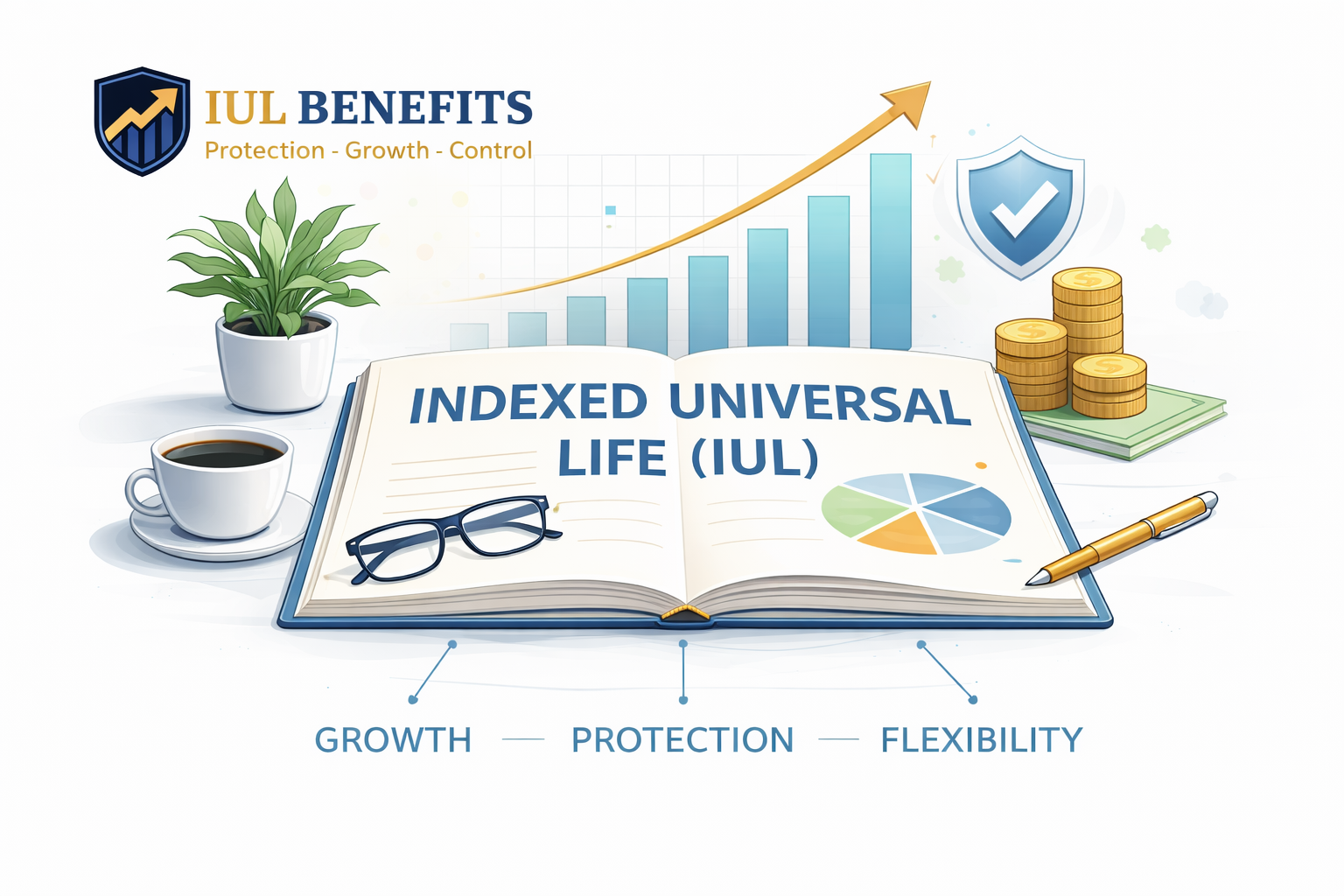
- Indexed Universal Life: Links cash value growth to the performance of an external market index, such as the S&P 500, typically featuring a guaranteed floor (often 0%) and a participation cap.
- Variable Universal Life: Directs cash value into underlying sub-accounts similar to mutual funds, exposing the principal to direct market risk and potential rewards.
Mechanisms of Access: Loans Versus Withdrawals
Accumulating cash value is only the first step. To utilize that money during retirement without triggering a massive tax bill, policyholders must rely on specific distribution methods recognized by the IRS. The two primary avenues are withdrawals and policy loans.
Withdrawals (Cost Recovery Rule)
When a policyholder takes a withdrawal from a permanent life insurance policy, the IRS applies the "cost recovery rule" (often referred to as FIFO, or First-In, First-Out). Under this rule, withdrawals are treated as a return of the principal-the premiums the policyholder has already paid into the system with after-tax dollars. Because this money was already taxed, the initial withdrawals are entirely tax-free.
Once the total withdrawals equal the total basis (premiums paid), any subsequent withdrawals are treated as taxable income, taxed as ordinary income rather than capital gains.
Policy Loans
Rather than withdrawing cash directly, many financial planners recommend taking policy loans against the cash value. When a policyholder takes a loan, the insurance company uses the cash value as collateral. The insurer advances the funds from its own general account, while the policyholder's cash value continues to earn interest or dividends within the policy.
- Tax Status: Because loans are considered debt rather than income, they are generally not subject to income tax.
- Interest and Fees: The insurance company charges interest on the loan. However, many permanent policies offer "wash loans" or participating loans where the interest charged by the insurer is largely offset by the interest credited to the cash value collateral.
- Repayment: Policy loans do not legally require scheduled out-of-pocket repayments during the insured's lifetime. Instead, the outstanding loan balance, plus accrued interest, is simply deducted from the death benefit when the insured passes away.
| Feature | Policy Withdrawals | Policy Loans |
|---|---|---|
| Tax Treatment | Tax-free up to the cost basis; taxable as ordinary income thereafter. | Generally tax-free as long as the policy remains in force. |
| Impact on Cash Value | Permanently reduces the cash value and often the death benefit. | Cash value remains in the account, serving as collateral while continuing to earn interest. |
| Repayment Requirement | None (funds are permanently removed). | Not required during life, but subtracted from the final death benefit. |
| Risk of Policy Lapse | Low risk unless withdrawals deplete the account entirely. | High risk if loan balances exceed cash value, triggering a taxable event. |
The IRS Trap: Modified Endowment Contracts (MECs)
The primary legislative safeguard governing life insurance tax advantages is the definition of life insurance outlined in Internal Revenue Code Section 7702. If a policy is funded too aggressively in its early years, it can trip the "7-pay test"—a federal benchmark that measures whether the cumulative premiums paid over the first seven years exceed what is required to fund the policy's future death benefit.
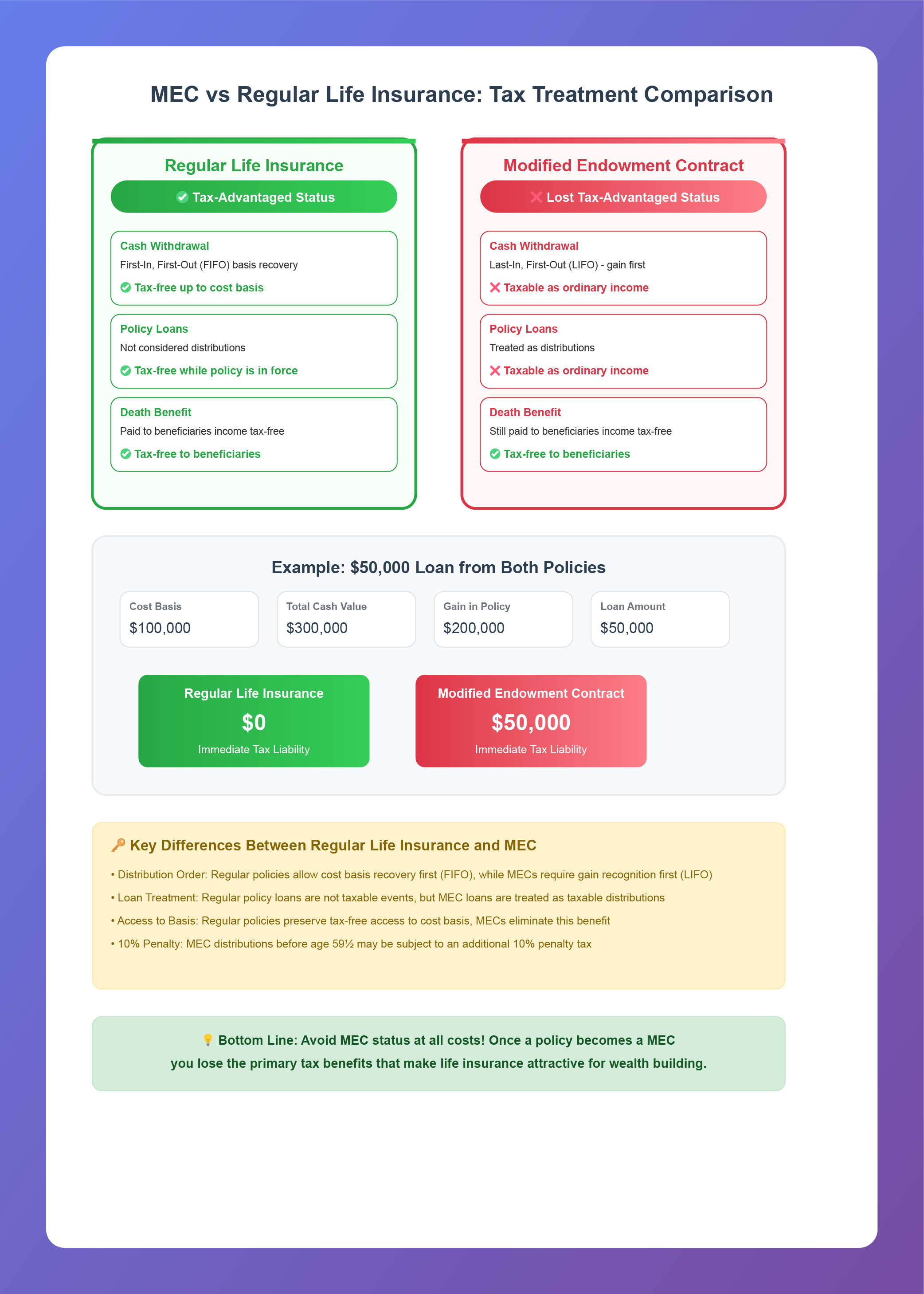
If a policy fails this test, it is reclassified as a Modified Endowment Contract (MEC).
Once a policy becomes a MEC, its tax advantages shift dramatically:
- LIFO Treatment: Distributions, loans, and withdrawals are subject to Last-In, First-Out (LIFO) tax rules. This means earnings are withdrawn first, and they are taxed as ordinary income.
- Early Withdrawal Penalties: If the policyholder is under age 59½, distributions of earnings from a MEC are subject to a 10% IRS early withdrawal penalty, mirroring the rules governing traditional IRAs and 401(k)s.
Maintaining non-MEC status requires careful monitoring of premium contributions, often requiring the guidance of a licensed financial professional or insurance actuary to ensure funding stays within regulatory boundaries.
Comparing Tax-Free Income Vehicles
To evaluate whether life insurance tax-free income fits into a broader retirement strategy, it helps to compare it against other common tax-advantaged accounts, such as Roth IRAs and Roth 401(k)s.
| Attribute | Permanent Life Insurance | Roth IRA / Roth 401(k) |
|---|---|---|
| Contribution Limits | No IRS statutory limits on contributions, though limited by underwriting and policy design. | Strict annual contribution limits set by the IRS (adjusted periodically). |
| Income Restrictions | None; high earners can utilize permanent policies regardless of income. | Subject to IRS phase-out income limits for Roth IRAs. |
| Access Prior to Age 59½ | Available via loans and withdrawals at any age without IRS early distribution penalties (subject to policy rules). | Contributions can be withdrawn tax-free anytime; earnings withdrawals before 59½ may trigger taxes and penalties. |
| Underwriting Required | Yes; requires medical underwriting and approval based on health and age. | No underwriting required. |
| Upfront Costs | High commissions, mortality charges, and administrative fees, especially in early years. | Low or negligible maintenance and investment management fees. |
Practical Risks and Operational Limitations
While the prospect of tax-free retirement income is attractive, life insurance policies come with distinct operational risks that require careful management:
- High Internal Costs: Permanent life insurance policies carry significant fees, including mortality and expense charges, administrative costs, and potential surrender charges that can last for the first 10 to 15 years of the contract.
- Underperformance Risk: For variable or indexed policies, if the underlying market or crediting strategy performs poorly over an extended period, the cash value may fail to grow as projected. This can force the policyholder to pay higher-than-expected out-of-pocket premiums to keep the policy from lapsing.
- The Lapse Time Bomb: If a policy has substantial outstanding loans and the cash value drops—due to poor performance, increased cost-of-insurance charges as the insured ages, or insufficient premium payments—the policy can lapse. When a policy lapses with outstanding loans exceeding the basis, the IRS treats the entire forgiven loan amount as taxable income realized in that single tax year, potentially triggering a massive, unexpected tax liability.
Frequently Asked Questions
Can anyone qualify for tax-free income through life insurance?
Qualifying requires being insurable. Applicants must pass medical underwriting. Individuals with significant health issues may face high premium costs or outright denial, making the strategy economically unviable. Furthermore, the strategy requires capital to fund the policy adequately during its accumulation phase.
How do I ensure my life insurance policy does not become a MEC?
To prevent a policy from becoming a Modified Endowment Contract, contributions must comply with the 7-pay test governed by IRC Section 7702. Working with an experienced insurance agent or financial planner allows you to structure premium payments and utilize "corridor" options that adjust the death benefit upward as cash value grows.
What happens to outstanding policy loans when I die?
When the insured passes away, the insurance company settles the death benefit by subtracting any outstanding loan balance and accrued interest from the total payout. The remaining balance is then distributed to the beneficiaries tax-free. However, if the loan balance exceeded the cash value prior to death, the policy may have lapsed prematurely, altering the tax outcome.
Are all withdrawals from cash value completely tax-free?
Withdrawals are tax-free only up to the policyholder's cost basis (the total amount of premiums paid into the policy). Once withdrawals exceed the cost basis, any additional withdrawals or distributions are treated as taxable ordinary income.
How do rising interest rates affect life insurance cash value loans?
When benchmark interest rates rise, insurance carriers often increase the loan interest rate charged on policy loans. If the policy features a fixed or capped crediting rate on the cash value, the spread between what the cash value earns and what the loan costs can widen, placing a heavier financial drain on the policy's underlying reserves.
Conclusion and Next Actions
Generating tax-free income through life insurance is a sophisticated strategy best suited for high-earning individuals who have already maximized traditional retirement accounts like 401(k)s and IRAs. Because of the high upfront costs, complex IRS regulations, and the ongoing risk of policy lapse, it is not a universal solution.
If you are considering this strategy, your next step should be to consult with an independent fee-only financial planner and an insurance specialist. Request a comprehensive, inforce ledger illustration that models conservative, median, and poor-performance scenarios over a 30-year horizon to evaluate how the policy will behave under stress before committing capital.
Image Gallery