Why Does the TSA Limit Liquids in Carry-On Bags?
The Transportation Security Administration (TSA) limits liquids in carry-on bags to prevent the assembly of liquid explosives during a flight. By restricting containers to 3.4 ounces (100 milliliters) and requiring them to fit in a sin...
The Transportation Security Administration (TSA) limits liquids in carry-on bags to prevent the assembly of liquid explosives during a flight. By restricting containers to 3.4 ounces (100 milliliters) and requiring them to fit in a single quart-sized bag, security protocols ensure that any potentially hazardous substances are kept below the volume necessary to cause a catastrophic explosion.
Contents
The Catalyst: Operation Overt and the 2006 Liquid Plot
To understand why these restrictions exist in 2026, one must look back to August 2006. Before this time, passengers could bring almost any amount of liquid through security checkpoints. The policy changed overnight due to a foiled terrorist plot in the United Kingdom known as Operation Overt.
British intelligence discovered a plan to detonate liquid explosives on board multiple transatlantic flights traveling from London to various North American cities. The conspirators intended to use common sports drink bottles to conceal binary explosive components. They planned to assemble these components in the aircraft lavatories and detonate them using a charge from a small electronic device, such as a camera or a cellular phone.
The primary substance involved was hydrogen peroxide, a high-strength oxidizer that, when mixed with other specific chemicals, becomes a powerful explosive. Because these precursors are clear liquids, they are nearly indistinguishable from water or soda during a standard X-ray scan. Immediately following the discovery of this plot, the TSA and international aviation authorities implemented a total ban on liquids, which was later refined into the "3-1-1" rule we use today.
The Science of Volumetric Limits
The specific limit of 3.4 ounces (100ml) is not an arbitrary number. It is based on the "critical diameter" and the minimum quantity of explosive material required to cause significant structural damage to a pressurized aircraft hull.
Critical Diameter and Detonation
In explosives science, the critical diameter is the minimum physical width a substance must have to sustain a detonation wave. If an explosive is contained in a vessel too small, the energy dissipates too quickly for the reaction to become self-sustaining. By limiting each container to 100ml, security agencies ensure that even if a passenger managed to bring a dangerous liquid on board, the individual container size is generally insufficient to initiate a powerful, high-order explosion.
The Cumulative Effect
While 100ml might be safe individually, a person carrying several liters of liquid would pose a significant threat. This is why the TSA enforces the "one quart-sized bag" rule. By limiting the total volume of all containers to what can fit in a single, clear, quart-sized plastic bag, the TSA effectively caps the total amount of liquid any single passenger can possess. Security experts have determined that the total volume allowed in a one-quart bag is below the threshold needed to destroy a modern commercial aircraft, provided the liquids are handled and screened correctly.
Technological Challenges in Liquid Detection
The reason liquids remain a focal point of security theater is that they are fundamentally more difficult to analyze than solid objects.
2D X-Ray Limitations
Traditional X-ray machines used at airports produce a two-dimensional image based on the density of the objects in a bag. While these machines are excellent at identifying metallic objects like knives or firearms, they struggle with "organic" materials. Many explosives, both solid and liquid, are made of organic compounds (carbon, hydrogen, nitrogen, and oxygen). On a standard X-ray screen, water, gin, hair gel, and liquid explosives often look identical—they all appear as various shades of orange.
Computed Tomography (CT) Advancement
As of 2026, many major airports have transitioned to Computed Tomography (CT) scanners for carry-on luggage. These machines are more advanced versions of the CT scanners used in hospitals. They take hundreds of images as the bag passes through a rotating X-ray, creating a 3D model that allows the computer to calculate the exact mass and density of a liquid.
These algorithms can detect the "atomic number" of a substance. If the density and atomic number match the known signature of an explosive, the machine alerts the operator. In lanes equipped with these 3D scanners, the TSA has occasionally relaxed the requirement to remove liquids from bags, though the 3.4-ounce volume limit remains the standard for most travelers to maintain consistency across the global aviation network.
The 3-1-1 Rule Explained
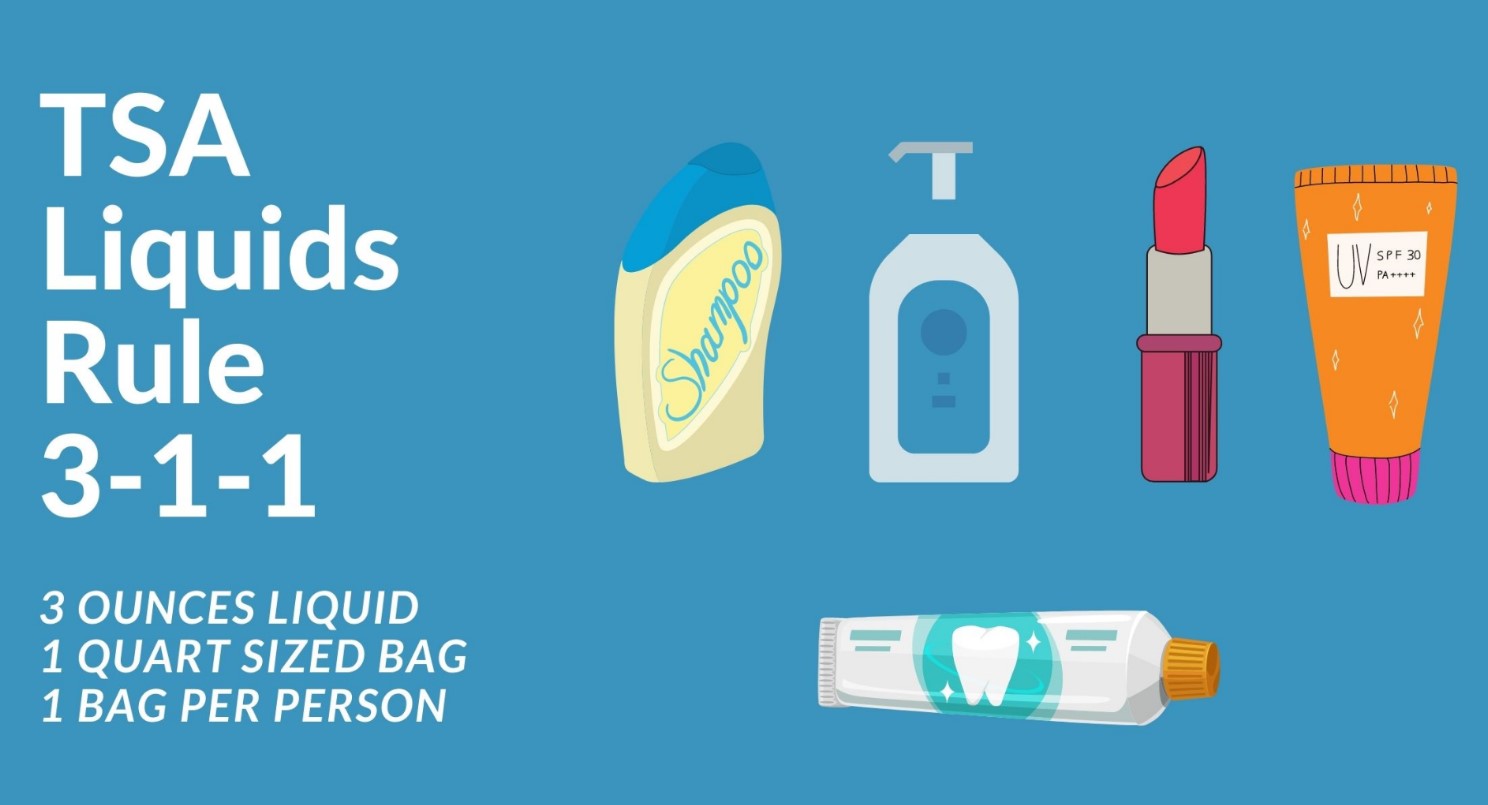
The TSA's "3-1-1" acronym serves as a memory aid for passengers to ensure they comply with the regulations and speed up the screening process.
- 3: Each liquid, gel, aerosol, cream, or paste must be in a container of 3.4 ounces (100 milliliters) or less. It is important to note that the container itself must be 3.4 ounces or smaller; a half-empty 6-ounce tube of toothpaste is not permitted.
- 1: All containers must fit inside one clear, plastic, quart-sized, zip-top bag.
- 1: Each passenger is allowed only one such bag in their carry-on.
Defining "Liquids, Gels, and Aerosols"
The TSA uses a broad definition for what constitutes a liquid. A common rule of thumb is: "If you can spill it, spray it, spread it, pump it, or pour it, it’s a liquid." This includes items that travelers might mistakenly categorize as solids, such as:
- Peanut butter and Nutella.
- Mashed potatoes or gravy.
- Deodorant (gel or spray; solid sticks are exempt).
- Snow globes.
- Lip gloss and mascara.
Necessary Exceptions to Liquid Restrictions
The TSA recognizes that certain liquids are essential for health and safety. These items are exempt from the 3-1-1 rule, though they still require manual inspection.
| Category | Permitted Items | Requirements |
|---|---|---|
| Medical | Prescription liquids, insulin, eye drops, saline solution. | Must be declared; may undergo additional screening (vapor test). |
| Infants/Toddlers | Breast milk, formula, juice, baby food (purees). | Allowed in "reasonable quantities"; do not need to fit in a quart bag. |
| Duty-Free | Alcohol or perfumes purchased at the airport. | Must be in a Secure Tamper-Evident Bag (STEB) with a receipt. |
| Life-Sustainers | Liquids used to cool vital medical organs or bones. | Requires documentation and specialized screening. |
The Screening Process for Exceptions
When a passenger carries exempted liquids, they must notify a TSA officer at the start of the screening process. These liquids are often placed in a separate bin and may be subjected to Liquid Explosive Detection Systems (LEDS). This often involves the officer opening the container to wave a pH strip or a vapor-sensing wand over the opening to ensure the contents do not emit chemical signatures associated with explosives.
Why Can’t I Just Bring a Large Water Bottle?
The most common frustration for travelers is the inability to bring bottled water through security. While a single bottle of water is not a threat, the logistical challenge is that a TSA officer cannot verify the contents of every bottle quickly.
If the TSA allowed one person to bring a 16-ounce bottle of "water," they would have to chemically test every single bottle brought through the line to ensure it wasn't actually liquid explosive. This would grind airport security to a halt. Instead, the TSA mandates that passengers empty their bottles before the checkpoint and refill them at "hydration stations" on the secure side, where the water source is verified and safe.
The Global Standard: Why the Rule Persists in 2026
You might wonder why, with 2026 technology, we still follow rules established two decades ago. The answer lies in international harmonization. The International Civil Aviation Organization (ICAO) sets standards that most countries follow to ensure a seamless travel experience.
If the United States unilaterally abolished the liquid limit, passengers transferring in London, Tokyo, or Paris would find their belongings confiscated during their layover because those regions still enforce the 100ml limit. Until the majority of the world’s 40,000+ airports are equipped with high-end CT scanners and automated explosive detection, the 3-1-1 rule remains the most practical way to maintain global aviation security.
Frequently Asked Questions
Does the liquid limit apply to checked bags?
No. The 3.4-ounce limit applies only to carry-on luggage. You can pack full-sized bottles of shampoo, wine, or other liquids in your checked bags. These bags are screened by large-scale, automated explosive detection systems in the belly of the airport that are much more powerful than the machines used at passenger checkpoints.
Can I bring frozen liquids through security?
Yes, but with a strict condition. If a liquid is frozen solid (like an ice pack or a frozen water bottle) at the time it passes through the X-ray, it is treated as a solid. However, if there is any liquid at the bottom of the container or if the item is "slushy," it must meet the 3.4-ounce requirement or it will be confiscated.
What happens if I accidentally leave a large liquid in my bag?
If a large liquid is detected, your bag will be pulled for secondary screening. A TSA officer will manually inspect the bag and locate the item. Generally, you will be given the option to go back and check the bag, give the item to a friend who isn't flying, or simply abandon it so it can be disposed of.
Are solid toiletries better for travel?
In 2026, many frequent flyers have transitioned to solid alternatives to avoid the 3-1-1 rule entirely. Solid shampoo bars, toothpaste tablets, and stick deodorants do not count toward your liquid limit, leaving more room in your quart-sized bag for essential items that only come in liquid form.
Why is the limit exactly 100ml/3.4oz?
The limit was standardized internationally. While 3.4 ounces is a slightly awkward number in the U.S. customary system, it is exactly 100 milliliters, which is the standard unit of measurement used by most of the world's aviation authorities.
Practical Recommendations for Travelers
To ensure a smooth experience at the security checkpoint, travelers should proactively manage their liquids. Use a high-quality, reusable quart-sized bag made of clear plastic, which is more durable than standard kitchen bags. Always place this bag in an easily accessible pocket of your carry-on so it can be removed quickly if you are in a lane that does not yet use CT technology.
For those who frequently travel with medical liquids or baby formula, allow an extra 15 minutes for the manual screening process. Being transparent with the TSA officers about these items before they are flagged by the X-ray will almost always result in a faster, more professional interaction.
Image Gallery