Understanding Basic Paper Size Standards and Systems
The term basic paper size refers to the foundational dimension from which a specific paper grade's standard weights and sizes are calculated, though it also colloquially describes standard everyday formats like Letter and A4. Understan...
The term basic paper size refers to the foundational dimension from which a specific paper grade's standard weights and sizes are calculated, though it also colloquially describes standard everyday formats like Letter and A4. Understanding these dimensional systems ensures efficiency across commercial printing, office administration, and publishing workflows.
Contents
Navigating the Fundamentals of Paper Dimensions
Paper sizing is not merely a matter of cutting sheets to random measurements. It is governed by precise industrial standards, historical conventions, and mathematical proportions. When professionals talk about paper sizes, they generally divide the topic into two distinct categories: the standard sizes used for everyday printing and writing, and the specific manufacturing definitions known as basic paper sizes.
For the average consumer, paper size means the sheet loaded into a home printer or bound into a notebook. For printers, publishers, and paper merchants, however, basic paper size represents a foundational manufacturing benchmark. This benchmark determines how heavy a ream of paper is and how efficiently larger parent sheets can be cut down into smaller, usable products without excessive waste.
Resolving this ambiguity requires looking at how different regions approach the concept. In North America, dimensions are anchored by traditional inch-based systems governed by organizations like the American National Standards Institute (ANSI). Meanwhile, the rest of the world relies on the international standard metric system established by the International Organization for Standardization (ISO). Grasping both frameworks is essential for anyone involved in cross-border design, manufacturing, or document production.
The North American Paper Size System
The North American system relies heavily on traditional inch measurements. Unlike the metric system, which scales dimensions by geometric ratios, the North American system evolved from historical hand-moulded paper production.
Standard Office and Consumer Formats
In daily administrative and academic environments, North America relies on a few core formats. The most common of these is Letter size, measuring 8.5 by 11 inches. Larger documents often utilize Legal size (8.5 by 14 inches) or Ledger/Tabloid size (11 by 17 inches). These dimensions are deeply embedded in hardware design, from desktop inkjet printers to high-capacity office multifunction copiers.
- Letter: 8.5 × 11 inches (215.9 × 279.4 mm)
- Legal: 8.5 × 14 inches (215.9 × 355.6 mm)
- Ledger / Tabloid: 11 × 17 inches (279.4 × 431.8 mm)
- Executive: 7.25 × 10.5 inches (184.15 × 266.7 mm)
Understanding Basic Sizes in Manufacturing
In the paper manufacturing and printing industries, the term basic paper size has a much more technical definition. It refers to the standard, un-trimmed size of a specific grade of paper from which its basis weight is calculated. For example, the basic size for bond paper—the type commonly used in office copiers and letterhead—is 17 by 22 inches. A ream (500 sheets) of bond paper at this exact size determines the nominal weight of that paper grade (for example, 20-pound bond).
Different paper grades rely on different basic sizes:
- Bond / Writing: 17 × 22 inches
- Book / Offset: 25 × 38 inches
- Cover: 20 × 26 inches
- Index: 25.5 × 30.5 inches
Because these parent sheets are much larger than final office documents, printing presses run them at scale and then trim them down. Knowing the basic size of a sheet allows press operators to calculate layout efficiency, minimizing paper waste and optimizing production budgets.
The International ISO 216 Metric Paper System
Outside of North America, the ISO 216 standard—commonly known as the A-series—dominates. Developed in Germany in the early 20th century and later adopted globally, this system is rooted in a brilliant mathematical principle: the aspect ratio of all pages is the square root of two (approximately 1:1.4142).
The A-Series Principle
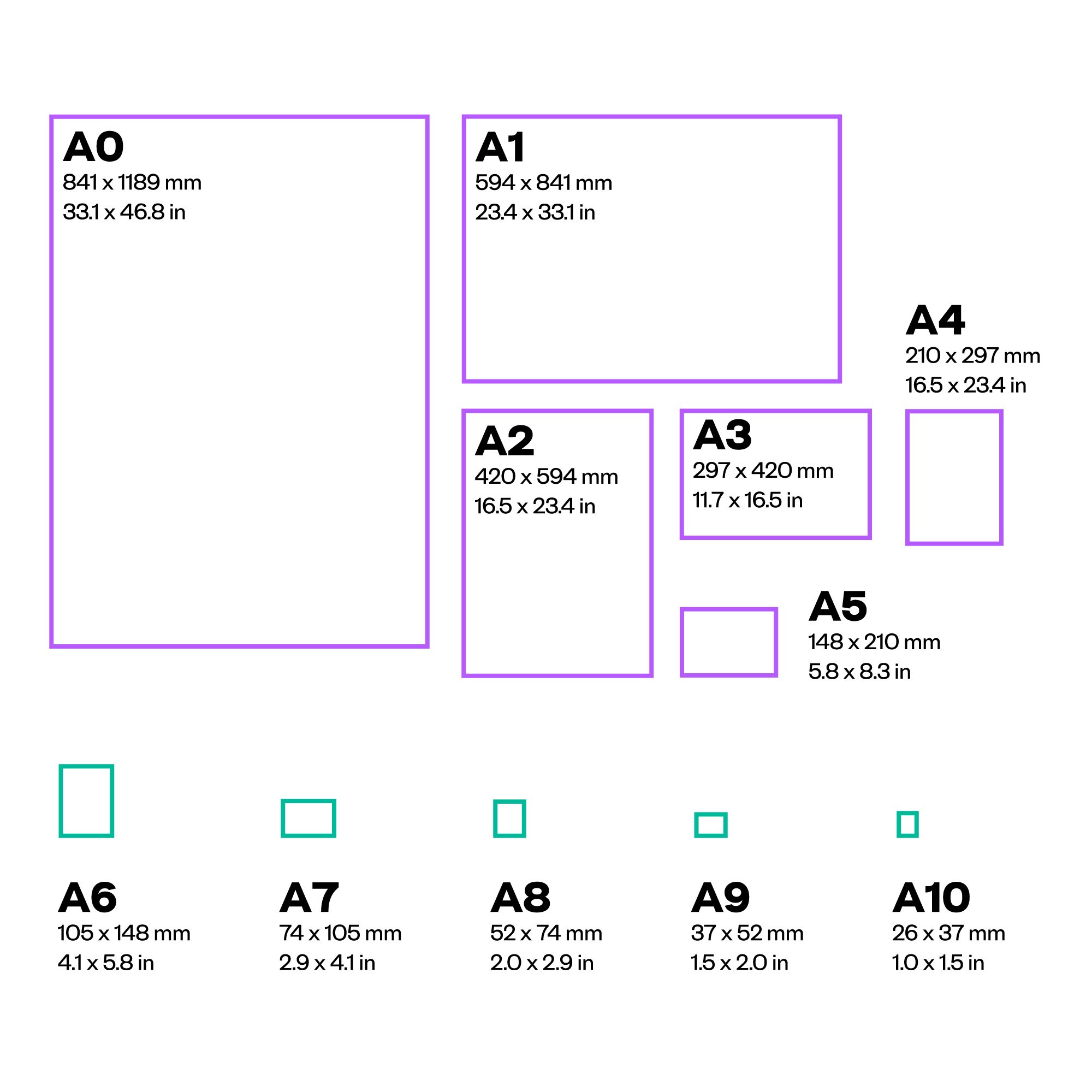
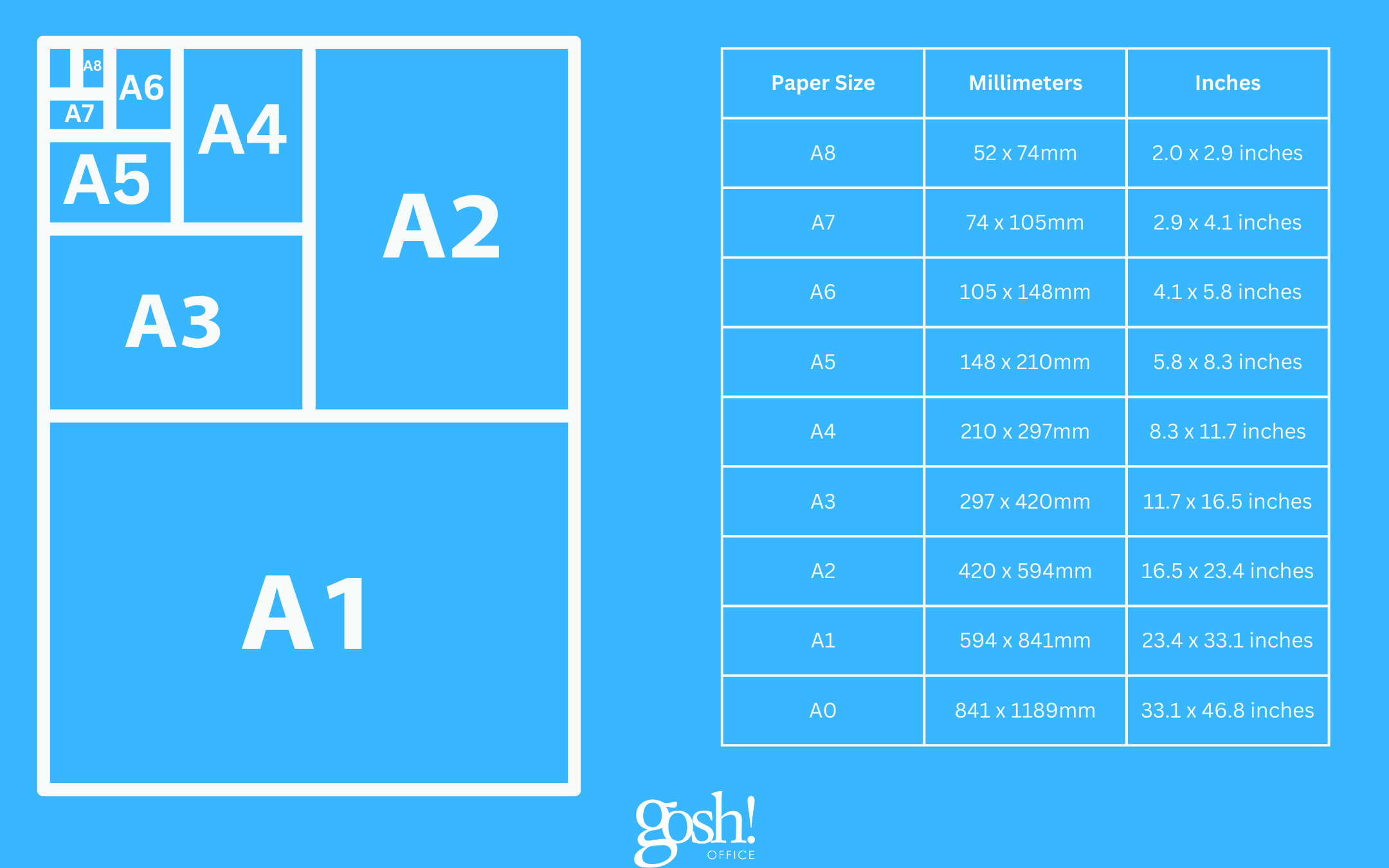
The primary advantage of the ISO system is scaling consistency. If you take an A4 sheet and fold it in half parallel to its shortest side, the resulting two pieces are each exactly an A5 size. Conversely, placing two A4 sheets side by side creates an A3 sheet. This constant aspect ratio means that scaling documents up or down—such as copying an A4 document onto an A3 sheet or reducing it to A5—does not distort the image or leave awkward blank margins.
| Format | Dimensions (Millimeters) | Dimensions (Inches) | Common Practical Application |
|---|---|---|---|
| A0 | 841 × 1189 mm | 33.1 × 46.8 in | Architectural drawings, large posters |
| A1 | 594 × 841 mm | 23.4 × 33.1 in | Engineering plans, flip charts |
| A2 | 420 × 594 mm | 16.5 × 23.4 in | Medium posters, large diagrams |
| A3 | 297 × 420 mm | 11.7 × 16.5 in | Spreadsheets, tabloid-style layouts |
| A4 | 210 × 297 mm | 8.3 × 11.7 in | Standard letters, reports, printing |
| A5 | 148 × 210 mm | 5.8 × 8.3 in | Notebooks, flyers, small pads |
Supplementary ISO Series: B and C
Beyond the popular A-series, the ISO standard includes B and C series to cover edge cases in publishing and envelope manufacturing.
The B-series provides sizes that fall between the steps of the A-series. For instance, a B4 sheet is larger than an A4 sheet but smaller than an A3 sheet. This is particularly useful for posters, books, and wall charts where A-series dimensions are either too small or too large.
The C-series is designed specifically for envelopes. A C4 envelope is sized to comfortably hold an unfolded A4 sheet of paper without bending or folding. Similarly, a C5 envelope accommodates an A5 sheet or a folded A4 sheet.
Practical Implications for Design and Printing
Working across different paper standards requires careful attention to document setup, printer properties, and finishing requirements. Ignoring regional differences can lead to clipped text, formatting errors, and wasted materials.
Margin and Bleed Management
When designing digital documents intended for physical printing, the choice of basic paper size dictates layout margins. An 8.5 x 11-inch document formatted with standard one-inch margins will look severely misaligned if printed on an A4 sheet, which is slightly narrower and longer.
For professional graphic design, bleed areas—extra space added to the edges of a design to ensure ink covers the entire page after trimming—depend heavily on whether the printer is feeding North American standard stock or ISO metric stock. Press operators use the basic size of the parent sheet to nest multiple pages together, maximizing the usable area of the printing plate.
Weight vs. Size Considerations
Paper weight calculations differ significantly between regions, which often causes confusion when ordering paper stock internationally.
- North American Basis Weight: Measured in pounds (lbs) based on the total weight of 500 sheets of the paper's basic size for that specific grade. Because bond paper has a basic size of 17x22 inches while cover stock has a basic size of 20x26 inches, a 65 lb cover stock is vastly heavier and thicker than a 24 lb bond stock.
- International Grammage: Measured in grams per square meter ($g/m^2$ or gsm). This is an absolute measurement. A sheet of 80 gsm paper weighs 80 grams regardless of whether it is cut down to A4, A5, or left as an A0 sheet. This makes international weight specifications much more intuitive for everyday consumers.
Frequently Asked Questions
What is the difference between Letter and A4 paper?
Letter paper measures 8.5 by 11 inches (215.9 by 279.4 mm) and is the standard in North America. A4 paper measures 210 by 297 mm (8.27 by 11.69 inches) and is the international standard defined by ISO 216. A4 is slightly narrower and longer than Letter paper.
How does basic paper size affect paper weight?
In the North American system, paper weight in pounds refers to the weight of 500 sheets of paper at its un-trimmed basic manufacturing size. Because different paper grades (like bond, cover, or index) have different basic sizes, a 24-pound bond paper and a 24-pound cover paper are not the same thickness.
Can I print an A4 document on US Letter paper without scaling?
Printing an A4 document directly onto US Letter paper without scaling will result in either clipped text or unexpected white space, because the two formats have different aspect ratios and overall dimensions. Most printer software includes a "Fit to Page" setting to automatically adjust documents to the loaded paper size.
Why do international paper sizes scale so easily?
The ISO 216 standard uses a constant aspect ratio of the square root of two. When you cut a sheet in half parallel to its short side, the two resulting smaller sheets maintain the exact same proportions as the original sheet, enabling seamless enlargement and reduction.
What is the standard size for commercial printing parent sheets?
Commercial offset printers typically run large parent sheets rather than finished office sizes. For book and offset printing, the traditional basic sheet size is 25 by 38 inches, which allows presses to efficiently cut multiple pages per revolution.
Conclusion
Mastering basic paper size concepts prevents costly production mistakes and streamlines document formatting. Whether you are adjusting printer trays for standard office work or laying out signatures for a commercial press, knowing the distinction between consumer formats and manufacturing dimensions ensures professional results. Always verify your target audience's regional standards before finalizing layouts or ordering paper stock.
Image Gallery