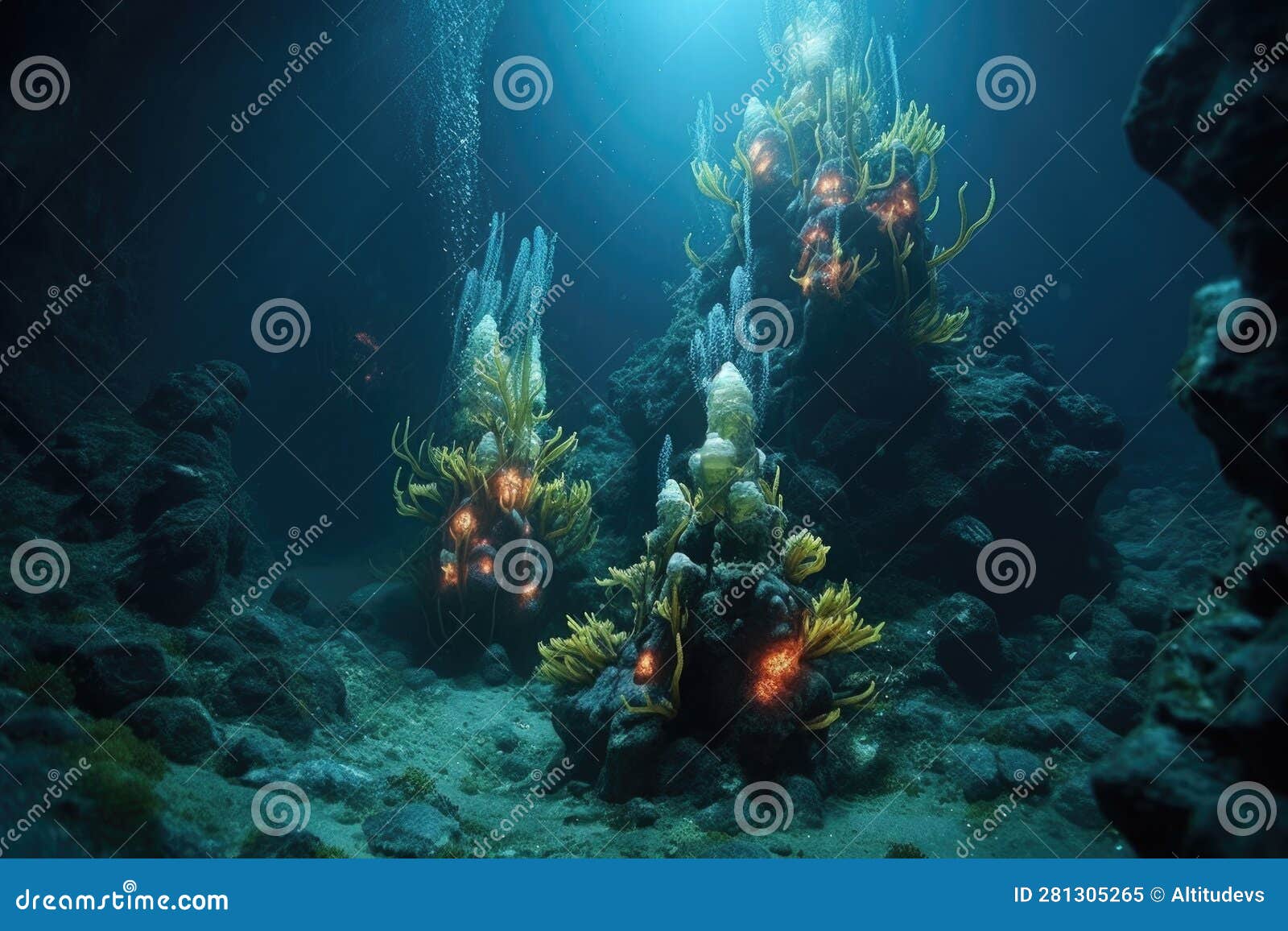
Life in Deep-Sea Vent Ecosystems: Biological Adaptations, Chemosynthesis, and Extreme Environments
Deep-sea hydrothermal vent ecosystems thrive in the bathypelagic and abyssal zones, supported not by sunlight, but by chemosynthesis. Specialized microorganisms convert chemical energy from mineral-rich vent fluids into organic matter....
Deep-sea hydrothermal vent ecosystems thrive in the bathypelagic and abyssal zones, supported not by sunlight, but by chemosynthesis. Specialized microorganisms convert chemical energy from mineral-rich vent fluids into organic matter. This primary production sustains dense communities of specialized organisms—including giant tubeworms, vent shrimp, and armored snails—adapted to toxic fluids, extreme pressure, and severe thermal gradients.
Contents
Geological Foundation and Discovery of Hydrothermal Vents
Hydrothermal vents are deep-ocean localized discharge sites where geothermally heated water escapes from beneath the Earth's crust. Discovered in 1977 by oceanographers aboard the research vessel Lulu using the deep-submergence vehicle Alvin along the Galápagos Rift, these ecosystems fundamentally altered marine biology. Prior to their discovery, oceanographers assumed deep-sea life depended exclusively on organic debris sinking from photic surface waters, known as "marine snow." The discovery revealed entire ecosystems operating independently of solar energy.
Tectonic Mechanisms and Fluid Dynamics
Vents form primarily along mid-ocean ridge systems, back-arc basins, and volcanic arcs where tectonic plates diverge or subduct. Cold seawater (approximately 2°C) percolates down through fractures in the oceanic crust toward shallow magma chambers. As the water approaches molten rock, it reaches temperatures exceeding 400°C.
Under ambient hydrostatic pressures at depths between 2,000 and 4,000 meters (20 to 40 MPa), the superheated fluid remains liquid rather than boiling. This high-temperature environment drives chemical reactions between seawater and surrounding basaltic rock:
- Oxygen is completely stripped from the fluid.
- Sulfate ($SO_4^{2-}$) is reduced to hydrogen sulfide ($H_2S$).
- Metals such as iron, copper, manganese, and zinc are dissolved from the crust.
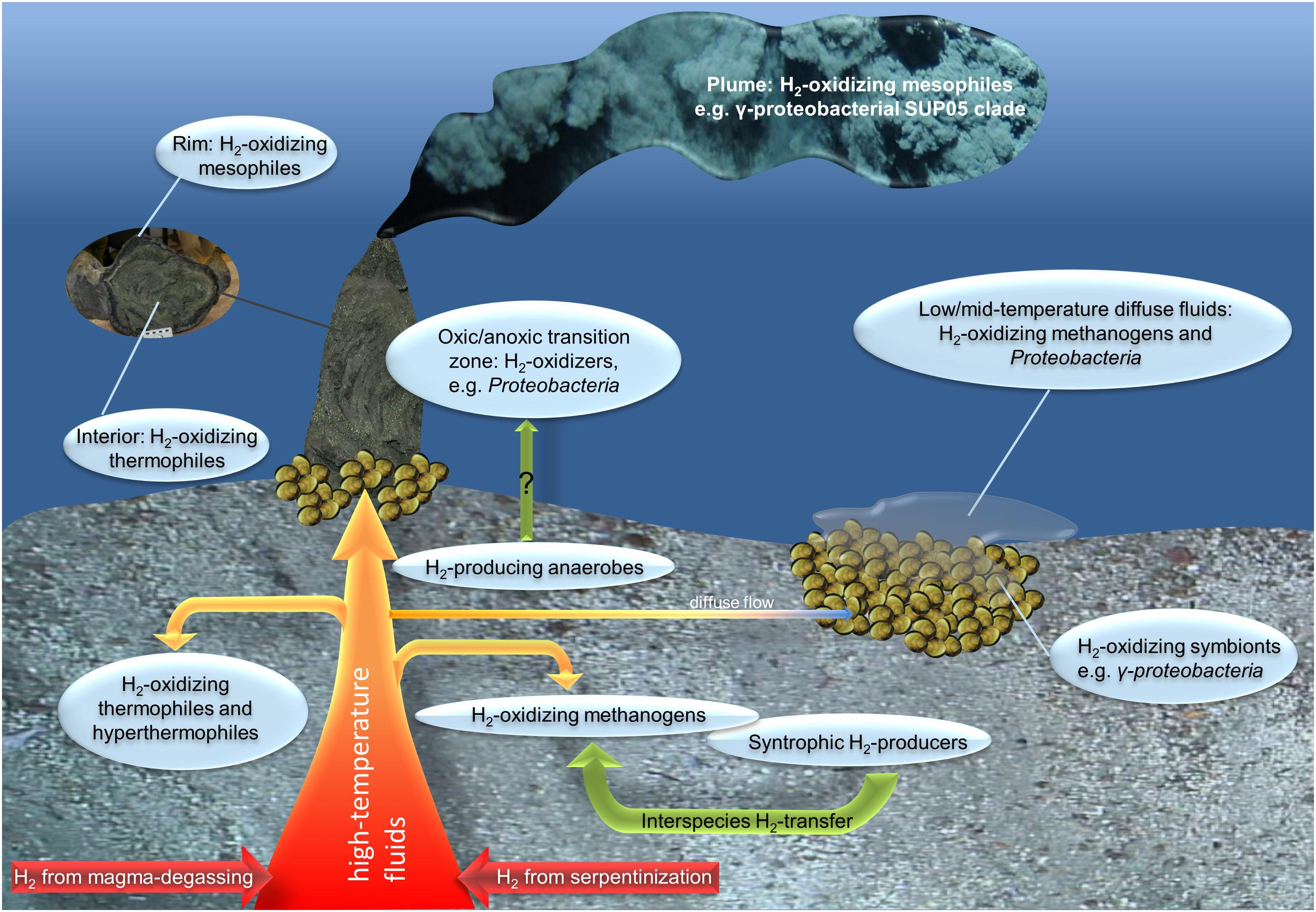
- Methane ($CH_4$) and molecular hydrogen ($H_2$) are produced via rock-water interactions.
When this hot, acidic, highly reduced fluid buoyant rise exits back into cold, oxygenated, alkaline seawater, rapid cooling causes heavy metal sulfides to precipitate instantly, forming towering chimney structures.
- Cold Seawater (2°C) enters basalt fractures
- Heated near magma chamber (350–400°C)
- Strips O2; dissolves Fe, Cu, Zn; generates H2S, CH4
- Superheated fluid rises buoyantly
- Discharges into ocean
- Instant precipitation of metal sulfides
- Hydrothermal Chimneys & Plumes
Types of Hydrothermal Vents
Hydrothermal vent systems vary widely depending on geological substrate, fluid chemistry, and exit temperature:
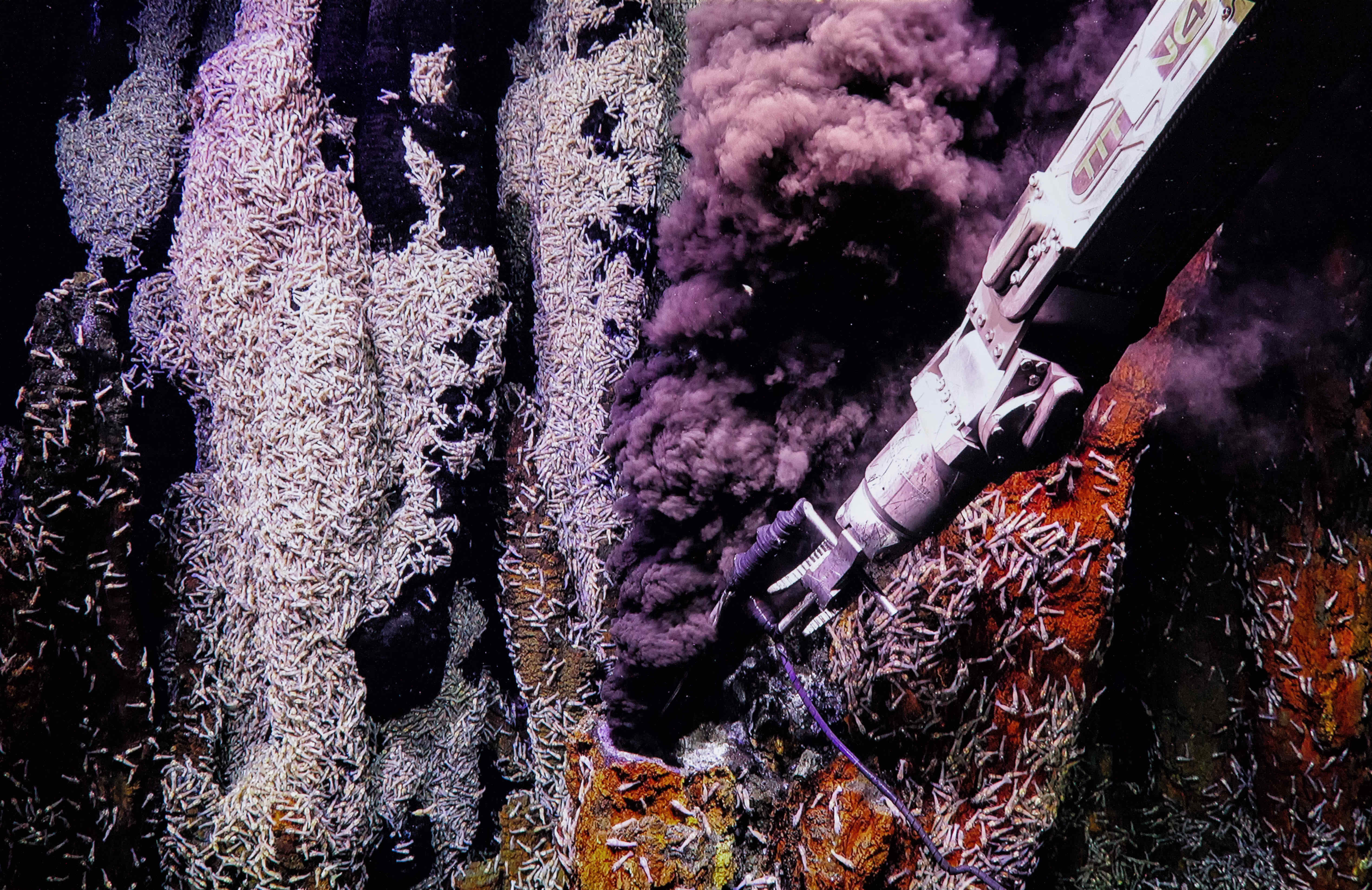
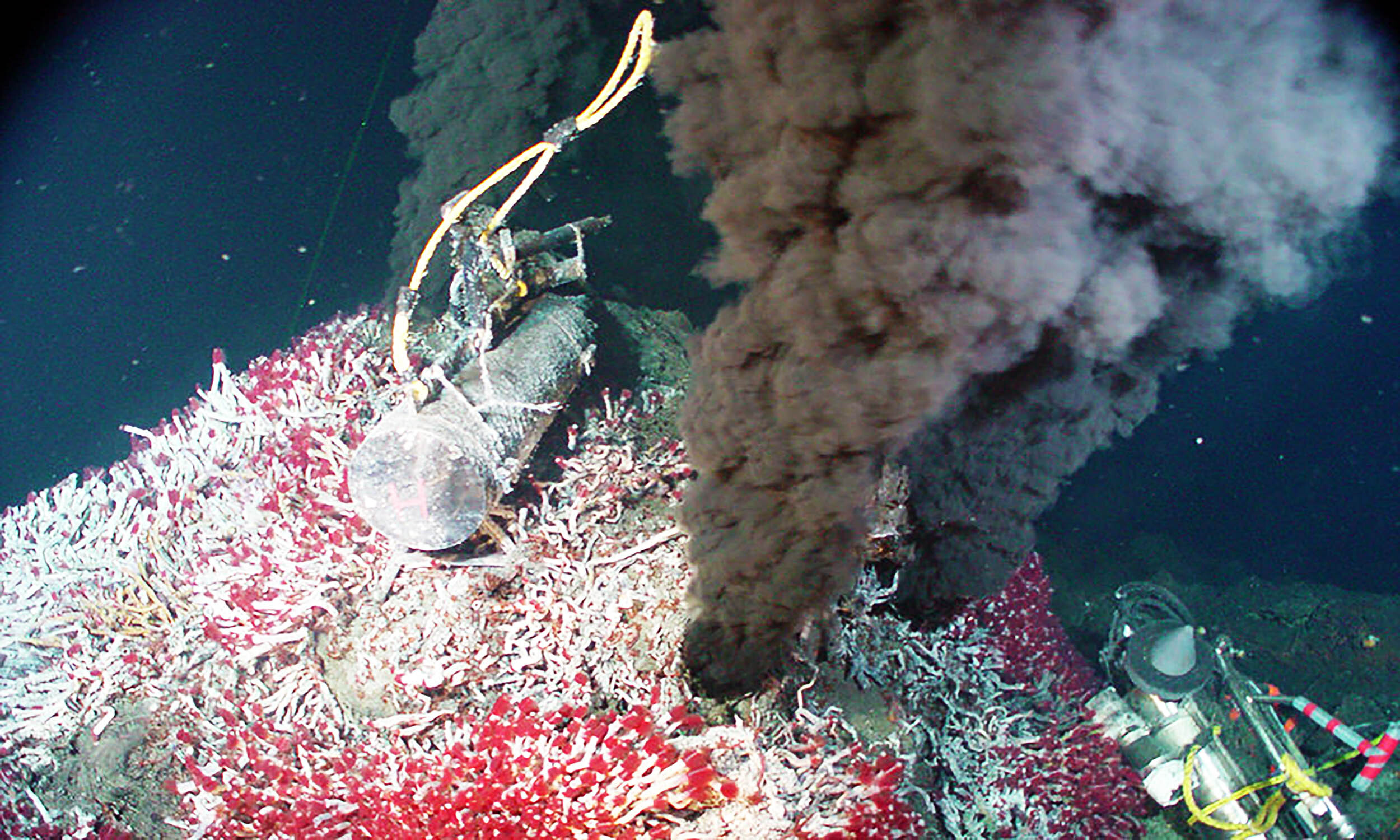
- Black Smokers: Emitting fluids at temperatures between 300°C and 400°C, black smokers are rich in iron sulfides (such as pyrite and chalcopyrite). The dark mineral precipitate creates dense, black particulate plumes that build mineral chimneys reaching tens of meters in height.
- White Smokers: Emitting cooler fluids ranging from 100°C to 300°C, these vents contain higher proportions of barium, calcium, and silicon oxides. Precipitates such as anhydrite ($CaSO_4$) and silica yield lighter-colored fluid plumes and lower-profile structures.
- Alkaline Vents: Exemplified by the Lost City Hydrothermal Field on the Mid-Atlantic Ridge, alkaline vents form away from volcanic axes. Serpentinization—the reaction between seawater and mantle peridotite—produces warm (40°C to 90°C), highly alkaline (pH 9 to 11) fluids rich in hydrogen and methane, creating tall aragonite and calcite chimneys.
The Energetic Engine: Chemosynthesis vs. Photosynthesis
In sunlit surface waters, photosynthesis uses solar energy to convert carbon dioxide ($CO_2$) and water into carbohydrates, releasing oxygen ($O_2$) as a byproduct. In the absolute darkness of the deep ocean, hydrothermal vent communities rely on chemosynthesis driven by chemolithoautotrophic bacteria and archaea.
- Photosynthesis: 6 CO2 + 6 H2O + Sunlight
- Result: C6H12O6 + 6 O2
- Chemosynthesis: 6 CO2 + 6 H2O + 3 H2S + O2 (Sulfur Oxidation Pathway)
- Result: C6H12O6 + 3 H2SO4
Chemical Pathways of Primary Production
Chemolithoautotrophs use inorganic chemical reactions to generate adenosine triphosphate (ATP) and reducing power (NADPH), which fuel carbon fixation via pathways such as the Calvin-Benson-Bassham (CBB) cycle or the Reductive Tricarboxylic Acid (rTCA) cycle.
- Sulfur Oxidation: The most dominant energy pathway at hydrothermal vents involves the oxidation of reduced sulfur compounds, such as hydrogen sulfide ($H_2S$), thiosulfate ($S_2O_3^{2-}$), or elemental sulfur ($S^0$). Bacteria utilize dissolved oxygen or nitrate ($NO_3^-$) as terminal electron acceptors to produce sulfate ($SO_4^{2-}$).
- Methanogenesis and Methanotrophy: Archaeal methanogens reduce carbon dioxide using hydrogen gas to form methane ($CH_4$). Methanotrophic bacteria then oxidize this methane to generate cellular energy and organic carbon.
- Hydrogen Oxidation: Microorganisms capable of hydrogenotrophy oxidize molecular hydrogen ($H_2$), yielding high free energy that supports rapid microbial growth in high-temperature fluid zones.
Biological Adaptations of Hydrothermal Vent Fauna
Hydrothermal vent organisms face severe environmental challenges: pressure exceeding 300 atmospheres, absolute darkness, toxic levels of heavy metals and hydrogen sulfide, rapid shifts in pH, and severe thermal gradients spanning 2°C to over 80°C within fractions of a centimeter.
Giant Tubeworms (Riftia pachyptila)
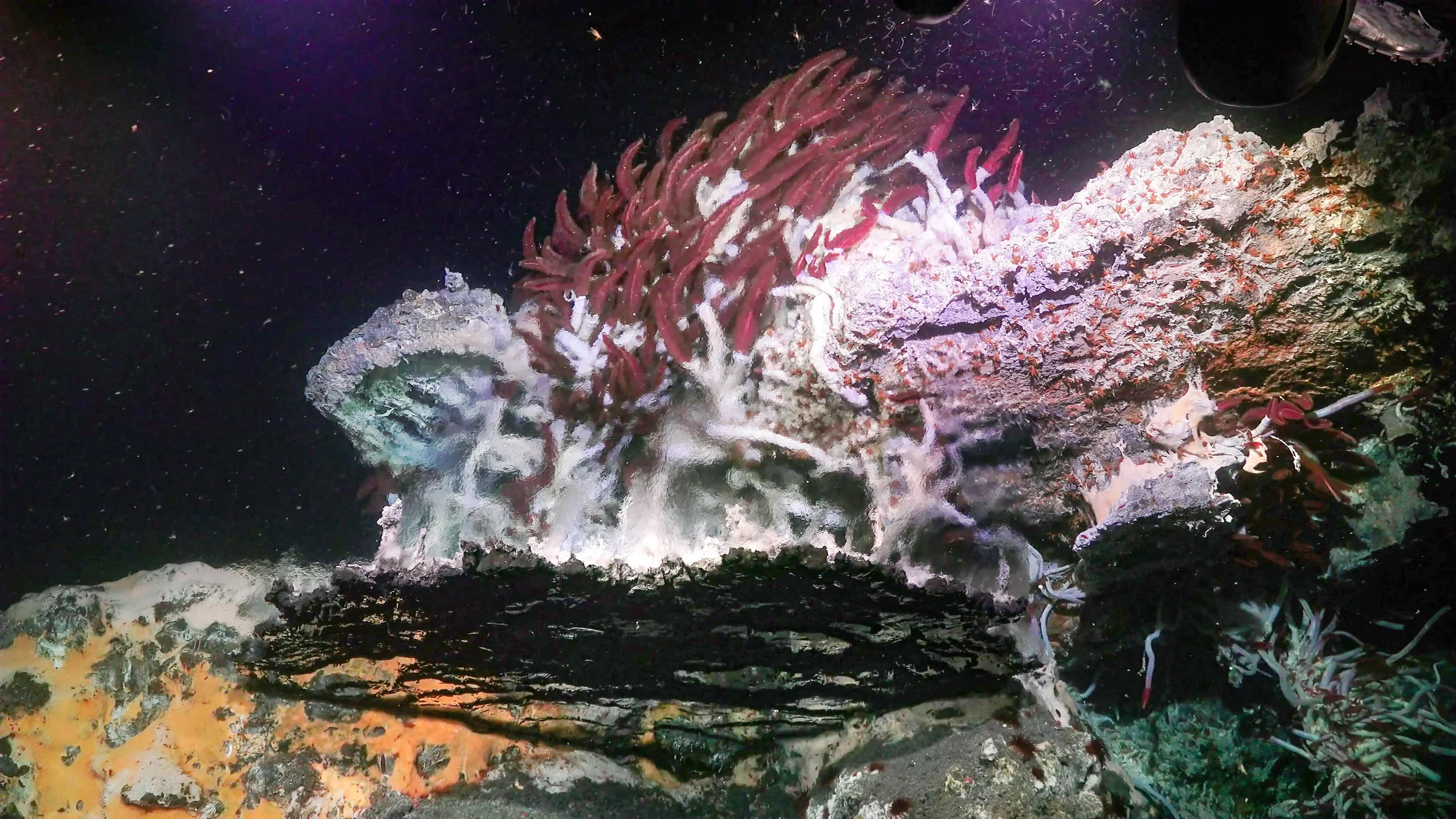
The giant tubeworm Riftia pachyptila, which grows up to two meters in length along Pacific spreading ridges, lacks a mouth, gut, and functional digestive system. Instead, it relies entirely on endosymbiotic sulfur-oxidizing bacteria housed within a specialized organ called the trophosome, which occupies most of its coelomic cavity.
- Riftia pachyptila Anatomy:
- Red Plume: Absorbs O2, H2S, and CO2 from seawater
- Vascular System: Specialized Hemoglobin binds H2S & O2 simultaneously
- Trophosome: Housed Endosymbiotic Bacteria fix CO2
- Coelomic Cavity: Receives organic nutrients
To nourish its endosymbionts, Riftia extends a bright red vascular plume into the water column to absorb $O_2$, $CO_2$, and toxic $H_2S$. Riftia possesses a unique extracellular hemoglobin that binds both oxygen and hydrogen sulfide simultaneously at distinct molecular binding sites. This adaptation prevents sulfide toxicity to animal tissue respiration while transporting both compounds to the trophosome.
Pompeii Worms (Alvinella pompejana)
Residing on the active walls of black smoker chimneys, the polychaete Alvinella pompejana is considered one of the most heat-tolerant complex animals known. The worm builds fibrous tubes where its tail rests in fluids near 80°C while its head extends out into ambient seawater at 20°C.
- Thermal Stabilization: Alvinella produces heat-shock proteins (HSPs) and structural proteins stabilized by dense hydrophobic cores and disulfides, preventing protein denaturation under thermal spikes.
- Epibiotic Mutualism: Thick mats of filamentous bacteria cover the worm's dorsal surface. These bacteria secrete protective enzymes that detoxify heavy metals and provide a thermal insulation barrier.
Rimicaris Vent Shrimp (Rimicaris exoculata)
Along the Mid-Atlantic Ridge, thousands of hydrothermal vent shrimp (Rimicaris exoculata) cluster along vent chimneys. Lacking conventional compound eyes, Rimicaris exoculata has evolved fused dorsal organ structures under its carapace. This organ contains a specialized rhodopsin-like visual pigment capable of detecting extremely faint thermal radiation (infrared and low-wavelength light) emitted by high-temperature vent fluids. This allows the shrimp to navigate around lethal thermal plumes without burning themselves.
Rimicaris harbors epibiotic thiotrophic bacteria inside its expanded branchial (gill) cavities, scraping and consuming these bacterial cultures for primary nutrition.
Scaly-Foot Snail (Chrysomallon squamiferum)
Inhabiting deep-sea vents in the Indian Ocean, the gastropod Chrysomallon squamiferum features a unique multi-layered shell and foot armor. The outer layer of its shell and the sclerites covering its soft foot are composed of iron sulfides—primarily greigite ($Fe_3S_4$) and pyrite ($FeS_2$).
This gastropod is the only known metazoan to incorporate iron sulfide minerals directly into its structural skeleton, providing mechanical protection against predators such as crab species (Bythograea) and buffering chemical gradients.
Key Hydrothermal Vent Species Comparison
The following table summarizes the distribution, symbiotic strategies, and evolutionary adaptations of key hydrothermal vent species:
| Species | Geographic Region | Primary Symbiosis / Food Source | Key Physiological Adaptation | Environmental Extremes Tolerated |
|---|---|---|---|---|
| Giant Tubeworm(Riftia pachyptila) | East Pacific Rise, Galápagos Rift | Endosymbiotic thiotrophic bacteria in trophosome | Multi-site extracellular hemoglobin binding $H_2S$ and $O_2$ | High hydrogen sulfide levels; variable fluid temperatures (2°C–30°C) |
| Pompeii Worm(Alvinella pompejana) | East Pacific Rise | External epibiotic bacterial mat | Specialized heat-shock proteins and metal-binding metallothioneins | Thermal gradients spanning 20°C to >80°C |
| Vent Shrimp(Rimicaris exoculata) | Mid-Atlantic Ridge | Epibiotic gill bacteria; opportunistic grazing | Fused dorsal photoreceptors sensing low-light thermal radiation | High heavy metal exposure; fluid boundaries near 30°C–40°C |
| Scaly-Foot Snail(Chrysomallon squamiferum) | Indian Ocean Vents | Endosymbiotic sulfur-oxidizing bacteria in esophageal gland | Greigite ($Fe_3S_4$) and pyrite armored foot sclerites and shell | High sulfide toxicity; extreme hydrostatic pressure (~2,500m depth) |
| Vent Mussel(Bathymodiolus thermophilus) | Global Mid-Ocean Ridges | Dual endosymbiosis (methanotrophic & thiotrophic bacteria) | Flexible metabolic switching based on fluid chemical supply | Low oxygen; variable methane and hydrogen sulfide ratios |
| Yeti Crab(Kiwa hirsuta) | Pacific-Antarctic Ridge | Epibiotic filamentous bacteria farmed on chelae (claws) | Dense setae (hairs) hosting autotrophic bacterial cultures | Sub-zero background ocean temperatures near sub-polar vents |
Ecological Structure and Trophic Dynamics
Trophic structures in hydrothermal vent ecosystems are short and concentrated around primary productivity hot spots. Because sunlight does not penetrate to these depths, energy transfer efficiency differs markedly from surface marine food webs.
- Apex Predators: Zoarcid Fish, Vent Octopuses, Bythograeid Crabs
- Trophic Transfer
- Primary Consumers / Hosts: Riftia Tubeworms, Bathymodiolus Mussels, Vent Shrimp, Grazing Snails
- Carbon Fixation (Chemosynthesis)
- Primary Producers: Free-living microbial mats, Endosymbionts, Epibionts
Food Web Hierarchy
- Primary Producers: Free-living chemolithoautotrophic bacteria and archaea forming thick benthic mats, plus endosymbiotic and epibiotic microbial populations.
- Primary Consumers: Herbivorous and symbiotic organisms. Snails (Provanna), limpets, and amphipods graze directly on microbial mats. Tubeworms (Riftia, Tevnia) and mussels (Bathymodiolus) derive direct nutrition from internal bacterial symbionts.
- Secondary and Apex Predators: Predatory vent crabs (Bythograea thermydron), zoarcid fish (Thermarces cerberus), sea anemones, and deep-sea octopuses (Muusoctopus) consume tubeworms, shrimp, and smaller invertebrates.
Succession and Ecosystem Ephemerality
Hydrothermal vents are ephemeral environments. Volcanic eruptions, tectonic shifts, and subsurface mineral clogging can abruptly cut off thermal fluid flow, causing an entire vent field to collapse within months. Conversely, new vents can form suddenly following seafloor magmatic activity.
Ecological succession occurs rapidly at newly formed vent sites:
- Pioneer Stage: Within months of a new fluid vent forming, microbial mats coat fresh basalt surfaces.
- Tubeworm Colonization: Fast-growing tubeworms such as Tevnia jerichonana settle rapidly, altering micro-flow patterns.
- Dominance Phase: Riftia pachyptila outgrows pioneer species, creating dense habitat thickets that shelter shrimp, crabs, and polychaetes.
- Climax Community: As sulfide flow stabilizes or wanes over years to decades, long-lived Bathymodiolus mussels colonize, eventually replacing tubeworm aggregations until geothermal activity ceases entirely.
Anthropogenic Threats and Conservation
Despite their remote depths, hydrothermal vent ecosystems face growing pressures from human activities, most notably deep-sea mining interests.
Deep-Sea Mining (Seafloor Massive Sulfides)
Hydrothermal vent chimneys deposit high-grade metal ores containing copper, zinc, lead, gold, and silver over thousands of years. Known commercially as Seafloor Massive Sulfide (SMS) deposits, these formations have attracted commercial exploration interest.
Mining operations involve heavy machinery scraping and crushing chimney structures, creating severe environmental risks:
- Habitat Destruction: Physical removal of vent chimneys completely destroys localized benthic habitat structures.
- Toxic Sediment Plumes: Mining activities generate large particulate plumes laden with heavy metals, which can clog the delicate filter-feeding apparatuses of organisms and block thermal detection senses across wide ocean zones.
- Disruption of Endemic Species: Because many vent species exhibit high degrees of endemism—occurring only at specific, isolated vent fields—localized mining operations risk driving specialized species to extinction.
Environmental Governance and Stewardship
Management of international deep-sea vent sites falls under the jurisdiction of the International Seabed Authority (ISA), established under the United Nations Convention on the Law of the Sea (UNCLOS). The ISA oversees the designation of Regional Environmental Management Plans (REMPs) and Areas of Particular Environmental Interest (APEIs), which establish marine protected areas where commercial exploration is restricted.
Oceanographic institutions, such as the Woods Hole Oceanographic Institution and NOAA Ocean Exploration, advocate for long-term ecological monitoring and strict scientific protocols to safeguard these unique ecosystems during deep-sea research operations.
Frequently Asked Questions
How do hydrothermal vent organisms survive without sunlight?
They rely on chemolithoautotrophic bacteria and archaea that use chemical energy from compounds like hydrogen sulfide, methane, and molecular hydrogen to convert carbon dioxide into organic matter, replacing the role of sunlight in photosynthesis.
What is the temperature of the water around hydrothermal vents?
Vent fluids exiting black smoker chimneys can reach temperatures exceeding 400°C. However, rapid mixing with cold ambient seawater (2°C) creates steep thermal gradients, allowing surrounding organisms to live in fluid temperatures ranging from 2°C to 80°C.
Why doesn't superheated fluid boil at 400°C on the ocean floor?
The extreme hydrostatic pressure at ocean depths between 2,000 and 4,000 meters (200 to 400 atmospheres) prevents water from boiling, keeping superheated hydrothermal fluids in a liquid state.
How do giant tubeworms digest food if they have no mouth or stomach?
Giant tubeworms (Riftia pachyptila) host millions of endosymbiotic bacteria inside a specialized organ called a trophosome. The tubeworm's specialized hemoglobin transports hydrogen sulfide, oxygen, and carbon dioxide to the bacteria, which synthesize organic carbon compounds that nourish the worm directly.
Are hydrothermal vent ecosystems permanent?
No, vents are geologically temporary. Tectonic movements, magmatic shifts, or mineral blockages can open new vents or seal existing ones within days or decades, forcing vent organisms to rapidly colonize new chemical sources across the ocean floor.
Recommended Next Steps for Further Exploration
To deepen your understanding of deep-sea vent ecosystems and current conservation efforts:
- Review Oceanographic Data Portals: Examine scientific cruise data and high-definition video archives maintained by the NOAA Ocean Exploration Data Atlas and the Ocean Observatories Initiative (OOI).
- Track Marine Protection Policy: Stay informed on international seabed mining regulations and environmental frameworks by reviewing updates directly from the International Seabed Authority.
- Explore Scientific Literature: Read peer-reviewed oceanographic research published in journals such as Deep Sea Research, Limnology and Oceanography, and Nature Geoscience to monitor discoveries regarding extremophile genetics and deep-sea food web dynamics.
Image Gallery