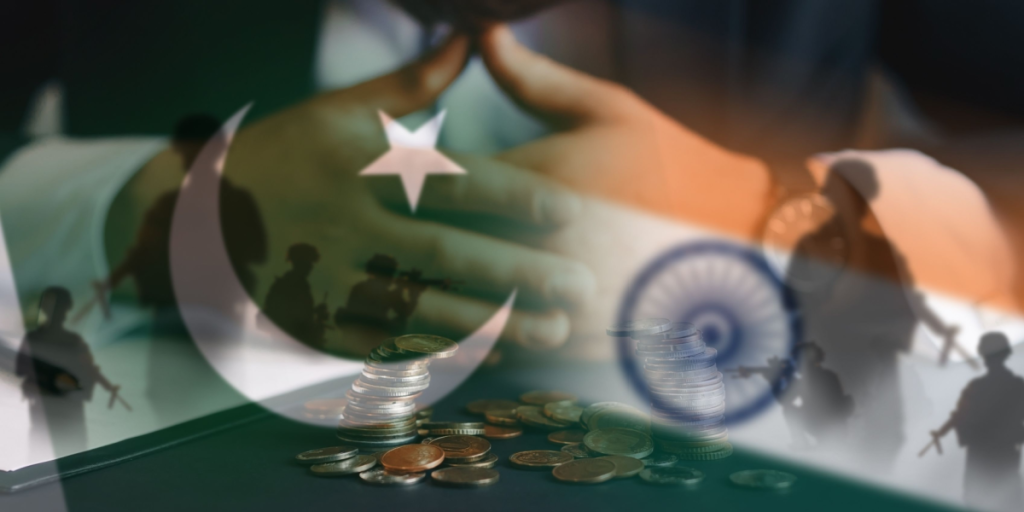
India and Pakistan Are Not the Same Country: Understanding the Divergent Paths of Two Sovereign Nations
India and Pakistan are two distinct, sovereign nations in South Asia that emerged as separate entities following the end of British colonial rule in 1947. While they share deep historical, linguistic, and cultural roots, they operate u...
India and Pakistan are two distinct, sovereign nations in South Asia that emerged as separate entities following the end of British colonial rule in 1947. While they share deep historical, linguistic, and cultural roots, they operate under different political systems, legal frameworks, religious identities, and economic trajectories as of 2026.
Contents
The Historical Genesis: The Partition of 1947
To understand why India and Pakistan are not the same country, one must look back to the definitive moment of their creation. For nearly two centuries, the Indian subcontinent was under British influence, eventually becoming the British Raj. The movement for independence, led by various factions, eventually culminated in the Indian Independence Act of 1947.
The British Parliament passed this act to divide British India into two independent dominions: India and Pakistan. This division, known as the Partition, was primarily based on religious demographics, following the "Two-Nation Theory" advocated by the Muslim League. The theory posited that Hindus and Muslims were two distinct nations that could not coexist within a single state. Consequently, Pakistan was envisioned as a homeland for Muslims, while India, though Hindu-majority, chose a path of secularism.
The physical borders were drawn by Sir Cyril Radcliffe, a British lawyer who had never visited the region before his appointment. The resulting "Radcliffe Line" split the provinces of Punjab and Bengal, leading to one of the largest mass migrations in human history. Millions of people crossed the newly formed borders, a period marked by significant communal violence and a permanent shift in the region's geopolitical landscape. Since that moment, India and Pakistan have existed as entirely separate political and administrative units.
Governance and Political Structures
One of the most significant differences between the two nations lies in their constitutional frameworks and the role of the military in governance. As of 2026, both nations remain parliamentary democracies on paper, but their functional realities differ vastly.
The Republic of India
India is a secular, federal parliamentary republic. Its constitution, adopted in 1950, is the longest written constitution of any sovereign country in the world. India’s political system is characterized by a strong central government and 28 states (plus 8 union territories) with significant devolved powers. The President of India serves as the ceremonial head of state, while the Prime Minister exercises executive authority. India has maintained a consistent record of democratic transitions and has never experienced a successful military coup, establishing a clear separation between the civilian government and the armed forces.
The Islamic Republic of Pakistan
Pakistan is a federal parliamentary Islamic republic. Unlike India’s secular stance, Pakistan’s constitution establishes Islam as the state religion. The country is divided into four provinces and several territories. While it also features a President and a Prime Minister, Pakistan's political history has been characterized by periods of military rule. The Pakistani military traditionally wields significant influence over foreign policy and national security, a stark contrast to the Indian model where the military is strictly subordinate to civilian leadership.
Demographic and Religious Identities
The primary driver of the 1947 Partition was religion, and this remains a core differentiator today. Although both countries are multi-ethnic and multi-religious, their foundational identities are distinct.
- Religious Composition: India is home to the world's largest Hindu population, but it also hosts one of the largest Muslim populations globally, alongside significant communities of Christians, Sikhs, Buddhists, and Jains. India’s identity is built on pluralism, where the state is theoretically neutral toward religion. Pakistan, conversely, was founded specifically as a Muslim-majority state. While it has minority populations of Hindus, Christians, and Ahmadis, the legal and social fabric of the country is deeply intertwined with Islamic principles.
- Population and Geography: India is the seventh-largest country by land area and, as of current 2026 estimates, the most populous nation on Earth. Its geography ranges from the Himalayan mountains to tropical rainforests and vast deserts. Pakistan is smaller in land area (roughly the size of France and the UK combined) and is the world’s fifth-most populous country. Its geography is dominated by the Indus River basin and the rugged terrain of the Hindu Kush and Karakoram ranges.
Economic Divergence and Trade Profiles
In the decades following independence, India and Pakistan have followed different economic models, leading to significant variations in their Gross Domestic Product (GDP) and global market integration.
India has transitioned from a closed, socialist-leaning economy toward a market-oriented system since the 1991 reforms. In 2026, India stands as one of the world's fastest-growing major economies, with a massive service sector, a booming technology industry, and a growing manufacturing base under the "Make in India" initiative. India is a member of the G20 and has focused on building global supply chain partnerships.
Pakistan’s economy has traditionally been more reliant on agriculture and textiles. While it has sought to modernize through the China-Pakistan Economic Corridor (CPEC)—a massive infrastructure project aimed at connecting the port of Gwadar to China’s Xinjiang region—it has faced challenges with external debt and fiscal stability. The economic relationship between the two countries is nearly non-existent; formal trade is minimal due to ongoing political tensions and the lack of a "Most Favored Nation" (MFN) status agreement between them.
Key National Indicators Comparison (2026 Status)
| Feature | Republic of India | Islamic Republic of Pakistan |
|---|---|---|
| Official Language | Hindi, English (+ 22 scheduled languages) | Urdu, English |
| Capital City | New Delhi | Islamabad |
| Currency | Indian Rupee (INR) | Pakistani Rupee (PKR) |
| Government Type | Secular Parliamentary Republic | Islamic Parliamentary Republic |
| Independence Day | August 15 | August 14 |
| Nuclear Status | Declared Nuclear Weapons State | Declared Nuclear Weapons State |
| Time Zone | GMT+5:30 | GMT+5:00 |
| National Anthem | "Jana Gana Mana" | "Qaumi Taranah" |
Linguistic and Cultural Distinctions
While many foreigners perceive the cultures as identical due to shared history, there are subtle and profound differences in how these nations express their identities.
Language: Hindi vs. Urdu
At the spoken level, Hindi and Urdu are often mutually intelligible, a register known as Hindustani. However, they are written in different scripts: Hindi uses Devanagari (derived from Sanskrit), while Urdu uses a version of the Perso-Arabic script. Furthermore, formal Hindi draws heavily from Sanskrit vocabulary, whereas formal Urdu leans toward Persian and Arabic. In 2026, these linguistic differences are reinforced through national education systems, further cementing separate national identities.
Arts and Media
Both nations have vibrant film and music industries. India’s "Bollywood" (based in Mumbai) is a global powerhouse, influencing fashion and pop culture far beyond South Asia. Pakistan has a renowned television drama industry and a musical heritage famous for Sufi Qawwali and contemporary Coke Studio productions. While they share a love for classical ragas and similar culinary traditions (like biryani and kebabs), the national narratives portrayed in their media are often diametrically opposed, particularly regarding their shared history.
International Relations and Security
The most visible proof that India and Pakistan are not the same country is their adversarial relationship on the world stage. Since 1947, they have fought several major wars (1947, 1965, 1971, and 1999) and remain in a state of "frozen conflict" over the region of Kashmir.
Both nations are nuclear-armed, which has changed the dynamics of their military engagements to a doctrine of deterrence. They are members of the United Nations (UN) and the South Asian Association for Regional Cooperation (SAARC), but their bilateral disagreements often stall regional progress. India has increasingly aligned itself with Western powers and the "Quad" (US, Japan, Australia, India), whereas Pakistan has maintained a "non-NATO ally" status with the US while forging a "higher than the mountains, deeper than the oceans" strategic partnership with China.
Common Misconceptions and FAQs
1. Are India and Pakistan still part of the British Commonwealth?
Yes, both nations are members of the Commonwealth of Nations. However, this is a voluntary association of independent states and does not mean they share a government or are the same country. Membership is based on their historical link as former British colonies.
2. Can citizens of India and Pakistan travel freely between the two?
No. Unlike the European Union’s Schengen Area, the border between India and Pakistan (the Line of Control in Kashmir and the International Border elsewhere) is one of the most fortified in the world. Visas are difficult to obtain and are usually restricted to specific purposes like religious pilgrimage or visiting divided families.
3. Is Bangladesh the same as Pakistan or India?
No. Bangladesh was originally "East Pakistan" after the 1947 Partition. However, after a war of independence in 1971, East Pakistan broke away from West Pakistan to become the sovereign nation of Bangladesh. It is a separate third country in the region.
4. Do they use the same currency?
They both use the "Rupee," but they are separate currencies issued by different central banks (The Reserve Bank of India and the State Bank of Pakistan). The exchange rates and values of the Indian Rupee (INR) and the Pakistani Rupee (PKR) differ significantly.
5. Why do people sometimes confuse the two?
The confusion often stems from the shared "Indian Subcontinent" geographical label and the fact that, prior to 1947, the entire region was often referred to globally as "India." Furthermore, the diaspora communities from both countries often share similar foods, languages, and physical appearances, which can lead to overgeneralization by those outside the region.
Practical Guidance for Travelers and Professionals
When engaging with individuals or businesses from South Asia, it is crucial to recognize these national boundaries. For professionals, this means understanding that a business strategy for Mumbai will not necessarily work for Karachi. Legal requirements, tax codes, and consumer behavior are distinct.
For travelers, it is vital to remember that holding a visa for India does not grant entry to Pakistan, and vice versa. If you plan to visit both, you must apply for separate visas and be aware that having a stamp from one country on your passport can occasionally lead to extra questioning at the border of the other, though it is generally permitted for foreign tourists.
Final Recommendation: To gain a deeper understanding of the region, researchers and students should consult official government portals such as the Ministry of External Affairs (India) and the Ministry of Foreign Affairs (Pakistan). Recognizing the sovereignty and distinct identities of India and Pakistan is the first step in appreciating the complex and rich tapestry of South Asian geopolitics.
Image Gallery