The Oldest Footprints Ever Found: A Journey Through Deep Time
As of 2026, the oldest footprints ever found are the 541-to-551-million-year-old tracks discovered in the Yangtze Gorges area of South China. These microscopic impressions, left by bilaterian animals with paired appendages, represent t...
As of 2026, the oldest footprints ever found are the 541-to-551-million-year-old tracks discovered in the Yangtze Gorges area of South China. These microscopic impressions, left by bilaterian animals with paired appendages, represent the earliest evidence of creatures walking on the Earth’s substrate. In the context of vertebrate evolution, the 395-million-year-old tetrapod tracks in Poland hold the record for the oldest land-dwelling "four-legged" walkers, while the 3.6-million-year-old Laetoli tracks remain the definitive record of early human ancestors.
Contents
Footprints, or ichnofossils, provide a unique window into the past that skeletal remains cannot. While a bone tells us what a creature looked like, a footprint tells us how it lived, how fast it moved, and how it interacted with its environment. This guide explores the most significant trackway discoveries in history, the science behind their preservation, and what they reveal about the evolution of life on Earth.
Understanding the "Oldest" Record: A Matter of Scale
When discussing the oldest footprints, it is essential to distinguish between different biological groups. The term "footprint" can refer to anything from the tiny scuttling of an Ediacaran worm to the heavy stride of a dinosaur or the bipedal gait of a hominin.
In the field of ichnology—the study of trace fossils—researchers categorize these finds by their geological period and the complexity of the organism that produced them. Because the fossil record is fragmentary, "new" oldest footprints are occasionally discovered as more remote geological formations are explored with modern imaging technology.
The Ediacaran Tracks: Life’s First Steps (550 Million Years Ago)
Long before dinosaurs or even fish existed, the Earth was home to the Ediacaran biota. In 2018, researchers published findings in the journal Science Advances regarding trackways found in the Shibantan Member of the Dengying Formation in China. These tracks date back to the Ediacaran Period (635–541 million years ago).
These are not "feet" in the modern sense but are categorized as "appendage-produced traces." The significance of this discovery cannot be overstated; it pushed back the timeline for the evolution of bilateral symmetry and complex limbs. The tracks show two parallel rows of impressions, suggesting the animal had pairs of legs that it used to lift its body off the seafloor—a precursor to walking on land.
The Zachelmie Tetrapod Tracks: Rewriting Evolutionary History
For decades, the transition of vertebrates from sea to land was thought to have occurred approximately 375 million years ago, with Tiktaalik roseae serving as the famous "fishapod" transitional fossil. However, in 2010, discovery of trackways in a Polish quarry known as Zachelmie threw the scientific community into a frenzy.
These tracks date back 395 million years, making them 18 to 20 million years older than the earliest known tetrapod skeletal fossils.
Why the Zachelmie Tracks Matter
The footprints found in Poland show distinct "hand" and "foot" impressions with clear toe marks. This suggests that complex, four-legged land animals existed much earlier than previously believed.
- Environment: The tracks were found in what was once a marine tidal flat or lagoon, suggesting that the transition to land may have happened in shallow coastal waters rather than inland rivers.
- The "Gap" in the Record: These tracks created a "ghost lineage," meaning scientists now know that tetrapods were walking around for millions of years before they left behind any skeletons that survived to the present day.
- Anatomy: The stride and width of the Zachelmie tracks indicate a creature that could reach up to 2.5 meters (8 feet) in length, suggesting that the first land-walkers were not small, timid pioneers but substantial predators.
The Laetoli Footprints: The Dawn of Humanity
Moving forward hundreds of millions of years, the most famous "oldest" footprints in the context of human evolution are the Laetoli tracks in Tanzania. Discovered by Mary Leakey’s team in 1976, these footprints are approximately 3.6 million years old.
The tracks were preserved when a nearby volcano, Sadiman, erupted and covered the landscape in fine ash. A brief rain shower turned the ash into a substance similar to wet cement. Our ancestors, Australopithecus afarensis (the same species as the famous "Lucy" skeleton), walked across this damp ash, leaving behind a 27-meter-long trail.
Evidence of Bipedalism
The Laetoli footprints provided the first "smoking gun" evidence that hominins were bipedal long before they developed large brains or stone tools.
- Heel Strike: The impressions show a clear "heel-first" landing, similar to modern human walking.
- The Arch: There is evidence of a longitudinal arch in the foot, which is a key adaptation for long-distance walking.
- The Big Toe: Unlike apes, whose big toes are opposable (like thumbs) for climbing, the Laetoli toes are aligned with the rest of the foot, optimized for forward propulsion.
The White Sands Discovery: Redefining the Peopling of the Americas
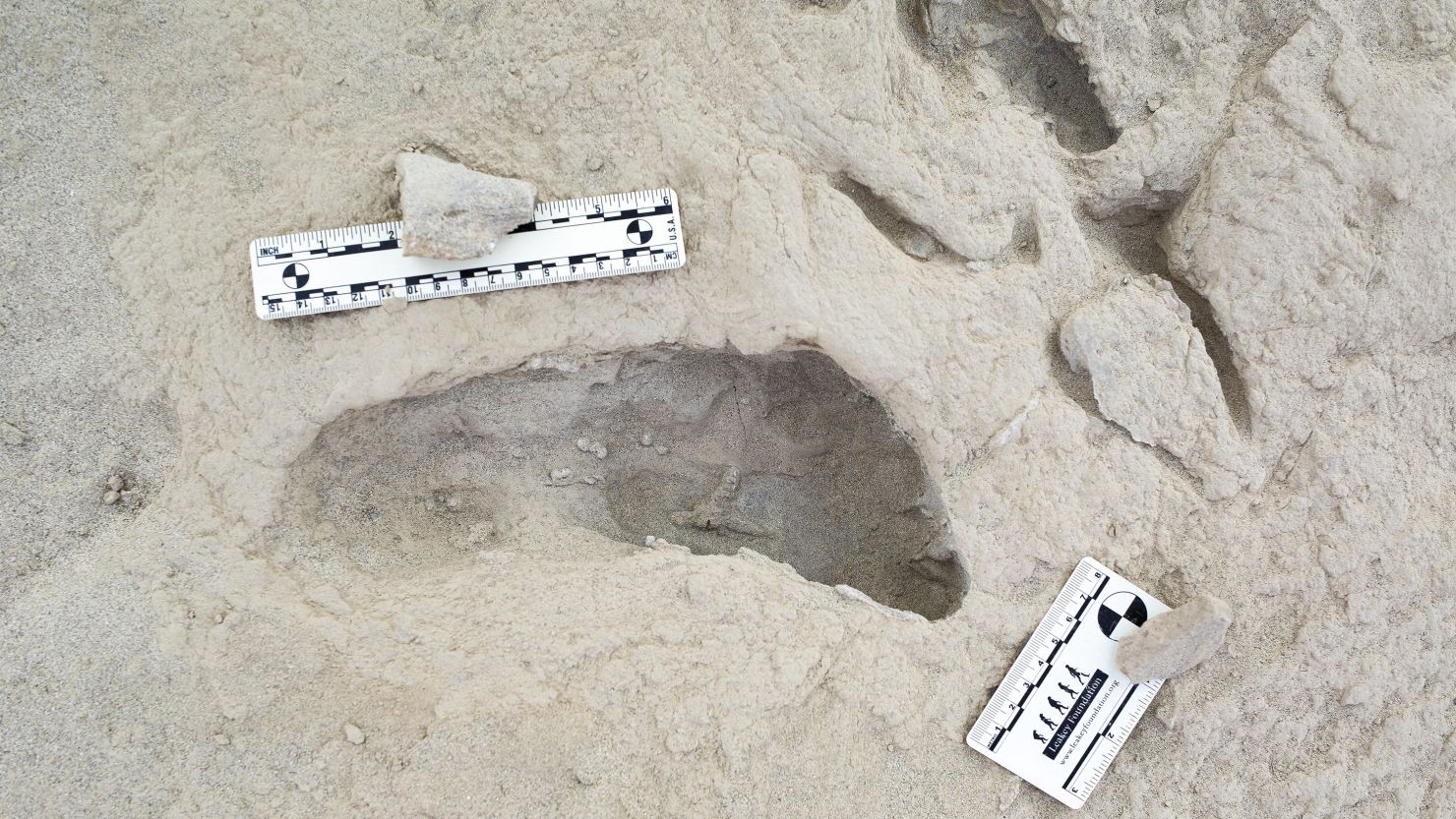
One of the most controversial and exciting discoveries in recent archaeology occurred at White Sands National Park in New Mexico. In the early 2020s, and confirmed through additional testing in 2024 and 2025, researchers identified human footprints dating back between 21,000 and 23,000 years.
Before this find, the prevailing theory was that humans arrived in North America around 13,000 to 15,000 years ago via the Bering Land Bridge. The White Sands footprints suggest that humans were present in the heart of North America during the height of the Last Glacial Maximum (the Ice Age).
Verification and Controversy
The dating was initially met with skepticism because it relied on the seeds of an aquatic plant, Ruppia maritima, which can sometimes yield inaccurate radiocarbon dates. However, subsequent studies using conifer pollen and terrestrial sediments confirmed the 23,000-year-old timeline. These footprints depict a narrative of daily life: teenagers and children running through the mud, and adults stalking giant ground sloths and mammoths.
Ichnology: The Science of Footprint Preservation
How does a footprint—the most ephemeral of marks—last for millions of years? The process of fossilization for tracks is known as biostratinomy.
The Goldilocks Zone of Substrate
For a footprint to be preserved, the ground must be exactly right:
- Moisture: Too dry, and the print doesn't form. Too wet, and the print collapses into a puddle.
- Sediment Type: Fine-grained sediments like silt, clay, or volcanic ash capture the best detail.
- Rapid Burial: The print must be covered quickly by a different type of sediment (like sand blowing over mud) before erosion can wipe it away.
Modern Imaging: Photogrammetry and LiDAR
In 2026, archaeologists no longer rely solely on plaster casts. Photogrammetry allows researchers to take hundreds of photos of a trackway and use software to create a 3D digital model. This reveals "under-tracks"—deformations in lower layers of soil caused by the weight of the animal—which can provide data even if the original surface track is eroded.
Comparison of Major Ancient Footprint Sites
The following table compares the most significant "oldest" footprint sites currently recognized by the scientific community.
| Site Location | Approximate Age | Organism Type | Primary Significance |
|---|---|---|---|
| Yangtze Gorges, China | 545 Million Years | Bilaterian (Invertebrate) | Earliest evidence of animal appendages and movement. |
| Zachelmie, Poland | 395 Million Years | Early Tetrapod | Pushed back the origin of four-legged land animals by 18M years. |
| Trachilos, Crete | 6 Million Years | Controversial Hominin | Suggests early bipedalism might have occurred outside Africa. |
| Laetoli, Tanzania | 3.6 Million Years | Australopithecus afarensis | Definitive proof of bipedal gait in human ancestors. |
| Ileret, Kenya | 1.5 Million Years | Homo erectus | First tracks showing a modern human-like foot anatomy. |
| White Sands, USA | 23,000 Years | Homo sapiens | Oldest confirmed human presence in North America. |
Why Footprints Often Disagree With Bone Fossils
One of the greatest challenges in paleontology is that footprints and bones rarely appear in the same place. This is known as the "Ichnofacies vs. Biofacies" problem. Bones are often preserved in deep-water environments or through sudden catastrophic burials, whereas footprints are, by definition, made in shallow water or on dry land.
Because of this, footprints often "predate" the skeletal record. It is much easier for an animal to leave thousands of footprints during its life than it is for its one skeleton to be fossilized after death. This makes ichnology the "early warning system" of the fossil record, telling us that a new species has evolved long before we find its remains.
Frequently Asked Questions
What are the oldest human footprints ever found?
The oldest footprints of our direct species, Homo sapiens, were found on the Garden Route coast of South Africa, dating back approximately 153,000 years. However, if you are referring to human ancestors (hominins), the Laetoli footprints in Tanzania are much older, at 3.6 million years.
How do scientists date footprints found in rock?
Scientists use a combination of Radiometric Dating (testing volcanic ash layers above or below the prints) and Stratigraphy (analyzing the layer of rock the prints are in). In recent years, Optically Stimulated Luminescence (OSL) has been used to determine when the sediment was last exposed to sunlight.
Are the "Trachilos footprints" in Crete really human?
The Trachilos footprints, dated to approximately 6 million years ago, are highly controversial. Some researchers believe they show hominin-like characteristics, which would challenge the "Out of Africa" theory of human origins. However, many paleontologists remain skeptical, suggesting they could be from an unrelated ape species that evolved similar foot structures convergently.
Can footprints tell us the weight of an extinct animal?
Yes, using a branch of physics called finite element analysis. By measuring the depth of the print and the displacement of the sediment, and comparing it to the known properties of that soil (moisture, density), scientists can estimate the mass required to create that specific impression.
Why are footprints found in deserts?
Many famous trackways, like those in White Sands or the Sahara, are found in deserts because these areas were once lush wetlands. The shifting sands of modern deserts often uncover ancient lakebeds where footprints were "frozen" in stone millions of years ago.
Further Action and Exploration
For those interested in seeing these ancient records firsthand, many sites are protected as UNESCO World Heritage sites or National Parks. If you are visiting White Sands National Park or the Olduvai Gorge in Tanzania, always stay on designated paths. Footprints are incredibly fragile; even the oils from human skin or a change in local humidity can cause ancient tracks to crumble.
To follow the latest developments in 2026, monitor publications from the Society of Vertebrate Paleontology or the Journal of Human Evolution. As imaging technology improves, we are likely to find even older "first steps" hidden in the world's most remote geological formations.
Image Gallery