Boat Loan Rates at Credit Unions: A Comprehensive 2026 Guide
In 2026, boat loan rates at credit unions typically range from 6.49% to 10.25%, depending on your credit score, the loan term, and the age of the vessel. Because credit unions are member-owned cooperatives, they generally offer interes...
In 2026, boat loan rates at credit unions typically range from 6.49% to 10.25%, depending on your credit score, the loan term, and the age of the vessel. Because credit unions are member-owned cooperatives, they generally offer interest rates 0.5% to 1.5% lower than commercial banks and marine dealerships, coupled with lower loan origination fees.
Contents
Why Credit Unions Offer Competitive Boat Loan Rates
As we move through 2026, the financial landscape has stabilized, but the fundamental structure of credit unions remains their greatest advantage for recreational lending. Unlike commercial banks that prioritize shareholder profits, credit unions operate as not-for-profit entities. This unique structure allows them to return surplus income to their members in the form of higher dividends on savings and lower interest rates on loans.
When you apply for a boat loan at a credit union, you are not just a customer; you are a member-owner. This relationship often results in more personalized underwriting. While a large national bank might use a rigid automated system to decline a loan based on a minor credit fluctuation, credit union loan officers frequently have the latitude to consider the "whole person," including your history with the institution and local economic factors.
Furthermore, credit unions are often more willing to finance older vessels that traditional banks might deem too risky. Many credit unions offer specialized "Marine Loans" that recognize the long-term value retention of high-quality boat brands, allowing for extended terms that make monthly payments more manageable.
Current Market Trends for Boat Financing in 2026
The 2026 lending market is characterized by a "flight to quality." While overall interest rates have moderated from the volatility of previous years, lenders remain diligent regarding collateral value. Boat loan rates are influenced by several macro and microeconomic factors:
- The Federal Funds Rate: While not a direct mirror, credit union lending rates fluctuate based on the cost of liquidity. In 2026, the baseline for "prime" marine lending has settled into a predictable range.
- Vessel Depreciation Curves: Lenders have updated their valuation models to account for the influx of late-model used boats entering the market. Credit unions often use resources like the J.D. Power Marine Buying Guide to ensure the loan-to-value (LTV) ratio remains healthy.
- Membership Growth: Many credit unions have expanded their "field of membership," making it easier for boaters to join based on geography or professional associations rather than just specific employer groups.
Comparing Boat Loan Rates: Credit Unions vs. Other Lenders
To understand the value proposition of a credit union, it is essential to compare the typical 2026 landscape across different lending institutions.
| Lender Type | Typical APR Range (2026) | Common Loan Terms | Pros | Cons |
|---|---|---|---|---|
| Credit Unions | 6.49% – 9.75% | 5 to 15 Years | Lower rates, fewer fees, local service. | Requires membership, may have slower tech. |
| National Banks | 7.75% – 11.50% | 5 to 20 Years | Faster digital applications, high loan caps. | Higher rates, stricter credit requirements. |
| Marine Dealers | 8.50% – 13.00% | 10 to 20 Years | Convenience at point of sale. | Significant markups, higher overall cost. |
| Online Lenders | 7.50% – 15.00% | 2 to 12 Years | Instant approval, often unsecured. | Much higher rates, shorter terms. |
Factors That Influence Your Specific Boat Loan Rate
Even within a single credit union, two members might receive different rate offers. Understanding these variables is crucial before you start shopping for your next center console, pontoon, or cruiser.
Credit Score and History
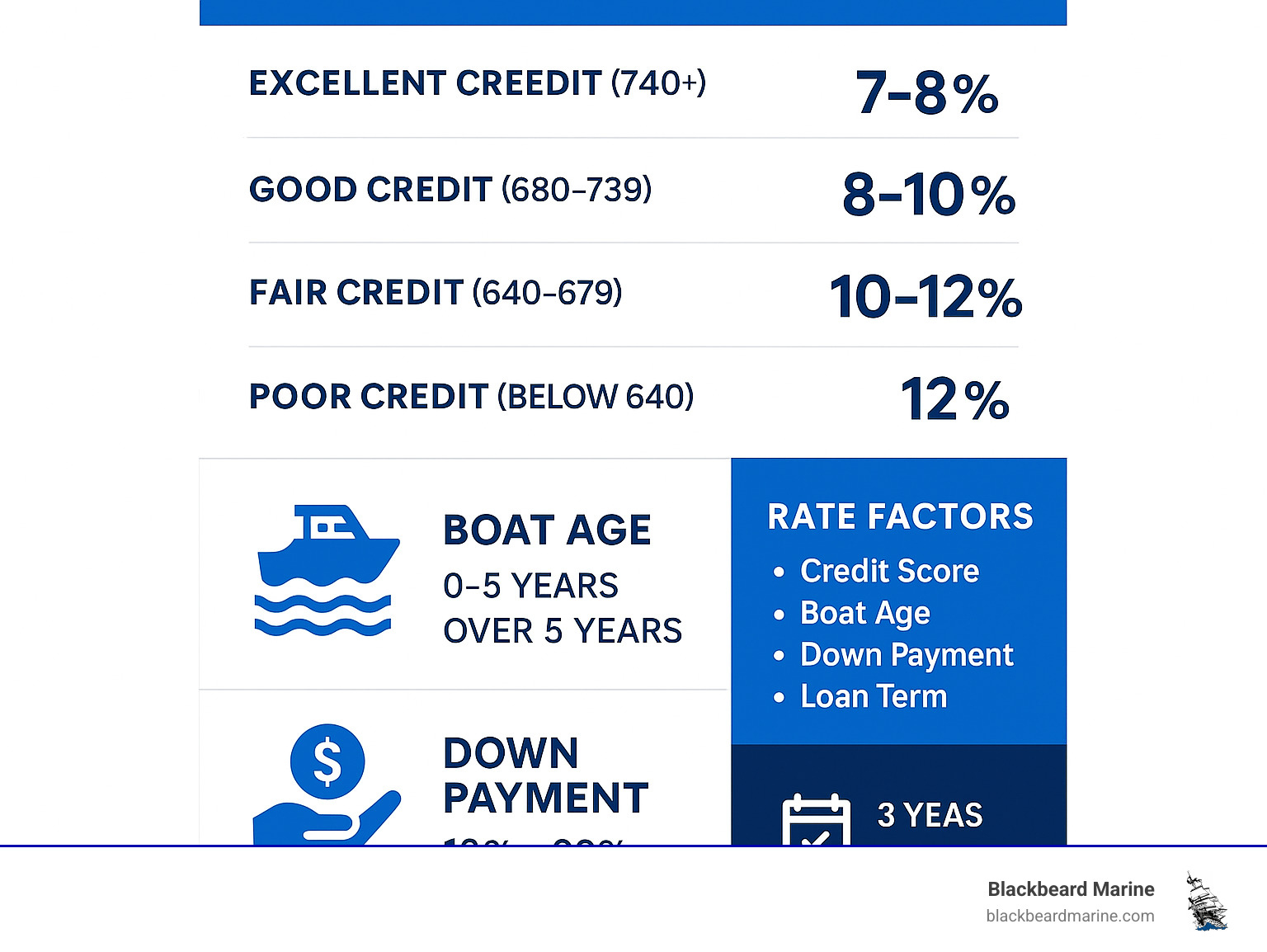
Your FICO score remains the most significant determinant of your interest rate. In 2026, a score of 740 or higher is generally required to lock in the "advertised" floor rates. Members with scores between 680 and 739 may see rates 1% to 2% higher, while those below 640 may require a larger down payment or a co-signer to secure a competitive rate.
Loan-to-Value (LTV) Ratio
The LTV represents how much you are borrowing compared to the boat's appraised value. Most credit unions prefer an LTV of 80% or lower, meaning you provide a 20% down payment. If you seek 100% financing (0% down), expect the credit union to increase the interest rate to compensate for the higher risk of the loan becoming "upside down" due to depreciation.
Loan Term Length
While it is tempting to choose a 15-year or 20-year term to lower the monthly payment, this almost always results in a higher interest rate. Shorter terms (3 to 5 years) carry the lowest rates because the lender's capital is at risk for a shorter duration. For most 2026 boat buyers, the "sweet spot" for balancing rate and payment is the 10-year (120-month) term.
New vs. Used Vessels
Typically, new boats qualify for the lowest rates. A "new" boat in 2026 is usually defined as the current or previous model year with zero previous owners. Used boats, specifically those older than 10 years, may carry a rate premium of 0.50% to 1.50% because their resale market is less liquid and their mechanical reliability is harder to verify.
How to Apply for a Boat Loan at a Credit Union
Navigating the application process at a credit union is slightly different than at a big-box bank. Following these steps can streamline your approval and ensure you get the best possible 2026 rates.
- Verify Eligibility and Join: Before applying for the loan, you must become a member. Most credit unions now allow you to join online by opening a simple savings account with a $5 to $25 deposit. Check the National Credit Union Administration (NCUA) "Research a Credit Union" tool to find institutions you are eligible to join.
- Gather Documentation: You will need recent pay stubs, W-2 forms, or tax returns (if self-employed). For the boat itself, have the Bill of Sale, the Hull Identification Number (HIN), and a marine survey if the vessel is used and over a certain length (usually 25-30 feet).
- Get Pre-Approved: Obtaining a pre-approval letter gives you significant leverage when negotiating the price with a boat dealer or private seller. It signals that you are a "cash buyer" in their eyes, as the funding is already secured.
- Finalize the Collateral: Once you have a specific boat in mind, the credit union will perform a "valuation check." If the asking price is significantly higher than the book value, you may need to increase your down payment to cover the gap.
- Closing and Funding: Credit unions often fund boat loans via direct check to the seller or dealer, or via electronic wire. Ensure you have marine insurance in place, as the credit union will require they be listed as the "Loss Payee" on the policy.
Hidden Costs and Considerations
When calculating the affordability of a boat loan, the interest rate is only one piece of the puzzle. In 2026, lenders are increasingly focused on the "total cost of ownership."
- Loan Origination Fees: While lower than banks, some credit unions charge a flat processing fee, typically between $100 and $300.
- Documentation Fees: If the boat requires United States Coast Guard (USCG) Documentation (common for larger vessels), there may be additional filing fees involved.
- Maintenance Requirements: Some loan contracts include clauses requiring the vessel to be maintained in good working order to protect the collateral value.
- Insurance Premiums: High-performance boats or those kept in hurricane-prone areas will carry higher insurance premiums, which can impact your debt-to-income (DTI) ratio during the loan approval process.
Frequently Asked Questions
Can I get a boat loan from a credit union if I am not a member yet?
Yes, you can often apply for the loan simultaneously with your membership application. However, the loan cannot be funded until your membership is officially established. Most modern credit unions can process both within 24 to 48 hours.
Do credit unions offer boat loan refinancing?
Absolutely. If you currently have a high-interest boat loan from a dealer or a bank, many credit unions offer "refinance specials" in 2026. This allows you to pay off your existing high-rate loan with a new, lower-rate loan from the credit union, potentially saving thousands in interest over the life of the loan.
What is the maximum age of a boat a credit union will finance?
While policies vary, many credit unions will finance boats up to 15 years old. Some specialized maritime-focused credit unions may go even older for "classic" vessels or well-known brands like Boston Whaler or Grady-White, provided a professional marine survey confirms the hull's integrity.
Are boat loan interest rates tax-deductible in 2026?
In some cases, yes. If the boat has basic sleeping, cooking, and toilet facilities, it may qualify as a "second home" for tax purposes. This allows you to deduct the mortgage interest. However, tax laws are subject to change, and you should consult a qualified tax professional regarding the current 2026 IRS regulations.
Is a marine survey required for a credit union boat loan?
For new boats, a survey is never required. For used boats, credit unions usually require a professional marine survey if the loan amount exceeds $50,000 or if the vessel is longer than 27 feet. This protects both you and the lender from hidden structural issues or osmosis in the hull.
Practical Recommendation
For the best financial outcome in 2026, avoid dealer financing at the point of sale. While convenient, the interest rates are frequently marked up. Instead, research three local or national credit unions at least two weeks before you plan to buy. Secure a pre-approval to understand your maximum budget and your guaranteed interest rate. This approach not only saves you money on interest but also provides a safety net, ensuring the boat you are buying is worth the price you are paying.
Image Gallery