Life Insurance vs. Accidental Death and Dismemberment (AD&D): Key Differences Explained
Life insurance provides a comprehensive death benefit to your beneficiaries regardless of whether you die from natural causes, illness, or an accident. Conversely, Accidental Death and Dismemberment (AD&D) insurance is a limited policy...
Life insurance provides a comprehensive death benefit to your beneficiaries regardless of whether you die from natural causes, illness, or an accident. Conversely, Accidental Death and Dismemberment (AD&D) insurance is a limited policy that only pays out if your death or specific severe injuries are the direct result of a covered accident.
Contents
When building a financial safety net in 2026, many individuals find themselves choosing between standard life insurance and Accidental Death and Dismemberment (AD&D) coverage. While both products offer a financial payout to help loved ones, they serve vastly different roles in a portfolio. Understanding the nuances of coverage, cost, and eligibility is essential to ensuring you are not left with significant gaps in your protection.
Understanding Life Insurance: The Comprehensive Shield
Life insurance is designed to be a broad financial tool. Its primary purpose is to replace the income or economic value of an individual upon their death, providing a tax-free lump sum to beneficiaries. As of 2026, life insurance remains the "gold standard" for family protection because it covers the vast majority of causes of death.
How Life Insurance Works
Most life insurance policies fall into two categories: term and permanent. Term life insurance provides coverage for a specific period (e.g., 10, 20, or 30 years), while permanent life insurance (such as whole life or universal life) lasts for the policyholder's entire lifetime and often includes a cash-value component.
The defining characteristic of life insurance is its breadth. If a policyholder dies from a heart attack, cancer, old age, or a car accident, the policy pays out the full death benefit to the named beneficiaries. There are very few exclusions in a standard life insurance policy once the initial "contestability period"—usually the first two years—has passed.
The Underwriting Process
Because life insurance covers death by natural causes and illness, insurance companies perform a process called underwriting. This involves assessing the applicant’s health, lifestyle, and family medical history. In many cases, this requires a medical exam, blood tests, and a review of physician records. Based on this data, the insurer determines the premium. Higher-risk individuals (such as smokers or those with chronic conditions) pay more, while those who cannot pass underwriting may be denied coverage entirely.
Understanding AD&D Insurance: The Specialized Supplement
Accidental Death and Dismemberment (AD&D) insurance is significantly more focused than life insurance. It is a "limited peril" policy, meaning it only triggers under very specific circumstances. It is often offered as an affordable "rider" (an add-on) to a life insurance policy or as a standalone benefit through employers.
The "Accidental Death" Component
The "AD" in AD&D stands for Accidental Death. For the policy to pay out, the death must be the direct result of an accident—such as a fall, a fire, a drowning, or a motor vehicle crash. If the policyholder dies from a stroke, a respiratory infection, or any other natural cause, AD&D provides zero benefit.
In the insurance industry of 2026, the definition of an "accident" is strictly interpreted. If an individual has a heart attack while driving and crashes their car, the insurer may investigate whether the heart attack (a natural cause) or the crash (an accident) was the primary cause of death. If the heart attack is deemed the cause, the AD&D claim may be denied.
The "Dismemberment" Component
The "D" in AD&D represents the "living benefits" of the policy. Unlike life insurance, which only pays out upon death, AD&D provides a partial or full payout if the insured survives an accident but suffers catastrophic injuries. This typically includes:
- Loss of limbs (arms, legs, hands, or feet).
- Loss of sight in one or both eyes.
- Loss of speech or hearing.
- Permanent paralysis (quadriplegia or paraplegia).
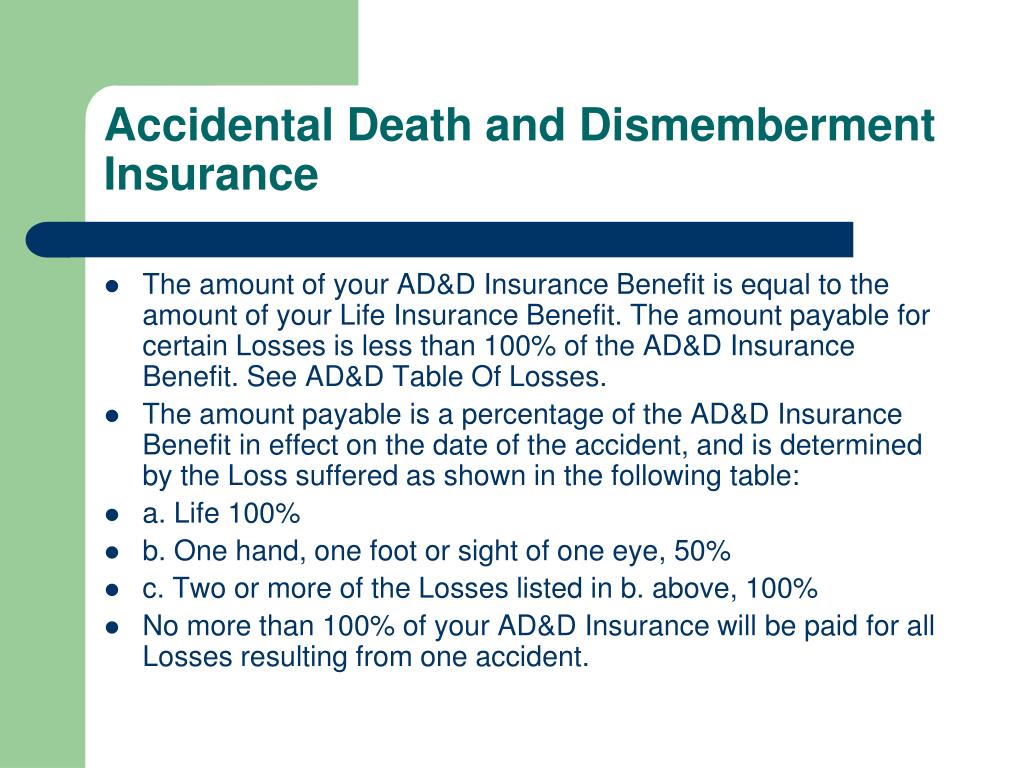
The payout for these injuries is usually based on a "schedule of benefits." For example, losing one limb might result in a 50% payout of the total coverage amount, while losing two limbs or sight in both eyes would result in a 100% payout.
Major Differences: Life Insurance vs. AD&D
To decide which coverage fits your needs, it is vital to compare them across several key dimensions: cause of death, cost, underwriting requirements, and payout triggers.
Cause of Death Coverage
The most critical difference is the scope of coverage. According to actuarial data relevant in 2026, the overwhelming majority of deaths in the United States are caused by illnesses such as heart disease, cancer, and respiratory issues. Standard life insurance covers all of these. AD&D covers none of them. AD&D only pays out for the "unforeseen and external" events that constitute an accident.
Underwriting and Accessibility
Life insurance is often difficult to obtain for individuals with serious pre-existing conditions. AD&D, however, is typically guaranteed issue. Because it does not cover death by illness, the insurance company does not need to know about your cholesterol levels or family history of diabetes. This makes AD&D an attractive option for people who have been denied traditional life insurance, though it should never be considered a full replacement.
Cost and Premiums
Because the probability of dying in a specific type of accident is much lower than the probability of dying from any cause, AD&D is much cheaper than life insurance. You can often purchase hundreds of thousands of dollars in AD&D coverage for the price of a few cups of coffee per month. Life insurance premiums are higher because the insurer is taking on a much greater statistical risk that they will eventually have to pay a claim.
Detailed Comparison Table
| Feature | Life Insurance (Term/Permanent) | Accidental Death & Dismemberment (AD&D) |
|---|---|---|
| Primary Payout Trigger | Death by almost any cause (Illness, Accident, Natural) | Death or injury by covered accident only |
| Covers Illness/Disease? | Yes | No |
| Living Benefits? | Rare (unless through specialized riders) | Yes (for loss of limbs, sight, hearing, etc.) |
| Medical Exam Required? | Usually yes (for full underwriting) | Almost never |
| Cost/Premium | Higher (based on age and health) | Very Low (flat rates often apply) |
| Suicide Coverage? | Yes (after a 2-year waiting period) | No |
| Primary Limitation | May require medical qualification | Very narrow definition of "Accident" |
The Role of "Double Indemnity"
A common way people encounter AD&D is through a Double Indemnity Rider on their life insurance policy. If you have a $500,000 life insurance policy with an AD&D rider for an additional $500,000, your beneficiaries would receive $1,000,000 if you die in a covered accident. If you die of a heart attack, they receive only the base $500,000. This is a popular way to boost coverage during years when an individual might be traveling frequently or working in a higher-risk environment.
Common Exclusions in AD&D Policies
While life insurance has very few exclusions, AD&D policies are famous for their fine print. To avoid surprises, policyholders in 2026 should be aware that AD&D typically does not pay out for:
- Death during surgery: Even if the death was unexpected, medical complications are rarely classified as "accidents" in AD&D terms.
- High-risk activities: Many policies exclude deaths resulting from skydiving, car racing, or bungee jumping unless a specific rider is purchased.
- Substance use: If an accident occurs while the insured is under the influence of non-prescribed drugs or alcohol, the claim is almost universally denied.
- Illegal acts: Death occurring during the commission of a crime is not covered.
- War or terrorism: Many policies exclude deaths resulting from acts of war or military service.
When Should You Choose AD&D?
AD&D should generally be viewed as a supplement, not a replacement, for life insurance. However, there are specific scenarios where it is particularly valuable:
- High-Risk Occupations: If your job involves heavy machinery, high-voltage electricity, or significant travel, the risk of an accidental injury or death is higher than average.
- Budget Constraints: If you currently cannot afford a full life insurance policy, an AD&D policy provides "some" protection for a very low cost until your financial situation improves.
- Uninsurability: If you have a terminal illness or chronic condition that prevents you from qualifying for traditional life insurance, AD&D allows you to leave at least some benefit to your family if an accident occurs.
FAQs
Can I have both life insurance and AD&D?
Yes, and many financial advisors recommend it. Having both ensures that your family is protected regardless of how you pass away, while providing additional funds (via the AD&D policy) if you die in an accident, which often brings unexpected costs like legal fees or sudden estate transitions.
Does AD&D cover "total disability"?
Not necessarily. AD&D is very specific about "dismemberment." If you are disabled due to a back injury or a chronic illness that doesn't involve the loss of a limb or sense, AD&D will not pay out. For general disability protection, you would need Disability Insurance.
If I lose a finger, will AD&D pay out?
Most AD&D policies have a "schedule of benefits" that defines what constitutes a loss. Usually, the loss of a single finger or toe does not trigger a payout. Most policies require the loss of an entire "member," such as a hand (at or above the wrist) or a foot (at or above the ankle).
Is AD&D coverage through an employer enough?
For most families, employer-provided AD&D is insufficient. Because it only covers accidents, you are left 100% unprotected against death from cancer, heart disease, or other illnesses. It is best treated as a "free bonus" rather than a foundational piece of your financial plan.
Does life insurance pay out if I lose a limb?
Standard life insurance does not pay out for the loss of a limb or sight. Some modern policies include "accelerated death benefit" riders that allow you to access a portion of the death benefit if you are diagnosed with a terminal or chronic illness, but these are distinct from the specific injury-based payouts of AD&D.
Recommendation for 2026 Financial Planning
For the majority of individuals, the priority should be securing a term or permanent life insurance policy that covers at least 10 to 15 times their annual income. This ensures your family is protected against the most statistically likely causes of death.
Once that foundation is in place, consider adding AD&D coverage only if you have a high-risk lifestyle, a dangerous job, or if the coverage is provided for free or at a negligible cost through your employer. Never rely on AD&D as your sole source of protection; the risk of a claim being denied due to a "natural cause" is too high to leave your family's future to chance.
Image Gallery