Understanding Apple Country of Origin Labeling and Verification
Determining the country of origin for apples involves navigating international trade regulations, agricultural labeling requirements, and supply chain transparency. Consumers, retailers, and distributors must rely on standardized label...
Determining the country of origin for apples involves navigating international trade regulations, agricultural labeling requirements, and supply chain transparency. Consumers, retailers, and distributors must rely on standardized labeling protocols, documentation such as Phytosanitary Certificates, and supply chain traceability systems to verify where apples were grown, harvested, and packed for distribution.
Contents
The Significance of Country of Origin Labeling
Country of Origin Labeling (COOL) is a regulatory requirement in many global markets, designed to provide transparency in the food supply chain. For agricultural products like fresh apples, the "country of origin" refers to the nation where the fruit was grown and harvested. This information is critical for public health, as it allows for effective traceability in the event of foodborne illness outbreaks or agricultural contamination.
Beyond safety, origin labeling supports consumer preferences and trade policy. Many consumers seek to support local agriculture or specific regions known for particular apple varieties. Furthermore, international trade agreements often hinge on the origin of goods to determine tariff schedules, quotas, and phytosanitary compliance. When you see an apple label, it is not merely a geographic indicator; it is a declaration of compliance with international standards for agricultural production.
Regulatory Frameworks for Fresh Produce
The rules governing how apples must be labeled vary by jurisdiction but generally fall under the purview of national agricultural and consumer protection agencies. In the United States, the U.S. Department of Agriculture (USDA) oversees the enforcement of COOL requirements for perishable agricultural commodities. These rules mandate that fresh produce, including apples, must bear a label indicating the country of origin at the retail level.
Similarly, the European Union employs strict standards under the Common Market Organisation (CMO) for fruit and vegetables. EU regulations require that the country of origin be explicitly stated on the packaging or, for bulk sales, on a sign adjacent to the display. These regulations serve two primary functions:
- Market Transparency: Ensuring that the consumer can make informed purchasing decisions based on the provenance of the produce.
- Quality Standards: Defining the production environment, as products from specific regions may be subject to different environmental and quality-assurance certifications.
How to Verify Apple Origin
Verifying the origin of an apple typically requires inspecting the packaging, the store signage, or the individual fruit stickers. In 2026, the industry continues to rely on a hierarchy of verification methods that range from simple visual inspection to complex digital tracking.
1. Retail Packaging and PLU Stickers
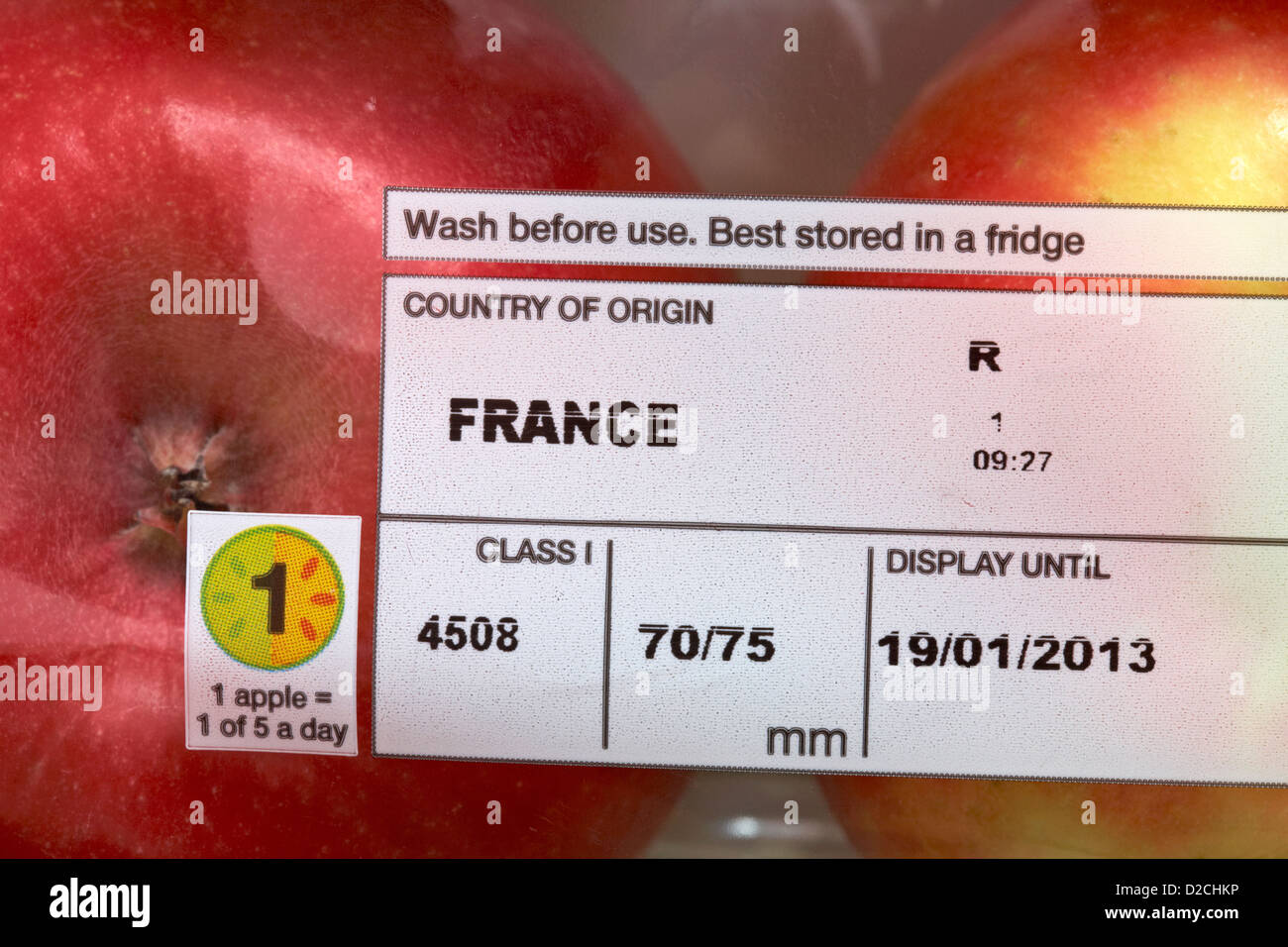
Most pre-packaged apples are legally required to state their origin on the bag or container. If you are purchasing loose apples, look for a sign on the shelf or display bin. Individual stickers on apples often contain a Price Look-Up (PLU) code. While PLU codes primarily facilitate pricing at the register, the surrounding label or the retailer’s manifest often links the PLU to a specific grower or origin.
2. Supply Chain Documentation
For bulk purchasers, distributors, or food service providers, verification relies on official documentation. The primary document is the Phytosanitary Certificate. This is an official document issued by the plant protection organization of the exporting country. It confirms that the consignment meets the phytosanitary import requirements of the destination country, explicitly stating the country of origin and the specific orchard or packing house involved.
3. Digital Traceability Platforms
In 2026, many major agricultural exporters utilize blockchain or cloud-based traceability software. These systems allow retailers and, occasionally, consumers to scan a QR code on the packaging. This digital trail provides a comprehensive view of the product’s journey, starting from the specific farm block where the apple was picked, through the cooling and packing facilities, and finally to the retail destination.
Comparison of Verification Methods
| Method | Target Audience | Reliability | Detail Level |
|---|---|---|---|
| Retail Labels | End Consumer | High | Country only |
| Shelf Signage | End Consumer | Moderate | Country/Region |
| Phytosanitary Docs | Commercial/Regulatory | Absolute | Farm/Orchard level |
| QR/Digital Trace | Consumer/Retailer | High | Complete history |
Common Challenges in Origin Identification
Despite robust regulations, identifying the origin of apples can be difficult due to several factors. One common issue is the process of repacking. If apples are imported from one country and then repacked into different containers in a second country, the rules regarding origin can become complex. In many jurisdictions, "substantial transformation" is required to change the origin label; however, simply washing, sorting, and bagging does not generally qualify an apple as having a new country of origin.
Another challenge is the use of non-specific labels. While a label might state "Product of the USA," it rarely denotes the state or specific valley, which can be frustrating for consumers looking for regional specialties. Additionally, fraudulent labeling—though strictly monitored by agencies like the USDA or the European Food Safety Authority (EFSA)—remains a risk in international trade, necessitating the reliance on verified supply chain partners.
Managing Risks and Next Actions
If you are a business owner or a procurement manager, you must prioritize documentation. Reliance on physical labels alone is insufficient for commercial compliance. Ensure that all incoming shipments are accompanied by a valid Phytosanitary Certificate or an equivalent Bill of Lading that confirms the origin.
For consumers, the best practice is to prioritize retailers that participate in transparent supply chain programs. When in doubt regarding the safety or origin of an apple, request the manager to view the "Produce Case Manifest," which contains the detailed shipping information for all items currently on the floor.
If you believe an apple has been labeled incorrectly, particularly regarding safety-sensitive information like country of origin, report the incident to the store manager first. If the issue remains unresolved, you can file a formal complaint with your local Department of Agriculture or national food safety authority. These agencies have the mandate to conduct audits and investigations into potential mislabeling of agricultural products.
Frequently Asked Questions
Does a "Product of" label on an apple imply it was grown there? Yes, in most major regulatory jurisdictions, "Product of" refers to the country where the apple was grown and harvested. If an apple was grown in one country but packaged in another, the original country of harvest must still be declared as the country of origin.
Why do some apples have different stickers? Stickers serve multiple purposes: PLU codes for pricing, variety identification (e.g., Gala vs. Honeycrisp), and increasingly, digital tracking codes. The sticker is part of a broader system to ensure the product is sold at the correct price and traced back to its source if a recall occurs.
Can I trace an apple back to the specific farm? Only if the producer uses a high-transparency supply chain system, such as blockchain tracking or specific lot-number coding. Most standard retail apples provide country-level origin, but higher-end or organic producers often provide more granular farm-level details.
What should I do if an apple has no label or sign? In many regions, it is a legal requirement for retailers to provide origin information for fresh produce. If there is no signage or label, you should ask the produce department staff. If they cannot identify the origin, it is advisable to choose a product that has clearly documented provenance for your own peace of mind.
How do imports affect the country of origin? Imported apples must clearly state the country of origin at the point of sale. Trade agreements may influence tariffs and volume, but the fundamental requirement to disclose the country of harvest remains constant across international trade laws to ensure consumer safety and market fair play.
Is it possible for an apple to have more than one origin? No. An apple is a biological product with a single point of harvest. Even if a shipment contains mixed batches, each distinct batch must be identified by its respective country of origin to maintain regulatory compliance and supply chain integrity.
Image Gallery