Can Semimembranosus Trigger Points Cause Knee Pain? Understanding Medial and Posterior Symptoms
Yes, trigger points in the semimembranosus muscle are a frequent but often overlooked cause of knee pain, specifically localized to the back (posterior) and the inner side (medial) of the joint. These myofascial "knots" refer pain dire...
Yes, trigger points in the semimembranosus muscle are a frequent but often overlooked cause of knee pain, specifically localized to the back (posterior) and the inner side (medial) of the joint. These myofascial "knots" refer pain directly to the knee joint line, often mimicking more serious structural issues like meniscus tears or ligament strains.
Contents
The semimembranosus is the most medial of the three hamstring muscles, playing a critical role in knee stability, flexion, and internal rotation. Because of its deep location and its attachment points near the medial meniscus and the posterior joint capsule, dysfunction in this muscle can manifest as deep, aching pain that patients often describe as being "inside" the knee. In the clinical landscape of 2026, myofascial diagnostic techniques have become standard in differentiating this referred pain from intra-articular pathology.
Anatomy and Function of the Semimembranosus
To understand how a trigger point in the back of the thigh can cause pain in the knee, one must first look at the unique anatomy of the semimembranosus. It originates at the ischial tuberosity (the "sit bone") and travels down the inner back of the thigh. Its insertion point is particularly complex; it attaches to the medial condyle of the tibia, but it also sends fibrous expansions to the oblique popliteal ligament and the medial meniscus.
This anatomical connection to the medial meniscus is vital. When the semimembranosus contracts, it actually helps pull the medial meniscus posteriorly during knee flexion, protecting it from being crushed between the femur and tibia. If the muscle harbors active trigger points, it can become hypertonic (abnormally tense), which may alter the mechanics of the meniscus and lead to sensations of "tightness" or "catching" in the knee that are frequently misdiagnosed as structural damage.
The muscle primarily functions to flex the knee and extend the hip. However, its secondary role in internally rotating the lower leg when the knee is bent is where many repetitive strain injuries occur. Athletes involved in sports requiring sudden changes in direction often overload this muscle, leading to the development of myofascial trigger points.
Defining Myofascial Trigger Points in the Hamstrings
A trigger point is a hyperirritable spot within a taut band of skeletal muscle fibers. These points are characterized by exquisite tenderness and the ability to refer pain to distant sites. In the context of the semimembranosus, trigger points are typically found in the lower half of the muscle belly, though they can occur closer to the origin.
Active vs. Latent Trigger Points
It is important to distinguish between active and latent trigger points. An active trigger point causes pain even at rest and produces a familiar "referred pain" pattern when pressed. If you have active semimembranosus trigger points, you likely feel a constant ache in the back of your knee.
A latent trigger point does not cause spontaneous pain but can restrict the muscle's range of motion and cause weakness. These often go unnoticed until a clinician applies pressure during an exam or until they are "activated" by sudden overexertion or prolonged shortening (such as sitting for several hours).
The Referral Pattern: Where the Pain Goes
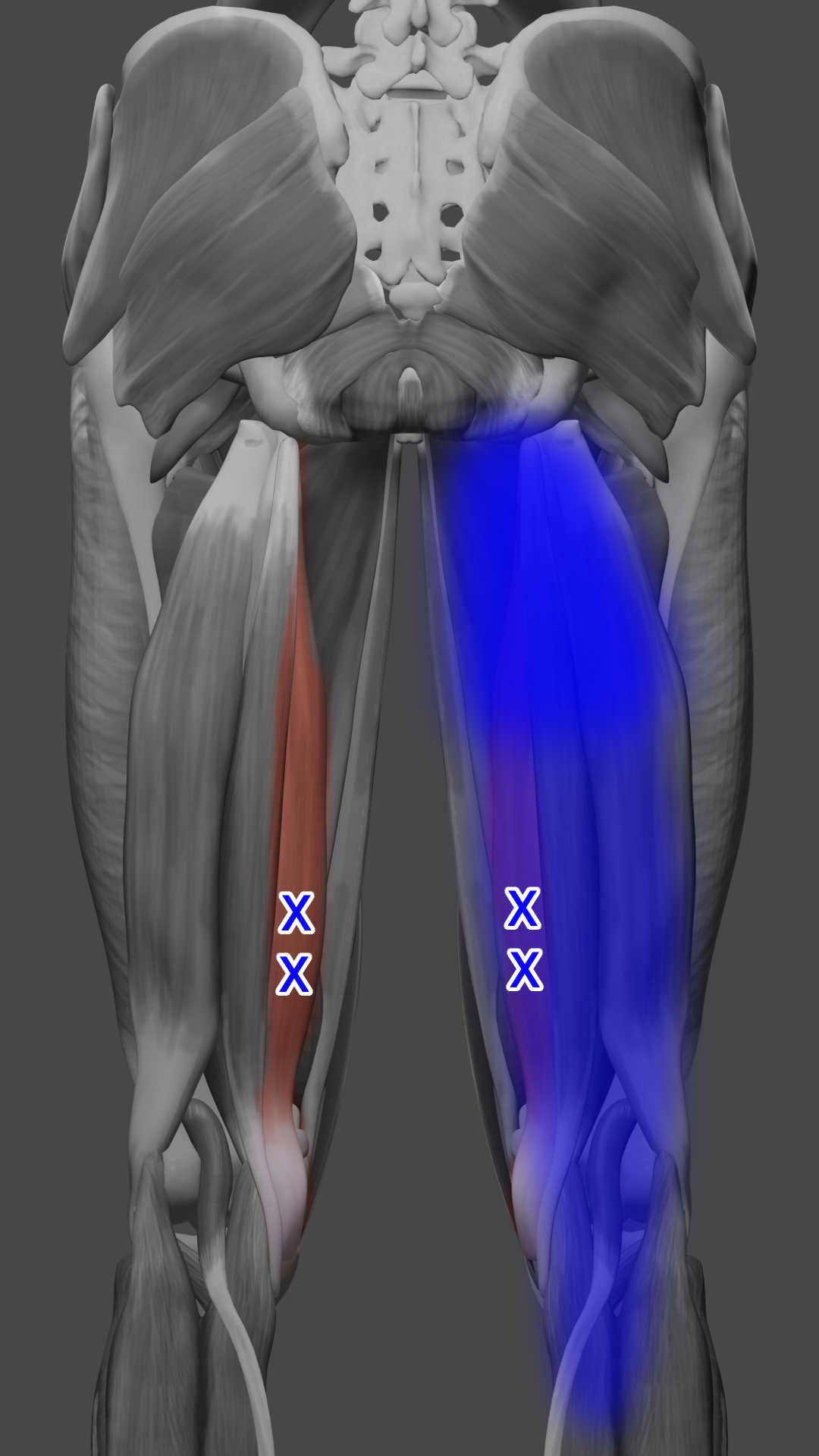
The primary referral zone for semimembranosus trigger points is the lower gluteal fold, extending down the back of the thigh and concentrating intensely at the medial and posterior aspects of the knee. Unlike the semitendinosus (its sibling muscle), the semimembranosus is known for referring pain that feels deeper and more localized to the joint line itself.
Patients often report:
- Pain that worsens when walking or running.
- Deep aching in the back of the knee when fully straightening the leg.
- Tenderness on the inner side of the knee that mimics "medial collateral ligament" (MCL) sensitivity.
- Difficulty or pain when rising from a deep squat.
Because this pain pattern overlaps with several common orthopedic conditions, identifying the muscular origin is essential for avoiding unnecessary surgical interventions or prolonged recovery times.
Common Causes and Risk Factors
Trigger points do not develop in a vacuum; they are usually the result of acute trauma or chronic repetitive strain. In 2026, lifestyle factors remain the leading contributors to hamstring dysfunction.
Prolonged Sitting and Ischemic Pressure
One of the most common causes is the "office chair effect." When sitting, the edge of the chair often presses directly against the mid-thigh, creating ischemic pressure (restricted blood flow) on the semimembranosus. This localized lack of oxygen and nutrients promotes the formation of taut bands and trigger points. Furthermore, sitting keeps the hamstrings in a shortened position for hours, leading to adaptive shortening and increased muscle tension.
Athletic Overload and "Start-Stop" Dynamics
Athletes, particularly runners and soccer players, are highly susceptible. The semimembranosus acts as a "brake" for the lower leg during the swing phase of running. If a runner suddenly increases their mileage or incorporates hill sprints without adequate conditioning, the muscle can become overloaded. Sudden, explosive movements—such as those found in tennis or basketball—can also create micro-tears that heal as fibrotic trigger points.
Secondary Compensation
Often, semimembranosus trigger points are "satellite" points. If a patient has a primary injury, such as an ACL strain or an antalgic gait (limping) due to a foot injury, the semimembranosus may overwork to stabilize the knee. This compensatory mechanism eventually leads to the development of its own trigger points, which may persist long after the original injury has healed.
Differential Diagnosis: Is it the Muscle or the Joint?
Distinguishing between semimembranosus trigger points and intra-articular knee issues is the most challenging part of the clinical assessment. Many patients arrive at physical therapy with an MRI showing "minor degenerative changes," yet their pain is actually coming from the muscle.
| Condition | Primary Pain Location | Key Distinguishing Feature |
|---|---|---|
| Semimembranosus TrP | Posterior/Medial knee line | Pain reproduced by pressing on the thigh muscle; no swelling. |
| Medial Meniscus Tear | Medial joint line | Often accompanied by joint "locking," clicking, or swelling. |
| Baker’s Cyst | Directly behind the knee | Visible or palpable swelling; tightness when flexing the knee. |
| Pes Anserine Bursitis | Front-inner side of the shin | Tenderness is lower than the joint line, where three tendons meet. |
| MCL Sprain | Inner side of the knee | History of a "valgus" injury (knee buckling inward); instability. |
If the pain can be reproduced by deep palpation of the lower-inner thigh but cannot be provoked by joint loading tests (like the McMurray test for meniscus), the cause is likely myofascial.
Identification and Self-Palpation
Locating these trigger points requires a basic understanding of the hamstring's layout. If you sit on a chair and feel the back of your thigh near the knee, the "outer" cord is the biceps femoris. On the "inner" side, you will feel two tendons. The more superficial, thinner one is the semitendinosus. Deep and slightly medial to that is the semimembranosus.
To identify a trigger point:
- Sit on the floor with your knee slightly bent.
- Use your thumb or a firm massage ball to press into the muscle about 3 to 5 inches above the back of the knee crease, slightly toward the inner thigh.
- Search for a "rope-like" band of tissue.
- Apply steady pressure. If this pressure "sends" pain into the back of your knee, you have found an active trigger point.
Evidence-Based Treatment Options
Treating semimembranosus trigger points requires a multi-faceted approach. Simply stretching a muscle with an active trigger point can sometimes make the pain worse by increasing the tension on the already irritated "knot."
Manual Release and Ischemic Compression
The "gold standard" for trigger point therapy is manual release. A clinician applies sustained, firm pressure to the point for 30–90 seconds. This process, often called ischemic compression, helps "reset" the neuromuscular junction and encourages fresh blood flow to the area once the pressure is released.
Dry Needling
In 2026, dry needling has become a primary intervention for deep muscle trigger points. A physical therapist inserts a thin filiform needle directly into the trigger point to elicit a "local twitch response." This involuntary contraction is often followed by immediate relaxation of the taut band and a significant reduction in referred knee pain.
Targeted Stretching and Eccentrics
Once the trigger point has been deactivated, stretching is essential to restore muscle length. The "seated hamstring stretch" with a focus on internal rotation of the foot can specifically target the semimembranosus. Additionally, eccentric strengthening (slowly lengthening the muscle under load), such as Nordic hamstring curls, helps rebuild the muscle's resilience and prevents the recurrence of trigger points.
Ergonomic Adjustments
If the cause is sedentary behavior, intervention must include ergonomics. Using a footrest to alleviate pressure on the thighs or switching to a standing desk for portions of the day can prevent the mechanical compression that creates these points in the first place.
Prevention and Maintenance
Preventing the return of knee pain caused by the semimembranosus involves maintaining "tissue quality." This means regular movement to prevent the muscle from remaining in a shortened state and staying hydrated to maintain the gliding properties of the fascia surrounding the muscle.
Regular use of a foam roller or a massage stick on the inner hamstrings can catch latent trigger points before they become active. Furthermore, strengthening the gluteus maximus is vital; when the glutes are weak, the hamstrings (including the semimembranosus) often overwork to compensate during hip extension, leading to chronic tightness.
FAQ
Can semimembranosus trigger points cause swelling in the knee?Generally, no. Myofascial trigger points cause pain and stiffness but do not typically cause joint effusion (fluid on the knee). If you notice significant swelling, redness, or warmth, you should consult a healthcare provider to rule out a Baker's cyst, inflammatory arthritis, or an acute ligamentous injury.
How long does it take for the knee pain to go away once the trigger point is treated?In many cases, the "referred" pain decreases significantly immediately after a successful release. However, because the muscle has likely been tight for weeks or months, it may take 3 to 6 sessions of targeted therapy and consistent stretching to achieve long-term resolution.
Is heat or ice better for this type of knee pain?For trigger points, heat is usually more effective. Heat helps relax the taut muscle fibers and increases local circulation. Ice is better suited for acute inflammation (like a sprain), whereas myofascial pain responds better to warming the tissue before stretching or manual therapy.
Can a tight semimembranosus cause my knee to "pop"?Yes. Because the semimembranosus attaches to the medial meniscus and the posterior capsule, excessive tension in the muscle can slightly alter the tracking of the joint or the position of the meniscus. This can lead to non-painful popping or clicking sounds during movement.
Are these trigger points common in older adults?Yes, but they are often misattributed to osteoarthritis. While an older adult may have some arthritis visible on an X-ray, their actual pain may be coming from the soft tissue. Treating the trigger points can often reduce the "perceived" pain of arthritis significantly.
Practical Recommendation
If you are experiencing persistent pain in the back or inner side of your knee that has not responded to typical joint-focused treatments, consider the semimembranosus as a potential culprit.
Next Action: Schedule an evaluation with a physical therapist or a certified myofascial trigger point therapist. Ask specifically for a "palpation exam of the medial hamstrings." In the meantime, evaluate your workstation for thigh compression and incorporate gentle, seated hamstring stretches twice daily, ensuring you keep your back straight to maximize the tension on the muscle belly rather than the nerves.
Image Gallery