How Agenda Setting Shapes Government Policy: Mechanisms and Theoretical Frameworks
Agenda setting is the fundamental process by which certain issues are prioritized for government action while others are excluded from the political conversation. It shapes government policy by acting as a gatekeeper, determining which...
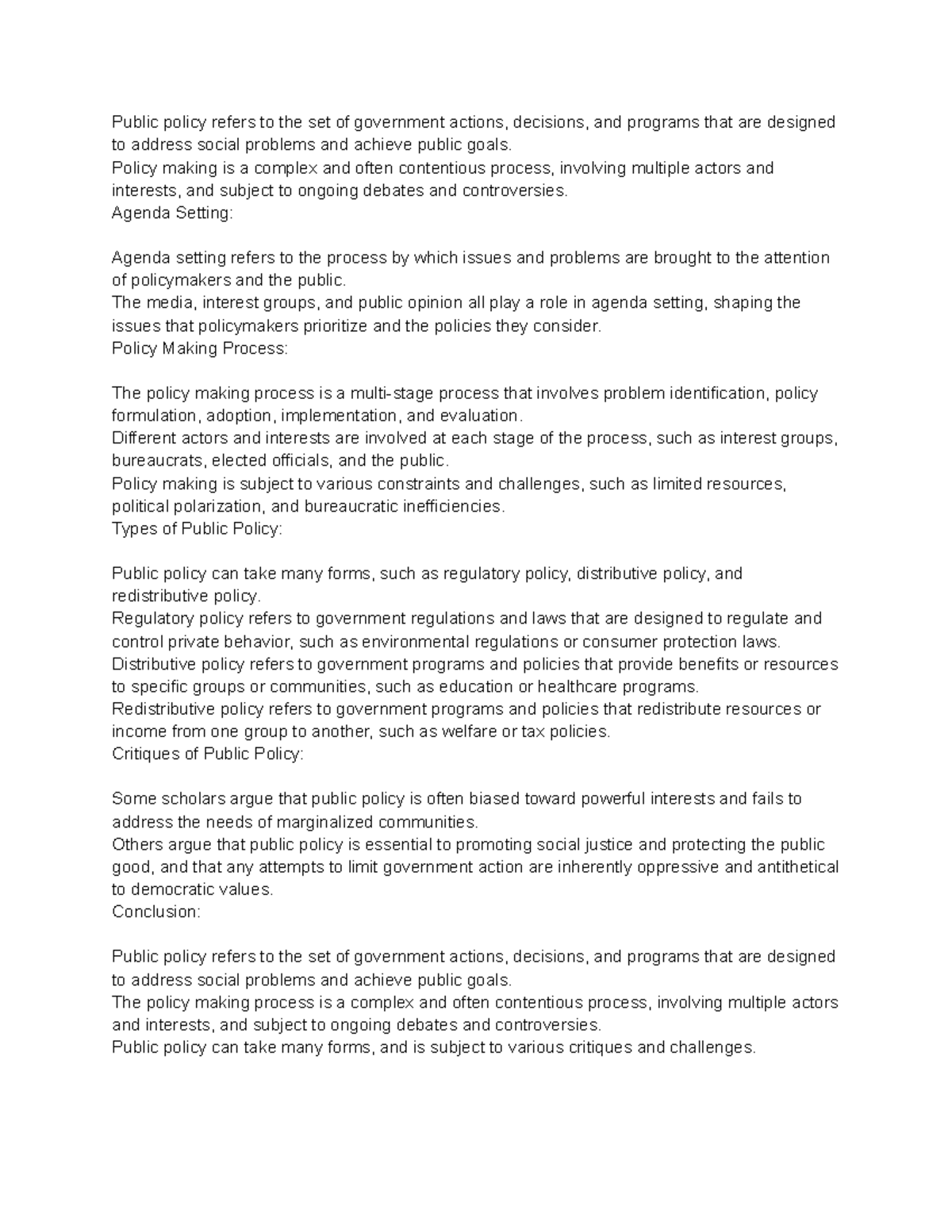
Agenda setting is the fundamental process by which certain issues are prioritized for government action while others are excluded from the political conversation. It shapes government policy by acting as a gatekeeper, determining which problems receive legislative attention, budgetary resources, and administrative focus. By defining the "what" and "how" of public debate, agenda setting dictates the trajectory of national governance and the eventual distribution of public goods.
Contents
The Fundamental Nature of Agenda Setting
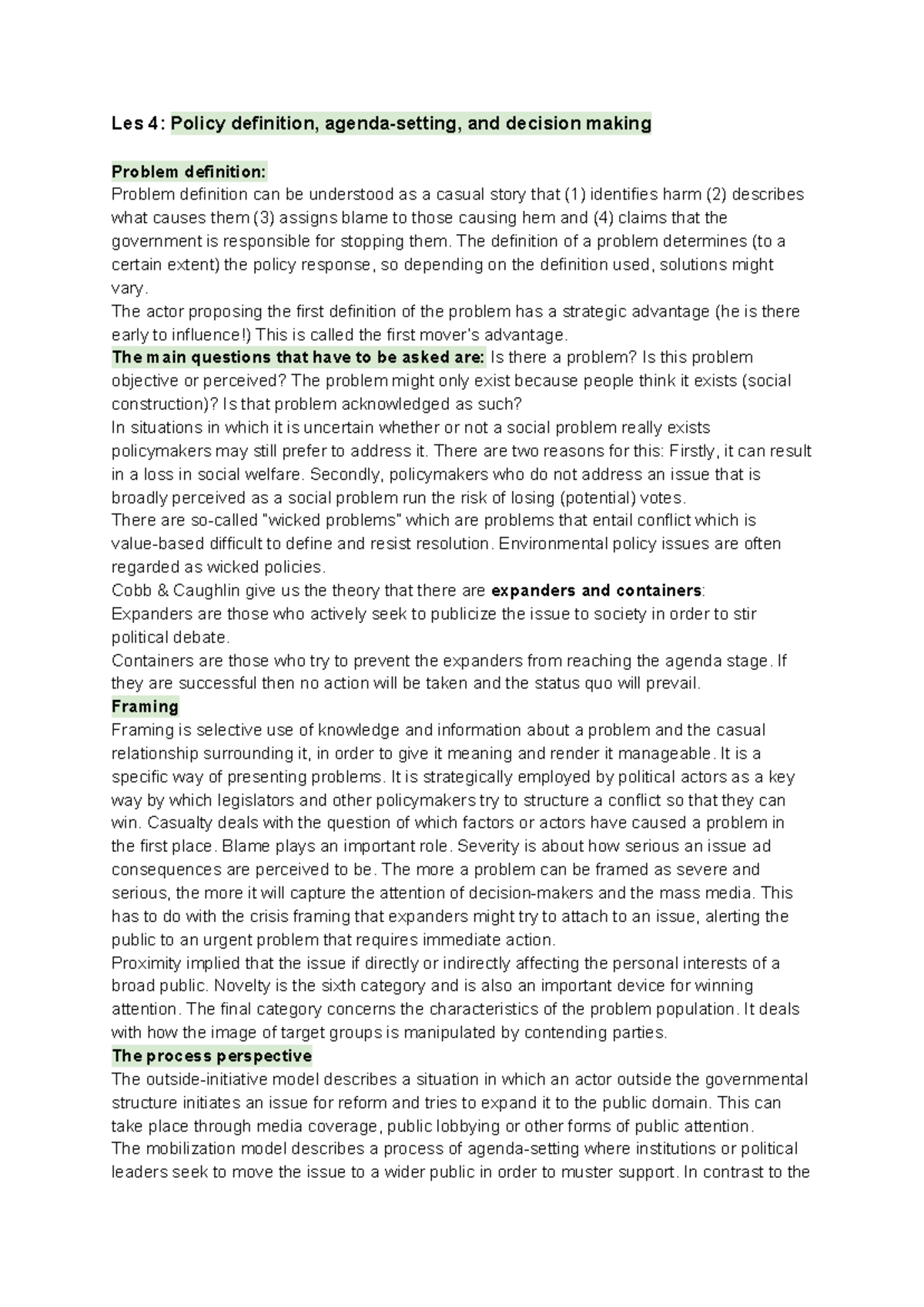
In any political system, the number of potential societal problems vastly exceeds the capacity of the government to address them. This scarcity of time, attention, and resources necessitates a selection process. Agenda setting is not merely the first stage of the policy cycle; it is the most critical phase where political power is most viscerally exercised. To control the agenda is to control the range of possible outcomes.
Political scientists distinguish between two primary types of agendas: the systemic agenda and the institutional agenda. The systemic agenda consists of all issues that are commonly perceived by members of the political community as meriting public attention and involving matters within the legitimate jurisdiction of existing governmental authority. In contrast, the institutional (or formal) agenda consists of the specific set of items explicitly up for active and serious consideration by authoritative decision-makers, such as a bill introduced in Congress or a regulatory review by an executive agency.
The transition from the systemic to the institutional agenda is where the shaping of policy occurs. When an issue successfully moves onto the formal agenda, it has already been "framed"—defined in a way that suggests a specific type of solution. For instance, if poverty is framed as a "lack of educational opportunity," the resulting policy will look significantly different than if it is framed as a "structural economic failure."
Theoretical Frameworks for Understanding Policy Shaping
To understand how agenda setting influences government policy in 2026, we must look at the established theoretical frameworks that describe the movement of ideas into the halls of power. These models explain why some issues "catch fire" while others languish for decades.
Kingdon’s Multiple Streams Framework
One of the most influential models is John Kingdon’s Multiple Streams Framework (MSF). Kingdon posits that three "streams" flow through the political system simultaneously but independently:
- The Problem Stream: This consists of various social conditions (e.g., rising inflation, climate change, healthcare costs) that are monitored via indicators, feedback from existing programs, or "focusing events" like a natural disaster or a financial crisis.
- The Policy Stream: This is the "primeval soup" where experts, researchers, and staffers develop proposals and ideas. Solutions are debated based on technical feasibility and value acceptability, often long before a problem is even identified.
- The Politics Stream: This involves the "national mood," interest group pressure, and changes in government (such as elections or shifts in legislative leadership).
Policy change occurs when these three streams converge during a "policy window." A policy window is a brief opportunity where a problem is recognized, a solution is available, and the political climate is right for action. Agenda setting shapes policy by "coupling" these streams. If a policy entrepreneur can successfully link a pre-existing solution to a newly urgent problem during a favorable political moment, they can fundamentally redirect government strategy.
Punctuated Equilibrium Theory
Developed by Frank Baumgartner and Bryan Jones, Punctuated Equilibrium Theory (PET) explains why government policy is usually characterized by long periods of stability (stasis) interrupted by short bursts of radical change.
Most of the time, policy is handled within "policy monopolies"—subsystems of experts and interested parties who keep the issue off the main political agenda to maintain the status quo. However, if an issue becomes highly "salient" (widely noticed and emotionally charged), it can break out of the subsystem and onto the macro-political agenda. This shift causes a "punctuation," leading to rapid and significant policy shifts. Agenda setting here shapes policy by shifting the venue of the debate from closed-door committees to the public stage.
Key Actors and Their Influence on the Agenda
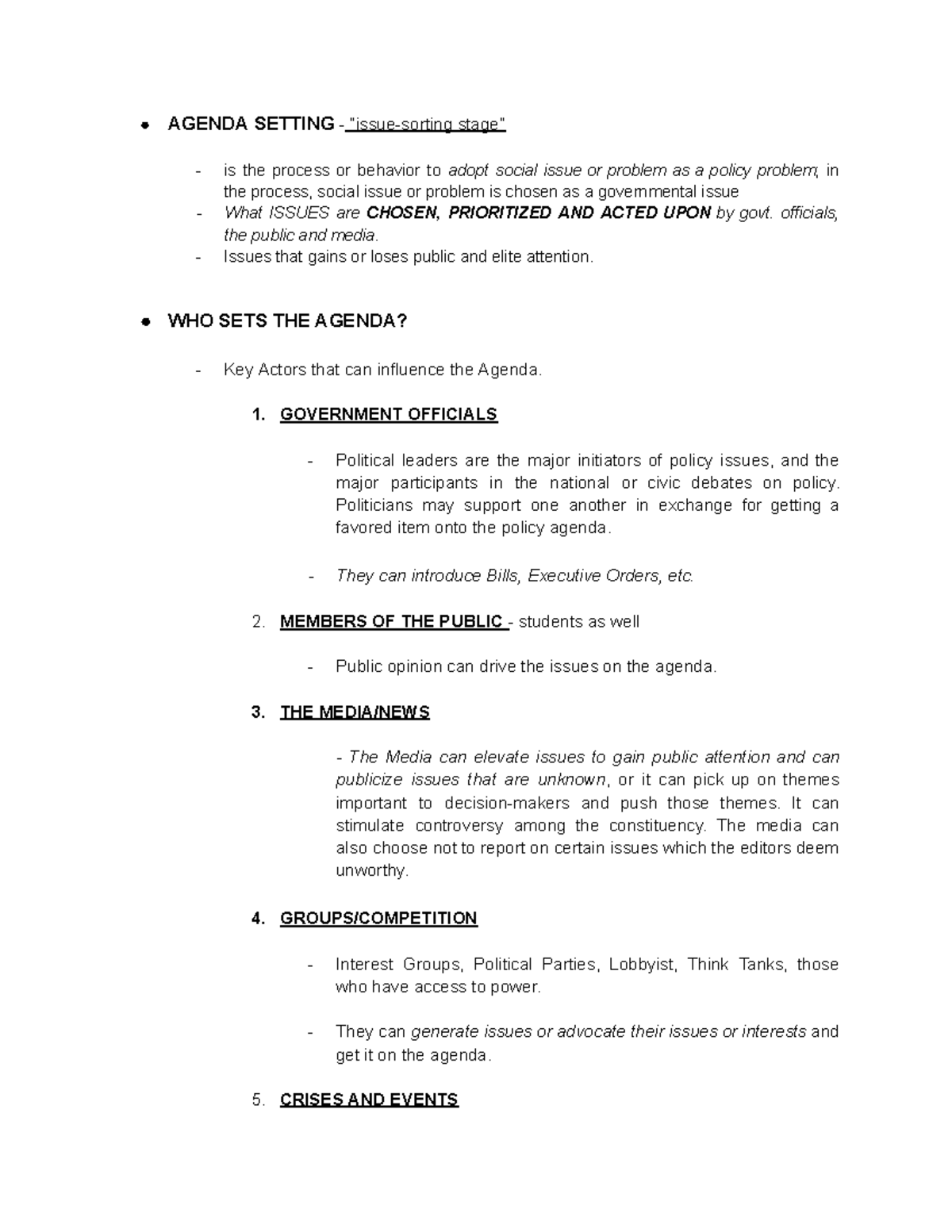
The shaping of government policy is a competitive process involving several key actors, each vying to push their priorities to the top of the list.
The Role of Executive Leadership
In modern governance, the executive branch—whether a President, Prime Minister, or Governor—is often the primary agenda-setter. Through the State of the Union addresses, budget proposals, and executive orders, the executive signals to the legislature and the public what the "top priorities" are. By controlling the administrative state, the executive can also set the agenda through "rulemaking," influencing policy without needing new legislation.
Interest Groups and Lobbying
Interest groups shape policy by acting as information providers and pressure points. They use "inside lobbying" (direct contact with officials) and "outside lobbying" (mobilizing public opinion) to ensure their issues are prioritized. Groups with significant resources can fund research that defines a problem in a way that favors their preferred solution, effectively "buying" a spot on the institutional agenda.
The Media and Information Ecosystems
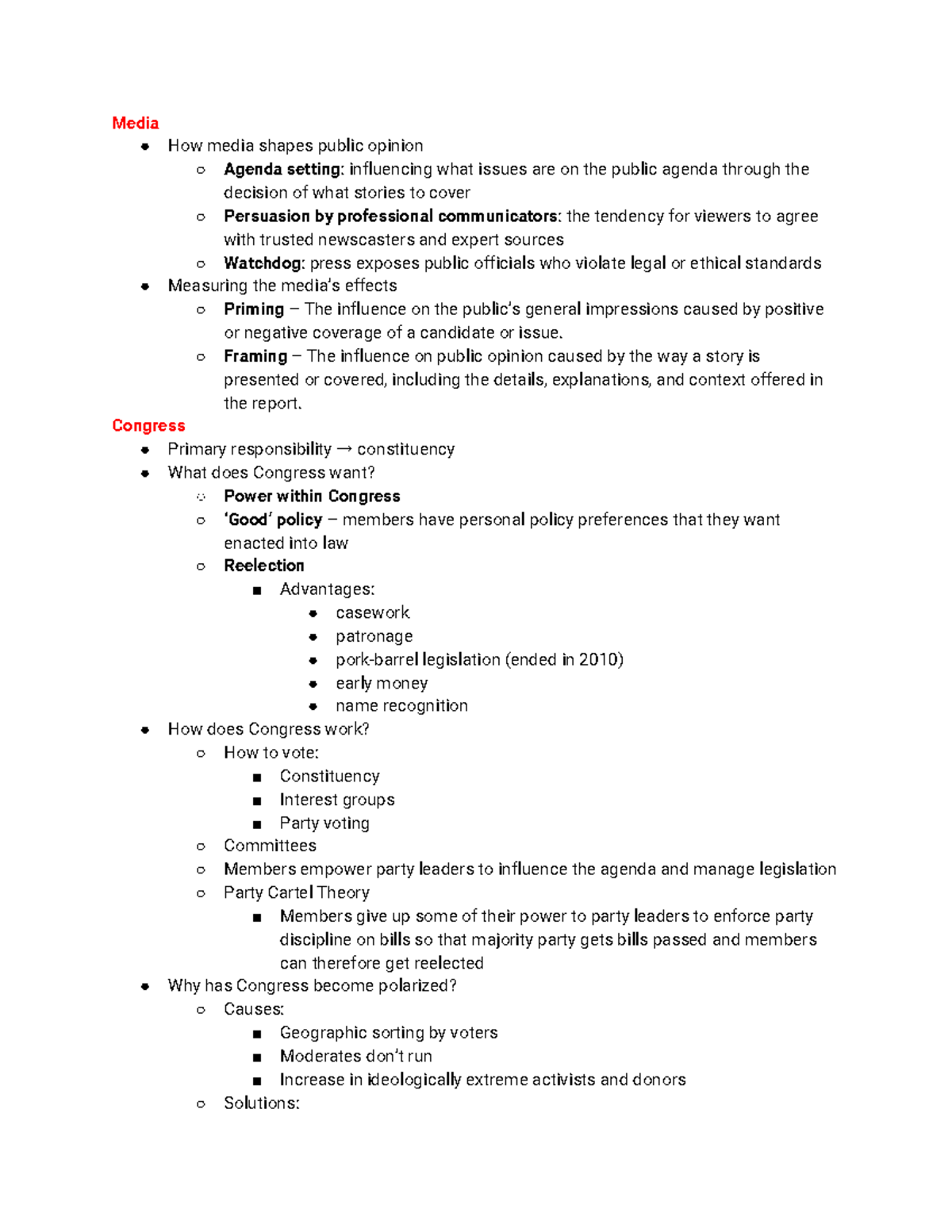
The media serves as a powerful "force multiplier" in agenda setting. Through priming and framing, news outlets tell the public not necessarily what to think, but what to think about. In 2026, the fragmentation of media into digital niches has complicated this. While traditional outlets still hold sway over institutional agendas, viral social media movements can force "bottom-up" agenda setting, bringing issues like social justice or specific environmental concerns to the forefront far faster than traditional lobbying could.
| Model / Framework | Primary Mechanism | Role of the Actor | Impact on Policy |
|---|---|---|---|
| Multiple Streams | Convergence of problem, policy, and politics streams. | Policy Entrepreneurs couple solutions to problems. | Creates "Policy Windows" for rapid legislative action. |
| Punctuated Equilibrium | Shift from policy subsystems to macro-political agenda. | Media and public opinion "punctuate" the status quo. | Results in large-scale shifts after long periods of stasis. |
| Elite Theory | Top-down direction by economic and political elites. | Leaders define which issues are "legitimate" for debate. | Maintains status quo; limits the range of radical policy change. |
| Pluralism | Competition between various interest groups. | Groups compete for attention and resources. | Policy is a compromise between competing interests. |
The Mechanics of Shaping: Framing and Salience
Agenda setting does not just choose the topic; it shapes the policy by determining the salience and frame of the issue.
Issue Framing
Framing is the process of emphasizing certain aspects of a situation over others. For example, if a government is considering policy regarding "Artificial Intelligence," the agenda can be framed as:
- Economic Growth: Focusing on subsidies and deregulation to beat global competitors.
- Safety and Ethics: Focusing on restrictive regulations to prevent algorithmic bias or job displacement.
- National Security: Focusing on defense applications and protecting data from foreign adversaries.
Whichever frame dominates the agenda-setting phase will dictate which government agencies are involved, which legislative committees have jurisdiction, and ultimately, what the law says.
The Power of Salience
Salience refers to how prominent an issue is in the minds of the public and policymakers. High-salience issues (like a sudden economic downturn) demand immediate action, often leading to "fast-track" policy-making that bypasses traditional vetting. Low-salience issues are typically handled by "iron triangles"—the stable relationship between a bureaucratic agency, a legislative committee, and an interest group—leading to incremental, technical policy changes that rarely capture public attention.
Strategic Barriers: Non-Decision Making
One of the most subtle ways agenda setting shapes policy is through what scholars call "non-decision making." This occurs when powerful actors use their influence to prevent an issue from ever reaching the agenda. By suppressing a topic, they ensure that the current policy remains unchanged.
This is often achieved by:
- Defining the issue as a "private" matter: Claiming the government has no right to intervene (e.g., historical arguments against labor laws).
- Discrediting the messengers: Attacking the credibility of those raising the issue.
- Bureaucratic delay: Shuffling an issue between departments until public interest wanes.
Understanding policy requires looking at the "missing" items on the agenda just as much as the visible ones. The absence of a policy is often a deliberate result of successful agenda-setting by those who benefit from the status quo.
Frequently Asked Questions
How does a "focusing event" change government policy?
A focusing event is a sudden, rare, and harmful occurrence—such as a major oil spill or a terrorist attack—that attracts immediate, intense public and media attention. These events act as catalysts in the agenda-setting process by providing "undeniable evidence" of a problem in the Problem Stream, often forcing a policy window to open and allowing pre-existing solutions to be rapidly adopted into law.
Why do some important issues never make it onto the policy agenda?
Issues often fail to reach the agenda due to a lack of political "salience," strong opposition from vested interests (non-decision making), or the lack of a clear, technically feasible solution. If an issue cannot be framed in a way that aligns with the current "national mood" or the interests of the party in power, it is unlikely to move from the systemic agenda to the institutional agenda.
What is the difference between agenda setting and policy formulation?
Agenda setting is the process of deciding which problems the government will address. Policy formulation is the subsequent stage where specific goals are set, and various technical and legislative "solutions" are drafted to address the problems that successfully made it onto the agenda. Agenda setting provides the boundaries; formulation fills in the details.
How has social media changed agenda setting in 2026?
Social media has democratized the initial stages of agenda setting by allowing grassroots movements to bypass traditional media gatekeepers. However, it has also led to "agenda fragmentation," where different segments of the population are focused on entirely different sets of problems, making it harder for the government to find a consensus on what the "national" priorities should be.
Can agenda setting happen within the bureaucracy?
Yes. Administrative agenda setting occurs when executive agencies prioritize certain regulations or enforcement actions over others. While the legislature sets broad goals, the bureaucracy often decides the specific technical issues that will be tackled first, effectively shaping the "on-the-ground" reality of government policy.
Practical Recommendations for Policy Advocates
To successfully shape government policy through agenda setting, advocates must move beyond merely identifying a problem. First, you must develop a technically sound solution (the Policy Stream) long before the opportunity for change arises. Second, you must wait for, or help create, a "focusing event" or a shift in political climate (the Politics Stream) that makes the public receptive to your message. Finally, framing is paramount: define your issue in a way that resonates with the prevailing values of the decision-makers in power, whether that be through the lens of economic efficiency, national security, or social equity.
Image Gallery