Crafting Compelling Sociology Research Ideas: A Strategic Framework
Developing high-quality sociology research ideas requires balancing theoretical inquiry with methodological feasibility and contemporary social relevance. To succeed, researchers must identify a specific social phenomenon, frame it wit...
Developing high-quality sociology research ideas requires balancing theoretical inquiry with methodological feasibility and contemporary social relevance. To succeed, researchers must identify a specific social phenomenon, frame it within established academic discourse, and apply rigorous data collection techniques—such as ethnography, quantitative surveys, or content analysis—to generate verifiable, meaningful insights into human behavior and societal structures.
Contents
Understanding the Research Landscape in 2026
Sociological research in 2026 is defined by a rapid intersection of traditional qualitative methods and advanced digital data analysis. As institutions and academic bodies refine their ethical guidelines regarding data privacy and the usage of artificial intelligence in social science, the landscape for research has become both more complex and more data-rich.
Selecting a research topic is not merely about finding a gap in the literature; it is about choosing a subject that is "researchable." A researchable topic is one where you can feasibly gain access to the subjects, navigate institutional review board (IRB) requirements, and produce findings that contribute to the broader sociological field without violating ethical boundaries or professional standards.
Identifying Your Niche: From Broad Interests to Specific Proposals
The most common mistake among emerging researchers is selecting a scope that is too broad. "Social inequality" is a field of study, not a research project. To narrow your focus, apply the "Levels of Analysis" approach:
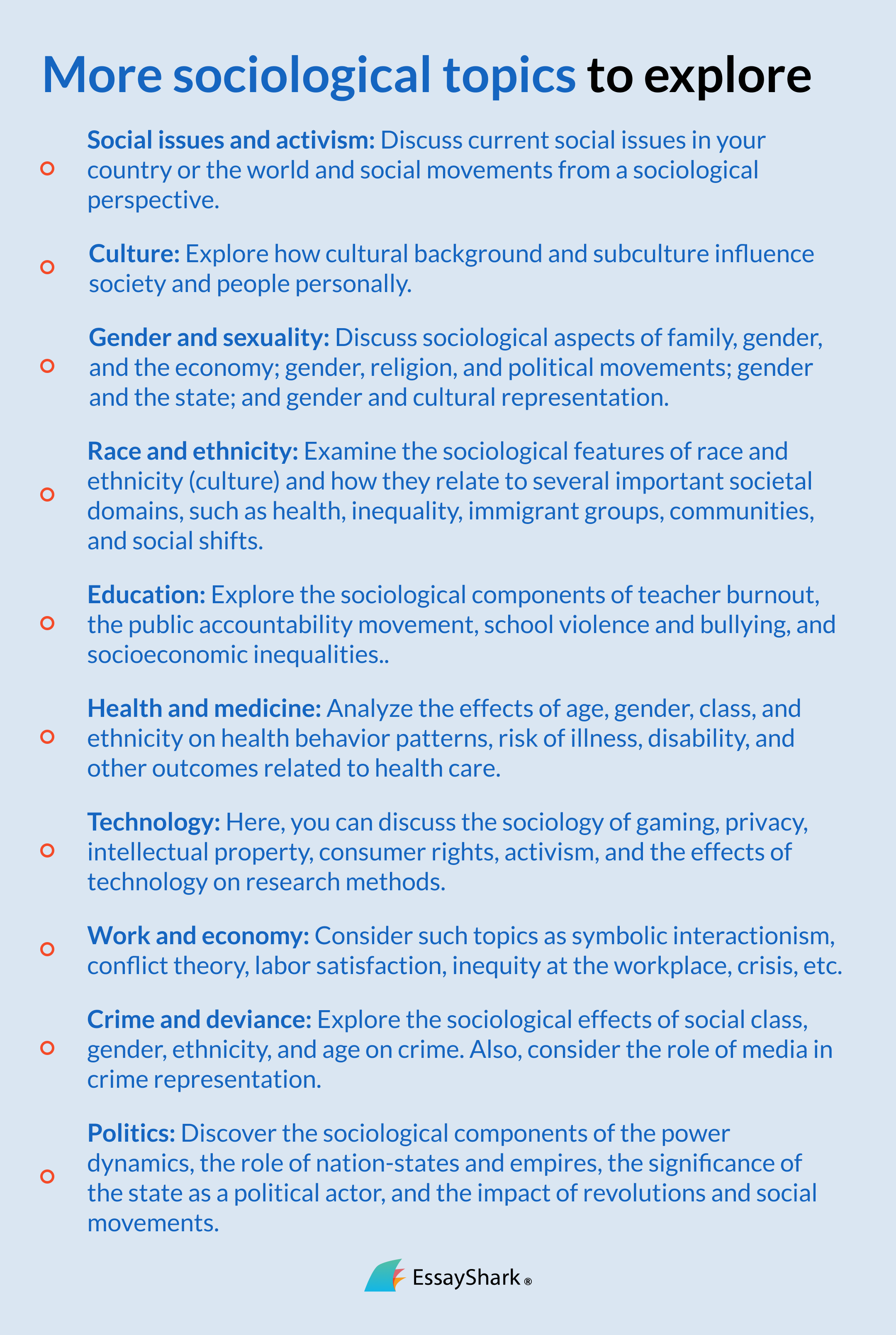
- Macro-Sociological Ideas: Focus on large-scale social processes, such as globalization, systemic shifts in labor markets, or the impact of international migration policies on national identities.
- Meso-Sociological Ideas: Examine organizations, communities, or institutions. This includes studying the social dynamics within specific workplaces, the integration of migrant populations into suburban neighborhoods, or the influence of digital platforms on community engagement.
- Micro-Sociological Ideas: Investigate face-to-face interactions, social roles, and the construction of identity. This might involve looking at how individuals negotiate personal privacy in the age of persistent digital tracking or the role of peer groups in shaping professional aspirations among youth.
Table 1: Converting Broad Topics to Researchable Questions
| Broad Interest | Researchable Focus Area | Potential Method |
|---|---|---|
| Education | Impact of remote learning on student peer social capital | Qualitative interviews |
| Technology | Algorithmic bias in professional hiring platforms | Content/Code analysis |
| Environment | Community climate anxiety in coastal populations | Quantitative surveys |
| Labor | The "gig economy" and worker isolation metrics | Mixed-methods study |
Prerequisites for Conducting Sociological Research
Before finalizing your topic, ensure you have addressed the necessary infrastructure for execution. Research is not purely conceptual; it is an operational undertaking.
- Access to Participants: Do you have the ability to contact and gain consent from your demographic of interest? Without "gatekeeper" access, you cannot conduct effective field research.
- Methodological Proficiency: Ensure you are proficient in the tools required for your chosen path. If you plan to conduct a statistical analysis of demographic data, you must be comfortable with software such as R or SPSS. If you are conducting ethnography, you must have the temperament and training for participant observation.
- Institutional Ethics (IRB): In 2026, oversight regarding human subjects is stringent. Familiarize yourself with the Common Rule or your local equivalent. Even if you are an independent researcher, maintaining ethical standards—such as informed consent, anonymity, and the prevention of harm—is mandatory for the credibility of your findings.
Structuring the Research Project
Once a topic is selected, the transition from idea to project follows a standardized academic trajectory. Following this sequence ensures your research remains focused and defensible.
1. Literature Review and Gap Identification
Your research must speak to what has already been said. By reviewing peer-reviewed journals and academic books from the past decade, you identify the "conversations" you are entering. If a topic has been saturated, look for a new population subset or a different socio-economic context that has not yet been documented.
2. Formulating the Hypothesis or Research Question
Your research question must be open-ended enough to allow for unexpected findings but specific enough to be answered. A good question should be "falsifiable"—meaning it should be possible to collect data that could potentially disprove your initial assumption.
3. Data Collection Strategies
In 2026, researchers have access to secondary data sets (such as those provided by national statistical agencies) that allow for robust secondary analysis. However, primary data collection remains the gold standard for unique sociological insights. Always prioritize the method that best fits the question, not the method you find easiest.
Common Mistakes to Avoid
- Subjective Bias: Avoid topics where you have a deep, unexamined personal stake that might preclude objective analysis. Sociologists strive for "value neutrality," as defined by Max Weber; this does not mean you lack opinions, but that you do not allow them to dictate the interpretation of data.
- Underestimating Time Constraints: Longitudinal studies take years. If you are operating under a academic or grant-based deadline, focus on cross-sectional research that provides a snapshot of a phenomenon rather than a long-term evolution.
- Ignoring Feasibility: Ensure your budget—even if self-funded—covers potential costs like participant compensation, transcription software, or access to proprietary databases.
Frequently Asked Questions
How do I know if my research idea is "sociological" enough?
A research idea is sociological if it moves beyond the individual and seeks to understand the social structures, norms, and collective behaviors that influence that individual. If your question centers on why a society is organized the way it is, or how social structures constrain or enable human action, it is firmly within the discipline.
Can I use AI tools for my sociology research?
AI can be used for administrative tasks, such as summarizing literature or cleaning data sets. However, the interpretation of social phenomena, the ethical engagement with human subjects, and the core analysis must be human-led. Relying on AI for the actual findings is generally considered a violation of academic integrity in 2026.
What is the best way to handle sensitive topics?
Researching sensitive or marginalized populations requires extra care in institutional clearance and respondent safety. Use "member checking," where you share your findings with the participants to ensure they feel their perspectives have been accurately represented without being harmed by the publication of the data.
How do I measure "social impact" in a study?
Social impact is measured by the degree to which your research clarifies a mechanism of inequality, provides a foundation for policy discussion, or alters the existing academic understanding of a demographic or institutional behavior. It is not necessarily about changing the world overnight, but about deepening the collective knowledge of how we function as a society.
Next Steps for Your Project
To move forward, write a one-page "prospectus" of your idea. Include your research question, the primary methodology you intend to use, and a list of three seminal sources that frame your inquiry. Once this is drafted, subject it to a "peer review" by a mentor or colleague. If your peers can identify the research intent and the path to execution clearly, you are ready to begin the formal proposal process.
Image Gallery