Understanding the ICD-10 Code for Diabetes with Peripheral Vascular Disease
To code diabetes with peripheral vascular disease (PVD) in 2026, the primary classification relies on the ICD-10-CM "with" convention, which assumes a causal link between the two conditions. For Type 2 diabetes, the most common code is...
To code diabetes with peripheral vascular disease (PVD) in 2026, the primary classification relies on the ICD-10-CM "with" convention, which assumes a causal link between the two conditions. For Type 2 diabetes, the most common code is E11.51 (Type 2 diabetes mellitus with diabetic peripheral angiopathy without gangrene) or E11.52 if gangrene is present. Type 1 cases use the E10.5- series.
Contents
Medical coding in 2026 requires a high degree of precision to ensure clinical accuracy, proper reimbursement, and compliance with Hierarchical Condition Category (HCC) models. When a patient presents with both diabetes mellitus (DM) and peripheral vascular disease, the ICD-10-CM Official Guidelines for Coding and Reporting dictate that these conditions should be coded as a single, linked entity unless the physician's documentation explicitly states the two are unrelated. This "linked" relationship is fundamental to understanding how to navigate the E08 through E13 categories.
The Significance of the "With" Guideline in 2026
The ICD-10-CM coding system uses the word "with" or "in" within the Alphabetic Index to signify a presumed causal relationship. According to the 2026 coding guidelines, conditions listed as "with" diabetes—such as peripheral angiopathy, neuropathy, or nephropathy—are assumed to be complications of the diabetes.
This means that if a provider documents "Type 2 Diabetes" and "Peripheral Vascular Disease," the coder does not need the provider to explicitly state "caused by" or "due to." The association is built into the code structure itself. This rule is designed to simplify the coding of chronic manifestations, but it requires coders to be diligent. If the physician clearly documents that the PVD is due to a non-diabetic cause (such as trauma or a specific genetic condition), only then is the link broken, and the conditions are coded separately.
Primary ICD-10-CM Codes for Diabetic Peripheral Vascular Disease
The selection of the correct code depends primarily on the type of diabetes the patient has and whether the condition has progressed to tissue necrosis (gangrene).
Type 2 Diabetes Mellitus (Category E11)
Type 2 diabetes is the most frequent diagnosis in clinical settings. When coding for circulatory complications in these patients:
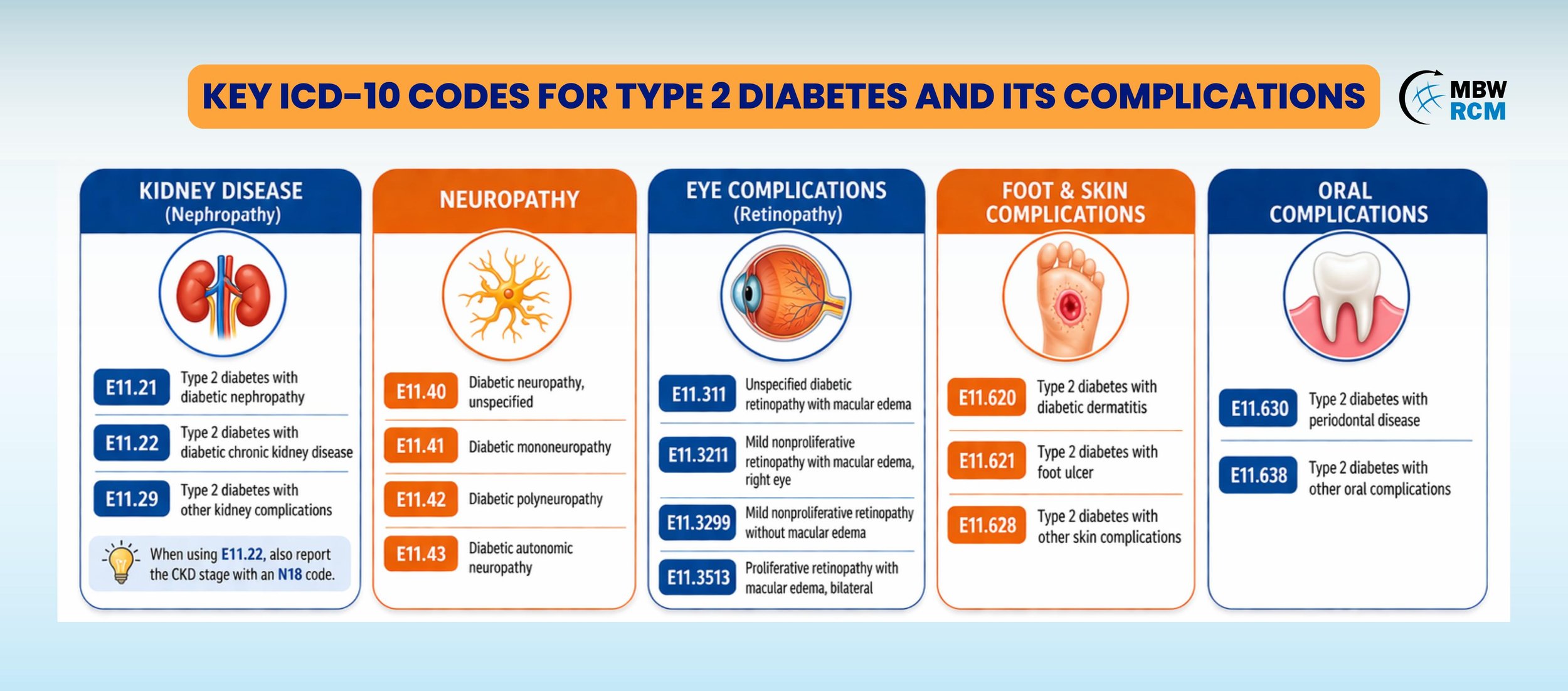
- E11.51: Type 2 diabetes mellitus with diabetic peripheral angiopathy without gangrene. This is the standard code for a diabetic patient with PVD or peripheral arterial disease (PAD).
- E11.52: Type 2 diabetes mellitus with diabetic peripheral angiopathy with gangrene. This code is used when the vascular compromise has led to localized death of body tissue.
Type 1 Diabetes Mellitus (Category E10)
For patients with Type 1 diabetes (insulin-dependent from onset due to pancreatic failure):
- E10.51: Type 1 diabetes mellitus with diabetic peripheral angiopathy without gangrene.
- E10.52: Type 1 diabetes mellitus with diabetic peripheral angiopathy with gangrene.
Other Specified and Secondary Diabetes (Categories E08, E09, E13)
In cases where diabetes is caused by an underlying condition, such as cystic fibrosis, or is drug-induced (e.g., long-term steroid use), the categories change, but the sub-classification for PVD remains consistent:
- E08.51/E08.52: Diabetes mellitus due to an underlying condition with circulatory complications.
- E09.51/E09.52: Drug or chemical induced diabetes mellitus with circulatory complications.
- E13.51/E13.52: Other specified diabetes mellitus with circulatory complications.
Navigating Peripheral Angiopathy vs. Peripheral Vascular Disease
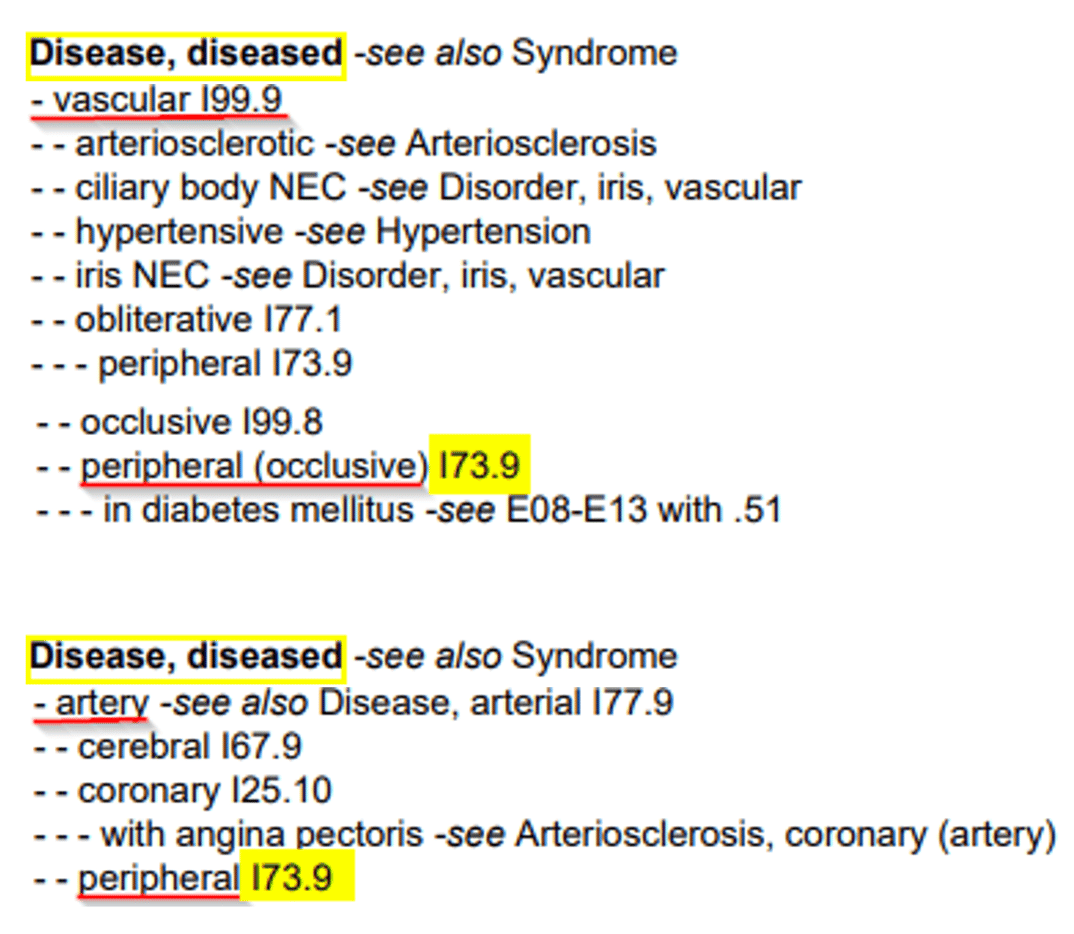
A common point of confusion for new coders is the terminology shift between clinical documentation and the ICD-10-CM index. While clinicians often write "PVD" or "PAD," the ICD-10-CM index classifies these under the term "peripheral angiopathy."
Peripheral vascular disease is an umbrella term that includes any condition that affects the blood vessels outside the heart and brain. In the context of diabetes, the high blood glucose levels lead to damage of the vessel walls (atherosclerosis), narrowing the arteries and reducing blood flow to the extremities. When you look up "Diabetes, with, peripheral vascular disease" in the Alphabetic Index, it directs you to "Diabetes, with, circulatory complication," which eventually leads to the codes for "peripheral angiopathy."
Documentation Requirements for Clinical Accuracy
To support these codes in an audit, the medical record must be robust. In 2026, payers and regulatory bodies emphasize the "MEAT" criteria—Monitor, Evaluate, Assess, or Treat. Documentation should not merely list PVD as a past medical history item but should describe its current status.
- Type of Diabetes: The provider must specify Type 1, Type 2, or secondary diabetes. If the type is not documented, the default is Type 2.
- Manifestation: The record should clearly link the circulatory issue. Mentions of "claudication," "rest pain," or "diminished pulses" in a diabetic patient support the use of E11.51.
- Presence of Gangrene: This is a critical distinction. The presence of gangrene significantly changes the complexity of the case and the reimbursement level.
- Site Specificity: While the E11.51 code itself is not lateralized (it doesn't specify left or right leg), the provider should still document the location of the vascular disease to support the medical necessity of diagnostic tests like Ankle-Brachial Index (ABI) or arterial duplex scans.
The Role of DM with PVD in HCC Coding
In the 2026 healthcare landscape, Hierarchical Condition Category (HCC) coding is vital for Medicare Advantage and other risk-adjusted payment models. Diabetes with PVD (E11.51) carries a higher Risk Adjustment Factor (RAF) score than "uncomplicated" diabetes (E11.9).
Because PVD represents a manifestation of end-organ damage (the circulatory system), it signals to the payer that the patient is more complex and will likely require more resources. Accurate coding ensures that the healthcare facility receives the appropriate funding to manage the patient's care. Failure to capture the PVD complication leads to underfunding and an inaccurate representation of the patient's health status.
| ICD-10 Code | Description | HCC Impact (Approx.) | Key Documentation Elements |
|---|---|---|---|
| E11.51 | Type 2 DM with peripheral angiopathy without gangrene | High | DM Type, PVD/PAD presence, absence of gangrene |
| E11.52 | Type 2 DM with peripheral angiopathy with gangrene | Very High | Evidence of necrosis, specific site of gangrene |
| E10.51 | Type 1 DM with peripheral angiopathy without gangrene | High | Confirmation of Type 1 status, circulatory symptoms |
| I73.9 | PVD, unspecified | Low | Use ONLY if the provider states PVD is NOT related to DM |
| E11.9 | Type 2 DM without complications | Base | Use if no circulatory or other complications exist |
Common Coding Errors to Avoid
Using I73.9 Instead of E11.51
One of the most frequent errors is coding the diabetes and the PVD separately using E11.9 and I73.9. Under the ICD-10-CM guidelines, these two should be collapsed into E11.51. Coding them separately can be flagged as "unbundling" or simply incorrect coding, leading to claim denials.
Overlooking Gangrene
If a patient has a diabetic foot ulcer that has become gangrenous, using E11.51 is an under-coding error. E11.52 must be used. Furthermore, if gangrene is present, additional codes from category I96 (Gangrene, not elsewhere classified) are not typically required because the gangrene is already captured in the diabetic combo code.
Confusing PVD with Venous Insufficiency
PVD/PAD refers to arterial issues. Venous insufficiency (I87.2) is a different circulatory problem involving the veins. While diabetes can coexist with venous insufficiency, the "with" guideline for diabetes does not automatically link venous issues in the same way it links arterial angiopathy. If the patient has venous stasis, you would code E11.9 and I87.2 separately, unless the provider specifically links them.
Summary of Coding Steps for 2026
To ensure the most accurate code assignment for diabetes with peripheral vascular disease, follow this sequence:
- Identify the Diabetes Type: Determine if the patient has Type 1, Type 2, or a secondary form of diabetes.
- Verify the Circulatory Condition: Confirm that the patient has an arterial vascular issue (PVD, PAD, or peripheral angiopathy).
- Check for Gangrene: Look for any documentation of necrotic tissue.
- Apply the Combo Code: Use the Alphabetic Index under "Diabetes, with, peripheral angiopathy" to find the correct E-series code.
- Review Excludes Notes: Ensure there are no "Excludes1" notes in the Tabular List that would prevent the use of the selected code in conjunction with other documented conditions.
For more detailed guidance, professionals should refer to the CMS ICD-10-CM Resources and the Official Guidelines for Coding and Reporting.
Frequently Asked Questions
Does the patient need to have a diagnostic test to code E11.51?
While a diagnostic test like an ultrasound or ABI provides strong evidence, the ICD-10-CM code is assigned based on the provider's clinical statement. If the physician diagnoses the patient with diabetic PVD based on physical exam findings (like skin temperature changes or hair loss on the legs), the code can be assigned.
Can I code E11.51 and E11.621 (foot ulcer) together?
Yes. If a patient has both PVD and a foot ulcer, both codes should be used to provide a complete clinical picture. The PVD code (E11.51) explains the circulatory complication, while the ulcer code (E11.621) specifies the localized skin breakdown. You should also add a code from category L97 to specify the site and severity of the ulcer.
If the doctor only writes "PAD," do I still use the diabetes combo code?
Yes. Peripheral Arterial Disease (PAD) is synonymous with peripheral angiopathy in the context of the ICD-10-CM index for diabetes. Following the "with" guideline, you would code this as Type 2 DM with peripheral angiopathy (E11.51).
Is laterality required for diabetic PVD codes?
In the current ICD-10-CM structure (2026), the E11.51 code itself does not have a character for laterality (left, right, or bilateral). However, if the patient has an associated ulcer or specific atherosclerotic changes in the legs (Category I70), those secondary codes will require laterality.
Practical Recommendation for 2026
Medical coders and clinicians should prioritize clear documentation of the relationship between diabetes and its manifestations. For healthcare organizations, regular audits should be conducted to ensure that "unspecified" diabetes codes are not being used when manifestations like PVD are clearly present in the clinical notes. Leveraging the "with" guideline is essential for capturing the true acuity of the patient population and ensuring that the financial health of the practice reflects the complexity of the care provided.
Image Gallery