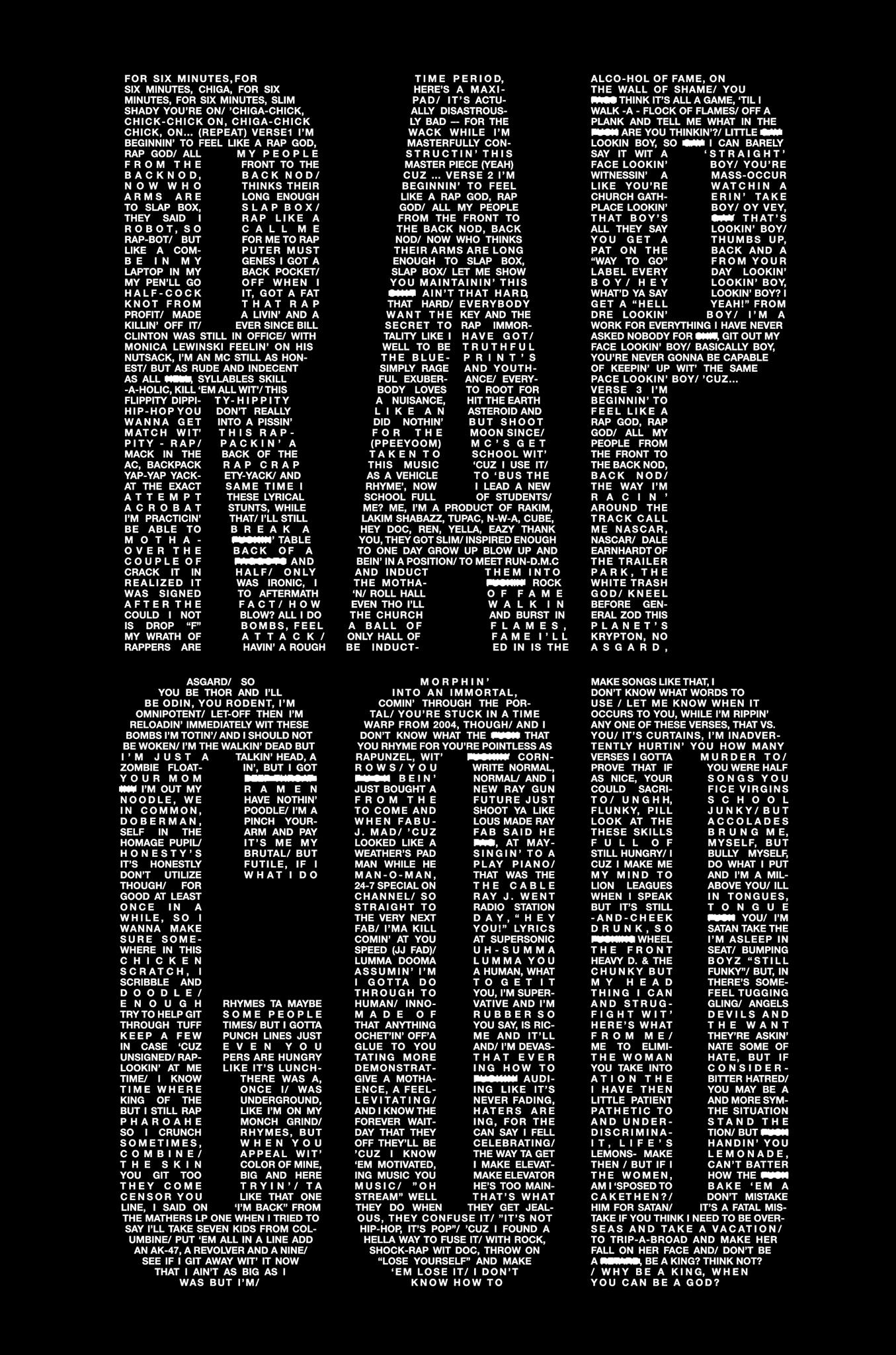
Eminem's "Rap God" Lyrics Explained: Meaning, References, and Fast Verse Breakdown
Eminem’s 2013 hit "Rap God" is a dense, six-minute thesis on hip-hop history, technical virtuosity, and personal longevity. The track serves as both a flex of lyricism and an homage to the golden era of hip-hop, blending complex multis...
Eminem’s 2013 hit "Rap God" is a dense, six-minute thesis on hip-hop history, technical virtuosity, and personal longevity. The track serves as both a flex of lyricism and an homage to the golden era of hip-hop, blending complex multisyllabic rhyme schemes, rapid-fire cadences, and deep-cut pop culture allusions.
Contents
Beyond its headline-grabbing speed, "Rap God" functions as Eminem’s definitive assertion of his place in the rap pantheon. Released on The Marshall Mathers LP 2, the track dissects his rise to fame, his battles with censorship, his place among hip-hop pioneers, and his ability to remain commercially dominant across decades.
The Origin and Intent Behind "Rap God"
When Eminem released "Rap God" in October 2013, he was addressing a rap landscape that had shifted drastically since his late-1990s debut. Produced by DVLP (Development) and Filthy, the beat incorporates elements of electronic music and trap, giving Marshall Mathers a frantic canvas on which to display his technical capabilities.
The primary goal of "Rap God" is threefold:
- Assert Technical Dominance: Demonstrate that despite his veteran status, Eminem can out-rap younger generations in speed, flow variation, and structural rhyme complexity.
- Pay Homage to Hip-Hop History: Acknowledge the foundation built by the pioneers who influenced his style.
- Reflect on his Controversial Legacy: Re-examine themes of free speech, shock rap, and media backlash that defined his earlier career, specifically the era surrounding the original The Marshall Mathers LP (2000).
The song set a Guinness World Record for the most words in a hit single, cramming 1,560 words into 6 minutes and 4 seconds—averaging roughly 4.28 words per second, with peak bursts reaching nearly 9.7 words per second.
Verse-by-Verse Lyric Breakdown
Verse 1: The Claim to Royalty and Golden Era Roots
Eminem opens the track by establishing a mock-deity persona, signaling that his lyricism transcends standard hip-hop metrics:
"Look, I was gonna go easy on you not to hurt your feelings / But I'm only goin' to get this one chance / Somethin' wrong, I can feel it..."
This opening pays homage to the classic sci-fi trope of a high-stakes, supernatural transformation, setting an epic tone. He immediately moves to ground his lyrical abilities in hip-hop lineage rather than hubris alone.
Homage to MCs of the 1980s and 1990s
Eminem asserts his pedigree by name-dropping foundational artists who shaped his early style:
"I'm a product of Rakim, Lakim Shabazz, 2 Live Crew / N.W.A, Yella, MC Ren, Q-Tip, André 3000..."
- Rakim: Widely regarded as the pioneer of internal rhyming and complex flow structures in hip-hop.
- Lakim Shabazz: A member of the Flavor Unit and an influential figure in the late 1980s conscious rap movement.
- 2 Live Crew: Pioneers of explicit content and free speech battles, mirroring Eminem’s own legal and cultural battles over explicit lyrics.
- Pharoahe Monch: Mentioned later in the verse, Monch is renowned for intricate cadence variations and technical precision, key components of Eminem's own approach.
By linking himself directly to these artists, Eminem frames his technical skill not as an anomaly, but as the natural evolution of classical hip-hop fundamentals.
Verse 2: Addressing Controversies, Censorship, and Pop Culture
The second verse pivots to Eminem’s relationship with mainstream culture, media outrage, and rivalries within the entertainment industry.
The Bill Clinton and Monica Lewinsky Metaphor
Eminem revisits the political climate of the late 1990s, when his career was blossoming alongside major political scandals:
"Back to the rap-bot, dad's got a laptop in his back pocket / Have a rap battle, start a chain reaction / Like Eli's comin' / Take a look at Monica Lewinsky, feelin' on her nut-sack..."
This line connects the political scandals of the 1990s to his own explosive arrival in pop culture. The reference to "Eli's comin'" double-entendre touches on both the classic Laura Nyro song (popularized by Three Dog Night) and former NFL quarterback Eli Manning's late-game comeback drives, framing himself as an unstoppable force entering the game.
The Fabolous and Ray J Beef Reference
Eminem highlights the absurd nature of celebrity beefs by referencing a real-life 2011 altercation between R&B singer Ray J and rapper Fabolous in Las Vegas:
"Cause I'll be damned if I do / Match it with Fabolous and Ray J, cause I'm'a try to get it / On with a guy who's got a high-pitch voice like Ray J..."
He contrasts minor celebrity disputes with his own high-stakes rivalries, mocking the sensationalism that drives modern music news coverage.
Resurrecting the Columbine Line
One of the most significant moments in Verse 2 is the reference to a line censored from his 2000 song "I'm Back":
"I take seven kids from Columbine, put 'em all in a line / Add an AK-47, a revolver, and a nine / See if I can get away with it now that I ain't as big as I was..."
In the original 2000 release of The Marshall Mathers LP, Interscope Records muted the name "Columbine" due to proximity to the 1999 tragedy. By re-delivering the line over a decade later, Eminem tests whether society's censorship standards have loosened, while commenting on how public outrage shifts over time.
Verse 3: The Ascent to Omnipotence and the "Fast Verse"
The final verse is the structural peak of the song, where Eminem transitions from historical context to pure execution.
Comic Book and Mythological Imagery
Eminem blends pop culture mythology with hip-hop braggadocio:
"As long as I got a mic, I'm godlike / So tell me, what the hell is a king to a god? / What's a god to a non-believer who don't believe in anything?"
This sequence relies on a famous rhetorical chain (often attributed to Frank Ocean’s hook on Jay-Z and Kanye West's "No Church in the Wild"). Eminem uses it to position himself beyond standard industry hierarchies—he isn't competing for a temporary "king" title; he is claiming permanent "god" status in the medium.
Deconstructing the "Fast Verse"
The defining section of "Rap God" occurs between 4:25 and 4:40 in the track. Over a 15-second span, Eminem delivers 97 words, averaging 6.46 words per second (or approximately 9.7 syllables per second).
"Uh, summa-lumma, dooma-lumma, you assumin' I'm a human What I gotta do to get it through to you I'm superhuman? Innovatin' and I'm made of rubber so that anything you say is ricochetin' off of me And it'll glue to you, I'm devastating, more than ever demonstrating How to give a motherfuckin' audience a feeling like it's levitating..."
1. Homage to J.J. Fad's "Supersonic"
The intro phrase "Uh, summa-lumma, dooma-lumma" is a direct interpolation of the 1988 track "Supersonic" by the hip-hop group J.J. Fad (produced by Dr. Dre's early group, World Class Wreckin' Cru). Eminem takes their fast-paced hook cadence and speeds it up, modernizing an early artifact of fast-rap technique.
2. Multi-Syllabic Rhyme Schemes
The complexity of the fast verse rests on maintaining a single rhyme sound across rapid cadence shifts:
- Assu- / -min'
- Hu- / -man
- Super- / -human
- Rico- / -chetin'
- Deva- / -stating
- Demon- / -strating
- Levi- / -tating
By anchoring the rapid delivery around the long "A" and soft "ing" vowel sounds, he maintains musicality and clarity despite the extreme speed.
3. Metric Precision and Breath Control
Unlike digitally sped-up vocals, Eminem recorded the segment in distinct physical takes requiring precise breath control. The rhythm relies on sixteenth-note and thirty-second-note subdivisions, staying perfectly locked into the 148 BPM tempo of the beat.
Key Cultural and Hip-Hop References Matrix
To fully appreciate "Rap God," it helps to understand the wide range of historical, cultural, and musical references Eminem weaves together throughout the track:
| Reference | Category | Timestamp | Context & Meaning |
|---|---|---|---|
| Rakim & Lakim Shabazz | Golden Era Hip-Hop | 0:34 | Credits late-80s pioneers for inventing internal rhyme patterns and complex flow mechanics. |
| Heavy D & Slick Rick | Golden Era Hip-Hop | 1:12 | References storytellers and stylistic innovators who influenced his narrative pacing. |
| Busta Rhymes | Fast Rap Pioneer | 1:45 | Nods to Busta's rapid-fire verse on "Look at Me Now," asserting he can match that speed. |
| Columbine High School | Pop Culture / Censorship | 2:38 | Recalls the line muted by labels in 2000, challenging media selective outrage. |
| Ray J & Fabolous | Celebrity Gossip | 3:15 | Mocks trivial R&B/hip-hop squabbles to contrast them with high-level lyrical skill. |
| J.J. Fad ("Supersonic") | Electro-Hop | 4:25 | Interpolates the rhythmic cadence of the 1988 classic to start the fast verse. |
| Thor & Odin | Mythology / Comics | 5:10 | Frame his mic skill as a cosmic weapon akin to Mjolnir, wielding divine power. |
| Pharoahe Monch | Underground Hip-Hop | 5:35 | Honors Monch's technical flow style on underground tracks like "Simon Says." |
Why "Rap God" Remains a Technical Milestone
"Rap God" functions as a comprehensive exercise in advanced rhyming mechanics. Broadly, Eminem leverages three specific literary and technical devices throughout the track:
1. Internal Double-Entendres
Eminem consistently layering words with dual meanings. For instance, when he references "heavy artillery" alongside "Heavy D," he simultaneously invokes physical weaponry and pays respect to the late Dwight Arrington Myers (Heavy D), combining thematic flexes with historical homage.
2. Assonance and Alliteration Clusters
Rather than relying solely on end rhymes (e.g., matching the final word of line A with line B), Eminem builds entire sentences where every accented vowel sound matches:
"Slob on your knob like Juicy J / Everybody told me I should slant-rhyme..."
Here, short "o" and long "a" sounds bounce off each other in rapid succession, creating an internal rhythm that carries the listener through beat switches.
3. Cadence Shifting
Throughout the 6-minute duration, Eminem changes his flow pattern over 14 distinct times. He alternates between staccato triplet flows, drawn-out mid-tempo phrasing, off-beat syncopation, and dense fast-velocity runs. This prevents the long song from feeling monotonous, using the vocal delivery as a secondary instrument.
Frequently Asked Questions
How fast is the fast verse in "Rap God"?
During the 15-second speed burst in the third verse, Eminem raps 97 words. That equals an average of 6.46 words per second, with peak syllables reaching almost 9.7 syllables per second.
Did "Rap God" win a Guinness World Record?
Yes. Following its release on The Marshall Mathers LP 2, "Rap God" was officially recognized by the Guinness Book of World Records for containing the most words in a hit single, totaling 1,560 words in 6 minutes and 4 seconds.
What is the meaning behind the J.J. Fad reference?
Eminem uses the phrase "summa-lumma, dooma-lumma" as a tribute to J.J. Fad's 1988 hit single "Supersonic." It pays homage to early electro-hip-hop pioneers who pioneered fast rhythmic vocal delivery in mainstream rap.
Why did Eminem repeat the Columbine line from 2000?
The original line was censored by his record label on the 2000 track "I'm Back" due to national sensitivities following the Columbine High School shooting. By re-recording the exact line on "Rap God," Eminem aimed to highlight how cultural standards of censorship change over time and test whether he would face the same pushback years later.
Who produced the beat for "Rap God"?
"Rap God" was produced by American hip-hop producers DVLP (Bigram Zayas) and Filthy (Matthew DelGiorno). The beat features a blend of synth-heavy electronic music elements paired with modern trap drum patterns.
Recommended Next Steps
To deepen your understanding of technical hip-hop lyricism and Eminem's musical evolution:
- Compare Historical Fast-Rap Tracks: Listen to J.J. Fad’s "Supersonic" (1988), Twista’s "Slow Jamz" (2003), and Busta Rhymes’ verse on "Look at Me Now" (2011) to trace how rapid-fire flows evolved leading up to "Rap God."
- Study The Marshall Mathers LP 2 in Context: Analyze "Rap God" alongside tracks like "Bad Guy" and "Headlights" to see how Eminem balanced technical skill with emotional storytelling during this era of his career.
- Examine Metric Verse Structures: Read along with an official lyric transcript to observe how multisyllabic rhymes line up rhythmically across beat bars.
Image Gallery