Holiday Loan No Credit Check: Options, Costs, and Safer Alternatives
A holiday loan with no credit check is a short-term consumer financing option designed to fund seasonal expenses without requiring a hard credit bureau inquiry. Instead of reviewing traditional credit scores, lenders evaluate eligibili...
A holiday loan with no credit check is a short-term consumer financing option designed to fund seasonal expenses without requiring a hard credit bureau inquiry. Instead of reviewing traditional credit scores, lenders evaluate eligibility through proof of steady income, active bank account history, or collateral. While accessible to bad-credit borrowers, these products often carry substantial interest rates and fees.
Contents
How "No Credit Check" Holiday Loans Work
When consumers search for holiday loans with no credit check during peak shopping seasons, they are typically looking for emergency cash or seasonal financing that does not trigger a hard inquiry on their credit reports. In traditional lending, a hard inquiry occurs when a financial institution pulls a full credit report from Equifax, Experian, or TransUnion. This pull can temporarily reduce a credit score by a few points and remains visible on the report for up to two years.
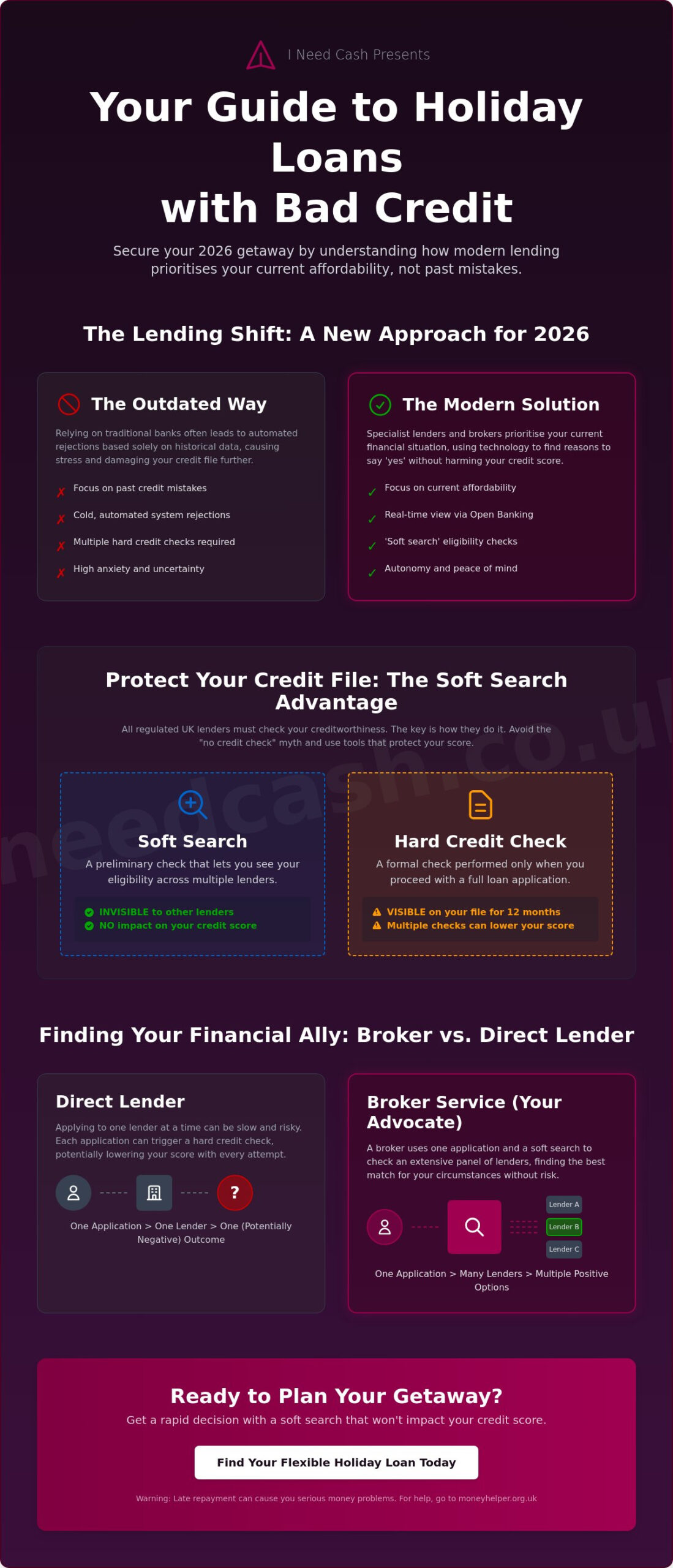
Lenders offering "no credit check" holiday loans bypass traditional credit reporting agencies entirely or use soft credit pulls that do not affect consumer scores. However, "no credit check" rarely means "no verification." Lenders must still assess the likelihood of repayment to mitigate their financial risk. Instead of credit scores, these lenders rely on alternative data points, such as:
- Verified Cash Flow: Reviewing recent pay stubs, direct deposit records, or bank statements to confirm regular earnings.
- Alternative Credit Bureaus: Querying specialty reporting agencies—such as FactorTrust, Teletrack, or Clarity Services—which track short-term lending history, subprime borrowing, and core banking activity.
- Banking Data Aggregators: Utilizing secure open-banking services (like Plaid or DecisionLogic) to analyze real-time account balances, recurring bill payments, and historical overdraft frequencies.
Because the lender takes on higher risk by waiving standard credit score minimums, the cost of borrowing is adjusted upward. Understanding how these products operate helps consumers distinguish between manageable short-term tools and predatory financial instruments.
Common Types of Seasonal "No Credit Check" Loans
Financing options marketed as holiday loans with no credit check span several distinct product categories, each with its own structure, cost framework, and repayment schedule.
1. Short-Term Personal Installment Loans
Some direct online lenders offer seasonal installment loans ranging from $300 to $2,000 without performing a hard credit check. Repayment occurs over fixed monthly or bi-weekly intervals lasting three to twelve months. While easier to manage than lump-sum payday loans, the interest rates for non-credit-checked installment loans often range between 36% and 299% APR, depending on state lending caps and lender structure.
2. Payday Loans and Single-Payment Cash Advances
Payday loans are high-cost, short-term borrowings usually capped at $500 to $1,000. The total balance, along with mandatory finance charges, is due in a single lump sum on the borrower’s next payday—typically within two to four weeks. The Federal Trade Commission (FTC) warns consumers that the fee structure of payday loans often translates into effective Annual Percentage Rates (APRs) of nearly 400%.
3. Buy Now, Pay Later (BNPL) Services
Point-of-sale financing through BNPL providers (such as Klarna, Afterpay, or Affirm) has largely replaced traditional layaway and holiday loans for retail purchases. Most standard BNPL plans split a purchase into four equal, interest-free installments paid over six weeks without a hard credit pull. While convenient, missing a payment can trigger late fees, account freezes, or external collections reporting.
4. Earned Wage Access (EWA) and Payroll Advance Apps
Earned Wage Access applications allow workers to access income they have already earned prior to their official payday. Apps like EarnIn or Brigit do not perform credit checks; instead, they sync with a user’s employer payroll system or track hours worked. Users can draw small sums (often $50 to $100 per day) for flat monthly subscription fees or voluntary "tips."
5. Pawn Shop Loans and Auto Title Loans
Collateral-based loans do not require credit checks because the debt is secured by physical property. Pawn shops hold items of value (e.g., jewelry, electronics) in exchange for cash loans, while auto title lenders take a lien on a paid-off vehicle title. If the borrower defaults, the lender seizes the collateral. Title loans carry annual percentage rates that frequently exceed 300%.
The True Cost of No-Credit-Check Holiday Financing
Borrowing money without a credit check comes at a measurable financial cost. Federal law, under the Truth in Lending Act (TILA), requires lenders to disclose the total finance charge and Annual Percentage Rate (APR) before a contract is signed. However, seasonal stress can cause consumers to overlook these disclosures.
To illustrate the financial impact, consider a seasonal loan of $500 taken out in December with a two-week repayment window:
Fee Charged: $15 per $100 borrowedTotal Fee for $500: $75Total Amount Due in 14 Days: $575
Effective APR Calculation:($75 Fee / $500 Principal) x (365 Days / 14 Days) x 100 = 391.07% APR
When borrowers cannot repay the full $575 on their next payday, lenders may offer to "roll over" or renew the loan for an additional fee. A single rollover increases the fee burden to $150 on a $500 principal within one month, compounding the risk of a long-term debt cycle.
The Consumer Financial Protection Bureau (CFPB) reports that a significant portion of short-term payday borrowing consists of repeated renewals rather than single one-off transactions, underscoring the risk of using high-cost credit for discretionary holiday spending.
Eligibility Criteria and Application Requirements
While credit scores are not evaluated for these loans, applicants must satisfy baseline operational and identity verification standards. Missing any single requirement usually results in an immediate administrative rejection.
- Age and Legal Identity: Applicants must be at least 18 years old (or the legal age of majority in their jurisdiction) and present valid government-issued photo identification (Driver's License, Passport, or State ID).
- Active Bank Account: Lenders require an open checking account in good standing. This account is used to disburse funds via direct deposit and to set up automated clearing house (ACH) withdrawals for repayments.
- Proof of Consistent Income: Applicants must supply documentary evidence showing regular earnings for at least 30 to 90 consecutive days. Acceptable documentation includes pay stubs, electronic deposit records, or tax schedules for self-employed individuals.
- Contact and Address Verification: Proof of physical residence (e.g., a utility bill or lease agreement) alongside a active phone number and email address.
Comparing Short-Term Holiday Financing Options
The table below contrasts common financing methods used during the holiday season. Use this data to compare total costs, structural features, and credit impacts.
| Option | Credit Inquiry Type | Average APR or Cost | Standard Repayment Term | Primary Risk Factor |
|---|---|---|---|---|
| Payday Alternative Loans (PALs) | Soft or Hard Pull (Varies) | Capped at 28% APR | 1 to 12 Months | Requires credit union membership |
| Buy Now, Pay Later (BNPL) | Soft Pull | 0% for 4-installments; up to 36% for long-term | 6 Weeks to 12 Months | Overspending across multiple merchant accounts |
| Short-Term Installment Loan | Soft Pull / Alternative | 36% to 299% APR | 3 to 12 Months | High interest compounding over time |
| Earned Wage Access (EWA) | None | Flat fee ($0–$10/month) or optional tips | Next Payday | Reduced future paycheck availability |
| Store Credit Cards | Hard Pull | 25% to 32% APR | Revolving Monthly | High APR combined with deferred interest traps |
| Payday Loans | None | 300% to 500% APR | 14 to 30 Days | High likelihood of loan rollover debt cycles |
Step-by-Step Application Process
If you decide to proceed with a holiday financing application that avoids traditional credit pulls, following a structured workflow helps prevent errors and unexpected costs.
- Step 1: Calculate the Exact Funding Need
- Determine the minimum necessary loan amount; avoid borrowing extra.
- Step 2: Verify Lender Credentials & Licensing
- Cross-check lender registration with state financial regulators.
- Step 3: Gather Verification Documents
- Prepare ID, bank statements, pay stubs, and routing numbers.
- Step 4: Review Truth in Lending Act (TILA) Disclosures
- Inspect the APR, total finance charge, fee table, and schedule.
- Step 5: Execute Agreement & Establish Repayment Safeguards
- Set up payment calendar alerts before automated ACH debits occur.
1. Calculate the Exact Funding Need
Determine the minimum amount required to cover essential seasonal expenses. Borrowing additional capital simply because it is offered increases total finance charges unnecessarily.
2. Verify Lender Credentials and Licensing
Ensure the lender is licensed to operate legally within your state or jurisdiction. Check state banking departments or attorney general portals to confirm that the lender complies with local interest rate caps and consumer protection laws.
3. Gather Verification Documents
Collect digital copies of your government ID, your most recent two pay stubs, and 30 to 90 days of official bank account statements. Having these ready prevents delays during automated account verification.
4. Review Truth in Lending Act Disclosures
Before signing the digital agreement, locate the TILA box in your contract. Examine the Total Finance Charge, the Annual Percentage Rate (APR), and the exact debit dates. Look specifically for hidden fee clauses, such as prepayment penalties, origination charges, or statement processing fees.
5. Execute the Agreement and Prepare Repayment Safeguards
Once the contract is executed and funds are transferred to your checking account, set calendar reminders for every scheduled debit date. Ensure your account maintains sufficient funds on those dates to avoid bank overdraft fees alongside lender non-sufficient funds (NSF) charges.
Safer Alternatives to High-Cost Holiday Loans
Before agreeing to high-cost no-credit-check financing, consider these lower-cost alternative resources designed for consumers with limited or bad credit.
Payday Alternative Loans (PALs)
Federal credit unions offer Payday Alternative Loans (PALs) regulated by the National Credit Union Administration (NCUA). PAL I and PAL II products offer accessible terms:
- PAL I: Loan amounts from $200 to $1,000, repayment terms from 1 to 6 months, and application fees capped at $20.
- PAL II: Loan amounts up to $2,000, repayment terms up to 12 months, with immediate eligibility upon joining the credit union.
- APR Cap: Interest rates on PALs are capped at 28%, making them significantly less expensive than traditional payday or non-credit-checked installment options.
Community Assistance Programs
Local charitable organizations, religious institutions, and non-profit community action agencies offer seasonal support programs. Organizations such as The Salvation Army, Toys for Tots, and local food banks provide food boxes, gift vouchers, and utility assistance during the holiday season. Utilizing these resources directly reduces the need to take on seasonal debt.
Credit Union Soft-Check Personal Loans
Many local credit unions consider non-traditional factors—such as local employment longevity, savings history, and personal references—when reviewing loan applications from established members. Even with poor credit, a credit union personal loan will feature significantly lower interest rates than specialized online subprime lenders.
How to Identify and Avoid Holiday Loan Scams
The increased demand for seasonal funding creates opportunities for dishonest actors. Recognizing standard fraud indicators protects your personal information and financial assets.
- Advance-Fee Scams: Legitimate lenders will never ask you to pay money upfront via gift cards, wire transfers, or cryptocurrency to approve a loan or cover "insurance." All legitimate lender fees are deducted directly from the loan proceeds or calculated into monthly payments.
- Guaranteed Approval Promises: While non-credit-check lenders have flexible standards, no legitimate lender guarantees approval prior to reviewing income and bank records. Claims of "100% Guaranteed Approval" are common indicators of fraudulent activity.
- Unsolicited Solicitations: Be cautious of loan offers received through unexpected text messages, social media direct messages, or robocalls. Legitimate financial institutions do not solicit loan applications through informal channel outreach.
- Unsecured Web Portals: Ensure any application website uses modern encryption standards (
https://protocol with a valid security certificate). Avoid entering sensitive details like Social Security Numbers or online banking credentials on unverified websites.
Frequently Asked Questions
Can I get a holiday loan with no credit check and instant approval?
While many online lenders offer rapid decisioning within minutes using automated bank verification, true "instant approval" is rare. Lenders must verify identity, income, and account details before transferring funds. Be cautious of services advertising instant approval without any income or identity verification, as these are often scams or predatory schemes.
Does applying for a no-credit-check loan hurt my credit score?
Applying for a loan that relies on soft inquiries or non-traditional underwriting does not reduce your standard credit score. However, if you default on the loan, the lender may transfer the outstanding balance to a third-party collection agency. Collection accounts reported to Equifax, Experian, or TransUnion will negatively impact your credit profile.
What is the maximum amount I can borrow without a credit check?
Most non-collateralized no-credit-check options—such as short-term installment loans, payday loans, or BNPL services—cap initial borrowing limits between $100 and $1,500. Larger loan amounts generally require physical collateral (such as a vehicle title) or a traditional credit assessment to confirm borrowing capacity.
Are Buy Now, Pay Later (BNPL) services safer than holiday loans?
Yes, standard 4-installment BNPL services are generally safer and far less expensive than short-term high-interest loans, provided they offer 0% APR and carry no hidden fees. However, BNPL can still encourage overspending across multiple retail platforms, leading to cumulative debt and late fee liabilities if managed carelessly.
How do Payday Alternative Loans (PALs) compare to online holiday loans?
Payday Alternative Loans offered by federal credit unions are substantially cheaper. PAL interest rates are legally capped at 28% APR, whereas standard online no-credit-check short-term loans frequently carry APRs exceeding 300%. PALs also offer longer repayment periods, making monthly installments easier to fit into a household budget.
Practical Next Steps
If you need seasonal funding, start by taking concrete steps to minimize total financing costs:
- Exhaust Non-Credit Alternatives First: Review local community assistance programs, ask your employer about Earned Wage Access options, or use short-term budgeting adjustments to cover holiday expenses.
- Contact a Local Federal Credit Union: Inquire about joining a credit union to apply for a Payday Alternative Loan (PAL), which offers lower rates and clear repayment terms.
- Read TILA Disclosures Carefully: If you choose an online lender, locate the Truth in Lending Act disclosure box to check the exact APR and fee schedule before signing any contract.
- Create a Firm Repayment Schedule: Map out debit dates against your incoming paychecks to ensure full payment on time, protecting your bank account from overdraft fees and preventing expensive debt rollovers.
Image Gallery