How to Choose PMI ACP Training Online
To choose the best PMI-ACP training online, you must verify that the course provides the mandatory 21 contact hours of agile training required by the Project Management Institute (PMI). Prioritize programs aligned with the most recent...
To choose the best PMI-ACP training online, you must verify that the course provides the mandatory 21 contact hours of agile training required by the Project Management Institute (PMI). Prioritize programs aligned with the most recent Exam Content Outline (ECO), featuring instructors with real-world agile experience and high-quality simulation exams.
Contents
The Agile Certified Practitioner (PMI-ACP) remains the most comprehensive agile certification in the project management industry as of 2026. Unlike framework-specific certifications that focus exclusively on Scrum or Kanban, the PMI-ACP requires a broad understanding of multiple agile methodologies, including Lean, XP (Extreme Programming), and Test-Driven Development (TDD). Because the scope is so vast, selecting an online training provider is a critical decision that directly impacts your ability to pass the exam on the first attempt and your capacity to apply these principles in a professional environment.
Understanding the PMI-ACP Educational Requirements
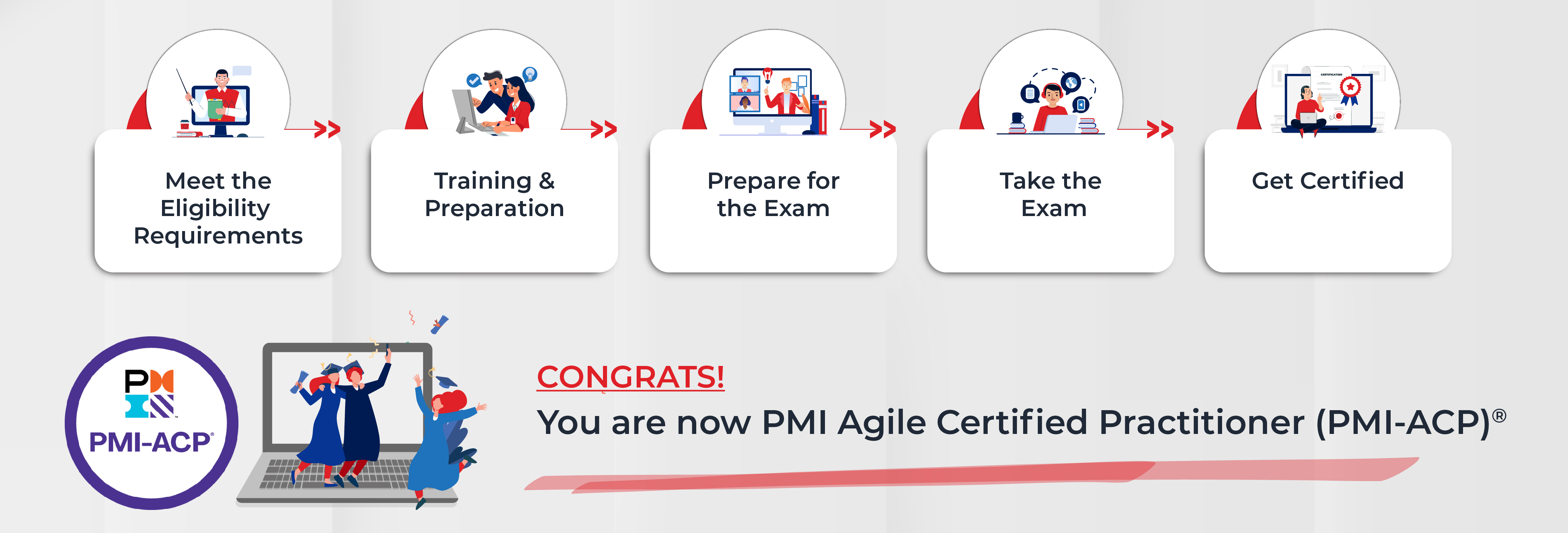
Before evaluating specific training providers, you must understand the formal requirements set by PMI. To sit for the PMI-ACP exam, candidates must document at least 21 contact hours of formal education in agile practices. These hours must be completed before you submit your application.
When choosing a course online, the "contact hour" is a specific unit of measure. One hour of active participation in a structured course equals one contact hour. In 2026, most reputable online platforms use Learning Management Systems (LMS) that track your progress to the minute, ensuring that when you receive your certificate of completion, it legally satisfies PMI’s audit requirements. If a course does not explicitly state that it provides a certificate for 21 contact hours, it should be disregarded, as it will not help you qualify for the exam.
Criteria 1: Alignment with the Exam Content Outline (ECO)
The PMI-ACP exam is not based on a single textbook. Instead, it is built around the Exam Content Outline, which spans seven domains. Your chosen online training must provide deep coverage of each of these areas rather than focusing disproportionately on Scrum.
- Agile Principles and Mindset: This domain covers the foundational philosophy. Training should explain how to transform a traditional mindset into one that embraces uncertainty and iterative delivery.
- Value-Driven Delivery: You need to learn how to prioritize work based on business value and how to deliver "minimally viable products" (MVPs) to gain early feedback.
- Stakeholder Engagement: Training must cover soft skills, active listening, and how to manage expectations in a high-transparency environment.
- Team Performance: This involves understanding self-organizing teams, "servant leadership," and the mechanics of high-performing agile squads.
- Adaptive Planning: Agile planning occurs at multiple levels (release, iteration, daily). A good course explains the "Cone of Uncertainty" and how to refine plans as more information becomes available.
- Problem Detection and Resolution: This section focuses on identifying bottlenecks, using "lead time" and "cycle time" metrics, and fostering a culture of continuous improvement (Kaizen).
- Continuous Improvement: This involves retrospectives and process tailoring.
If a course description seems too focused on the "Agile Practice Guide" alone, it may lack the depth required for the 2026 exam version, which incorporates evolving industry standards in DevOps and scaled agile frameworks.
Criteria 2: Instructor Expertise and Teaching Methodology
In the online space, the quality of the instructor is often the variable that determines student success. Many low-cost "exam factories" use narrators who simply read slides. For a certification as nuanced as the PMI-ACP, you require an instructor who has lived through agile transformations.
Search for instructors who hold the PMI-ACP themselves, along with other advanced credentials such as the CSP (Certified Scrum Professional) or the PMP. Experience in 2026 demands that instructors understand "Hybrid Agile"—the blending of predictive and adaptive methodologies—as many organizations no longer use "pure" agile.
Furthermore, evaluate the teaching methodology. Is the course purely video-based? Does it include interactive "choose your own adventure" scenarios? High-quality online training often uses "micro-learning" segments—short, 5-to-10-minute videos—that make it easier to retain complex information like the differences between a "Burn-up" and a "Burn-down" chart.
Criteria 3: Quality of Practice Exams and Question Banks
The PMI-ACP exam is known for its situational questions. It rarely asks for definitions; instead, it asks, "What should the Agile Project Manager do next?"
Therefore, the practice exams included in your online training are perhaps the most valuable asset you are purchasing. When evaluating a provider, check if their question bank includes:
- Situational Analysis: Questions that place you in a conflict between a Product Owner and a Team.
- Detailed Explanations: For every practice question, the system should explain not only why the correct answer is right but also why the incorrect options are wrong, referencing the specific agile domain or methodology.
- Exam Simulation: A UI that mimics the actual Pearson VUE testing environment used in 2026. This helps reduce "exam-day anxiety" by familiarizing you with the digital whiteboard, strike-through tools, and time management indicators.
Comparing Online Training Formats
Not all online training is delivered in the same way. In 2026, the three primary delivery models each serve different learning styles and schedules.
| Feature | On-Demand (Self-Paced) | Live Virtual Class | Hybrid/Blended Learning |
|---|---|---|---|
| Schedule Flexibility | Highest - Learn any time | Fixed - Set dates/times | Moderate - Mix of both |
| Instructor Access | Limited (Email/Forums) | Immediate (Real-time Q&A) | Scheduled (Office hours) |
| Cost Range (2026) | $200 – $600 | $800 – $1,500 | $500 – $900 |
| Typical Duration | 2–6 weeks | 3–5 days | 4 weeks |
| Engagement Level | Passive | High | Moderate/High |
| Best For | Self-motivated learners | Those needing structure | Professionals wanting both |
Evaluating Platform Support and Community
Earning the PMI-ACP is a journey that often involves administrative hurdles, specifically the PMI application process. The best online training providers offer "application support." This means they provide templates for describing your agile experience in a way that aligns with PMI’s terminology, reducing the risk of your application being rejected or selected for a manual audit.
Additionally, look for platforms that offer an active community forum or a dedicated Discord/Slack channel. In these communities, students share "lessons learned" from their recent exam experiences (without violating PMI's ethics policies), such as which domains were most heavily tested or how the online proctoring process was handled.
Cost vs. Value: Avoiding "Too Good to Be True" Offers
In 2026, you will likely encounter extremely cheap courses on aggregate platforms. While these might provide the 21 contact hours, they often lack updated content or robust support. A mid-range investment in a dedicated project management training firm is usually more cost-effective in the long run.
Consider the cost of an exam retake. As of 2026, the PMI-ACP re-examination fee is significant. If a $300 course helps you pass on the first try, it is infinitely more valuable than a $20 course that leaves you unprepared, leading to a $300+ retake fee and months of delayed career progression.
Verification of Provider Credibility
Before entering your credit card details, perform a final credibility check.
- PMI Authorized Training Partner (ATP) Status: While PMI no longer strictly requires you to use an ATP for the ACP (unlike the PMP in some regions), using an ATP ensures the content has been reviewed for quality and consistency with PMI standards.
- Recent Reviews: Look for reviews dated within the last 6-12 months. Agile practices evolve, and a course recorded in 2020 may be missing critical updates regarding modern scaling frameworks or remote agile team management.
- Sample Lessons: Reputable providers always offer a "free preview" or a sample module. Use this to assess the instructor's clarity, the video production quality, and the ease of use of the learning platform.
Common Pitfalls to Avoid
When choosing your training, stay alert for these "red flags" that often signal a sub-par learning experience:
- "PMP-Lite" Approach: Some providers treat the PMI-ACP as just a subset of the PMP. While there is overlap, the PMI-ACP requires a much deeper dive into technical agile practices like Pair Programming and Refactoring.
- Outdated Terminology: If the course still emphasizes the "Project Management Body of Knowledge (PMBOK) 6th Edition" as its primary source without referencing the 7th edition's principles or the latest Agile Practice Guide, the material is likely stale.
- No Money-Back Guarantee: In 2026, established education providers usually offer a "Pass Guarantee" or a refund window if the course doesn't meet your expectations within the first few days.
Frequently Asked Questions
Does the 21-hour training certificate expire?
No, once you have earned your 21 contact hours, they do not expire for the purpose of your initial PMI-ACP application. However, the knowledge itself can become dated, so it is recommended to take the exam within six months of completing your training.
Can I use PDUs from my PMP for the PMI-ACP education requirement?
Yes, if you already hold a PMP, the hours you spent learning agile to maintain your PMP (Professional Development Units) can often be applied toward the 21-hour requirement for the PMI-ACP, provided the content was specifically about agile practices. However, many practitioners choose to take a dedicated ACP course to ensure they have no gaps in the specific domains tested.
Is an online "bootcamp" better than a self-paced course?
This depends on your learning style. A bootcamp is excellent for professionals who can dedicate three or four consecutive days to intensive study and want immediate interaction with an expert. Self-paced courses are better for those who need to balance study with a full-time job and prefer to digest complex topics like "Value Stream Mapping" over several weeks.
Do online courses include the PMI-ACP exam fee?
Generally, no. Online training providers charge for the educational content, but the exam fee is paid directly to the Project Management Institute when you submit your application. In 2026, PMI members usually receive a significant discount on the exam fee compared to non-members.
How do I know if an online course is "PMI-approved"?
Look for the PMI Authorized Training Partner (ATP) seal on the provider’s website. You can also verify providers through the PMI digital registry. While non-ATPs can still provide valid contact hours, the ATP seal is a guarantee that the provider meets PMI's rigorous standards for instructor training and course content.
Are 21 hours enough to pass the exam?
The 21 hours are the minimum required to apply. Most successful candidates spend an additional 60 to 100 hours of independent study, including taking multiple mock exams and reading the recommended reference books, to feel fully prepared for the 120-question exam.
Final Recommendation
To ensure you are making a sound investment, start by identifying three providers that hold the PMI Authorized Training Partner status. Compare their practice exam features, specifically looking for situational questions that reflect the current 2026 exam landscape. Opt for a course that offers a blend of video instruction, downloadable study guides, and a robust mobile app for studying on the go. Once you have verified the 21-contact-hour certification, you can confidently begin your journey toward becoming a PMI Agile Certified Practitioner.
Image Gallery