How to Interpret a Picture of Congruent Angles
To interpret a picture of congruent angles, you must identify matching visual indicators such as identical arcs, tick marks, or specific numerical labels. In geometric diagrams, congruence is denoted by these standardized symbols to si...
To interpret a picture of congruent angles, you must identify matching visual indicators such as identical arcs, tick marks, or specific numerical labels. In geometric diagrams, congruence is denoted by these standardized symbols to signify that two or more angles have the exact same measure in degrees, even if their orientations or positions differ.
Contents
In the study of geometry, visual literacy is just as important as logical reasoning. When you are presented with a complex diagram—whether in a 2026 standardized assessment, an engineering blueprint, or a high school textbook—the ability to quickly "read" the symbols for congruence allows you to unlock hidden information about the shape's properties. Interpreting these pictures requires a systematic approach to identifying markers, understanding geometric theorems, and avoiding the common trap of assuming equality based on visual appearance alone.
Understanding the Fundamentals of Angle Congruence
Before diving into the visual symbols, it is essential to define what congruence actually means in a spatial context. Two angles are congruent if they have the same measure. It is important to distinguish between "equal" and "congruent." While we say the measures of the angles are equal (e.g., $m\angle A = m\angle B$), we say the angles themselves are congruent ($\angle A \cong \angle B$).
In a picture, congruence does not depend on the length of the rays forming the angle. Because rays extend infinitely, the "size" of the drawing of an angle does not change its degree. A small, tight vertex and a large, expansive drawing can represent the same 30-degree angle. Therefore, you must rely entirely on the notation provided by the illustrator rather than your own perception of the angle's size.
Decoding the Visual Language: Symbols and Notations
The most common way to interpret congruence in a picture is by looking for specific geometric shorthand. Mathematicians and drafters use a set of standardized marks to communicate relationships without writing out long descriptions.
Single and Multiple Arcs
The most basic indicator of congruence is the arc. An arc is a small curved line drawn inside the opening of the angle near the vertex.
- Single Arcs: If two different angles each have one single arc drawn in them, they are congruent to each other.
- Double or Triple Arcs: If a diagram has multiple pairs of congruent angles, the illustrator will use double or triple arcs to distinguish them. For example, all angles with two arcs are congruent to each other, but they are not congruent to the angles that have only one arc.
Tick Marks on Arcs
In more complex diagrams, especially those found in modern 2026 digital geometry platforms, you might see arcs with small "tick marks" or slashes drawn through them. This serves the same purpose as multiple arcs.
- An arc with one slash is congruent to another arc with one slash.
- An arc with two slashes is congruent to others with two slashes. This notation is often preferred in crowded diagrams where drawing multiple nested arcs would become messy and difficult to read.
The Right Angle Symbol
While not always labeled as "congruent," the square symbol in the vertex of an angle indicates a 90-degree angle. If you see two angles in a picture both marked with this small square, they are automatically congruent because they both measure exactly 90 degrees. This is a fundamental rule used in interpreting perpendicular lines and rectangular structures.
Identifying Congruent Angles Through Geometric Relationships
Often, a picture will not have explicit tick marks or arcs. Instead, you must interpret the congruence based on the positional relationship of the angles. This requires knowledge of geometric theorems that "prove" congruence even when symbols are absent.
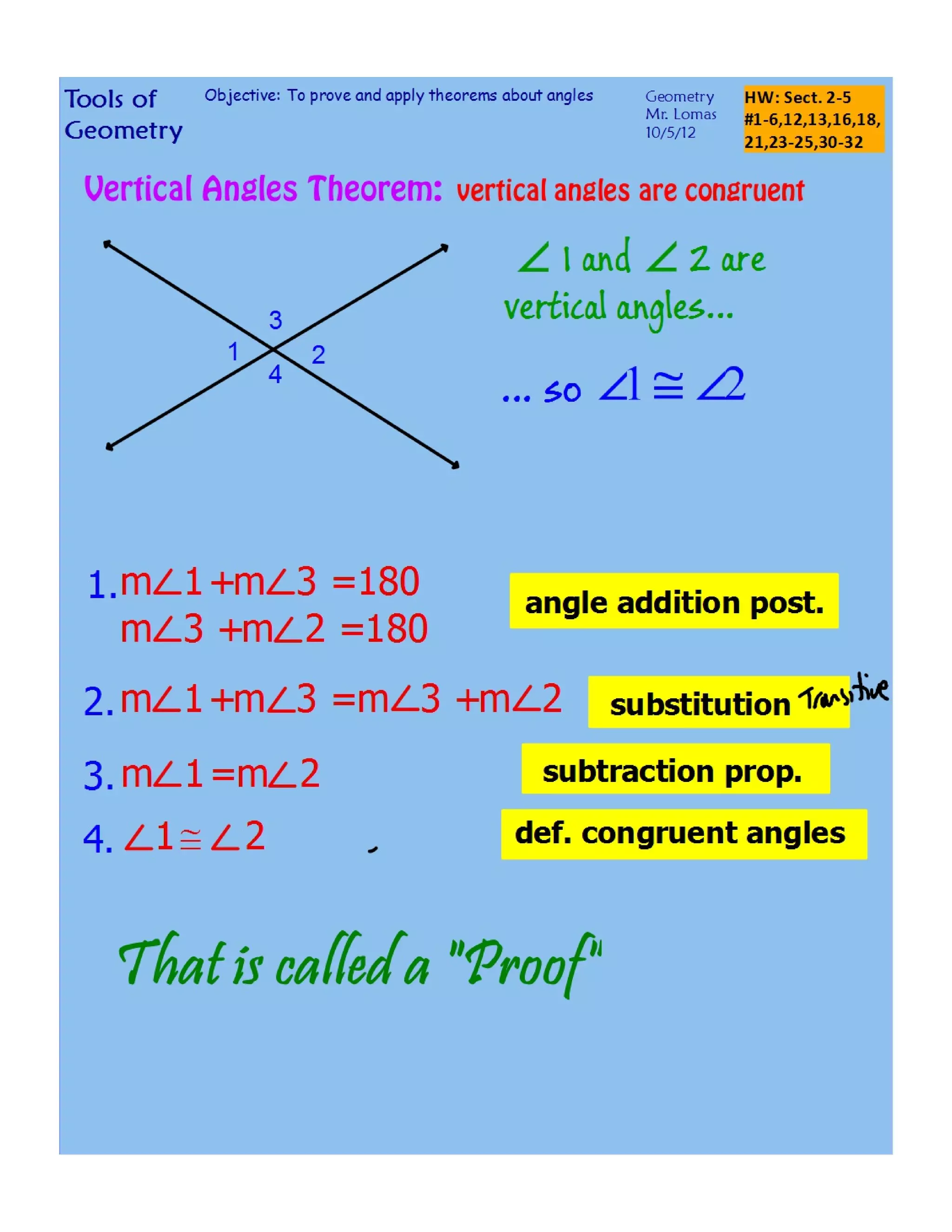
Vertical Angles
When two lines intersect, they form four angles. The angles opposite each other are called vertical angles. In any standard geometric picture, vertical angles are always congruent. Even if there are no arcs drawn, if you see an "X" shape formed by two straight lines, you can safely interpret the top/bottom pair and the left/right pair as congruent sets.
Parallel Lines and Transversals
Pictures involving parallel lines (often indicated by small solid arrows on the lines themselves) provide a wealth of congruent angle data. When a third line, called a transversal, crosses two parallel lines, several congruent pairs are created:
- Corresponding Angles: These are in the same relative position at each intersection. They "look" like they are in the same spot, and if the lines are parallel, they are congruent.
- Alternate Interior Angles: These are between the parallel lines but on opposite sides of the transversal. They form a "Z" or "N" shape.
- Alternate Exterior Angles: These are outside the parallel lines on opposite sides of the transversal.
Triangle Congruence and CPCTC
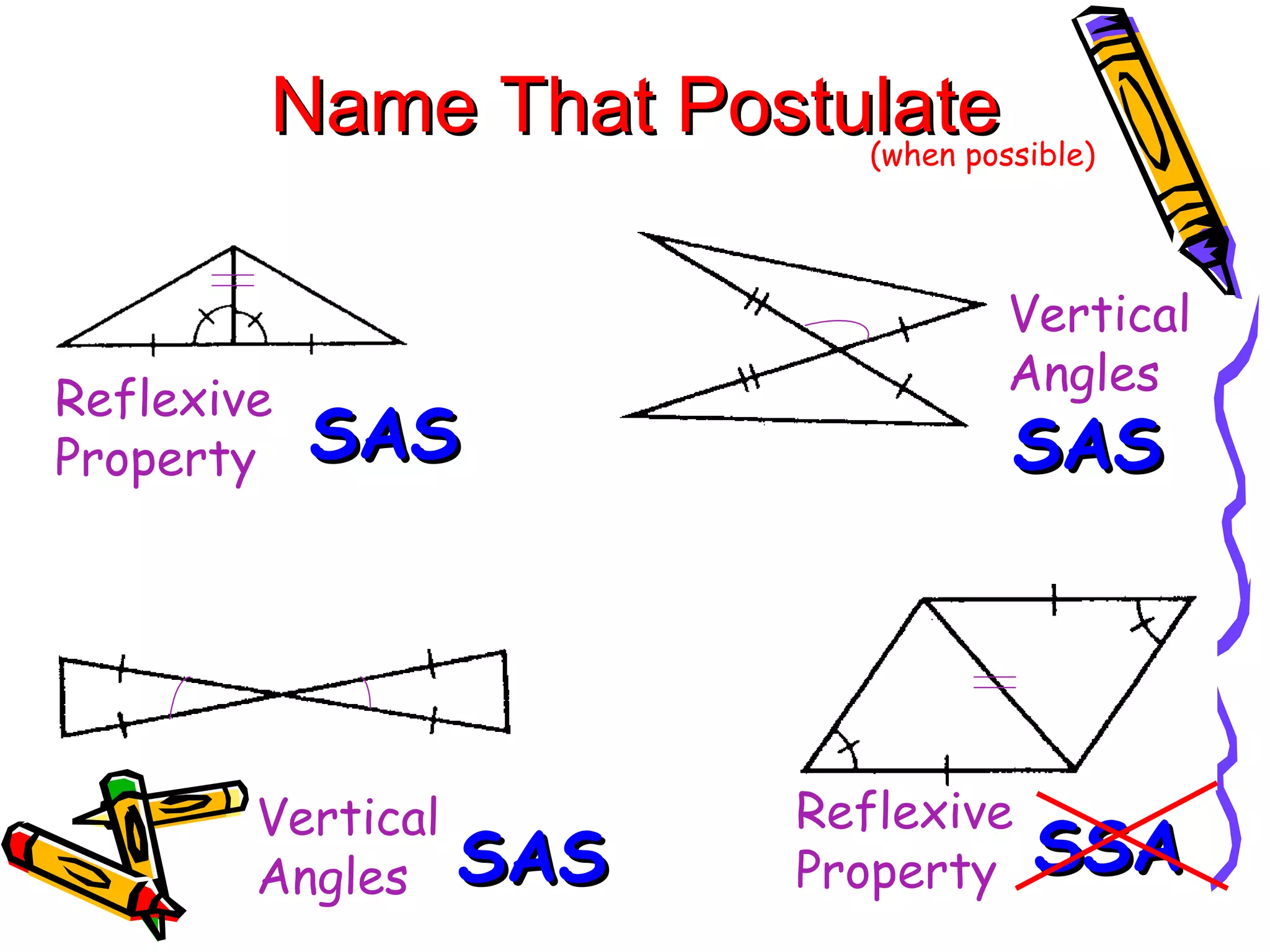
In pictures of triangles, you might see notations indicating that two triangles are congruent (such as SSS, SAS, or ASA markings). Once you identify that two triangles are congruent, you can interpret all their corresponding angles as congruent. This is known as CPCTC (Corresponding Parts of Congruent Triangles are Congruent). If a picture shows two triangles with identical side lengths marked, you can infer the congruence of the angles located between those sides.
Standardized Symbols and Their Interpretations
The following table summarizes the visual cues you will encounter when interpreting geometric diagrams.
| Symbol/Marker | Visual Description | Meaning in the Diagram |
|---|---|---|
| Single Arc | A single curve inside the vertex. | This angle is congruent to any other angle with a single arc. |
| Double Arc | Two concentric curves inside the vertex. | This angle is congruent to others with two arcs; differs from single-arc angles. |
| Slashed Arc | An arc with one or two small tick marks. | A variation of the multi-arc system used for clarity in dense drawings. |
| Square Box | A small square at the vertex. | Indicates a 90-degree (right) angle; all such marked angles are congruent. |
| Matching Variables | e.g., both angles labeled "$x$". | Indicates that the numerical value of both angles is identical. |
| Arrows on Lines | Small solid triangles on line segments. | Indicates lines are parallel, implying congruence in corresponding/alternate angles. |
Common Pitfalls and Misinterpretations
One of the most frequent mistakes when interpreting a picture of congruent angles is visual bias. Our brains are wired to see patterns, and we often assume two angles are the same because they "look" the same.
The "Looks Like" Fallacy
In geometry, diagrams are frequently "not drawn to scale." An author might draw a 45-degree angle and a 47-degree angle that look identical to the naked eye. Unless there is an arc, a tick mark, a variable, or a geometric theorem (like the Vertical Angle Theorem) to support it, you cannot assume they are congruent. Always look for the symbolic proof over the visual representation.
Misreading Orientation
Congruent angles do not have to "point" in the same direction. One angle might be opening to the right while the other opens downward. As long as the symbols (arcs/ticks) match, they are congruent. Beginners often struggle with rotated figures, but the symbolic notation remains the primary truth of the diagram regardless of the shape's orientation in 2D space.
Overlooking Implicit Congruence
Sometimes, congruence is implied through symmetry. In an isosceles triangle (indicated by two congruent sides), the angles opposite those sides are also congruent. If you see a triangle with two sides marked with single tick marks, you must interpret the base angles as congruent, even if they don't have arcs inside them yet.
Practical Steps for Analyzing a Geometric Picture
When you are faced with a complex image and need to find all congruent angles, follow this systematic process:
- Scan for Explicit Markers: Look for arcs, slashes, and square boxes. Group the angles into "families" based on their markers.
- Identify Parallel Lines: Look for the arrow symbols on lines. If they exist, look for the "Z" and "F" patterns to find alternate and corresponding angles.
- Check for Intersections: Locate every point where two straight lines cross. Mark the vertical angles as congruent.
- Analyze Triangle Properties: If there are triangles, check for side-length markers (tick marks on the lines). Use isosceles or equilateral properties to identify hidden congruent angles.
- Use Algebraic Labels: If angles are labeled with expressions like $(3x + 5)^\circ$, look for other angles with the same expression or information that allows you to set them equal to one another.
Frequently Asked Questions
What if an angle has no marks at all?
If an angle has no marks, you cannot assume it is congruent to any other angle unless you can prove it using a theorem. For instance, if it is a vertical angle to a marked angle, it is congruent by rule, even if the illustrator forgot to draw the arc. However, without a rule or a mark, you must treat it as an unknown value.
Can angles of different "lengths" be congruent?
Yes. Congruence refers only to the "openness" or the degree measure between the two rays. The length of the lines or rays drawn in the picture is irrelevant. A tiny triangle can have an angle congruent to one in a massive bridge design if they both measure 60 degrees.
How do I distinguish between side congruence and angle congruence?
Tick marks on the lines (the segments themselves) indicate that the sides are the same length. Tick marks on arcs (inside the corners) indicate that the angles are congruent. It is a common mistake to confuse these, so always check if the mark is on a straight line or a curved arc.
Does the color of the lines matter in a picture of congruent angles?
In standard geometry, color is usually just for aesthetic clarity or to help students track different shapes. Unless a key specifically states that "red angles are congruent," you should rely on standard symbols (arcs and ticks) rather than color.
Why do some pictures use numbers instead of arcs?
Sometimes an author will use numbers (e.g., $\angle 1, \angle 2$) just to name the angles. This does not mean they are congruent. However, if the picture shows "$40^\circ$" inside two different angles, that is an explicit statement of congruence.
Summary and Next Actions
Interpreting a picture of congruent angles is a foundational skill that bridges visual perception and logical deduction. By focusing on arcs, tick marks, and the square right-angle symbol, you can quickly categorize the relationships within a diagram. Remember to always prioritize these symbols and established geometric theorems over the literal "look" of the drawing.
If you are currently studying geometry or preparing for a technical certification in 2026, your next step should be practicing "diagram marking." Take a clean geometric drawing and, using the rules of vertical angles and parallel lines, see how many congruent sets you can identify and mark yourself. This active engagement will sharpen your ability to interpret complex visual data accurately.
Image Gallery