How Credit Life Insurance Premium Calculation Works: A Comprehensive Guide
Credit life insurance premiums are calculated based on the initial loan amount, the duration of the debt, and a specific premium rate—often referred to as a "prima facie" rate—set by the insurer and regulated by state authorities. The...
Credit life insurance premiums are calculated based on the initial loan amount, the duration of the debt, and a specific premium rate—often referred to as a "prima facie" rate—set by the insurer and regulated by state authorities. The two primary calculation methods are the single premium method, where the total cost is determined at the loan's inception, and the monthly outstanding balance method, where premiums are recalculated each month based on the remaining principal.
Contents
Credit life insurance serves as a niche financial product designed to protect both the lender and the borrower’s estate. Unlike traditional term life insurance, which provides a fixed death benefit to a designated beneficiary, credit life insurance is structured specifically to retire a debt obligation. As of 2026, the mechanics of these calculations remain governed by strict state-level regulations and actuarial standards that ensure the cost of coverage is commensurate with the risk of the declining loan balance. Understanding these formulas is essential for borrowers to determine if the convenience of credit life coverage outweighs the potentially higher cost compared to traditional insurance products.
The Core Components of Credit Life Premium Models
To understand how these premiums are derived, one must first identify the variables that feed into the actuarial formulas. In credit life insurance, the "benefit" is not a fixed sum but a moving target that tracks the amortization of a loan.
1. The Initial Loan Amount (Principal)
The primary driver of the premium is the amount of debt being covered. For a single premium policy, the calculation starts with the total amount of the loan, which may include the financed interest and the premium itself if the borrower chooses to roll the insurance cost into the loan.
2. The Loan Term (Duration)
The length of the loan significantly impacts the rate. A five-year auto loan represents a shorter risk window for the insurer than a fifteen-year personal loan or home equity line. Most jurisdictions cap the maximum term for credit life insurance, often at 10 to 15 years, as the product is not intended for long-term mortgage protection.
3. The Prima Facie Rate
State insurance departments establish "prima facie" rates—rates that are considered reasonable and non-excessive without further justification from the insurer. These rates are typically expressed as a dollar amount per $100 or $1,000 of the initial loan amount per year. For example, a state might set a rate of $0.50 per $100 of initial debt per annum.
4. Decreasing vs. Level Coverage
The premium calculation varies based on whether the coverage is decreasing or level.
- Decreasing Coverage: The death benefit declines in step with the loan balance. This is the most common form, used for installment loans.
- Level Coverage: The death benefit remains the same as the initial loan amount throughout the term. This is rarer and typically more expensive, often used for interest-only loans or specific balloon payment structures.
The Single Premium Calculation Method
The single premium method is the most common approach for closed-end loans, such as auto loans or fixed-term personal loans. In this scenario, the entire cost of the insurance for the life of the loan is calculated upfront and added to the total amount financed.
The Formula
The standard formula for a single premium decreasing term policy is:
Total Premium = (Initial Loan Amount / 100) × State Rate × (Term in Months / 12)
Example: Imagine a borrower takes out a $25,000 auto loan for 60 months (5 years). The state-approved prima facie rate is $0.60 per $100 of coverage per year.
- Divide the loan amount by 100: $25,000 / 100 = 250 units.
- Multiply by the rate: 250 × $0.60 = $150 per year.
- Multiply by the term: $150 × 5 years = $750 Total Premium.
The "Gross Debt" Complication
In many instances, the premium itself is financed. This creates a "premium on premium" scenario where the total amount insured is the loan principal plus the insurance cost. Insurers use a "gross debt" formula to ensure the entire obligation—including the insurance—is paid off upon the borrower's death. This formula is more complex:
Premium = (Rate × Loan Amount) / [1 - (Rate × Term)]
This ensures that the insurance coverage is sufficient to cover the slightly higher loan balance created by the financing of the premium.
The Monthly Outstanding Balance (MOB) Method
The Monthly Outstanding Balance (MOB) method is primarily used for open-end credit, such as credit cards or revolving lines of credit. Unlike the single premium method, the cost is not determined upfront. Instead, it is calculated at the end of each billing cycle based on the actual balance owed.
The Formula
Monthly Premium = (Current Outstanding Balance / 1,000) × Monthly Rate
If a borrower has a credit card balance of $5,000 and the monthly rate is $1.20 per $1,000 of balance, the premium for that month would be $6.00. If the borrower pays down the balance to $2,000 the following month, the premium drops to $2.40.
Advantages of the MOB Method
The MOB method is often more transparent for consumers because the cost directly mirrors the risk. As the borrower pays down the debt, the premium naturally decreases. Furthermore, if the borrower maintains a zero balance, they pay no premium at all for that period, even though the coverage remains "active" in the sense that future balances will be protected.
Technical Factors and Adjustments
While the basic formulas provide a baseline, several technical factors can adjust the final premium amount.
Joint Coverage Multipliers
If a loan has two co-signers (e.g., a married couple), both can be covered. Rather than charging two full premiums, insurers apply a "joint rate." This is usually 1.5 to 1.7 times the individual rate. The calculation assumes that the probability of either person dying is higher than a single person, but the probability of both dying simultaneously is low.
Age-Based Limitations and Underwriting
Credit life insurance is typically "guaranteed issue" up to a certain dollar limit (e.g., $50,000), meaning no medical exam is required. However, the calculation may be adjusted if the borrower is above a certain age (often 65 or 70). In some cases, a higher rate may be applied, or the term of coverage may be restricted to ensure the actuarial risk remains within the prima facie bounds.
Refund Calculations for Early Payoff
A critical aspect of credit life insurance is how premiums are handled if the loan is paid off early or refinanced. Since single premium policies are paid upfront, the borrower is entitled to a refund of the "unearned" portion of the premium.
As of 2026, most jurisdictions require either a Pro-Rata refund or the Rule of 78s (though the Rule of 78s is increasingly discouraged or banned in many states due to its bias toward the lender). A pro-rata refund simply returns the premium for the remaining months, while the Rule of 78s weights the insurance cost more heavily toward the beginning of the loan term.
Comparison of Calculation Methods
| Feature | Single Premium Method | Monthly Outstanding Balance (MOB) |
|---|---|---|
| Loan Type | Closed-end (Auto, Personal) | Open-end (Credit Cards, HELOC) |
| Payment Frequency | One-time, usually financed | Monthly, billed to account |
| Balance Basis | Initial total loan amount | Actual monthly balance |
| Cost Transparency | Total cost known at start | Fluctuates with spending/repayment |
| Refund Requirement | Requires refund if loan ends early | No refund needed (pay-as-you-go) |
| Impact of Interest | Premium may accrue loan interest | Premium does not accrue interest |
Regulatory Environment and Consumer Protections
In 2026, the National Association of Insurance Commissioners (NAIC) continues to provide the model act for credit life insurance, which most states use to set their calculation standards. These regulations are designed to prevent "reverse competition"—a situation where insurers compete to offer lenders higher commissions by charging borrowers higher premiums.
Prima Facie Rate Reviews
State regulators periodically review mortality data to adjust prima facie rates. If the "loss ratio" (the percentage of premiums paid out as claims) falls below a certain threshold (often 50% or 60%), the state may mandate a rate decrease. This ensures that the premium calculation remains fair to the consumer.
Disclosure Requirements
Lenders are legally required to disclose that credit life insurance is optional. The premium calculation must be clearly broken out in the Truth in Lending Act (TILA) disclosures. If a lender implies that the insurance is required for loan approval, it is considered a predatory practice and may violate federal and state consumer protection laws.
Common Mistakes in Estimating Premiums
- Ignoring the Finance Charge: Many borrowers forget that if the $1,000 premium is financed at a 7% interest rate over five years, the actual cost of the insurance is significantly higher due to the interest paid on the premium itself.
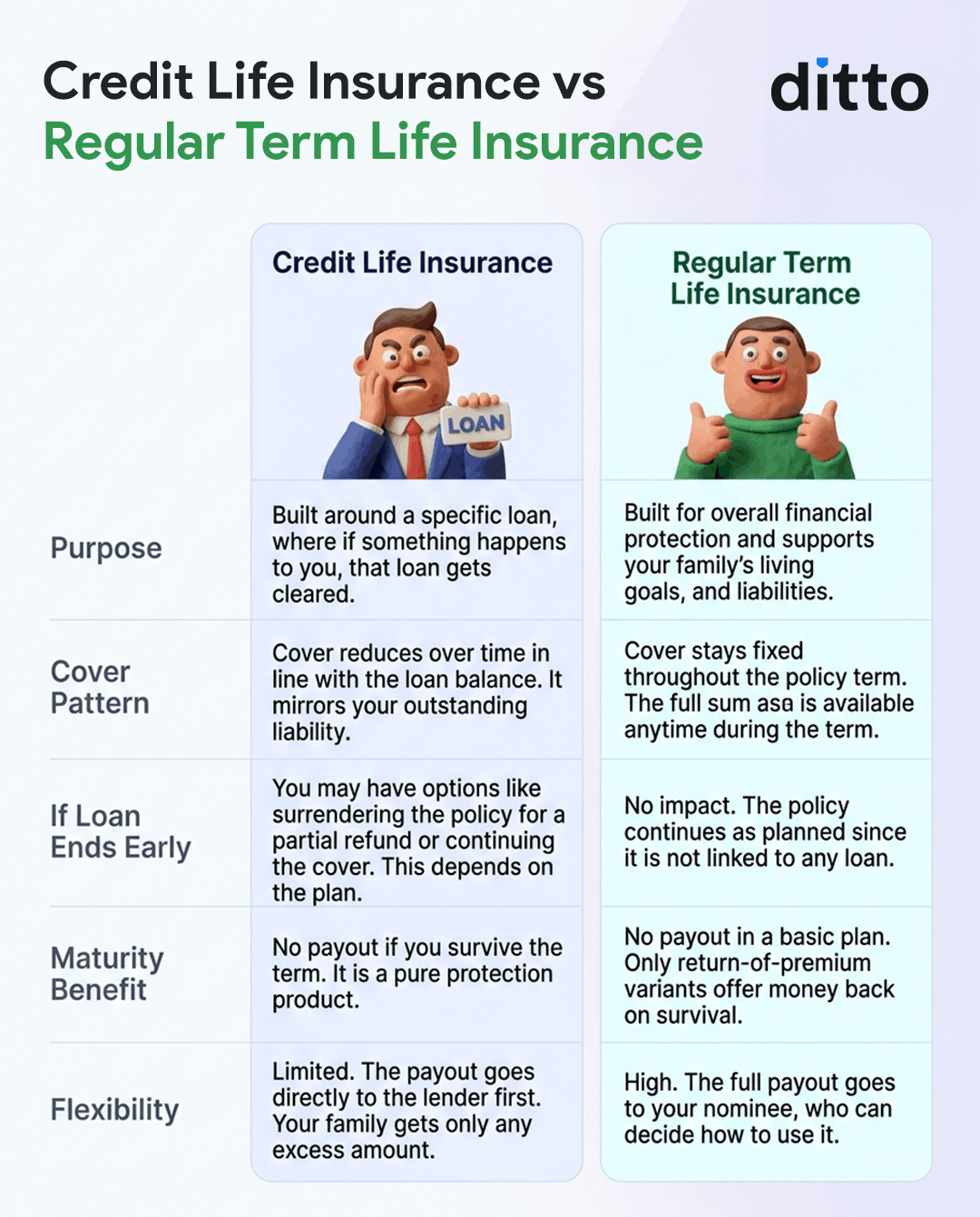
- Assuming Level Coverage: Borrowers often expect the full initial loan amount to be paid to their heirs. In reality, credit life insurance calculations are almost always for "decreasing term," meaning the benefit only covers the remaining balance.
- Miscalculating Joint Rates: Many assume that covering two people will cost twice as much. As noted, the joint multiplier is usually significantly less than 2.0, making joint coverage a relatively better value if both parties contribute to the income used for loan repayment.
FAQs
Is credit life insurance more expensive than regular term life?
Yes, in almost all cases. Credit life insurance premiums are calculated on a group basis with minimal underwriting, meaning healthy individuals "subsidize" those with higher risks. A healthy individual can typically find a 10-year term life policy with a much lower premium-to-benefit ratio than credit life.
How is the premium affected by the loan's interest rate?
The loan's interest rate affects the amortization schedule. A higher interest rate means the principal balance stays higher for longer. In "gross debt" calculations, this can slightly increase the required insurance amount to ensure the full payoff of the accrued interest upon death.
Can the premium rate change after the loan starts?
For a single premium policy, the rate is locked at the time of the loan. For an MOB policy, the premium rate is usually fixed by the master policy agreement between the lender and the insurer, but the amount you pay changes monthly based on your balance.
What happens to the premium calculation if I refinance my loan?
When you refinance, the original loan is considered "paid in full." The insurer must calculate a refund of the unearned premium. You would then need to decide whether to purchase a new credit life policy based on the terms and rates of the new loan.
Are there limits on how much a premium can be?
Yes. State insurance departments set "prima facie" rates, which are the maximum rates an insurer can charge without proving that their specific risk pool requires higher premiums. These caps prevent lenders from overcharging for the product.
Recommendation for Borrowers
Before agreeing to a credit life insurance policy, request a written breakdown of the premium calculation using both the single premium and monthly methods if available. Compare the total cost—including interest if the premium is financed—against the cost of a small, simplified-issue term life insurance policy. In many cases, if you are in relatively good health, a standard term life policy will provide higher coverage amounts for a significantly lower premium, while also allowing your beneficiaries to use the funds for expenses other than the specific debt.
Disclaimer: This article provides general information about financial calculations and insurance products. It does not constitute legal or financial advice. Regulations vary by jurisdiction; consult with a licensed insurance professional or financial advisor for specific guidance.
Image Gallery