Search Engines Other Than Google and Bing Explained
While Google and Microsoft’s Bing dominate the global search market, they are far from the only options available for navigating the web in 2026. Alternative search engines serve specific needs that the "Big Two" often overlook, includ...
While Google and Microsoft’s Bing dominate the global search market, they are far from the only options available for navigating the web in 2026. Alternative search engines serve specific needs that the "Big Two" often overlook, including absolute user privacy, independent indexing, ecological contributions, and ad-free subscription models. Understanding these alternatives allows you to tailor your browsing experience to prioritize data security, specialized results, or ethical considerations.
Contents
The Architecture of Alternative Search: Indexes vs. Metasearch
To understand search engines other than Google and Bing, it is essential to distinguish between how they retrieve information. Most search engines are not building their own maps of the entire internet; instead, they function as "front-ends" for existing data.
Independent Search Indexes
An independent search engine uses its own "spiders" or "crawlers" to visit websites, read their content, and store that information in its own database (the index). This is a monumental technical and financial undertaking. Besides Google and Bing, very few entities maintain a comprehensive, independent web index. Brave Search and Mojeek are among the few that have successfully built significant, non-dependent indexes to provide a truly diverse set of results that do not rely on Big Tech’s algorithms.
Metasearch Engines and Proxy Services
Most alternatives are metasearch engines or privacy proxies. They do not crawl the web themselves. Instead, they send your search query to an external provider—usually Google or Bing—and display those results to you. The value they provide is a "privacy buffer." They strip away your IP address, browser fingerprint, and tracking cookies before passing the query to the big provider. DuckDuckGo (primarily using Bing’s index) and Startpage (using Google’s index) are the primary examples of this model.
Privacy-Focused Alternatives
Privacy remains the primary driver for users seeking search engines other than Google and Bing. These engines operate on the principle that your search history should not be used to build a profiling dossier for advertisers.
DuckDuckGo: The Market Leader in Privacy
DuckDuckGo is the most recognizable alternative. It functions by aggregating results from over 400 sources, with Microsoft Bing serving as its primary partner for traditional web results.
- How it protects you: It does not store your IP address or search history. It uses "Bangs"—shortcuts like
!wfor Wikipedia or!afor Amazon—to allow you to search other sites directly from their interface. - The 2026 Perspective: As of 2026, DuckDuckGo has expanded into a full privacy ecosystem, including browsers and email protection, making it a "one-stop-shop" for users looking to de-Google their digital lives.
Brave Search: The Independent Contender
Brave Search, developed by the makers of the Brave Browser, is a significant technical achievement because it relies on the Brave Search Index rather than fetching results from Bing or Google.
- Why it matters: If Google and Bing decide to censor a specific topic or change their ranking algorithms, Brave Search provides a genuinely different set of results because it uses a different "map" of the web.
- Goggles Feature: Brave allows users to apply "Goggles," which are custom filters that re-rank results based on community-driven rules (e.g., "prioritize small blogs" or "exclude Pinterest").
Startpage: Google Results Without the Tracking
Startpage is a unique hybrid. It pays Google for the right to use its search results but acts as a middleman. When you search on Startpage, Google sees a request coming from Startpage’s servers, not from your computer. You get the perceived quality of Google’s index without the invasive telemetry. It also includes an "Anonymous View" feature that lets you visit the websites in the search results through a proxy, preventing those sites from tracking you as well.
Purpose-Driven and Ethical Search Engines
Some alternatives focus on using their search revenue for social or environmental good rather than maximum corporate profit.
Ecosia: Searching to Plant Trees
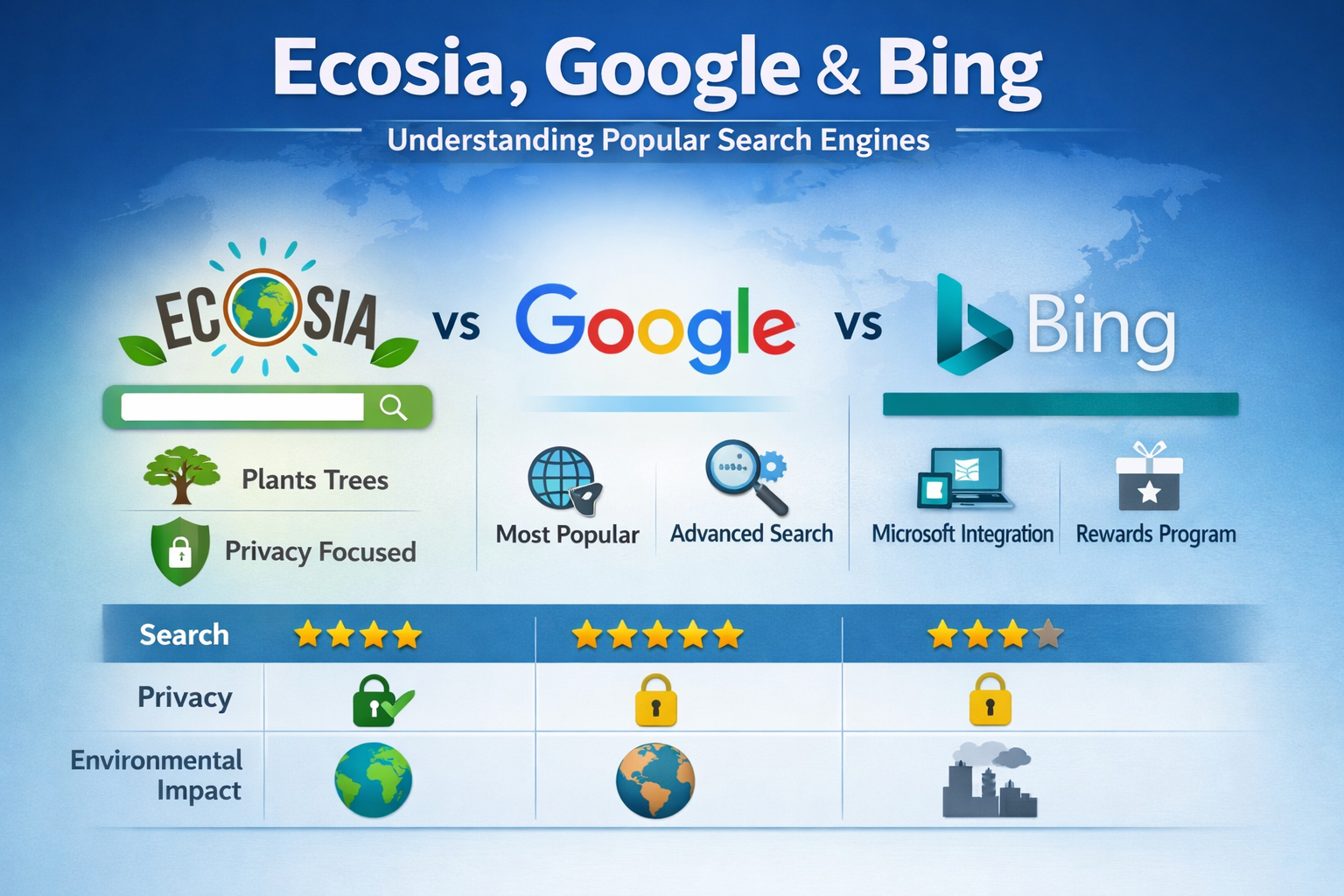
Ecosia is a certified B-Corp that uses its ad revenue to fund reforestation projects globally. It primarily uses the Bing index to serve results.
- Operational Transparency: Ecosia publishes monthly financial reports showing exactly where its income goes.
- Carbon Neutrality: Not only does it plant trees, but it also runs its own solar plants to power every search, making it a carbon-negative search option.
Mojeek: The UK-Based Independent Index
Mojeek is one of the few search engines in the world that is truly independent. Based in the UK, it has its own crawler and index. It does not track users and prides itself on providing "no-bias" results that aren't influenced by the dominant algorithms of US-based tech giants. It is a vital tool for researchers who want to see the web through a non-mainstream lens.
Specialized and Subscription-Based Search
In the current era of AI-generated content and "SEO-optimized" fluff, some users are moving toward specialized or paid search engines to find higher-quality information.
Kagi: The Premium Paid Search Engine
Kagi is a subscription-based search engine. By charging users a monthly fee, it eliminates the need for advertising and data tracking entirely.
- Performance: Because there are no ads, the search results page is incredibly fast and clean.
- Customization: Kagi allows you to "down-rank" or block specific domains (like low-quality content farms) permanently from your results, creating a personalized, high-signal search environment.
WolframAlpha: Computational Knowledge
WolframAlpha is not a traditional web search engine. Instead of returning a list of links, it computes answers using its vast internal database of structured data. It is the premier tool for mathematics, physics, engineering, and data analysis. If you ask it for the "GDP of Japan vs. Germany," it will generate a live comparison chart rather than sending you to a news article.
Comparison of Alternative Search Engines
The following table compares the primary features and architectures of the leading alternatives in 2026.
| Search Engine | Primary Data Source | Privacy Level | Best For |
|---|---|---|---|
| DuckDuckGo | Bing + 400 sources | High | General users wanting privacy |
| Brave Search | Independent Index | High | Avoiding Big Tech algorithms |
| Startpage | High | Google-quality results without ads | |
| Mojeek | Independent Index | Maximum | Purely independent, non-tracked search |
| Ecosia | Bing | Medium | Environmentally conscious users |
| Kagi | Mixed + Independent | High | Professional, ad-free experience (Paid) |
| WolframAlpha | Internal Structured Data | High | Academic and computational queries |
Technical Considerations When Switching
When moving away from Google or Bing, users should be aware of a few operational shifts.
- Localization: Google and Bing are exceptionally good at knowing your physical location to show you "pizza near me." Privacy-focused engines like DuckDuckGo or Mojeek may require you to manually enter your city or zip code because they do not track your precise GPS coordinates by default.
- The "Filter Bubble": Alternative engines often produce results that feel "different." This is usually because they aren't tailoring results to your past behavior. While this can feel less "accurate" at first, it is actually showing you a more objective view of the internet.
- Integration: Most modern browsers allow you to change your default search engine in the settings menu. However, Chrome (owned by Google) often makes it slightly more cumbersome to set a non-standard engine compared to Firefox or Brave.
Frequently Asked Questions
Are search engines other than Google and Bing safe to use?
Yes, most of the reputable alternatives mentioned are actually safer than the major search engines because they do not collect, store, or sell your personal data. Engines like DuckDuckGo and Startpage use encrypted connections and strip away metadata that could be used to identify you. However, you should always verify the privacy policy of any new service you use.
Why do some search engines still show ads if they are "private"?
Privacy-focused engines like DuckDuckGo and Ecosia still show advertisements to stay profitable, but these ads are contextual rather than behavioral. If you search for "mountain bikes," you will see an ad for a bike. They do not know that you were looking for bikes last week; they only know what you typed in the search bar at that exact moment.
Can I get the same results as Google on a private search engine?
Startpage is the most effective way to get Google’s exact results without being tracked. Other engines like DuckDuckGo or Brave will provide different results because they use different indexes or ranking algorithms. For many users, this "diversity of results" is actually a primary reason to switch.
Do alternative search engines have "Image" and "Maps" search?
Most major alternatives now offer image, video, and news search tabs. For mapping, many privacy engines integrate with Apple Maps or OpenStreetMap to provide location services without using Google’s tracking-heavy Map platform.
Is there a search engine that doesn't use AI?
As of 2026, most search engines have integrated some form of AI to summarize results. However, Mojeek and the "Classic" mode in Kagi remain focused on traditional keyword indexing and link-based results, avoiding the "generative AI" summaries that some users find intrusive or inaccurate.
Practical Recommendation for Users
If you are looking to move away from Google and Bing, the best approach is a tiered search strategy.
Start by setting Brave Search or DuckDuckGo as your default engine for everyday browsing. They provide the best balance of speed, privacy, and result quality. For academic or data-driven questions, keep a shortcut to WolframAlpha. If you find yourself unable to find a specific result on a private engine, use Startpage as your "backup" to access Google’s index without compromising your long-term privacy. By diversifying your search tools, you gain a broader perspective of the web while significantly reducing your digital footprint.
Image Gallery