Understanding the Rise of Biotech ETFs: Drivers, Dynamics, and Diversification
The rise of biotech ETFs is driven by accelerated innovation in genomic medicine, the integration of artificial intelligence in drug discovery, and a stabilizing interest rate environment in 2026. These funds provide diversified exposu...
The rise of biotech ETFs is driven by accelerated innovation in genomic medicine, the integration of artificial intelligence in drug discovery, and a stabilizing interest rate environment in 2026. These funds provide diversified exposure to high-growth companies, mitigating the "binary risk" of individual clinical trial failures while capturing the sector's long-term secular growth.
Contents
Biotechnology has transitioned from a speculative corner of the market into a fundamental pillar of the global healthcare economy. For investors, navigating this space has historically been challenging due to the extreme volatility of individual stocks, where a single FDA decision can result in a 50% price swing overnight. The surge in biotech Exchange-Traded Funds (ETFs) represents a structural shift in how both retail and institutional investors gain exposure to life sciences. By 2026, the maturation of several key technologies—most notably CRISPR gene editing and GLP-1 agonists—has solidified the sector's value proposition, making ETFs the preferred vehicle for capturing this complexity without the idiosyncratic risk of single-asset companies.
The Macroeconomic Recovery and Capital Inflow
To understand why biotech ETFs have gained such prominence by 2026, one must look back at the shifting economic tides of the previous three years. Between 2021 and 2023, the biotech sector faced significant headwinds as rising interest rates increased the cost of capital for pre-revenue companies. Since biotech is a capital-intensive industry reliant on long-term research and development (R&D), high rates devalued future cash flows, leading to a prolonged "biotech winter."
However, the stabilization of monetary policy in 2024 and 2025 created a fertile ground for a rebound. Lower cost of capital allowed mid-cap and small-cap biotech firms to secure funding for late-stage clinical trials. Consequently, investors who had moved to the sidelines returned to the sector, seeking growth. Biotech ETFs became the primary entry point because they allowed investors to "buy the basket," profiting from the general recovery of the industry rather than attempting to pick winners in a field where the technical barriers to entry are exceptionally high.
Furthermore, the "Patent Cliff" of 2025-2026 has played a massive role. Large pharmaceutical companies (Big Pharma) are currently facing the expiration of patents on several blockbuster drugs. To replenish their pipelines, these giants have engaged in an aggressive cycle of Mergers and Acquisitions (M&A). When a large pharma company acquires a smaller biotech firm at a premium, it boosts the Net Asset Value (NAV) of the ETFs holding that smaller firm. This M&A activity provides a "floor" for biotech valuations, attracting further investment into diversified funds.
Technological Pillars Driving the 2026 Biotech Surge
The current enthusiasm for biotech ETFs is not merely a result of financial engineering; it is rooted in genuine scientific breakthroughs that have reached commercial viability.
Artificial Intelligence in Drug Discovery
By 2026, AI-driven drug discovery has moved from a theoretical concept to a proven method for reducing the "time-to-market" for new therapeutics. Traditional drug discovery takes roughly 10 to 12 years and costs billions of dollars. AI platforms can now screen millions of molecular compounds in weeks, identifying candidates with the highest probability of success. ETFs that focus on "BioTech-meets-Tech" have seen substantial inflows as these AI-enabled companies begin reporting successful Phase II and Phase III trial results with higher-than-average efficiency.
The GLP-1 and Obesity Revolution
The global demand for metabolic health treatments, specifically GLP-1 agonists, has created a massive revenue stream for the sector. While initially dominated by a few large players, the "rise of the followers"—smaller biotech firms developing oral versions or next-generation formulations—has distributed growth across the broader industry. Biotech ETFs provide a way to play this entire sub-sector, capturing the growth of the innovators who are challenging the early market leaders.
Genomic Medicine and CRISPR
The approval of the first CRISPR-based therapies in recent years marked a turning point for genomic medicine. In 2026, the focus has shifted from rare "orphan" diseases to more common conditions, including cardiovascular health and certain types of cancer. Because the genomic space is highly technical and fraught with legal patent battles, investors use ETFs to gain exposure to the intellectual property (IP) leaders without having to monitor the day-to-day developments of patent litigation.
Structural Comparison of Leading Biotech ETFs
Not all biotech ETFs are created equal. Investors must distinguish between market-cap-weighted funds and equal-weighted funds, as their performance profiles differ significantly during various market cycles.
| ETF Ticker | Fund Name | Weighting Strategy | Primary Focus | Typical Expense Ratio |
|---|---|---|---|---|
| IBB | iShares Biotechnology ETF | Market-Cap Weighted | Large-cap established biotech and big pharma. | 0.44% |
| XBI | SPDR S&P Biotech ETF | Equal-Weighted | Small and mid-cap innovators; high M&A exposure. | 0.35% |
| ARKG | ARK Genomic Revolution ETF | Active Management | Disruptive tech, gene editing, and molecular diagnostics. | 0.75% |
| FBT | First Trust NYSE Arca Biotech | Tiered Equal-Weight | Highly liquid, established biotech companies. | 0.55% |
| PBE | Invesco Dynamic Biotech | Factor-Based | Quantitative selection based on price momentum and earnings. | 0.58% |
Choosing Between IBB and XBI
The choice between the iShares Biotechnology ETF (IBB) and the SPDR S&P Biotech ETF (XBI) is the most common decision for investors. IBB is dominated by the giants of the industry—companies like Amgen, Gilead, and Vertex. It is generally less volatile and provides more stability.
In contrast, XBI uses an equal-weighting methodology. This means a small startup has roughly the same weight in the fund as a multi-billion-dollar giant. XBI is far more sensitive to the "M&A tailwind." When a small-cap company is acquired, the impact on XBI’s price is much more pronounced than on IBB’s. For investors looking for the "explosive" growth characteristic of biotech, XBI is often the preferred choice, though it carries significantly higher volatility.
Navigating the Regulatory and Clinical Landscape
A critical component of understanding the rise of these funds is the evolving role of the U.S. Food and Drug Administration (FDA). In 2026, the FDA has continued to refine its "Accelerated Approval" pathways for unmet medical needs. This regulatory environment is more conducive to biotech growth than the more restrictive periods of the past.
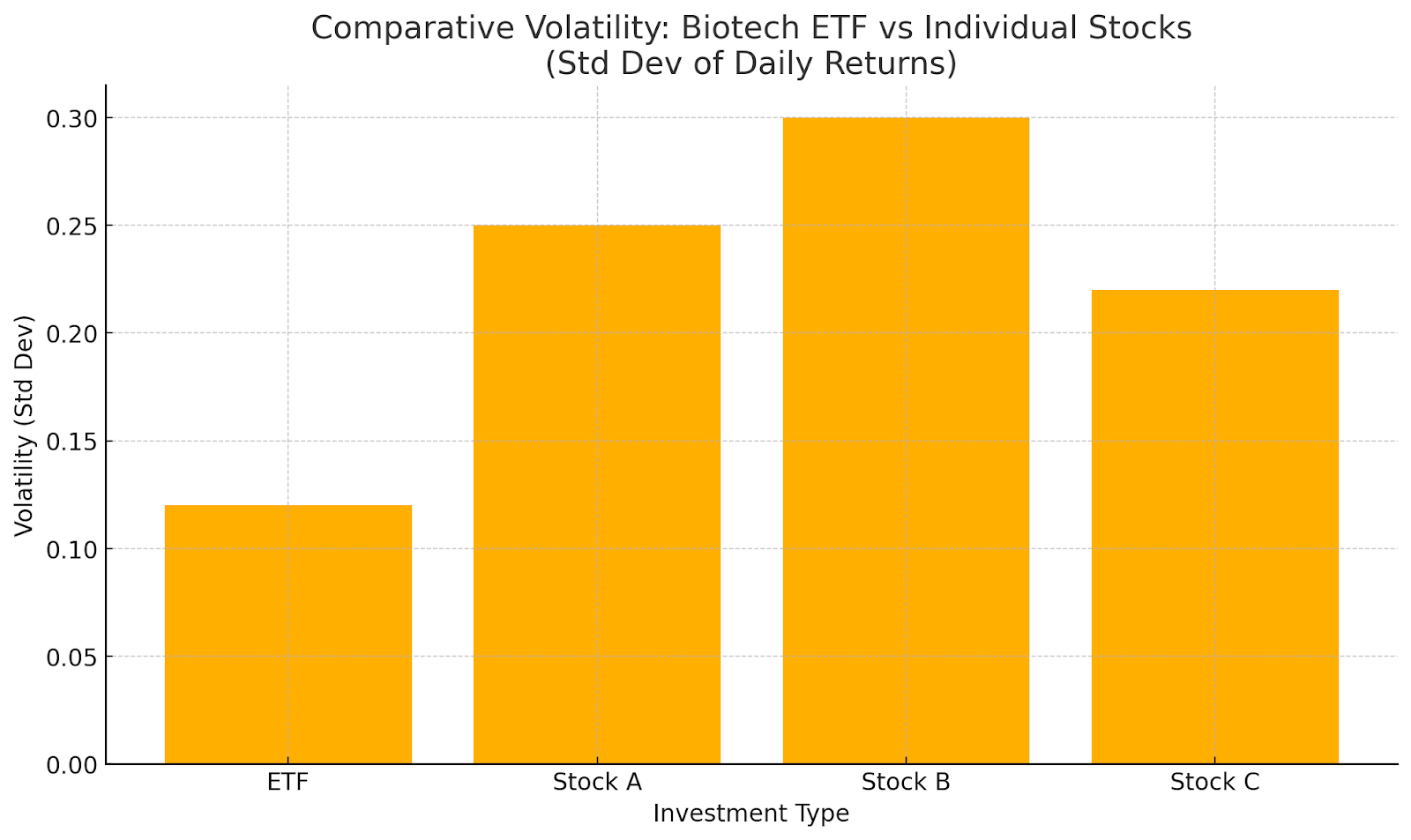
However, the risk of "binary events" remains. A binary event occurs when a company’s entire valuation hinges on the success or failure of a single clinical trial. For a single-stock investor, a "failed" Phase III trial can lead to a total loss of capital. Within an ETF, such a failure is mitigated by the performance of the other 50 to 100 holdings. This diversification is the primary reason why institutional pension funds and 401(k) providers have increasingly integrated biotech ETFs into their "growth" allocations. By 2026, the "risk-adjusted return" of a diversified biotech ETF is frequently seen as superior to the high-stakes gambling of individual drug-picking.
Common Pitfalls and Risk Management
Despite the bullish trend, investing in biotech ETFs requires a disciplined approach. The most common mistake is ignoring the expense ratio. Because many biotech funds are specialized or actively managed, their fees can be significantly higher than a standard S&P 500 index fund. Over a 10-year horizon, a 0.75% expense ratio can eat significantly into total returns.
Another risk is sector concentration. While an ETF provides diversification within biotechnology, it does not provide diversification outside of it. Biotech remains highly correlated with interest rates and general "risk-on" sentiment. If the broader economy enters a recession, biotech—as a high-growth, high-multiple sector—often sells off harder than defensive sectors like utilities or consumer staples.
Investors should also be aware of liquidity risks in smaller, more niche ETFs. While IBB and XBI have massive daily trading volumes, newer, "thematic" biotech ETFs (such as those focusing solely on "Longevity" or "Synthetic Biology") may have wider bid-ask spreads, making it more expensive to enter and exit positions.
Financial Advice Limitation
This analysis is for informational purposes only and does not constitute professional financial, investment, or legal advice. Investors should consult with a certified financial advisor to discuss their specific risk tolerance and jurisdictional tax implications before committing capital to the volatile biotechnology sector.
FAQ
Why are biotech ETFs considered less risky than individual biotech stocks?
The primary risk in biotech is clinical failure. If a company's lead drug fails a trial, the stock price often collapses. An ETF holds dozens or hundreds of companies; therefore, the failure of one drug at one company only has a fractional impact on the overall fund value, which is often offset by successes elsewhere in the portfolio.
How do interest rates specifically affect biotech ETFs?
Many biotech companies are "pre-revenue," meaning they spend money on research but don't yet sell a product. They rely on borrowing or issuing new stock to fund operations. High interest rates make borrowing expensive and reduce the present value of future earnings, typically causing biotech valuations to fall. Conversely, stable or falling rates in 2026 have historically supported higher valuations for the sector.
What is the difference between a "thematic" biotech ETF and a broad biotech ETF?
A broad biotech ETF like IBB or XBI tracks the entire industry. A thematic ETF focuses on a specific sub-sector, such as CRISPR (Genomic Revolution), AI-driven drug discovery, or immunology. Thematic ETFs offer higher potential rewards if that specific sub-sector booms, but they lack the broader diversification of general industry funds.
Is 2026 a good time to enter the biotech market?
By 2026, the industry has moved past the post-pandemic volatility and the high-interest-rate shocks of the early 2020s. With the integration of AI and a wave of new drug approvals, the fundamental outlook is strong. However, entry timing should always be based on an individual’s long-term investment horizon rather than short-term market timing.
Are there tax advantages to using ETFs for biotech exposure?
ETFs are generally more tax-efficient than mutual funds due to the "in-kind" creation and redemption process, which allows fund managers to minimize capital gains distributions. This is particularly beneficial in a high-turnover sector like biotech, where companies are frequently bought out or restructured.
Practical Recommendation for Investors
For most investors seeking to capitalize on the rise of biotechnology in 2026, a core-satellite approach is recommended. Use a broad, low-cost fund like XBI (for growth/M&A exposure) or IBB (for large-cap stability) as your core holding, representing 70-80% of your biotech allocation.
If you have a specific interest in emerging technologies like gene editing or AI-discovery, you can then add a "satellite" position in a more specialized, actively managed fund like ARKG. This strategy allows you to capture the sector's general upward trajectory while maintaining a controlled "bet" on the specific technologies you believe will define the next decade of medicine. Always ensure that your total biotech exposure remains a manageable percentage of your overall portfolio—typically 5% to 10% for aggressive growth investors—to protect against the sector's inherent volatility.
Image Gallery