Mansfield City Water Capacity and Service: Infrastructure, Connection, and Operational Overview
The City of Mansfield municipal water system provides potable water through a robust network capable of treating and delivering up to 45 million gallons per day (MGD) to residential, commercial, and industrial customers. Operating unde...
The City of Mansfield municipal water system provides potable water through a robust network capable of treating and delivering up to 45 million gallons per day (MGD) to residential, commercial, and industrial customers. Operating under strict state and federal drinking water standards, Mansfield combines substantial raw water contracts, advanced filtration facilities, and extensive distribution storage to maintain reliable service, adequate fire protection, and planned capacity for regional development.
Contents
Geographic Context Note: While multiple municipalities in the United States share the name Mansfield, this analysis primarily details the municipal water utility framework of the City of Mansfield, Texas—the fastest-growing municipality of this name, where infrastructure capacity and utility expansions are actively driven by regional population increases in the Dallas-Fort Worth metropolitan area. Where relevant, the technical principles outlined also reflect standard municipal water engineering practices found in similarly sized municipal systems, such as Mansfield, Ohio.
Municipal Water Sources and Raw Water Storage
A municipal utility's capacity depends fundamentally on the reliability and volume of its raw water supply. Mansfield relies on long-term surface water supply agreements rather than local groundwater wells, shielding the municipality from the aquifer depletion challenges common in arid regions.
Raw Water Procurement and Wholesalers
Mansfield secures its untreated water through contracts with regional wholesale water authorities—primarily the Tarrant Regional Water District (TRWD). TRWD manages multiple expansive reservoir systems, including:
- Cedar Creek Reservoir: Located southeast of the metroplex, providing high-volume storage.
- Richland-Chambers Reservoir: TRWD’s largest water supply reservoir, delivering water via large-diameter transmission pipelines.
- Lake Benbrook: Serving as a balancing reservoir and vital conveyance terminal within the regional transmission grid.
Raw water is transported through hundreds of miles of regional pipelines directly into Mansfield's terminal storage and raw water intake pump stations. This arrangement ensures that the city maintains firm yield capacity even during extended multi-year drought cycles.
Balancing Reservoirs and Terminal Storage
Raw water pumped to Mansfield enters terminal holding facilities that provide dual operational benefits: sedimentation pre-treatment and localized raw storage reserves. Maintaining on-site raw water reserves protects the treatment facilities from short-term disruptions along wholesale transmission lines, such as scheduled pipeline maintenance or emergency line repairs.
Treatment Infrastructure and Daily Capacity Metrics
Converting surface water into safe, clean drinking water requires complex physical and chemical purification processes. The primary engine of Mansfield’s distribution network is the Bud Ervin Water Treatment Plant, an advanced facility engineered to manage dramatic swings in seasonal demand.
Design Capacity vs. Peak Demand
Mansfield's municipal treatment system operates under two distinct metrics: rated treatment capacity and firm capacity.
Rated Treatment Capacity: The Bud Ervin facility has an engineered treatment rating designed to scale up to 45 MGD under peak operational conditions, following sequential infrastructure expansions.
Firm Pumping and Treatment Capacity: Engineering standards mandated by the Texas Commission on Environmental Quality (TCEQ) require utilities to maintain firm capacity—the ability to meet maximum daily demand with the largest single pump or treatment unit out of service. Mansfield maintains firm treatment capabilities that routinely exceed 30 MGD.
Average vs. Peak Daily Use: The city’s average daily demand generally ranges between 14 and 18 MGD during cool, wet months. During summer heatwaves, outdoor irrigation pushes peak daily demand toward 30 to 35 MGD, underscoring the critical necessity of expansive treatment headroom.
Raw Water Intake
Coagulation & Flocculation
Sedimentation Basins
Granular Media Filtration
Disinfection (Chloramines)
Clearwell Storage
High-Service Pumping Station
The Treatment Process
The purification train utilizes multiple barriers to eliminate suspended solids, biological pathogens, and chemical contaminants:
- Coagulation and Flocculation: Rapid-mix basins inject aluminum sulfate or ferric salts to destabilize dissolved and suspended particles, aggregating them into larger flocs.
- Sedimentation: Water moves into quiet settling basins where gravity pulls the heavy flocs out of suspension.
- Filtration: Clarified water passes through deep beds of granular activated carbon (GAC) and anthracite sand over gravel supports, filtering micro-turbidity and adsorbing compounds that impact taste and odor.
- Disinfection: Mansfield employs primary chlorination followed by chloramination (chlorine combined with ammonia). Chloramines maintain a stable, long-lasting disinfectant residual throughout thousands of miles of distribution piping without producing excessive levels of regulated disinfection byproducts (trihalomethanes and haloacetic acids).
Distribution Network, Pumping, and Finished Storage
Treating water is only half the engineering challenge; moving water through varying elevations while maintaining regulatory pressure is equally vital. Mansfield’s distribution infrastructure balances hydraulic grade lines across multiple pressure planes.
Finished Water Storage Facilities
Finished drinking water is held in two types of structural storage across the city:
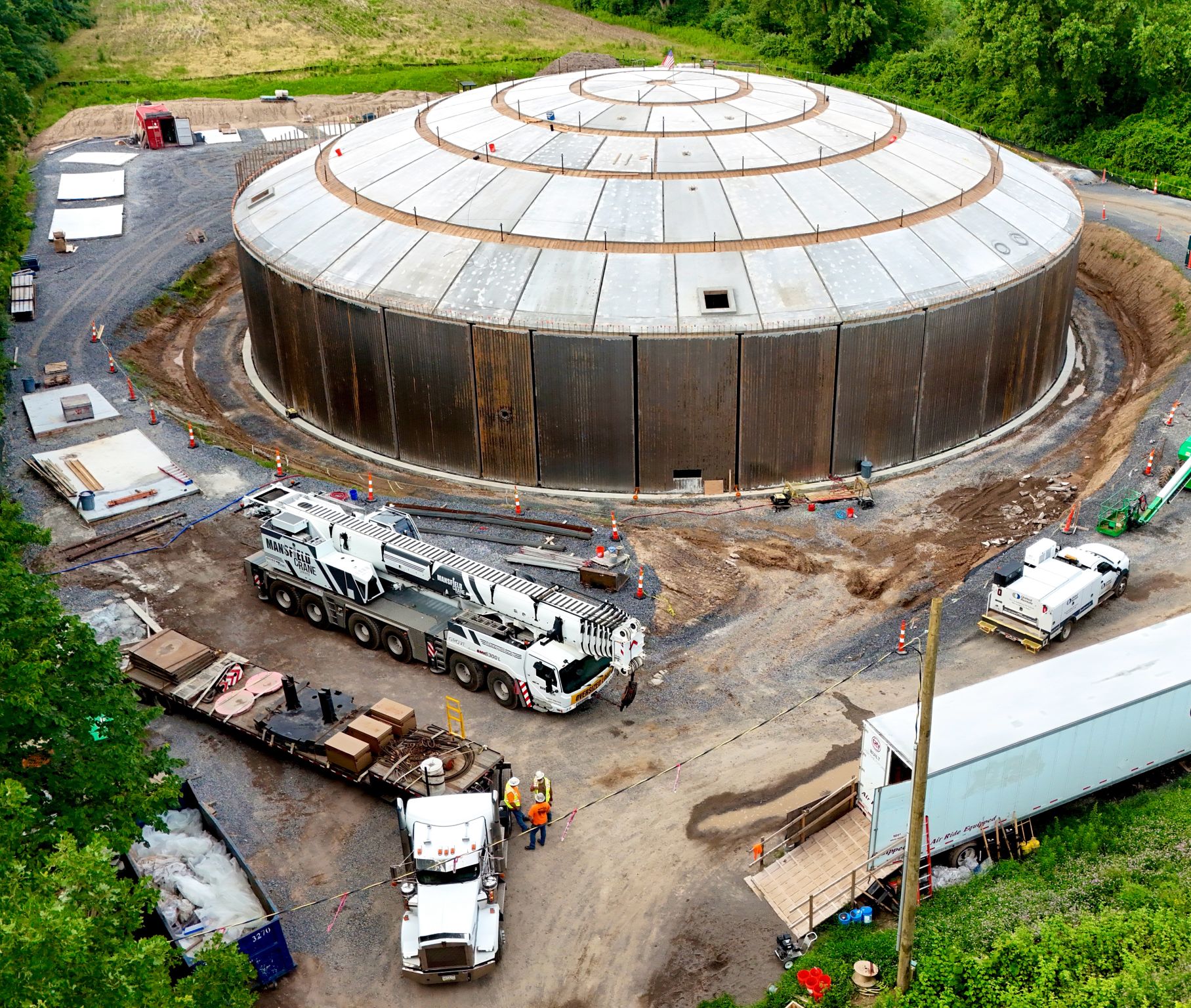
- Ground Storage Reservoirs (GSRs): Large-volume, concrete or welded-steel tanks situated adjacent to treatment facilities and booster pump stations. GSRs store millions of gallons of water immediately ready for high-service pumps to push into the main network.
- Elevated Storage Tanks (ESTs): Iconic overhead water towers strategically positioned across geographic quadrants. These tanks provide hydrostatic pressure across the distribution grid via gravity, eliminating pressure surges and ensuring uninterrupted water flow during power outages.
Pressure Management and Fire Protection
The TCEQ requires public water systems to maintain a minimum working pressure of 35 pounds per square inch (psi) under normal conditions and at least 20 psi during emergency fire-flow scenarios. Mansfield’s water distribution system operates at a standard line pressure of 50 to 75 psi. Pressure-reducing valves (PRVs) and booster stations prevent extreme high-pressure zones in low-lying topography while reinforcing flow in elevated subdivisions.
For commercial and residential developments, fire flow capacity is critical. Industrial corridors and high-density commercial centers require infrastructure capable of supplying up to 3,500 gallons per minute (gpm) for three or more consecutive hours, a requirement Mansfield accommodates through large-diameter arterial mains (16-inch to 24-inch lines).
Technical Specifications: Meters, Service Sizes, and Flow Rates
Establishing service requires proper meter sizing to prevent both pressure drop issues inside buildings and premature wear on utility measurement components. The city installs displacement-type meters for smaller residential services and compound or turbine meters for large commercial and fire-protection connections.
| Meter Size | Type | Safe Maximum Operating Flow | Recommended Continuous Flow | Typical Application |
|---|---|---|---|---|
| 5/8" x 3/4" | Positive Displacement | 20 gpm | 10 gpm | Single-family residential; low fixture-count homes |
| 1" | Positive Displacement | 50 gpm | 25 gpm | Large single-family residences; small commercial retail; dedicated irrigation |
| 1-1/2" | Positive Displacement / Piston | 100 gpm | 50 gpm | Multi-family fourplexes; commercial kitchens; extensive landscape irrigation |
| 2" | Compound / Disc | 160 gpm | 80 gpm | Commercial plazas; strip malls; schools; municipal sports fields |
| 3" | Compound / Turbine | 350 gpm | 175 gpm | Industrial facilities; mid-rise residential apartments; light manufacturing |
| 4" | Compound / Turbine | 700 gpm | 350 gpm | Heavy commercial complexes; high-volume distribution centers; major medical facilities |
| 6" to 8" | Turbine / Fire Service | 1,600 – 3,500 gpm | 800 – 1,750 gpm | Municipal distribution loops; direct fire suppression systems; warehouse hubs |
Customer Service: Establishing and Managing Accounts
Setting up residential or commercial water service requires adherence to standard municipal billing, verification, and permitting guidelines.
Residential Service Activation
New residents moving into an existing single-family residence must establish an account with Mansfield Water Utilities before service turn-on.
- Application Submission: Residents complete a service application online through the municipal customer portal or in person at City Hall / Utility Customer Service.
- Identity and Tenancy Verification: The city requires a government-issued photo ID and proof of property ownership (closing disclosure, deed) or a fully executed lease agreement if renting.
- Deposit and Activation Fees: A refundable security deposit is assessed based on customer class and credit verification, accompanied by a non-refundable account establishment fee. Deposits are credited back to the customer after a consecutive period of on-time payments.
- Turn-On Verification: Utilities require an adult on-site or assurance that all internal plumbing fixtures are fully closed during the scheduled connection window to avoid flooding from open valves.
Commercial Accounts and Cross-Connection Control
Commercial utility setup involves technical screening alongside administrative registration. Commercial operations must submit planned plumbing fixture schedules to verify appropriate meter sizing.
Commercial accounts are subject to mandatory Cross-Connection Control and Backflow Prevention inspections. Any property featuring irrigation systems, fire sprinkler connections, chemical storage, grease traps, or boiler networks must install approved backflow prevention assemblies (e.g., Reduced Pressure Zone / RPZ devices or Double Check Valve Assemblies). These assemblies must be tested upon installation and recertified annually by a state-licensed backflow tester, with records submitted to the utility's environmental department.
Development Engineering: Capacity Buy-In and Impact Fees
Rapid growth demands that capital improvements keep pace with distribution needs. Mansfield utilizes a structured development impact fee system to ensure that new construction funds the necessary expansion of treatment capacity, pump stations, and transmission mains.
Utility Impact Fees
When an undeveloped parcel or platted lot receives a building permit, the developer or builder pays water and wastewater impact fees. These fees are established via municipal ordinance and periodic hydraulic capacity studies:
- Equivalent Residential Unit (ERU): Impact fees are typically calibrated to the demand of a standard single-family home using a 5/8" x 3/4" meter. Larger meters pay a multiplier proportionate to their maximum flow potential.
- Capital Improvement Plan (CIP) Funding: Monies collected from these capacity buy-in fees are deposited into dedicated capital utility accounts. They cannot be diverted to general municipal operations; they must fund major line replacements, treatment plant expansions, and elevated storage construction.
Fire Flow Tests and Capacity Availability Reviews
Before submitting site development plans, civil engineers must request a water model review or conduct a physical fire flow test. A registered professional engineer oversees the flow testing of neighboring hydrants to measure:
- Static Pressure: Residual pressure in the main line when all hydrants are closed.
- Residual Pressure: Pressure measured while a nearby flow hydrant discharges water.
- Observed Flow Rate: Measured in gallons per minute (gpm) via pitot tube readings.
If the city’s hydraulic models determine that an intended development reduces surrounding pressures below state requirements, the developer must pay for off-site water main improvements or install on-site booster and storage assemblies.
Water Quality Compliance and Conservation Guidelines
Mansfield adheres to all National Primary Drinking Water Regulations under the Safe Drinking Water Act (SDWA), regulated by the Environmental Protection Agency (EPA) and enforced at the state level by the TCEQ.
Annual Water Quality Reports (CCR)
The city publishes an annual Consumer Confidence Report (CCR) outlining routine testing results across hundreds of potential parameters:
- Microbiological Purity: Continuous monitoring for E. coli and total coliform bacteria throughout the distribution grid.
- Inorganic Compounds: Tracking nitrates, nitrites, and trace minerals.
- Disinfection Byproducts: Rigorous sampling of total trihalomethanes (TTHMs) and haloacetic acids (HAA5), ensuring values remain comfortably beneath maximum contaminant levels (MCLs).
- Lead and Copper: Mansfield conducts standard periodic compliance testing at residential taps under the EPA Lead and Copper Rule Improvements (LCRI). The system relies on non-corrosive water chemistry adjustment (pH stabilization) to prevent pipe leaching.
Conservation and Drought Contingency Measures
Because water supplies rely on regional reservoir levels, Mansfield maintains permanent water conservation measures alongside staged drought contingency alerts:
- Year-Round Irrigation Rules: Landscape watering is limited to scheduled days based on residential street addresses. Automatic sprinkler use between 10:00 AM and 6:00 PM is prohibited during warmer months to minimize evaporative losses.
- Stage 1 & Stage 2 Triggers: If reservoir capacities in the wholesale supplier's system fall beneath predetermined thresholds (e.g., TRWD reservoir capacity drops below 75% or 60%), mandatory cutbacks activate. These stages prohibit vehicle washing at home, limit lawn irrigation to once per week or restrict it entirely, and enforce surcharges for high-volume discretionary water use.
Frequently Asked Questions
What should I do if my water pressure suddenly drops?
First, verify that your home's main shutoff valve and customer shutoff near the meter are fully open. Next, check if adjacent neighbors are experiencing the same issue; if they are, the drop may be due to a municipal main break, hydrant testing, or routine system maintenance. If the issue is isolated to your property, inspect your private pressure-reducing valve (PRV), typically located in a valve box near your home’s exterior wall or inside the garage, as failing PRVs frequently cause sudden pressure loss. If municipal lines appear to be affected, contact Mansfield Utility Operations.
How is water hardness classified in Mansfield?
Mansfield’s municipal water is generally classified as moderately hard to hard, averaging between 100 to 140 parts per million (ppm), or approximately 6 to 8 grains per gallon (gpg). This hardness stems from naturally occurring calcium and magnesium dissolved from the limestone formations underlying regional reservoirs. While harmless to health, some homeowners choose to install ion-exchange water softeners to reduce spot accumulation on dishes and prolong water heater lifespans.
Who is responsible for repairing a leaking water pipe?
Responsibility depends entirely on the location of the break relative to the water meter. The City of Mansfield maintains and repairs the raw mains, treatment plants, service lines, the meter box, and the physical meter itself. Any pipe, valve, or fixture extending from the meter’s downstream coupling into the private residence or business is the sole legal and financial responsibility of the property owner.
How do I check if my address is subject to drought watering restrictions?
Watering schedules and restriction stages are posted directly on the official City of Mansfield environmental and utility services portal. Permanent schedules assign watering days by address (for example, even-numbered addresses water on designated days such as Tuesdays and Saturdays; odd-numbered addresses water on Wednesdays and Sundays). Hand watering with a nozzle-equipped hose or drip irrigation is typically permitted during broader hours.
What are the standard procedures for contractors needing temporary construction water?
Contractors requiring bulk water for grading, dust control, or construction testing must apply for a temporary construction fire hydrant meter through Utility Customer Service. The contractor pays an equipment deposit and installation fee. The city assigns a metered backflow unit attached to a specified fire hydrant. Unauthorized drawing of water from a fire hydrant without an approved, metered assembly is a violation of municipal code and carries substantial municipal fines.
Practical Next Steps for Property Owners and Developers
- Existing Residents: To avoid unexpected late fees or service interruptions, register your account through the City of Mansfield online utility portal to enable automated leak alerts, track daily consumption trends, and set up electronic autopay.
- Prospective Homeowners & Landlords: When closing on a property, request a final meter read at least two business days prior to transfer to ensure billing integrity, and locate your private master shutoff valve in case of an on-site plumbing emergency.
- Commercial Builders & Civil Engineers: Before submitting formal development plats, schedule a pre-development conference with the Mansfield Water Utilities engineering division to evaluate local line capacities, confirm required fire flow metrics, and obtain an accurate impact fee assessment.
Image Gallery