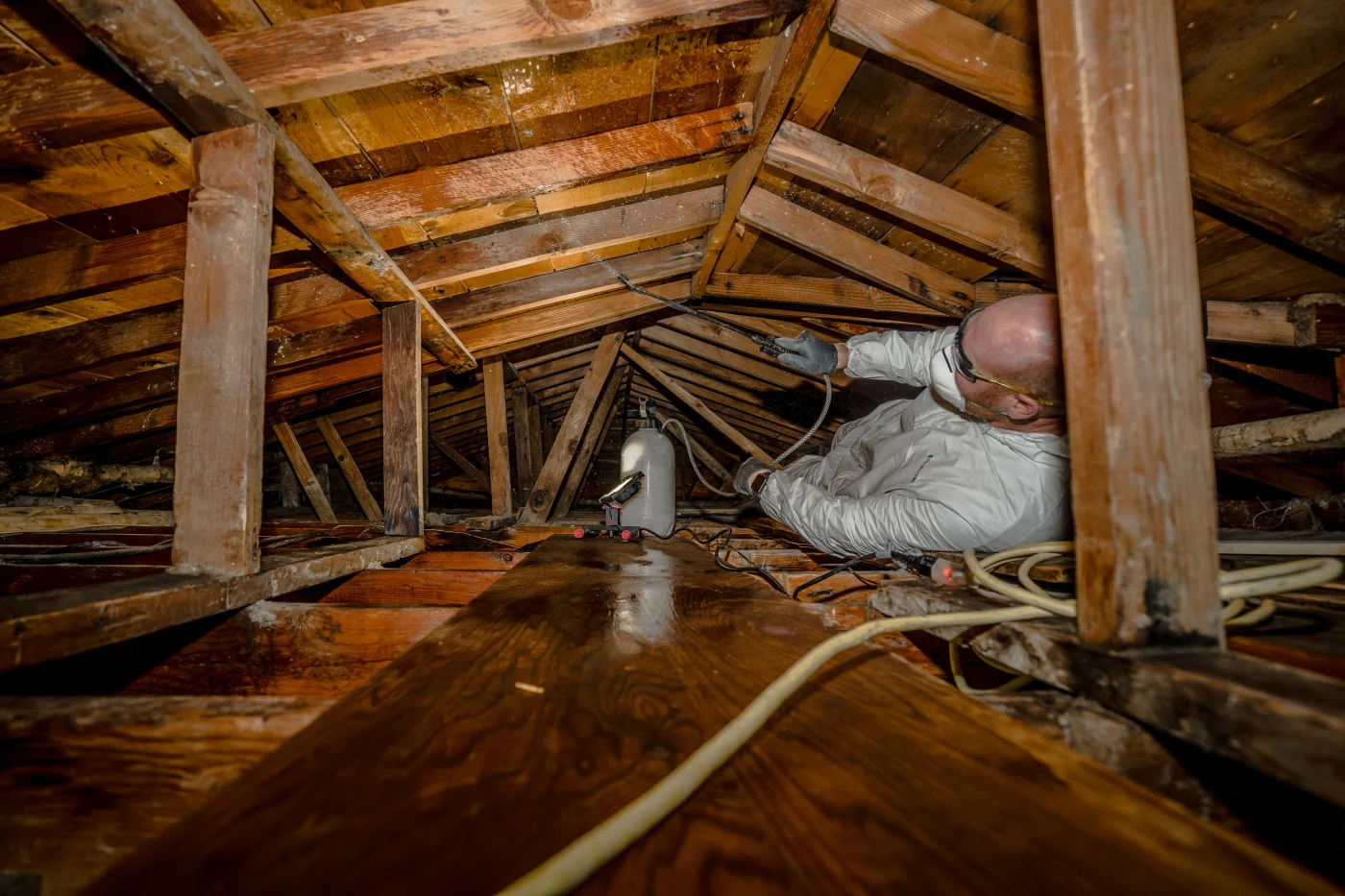
Quality Commercial Mold Remediation Services in NJ
Quality commercial mold remediation services in New Jersey provide specialized environmental cleanup for business facilities, adhering to IICRC S520 standards and OSHA safety protocols. These services involve professional moisture mapp...
Quality commercial mold remediation services in New Jersey provide specialized environmental cleanup for business facilities, adhering to IICRC S520 standards and OSHA safety protocols. These services involve professional moisture mapping, containment setup, HEPA-filtered air scrubbing, and the physical removal of contaminated porous materials to restore indoor air quality and structural integrity.
Contents
Commercial properties in New Jersey—ranging from expansive warehouses in the Meadowlands to high-rise office complexes in Jersey City—face significant environmental challenges. The state’s humid subtropical climate and aging infrastructure create an environment where mold can proliferate rapidly within HVAC systems, crawl spaces, and wall cavities. For business owners, the stakes of a mold outbreak go beyond mere aesthetics; they involve employee health liabilities, structural depreciation, and potential regulatory non-compliance.
The Critical Difference Between Commercial and Residential Remediation
While residential mold issues are often localized to a single room or basement, commercial mold remediation requires a significantly higher level of logistical planning and technical execution. Commercial buildings often feature complex HVAC systems that can distribute mold spores across multiple floors in a matter of hours.
Scale and Business Continuity
A primary concern for New Jersey businesses in 2026 is minimizing downtime. A quality remediation firm understands that shutting down an entire office wing or retail space is a last resort. Professional services utilize advanced containment strategies—often using fire-retardant polyethylene sheeting and negative air pressure machines—to isolate the affected area. This allows the rest of the business to remain operational while the remediation team works behind the scenes.
Regulatory and Liability Management
In a commercial setting, the legal implications of indoor air quality (IAQ) are substantial. Under the Occupational Safety and Health Administration (OSHA) General Duty Clause, employers are required to provide a workplace free from recognized hazards. Quality mold remediation services in NJ provide the necessary documentation, including "clearance reports" from independent third-party industrial hygienists, to protect the business from future litigation related to "Sick Building Syndrome."
The New Jersey Regulatory Environment in 2026
As of 2026, New Jersey continues to follow a combination of federal guidelines and state-specific health recommendations. While the state does not currently mandate a specific individual mold license for every technician (unlike New York or Florida), the New Jersey Department of Health (NJDOH) provides strict guidelines for public and commercial buildings regarding moisture intrusion and fungal growth.
Quality service providers differentiate themselves by maintaining certifications from the Institute of Inspection, Cleaning and Restoration Certification (IICRC). The IICRC S520 Standard for Professional Mold Remediation is the industry benchmark. Any commercial contractor operating in NJ without this specific technical foundation risks improper cleanup, which can lead to "rebound" growth—where mold returns more aggressively once the initial surface cleaning is finished.
The Standard Protocol for Quality Commercial Remediation
A comprehensive remediation project follows a specific sequence of events designed to eliminate the mold source while preventing cross-contamination.
1. Initial Assessment and Moisture Mapping
The process begins not with a sponge, but with technology. Technicians use infrared (thermal imaging) cameras to detect moisture behind drywall and under flooring that the naked eye cannot see. Moisture meters are then used to quantify the saturation levels of structural members. Understanding the "water story"—how the moisture got there—is essential; otherwise, the mold will simply return.
2. Containment and Air Pressure Control
Once the extent of the damage is mapped, the area is sealed. Quality services use "HEPA-filtered negative air machines." These devices pull air from the contaminated zone, pass it through a High-Efficiency Particulate Air (HEPA) filter (which catches 99.97% of particles down to 0.3 microns), and exhaust it outside the building. This creates a vacuum effect that prevents spores from escaping into clean areas of the facility.
3. Source Removal vs. Surface Cleaning
There is a common misconception that bleach kills mold on porous surfaces. It does not; it merely decolors the surface while the roots (hyphae) remain embedded. Professional commercial services follow these rules:
- Porous Materials (Drywall, insulation, ceiling tiles): These must be removed and disposed of as mold-contaminated waste.
- Semi-Porous Materials (Wood framing, concrete): These are cleaned using abrasive methods like wire brushing, HEPA vacuuming, or media blasting (such as dry ice blasting) to remove the mold roots.
- Non-Porous Materials (Metal, glass, hard plastic): These are cleaned with EPA-registered antimicrobial solutions.
4. HEPA Vacuuming and Detailed Cleaning
After the bulk removal of contaminated materials, every surface within the containment area—including the "stud bays" and undersides of flooring—is vacuumed with HEPA equipment. This is followed by a "sandwich wipe" technique using microfiber cloths and specialized detergents to ensure no residual spores remain.
Technology and Equipment Used in 2026 Commercial Projects
The tools used in commercial remediation have evolved to be more efficient and less intrusive. In 2026, NJ firms typically deploy a suite of high-tech solutions:
| Equipment Type | Purpose in Remediation | Benefit for Commercial Clients |
|---|---|---|
| FLIR Thermal Imagers | Identifying hidden leaks and cold spots. | Non-destructive; no need to tear down walls for inspection. |
| LGR Dehumidifiers | Removing deep-seated moisture from structural wood. | Prevents secondary mold growth during the drying phase. |
| Dry Ice Blasting | Using CO2 pellets to "scrub" mold off wood and masonry. | No secondary waste (pellets sublimate); faster than hand-scrubbing. |
| AI-Enabled Moisture Sensors | Real-time monitoring of drying progress via smartphone. | Provides a verifiable data log for insurance and compliance. |
| Hydroxyl Generators | Neutralizing odors and airborne pathogens. | Safe for use in occupied buildings (unlike high-concentration ozone). |
Cost Considerations for NJ Commercial Properties
Pricing for quality commercial mold remediation in New Jersey for 2026 varies based on the "Condition" of the space (Condition 1, 2, or 3 as defined by the IICRC). Generally, commercial projects are quoted based on square footage, accessibility, and the complexity of the HVAC involvement.
- Small Scale (Breakrooms, restrooms): $2,500 – $7,000. These usually involve localized leaks and minor drywall replacement.
- Medium Scale (Office suites, retail floors): $10,000 – $45,000. Often involves extensive containment, multiple air scrubbers, and significant structural drying.
- Large Scale (Industrial warehouses, multi-story hotels): $50,000+. These projects require dedicated project management, large-scale desiccant dehumidification, and often involve multiple phases over several weeks.
It is important to note that New Jersey businesses should prioritize "Quality" over the lowest bid. Incomplete remediation often leads to secondary claims, increased insurance premiums, and potential closure by local health departments.
How to Select a Qualified NJ Remediation Partner
When evaluating providers for commercial services, New Jersey property managers should look for the following "Red Flags" and "Gold Standards":
- Conflict of Interest: Avoid companies that insist on performing both the initial mold testing and the final remediation without allowing for a third-party clearance test. A quality firm encourages independent verification to prove the job was done correctly.
- Insurance Coverage: Verify that the contractor carries Pollution Liability Insurance. Standard general liability policies often have "mold exclusions," meaning if the contractor makes the problem worse (e.g., spreading spores through the HVAC), the property owner is not protected.
- Experience with NJ Climate: New Jersey's coastal areas and urban centers have different humidity profiles. A firm experienced in the local environment will understand the specific vapor barrier requirements for NJ building codes.
Frequently Asked Questions
Does insurance cover commercial mold remediation in NJ?
Coverage depends entirely on the "cause of loss." If the mold is the result of a sudden and accidental water discharge (like a burst pipe), it is often covered. If the mold developed over time due to high humidity or poor maintenance, insurance providers frequently deny the claim. Most commercial policies in 2026 have specific sub-limits for mold, typically capped at $15,000 to $25,000 unless an additional rider was purchased.
How long does a typical commercial remediation take?
Most commercial projects take between 3 and 7 days. This includes 24 hours for containment setup and initial stabilization, 2-3 days for physical removal and cleaning, and 24-48 hours for the final drying and clearance testing. Complex projects involving HVAC decontamination may take longer.
Can employees remain in the building during remediation?
Yes, provided that the remediation firm uses professional-grade containment and negative air pressure. These barriers are designed to ensure that the air in the occupied portions of the building remains at a higher pressure than the "dirty" zone, preventing any cross-contamination.
Is a "Clearance Test" mandatory in New Jersey?
While not strictly mandated by state law for all private commercial buildings, it is considered an industry best practice and is often required by lenders, insurers, and corporate health and safety policies. A clearance test involves an independent Professional Mold Inspector (PMI) or Industrial Hygienist taking air samples to ensure the spore counts inside the workspace are lower than or equal to the outdoor ambient air.
What is the difference between mold "removal" and "remediation"?
"Removal" is a subset of "Remediation." Removal refers to the physical act of taking moldy materials out of the building. Remediation is the entire process of identifying the moisture source, containing the area, cleaning the air, and ensuring the environment is returned to a normal fungal ecology.
Final Recommendation for NJ Property Managers
If you suspect mold growth in your commercial facility, the first step is to stop the water source. Once the leak is controlled, engage a certified professional who specializes in commercial-grade equipment. Do not attempt to "clean" large areas of mold with janitorial staff, as improper handling can aerosolize millions of spores, turning a minor repair into a building-wide environmental crisis. Always insist on a written scope of work that references the IICRC S520 standards and ensure a third-party clearance test is conducted before the containment barriers are removed.
Image Gallery