Understanding the String Theory Debate: Quantum Gravity, Testability, and the Search for Unity
The string theory debate centers on whether string theory—a theoretical framework replacing point-like elementary particles with vibrating one-dimensional strings—serves as a valid "Theory of Everything." While it mathematically unifie...
The string theory debate centers on whether string theory—a theoretical framework replacing point-like elementary particles with vibrating one-dimensional strings—serves as a valid "Theory of Everything." While it mathematically unifies general relativity and quantum mechanics, critics argue that its lack of experimental testability at accessible energy scales threatens its status as empirical physics.
Contents
The Core Conflict: Unifying Relativity and Quantum Mechanics
Modern physics rests upon two extraordinary foundational theories, both verified by decades of rigorous experimentation, yet fundamental contradiction remains between them.
- General Relativity governs the macro-cosmos: gravity, space-time curvature, black holes, and cosmological expansion. Albert Einstein modeled space-time as a smooth, continuous fabric bent by energy and mass.
- Quantum Mechanics governs the subatomic world: electrons, quarks, photons, and fundamental forces excluding gravity. It treats physical properties as probabilistic, discrete units (quanta) operating within non-curved background space.
When physicists attempt to apply general relativity at subatomic distances—specifically at the Planck scale ($10^{-35}$ meters or $10^{19}$ GeV of energy)—the mathematical equations break down entirely. Quantum fluctuations render the geometry of space-time violent and chaotic, producing infinite, nonsensical probabilities.
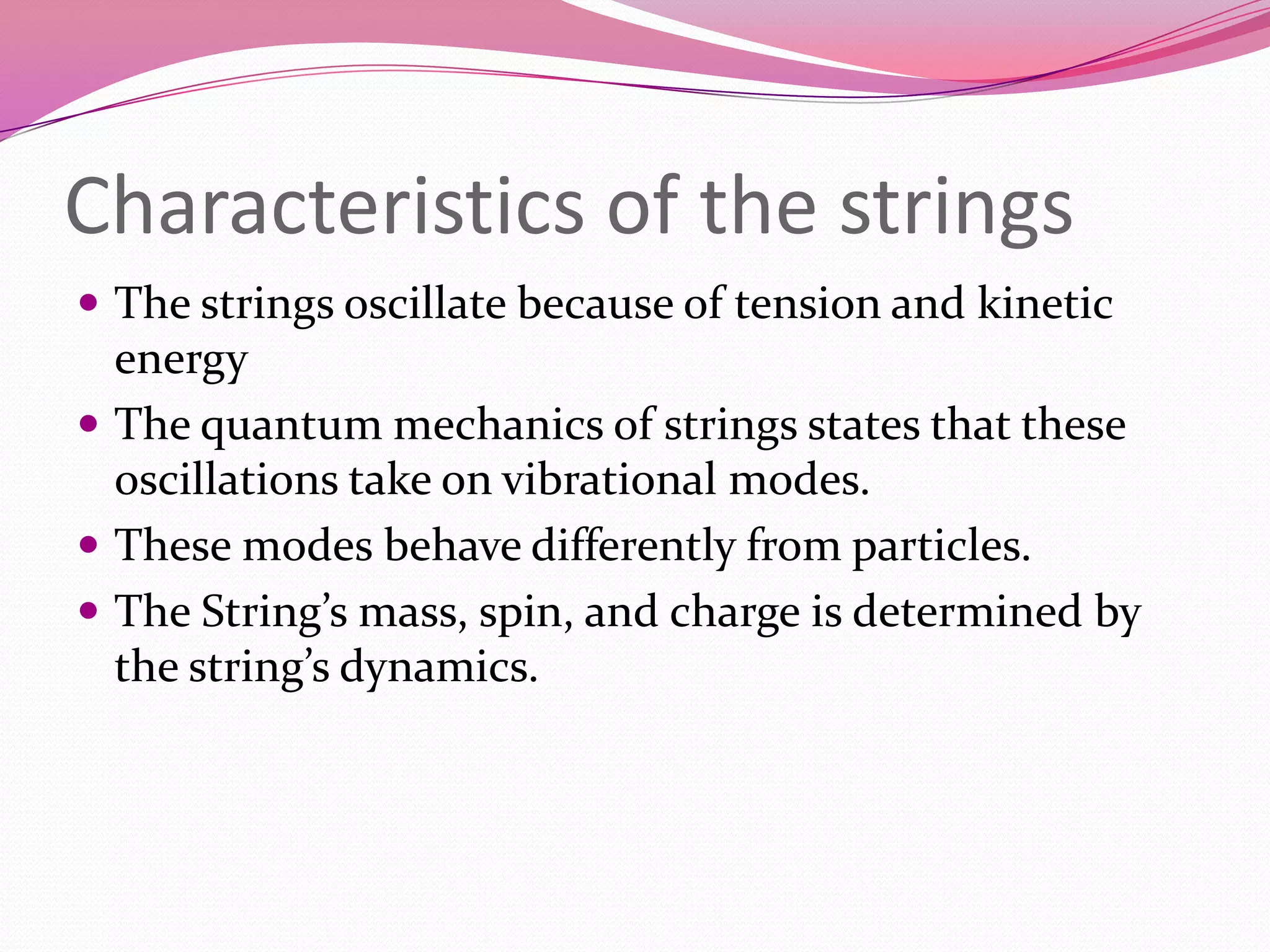
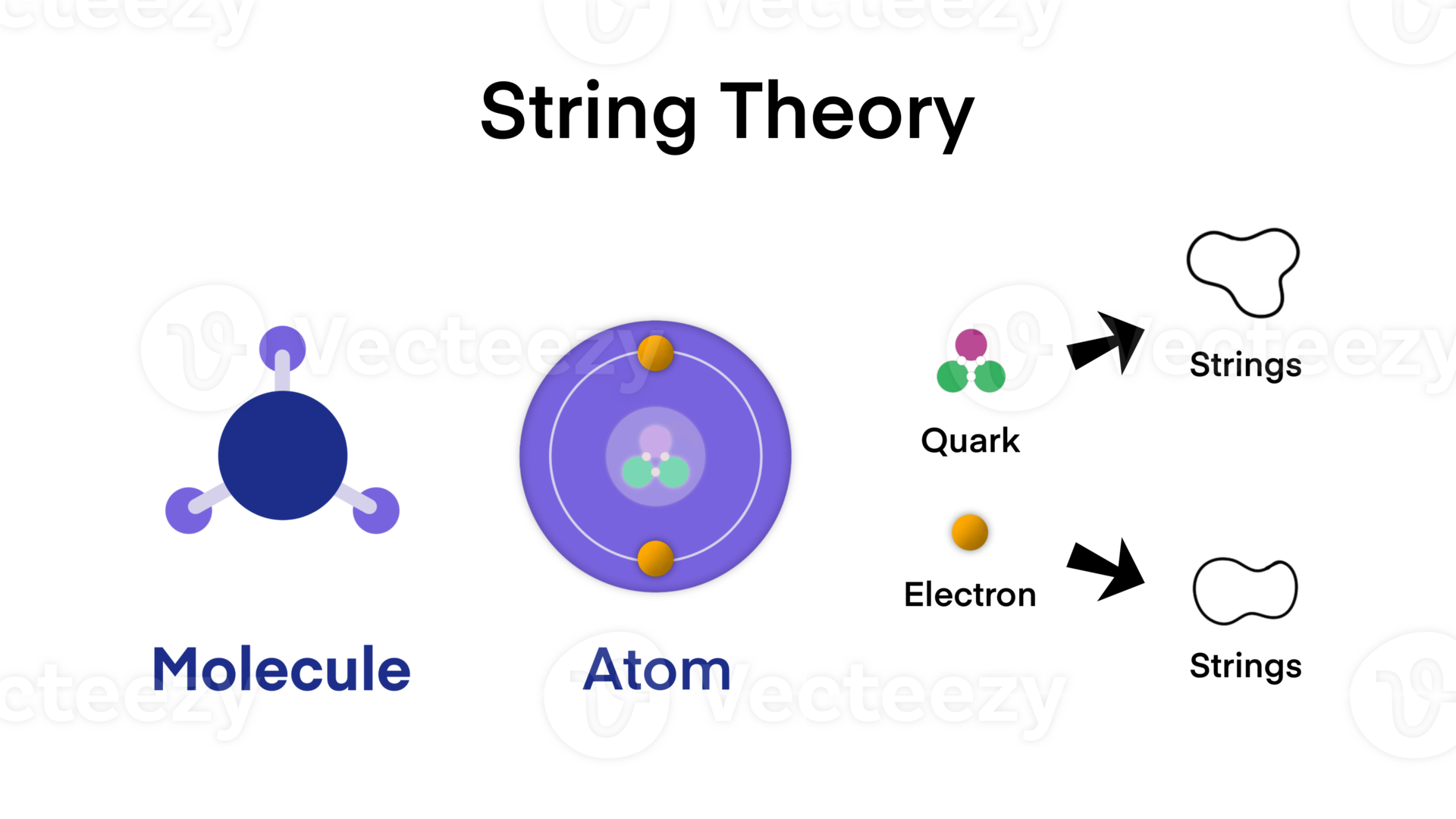
String theory emerged as a primary candidate to resolve this incompatibility. By proposing that the fundamental building blocks of nature are not zero-dimensional point particles but one-dimensional extended objects called strings, the theory smoothes out high-energy subatomic spacetime jitter. Different vibrational frequencies of these strings manifest as distinct observed particles, such as quarks, electrons, and photons.
- Point Particle Model (Quantum Field Theory): Zero-dimensional point: Creates mathematical infinities at subatomic gravity scales
- String Theory Model: One-dimensional vibrating string: Smoothes spacetime fluctuations at the Planck scale
Key Arguments Supporting String Theory
Proponents of string theory, including theoretical physicists who work on high-energy mathematical physics, emphasize several major triumphs that make the framework exceptionally compelling despite experimental hurdles.
1. Natural Integration of Gravity
In Quantum Field Theory (QFT), inserting a force-carrier particle for gravity (the hypothetical graviton) leads to unrenormalizable infinities. In string theory, however, a closed string vibrating at a specific fundamental mode naturally exhibits the exact properties of a spin-2, massless particle—precisely the theoretical profile of a graviton. Gravity is not forced into the equations; it emerges automatically from the geometry of vibrating strings.
2. Resolution of Black Hole Entropy
In the 1970s, Stephen Hawking and Jacob Bekenstein calculated that black holes possess thermodynamic entropy proportional to their event horizon area. For decades, physicists lacked a microscopic explanation for what microstates created this entropy. In 1996, physicists Andrew Strominger and Cumrun Vafa utilized string theory to calculate the microscopic quantum states of a specific class of extremal black holes, deriving the exact Bekenstein-Hawking entropy formula from first principles.
3. Holographic Duality and AdS/CFT Correspondence
Discovered by Juan Maldacena in 1997, the Anti-de Sitter / Conformal Field Theory (AdS/CFT) correspondence demonstrated a mathematical equivalence (duality) between a gravitational theory in a higher-dimensional space and a quantum field theory without gravity operating on that space's boundary. Detailed in research archived on the arXiv preprint server, AdS/CFT has provided physicists with a powerful calculator to solve complex quantum problems in condensed matter physics and strong force interactions (quark-gluon plasma) using classical gravitational mathematics.
Main Arguments Against String Theory: The Core Criticisms
Despite its mathematical elegance, string theory has faced intense criticism from prominent physicists, science philosophers, and experimental scientists. The debate intensified with published critiques such as Peter Woit’s Not Even Wrong and Lee Smolin’s The Trouble with Physics, establishing several key counterarguments.
String Theory Debate Breakdown
| Proponents | Critics |
|---|---|
| Unifies QFT & Gravity | Lacks Falsifiability |
| Includes Graviton Mode | No Direct Experiments |
| Mathematical Elegance | Multiverse / Landscape |
| AdS/CFT Holography | Requires Extra Dimensions |
1. The Falsifiability and Empirical Testability Problem
The most severe criticism of string theory concerns empirical testability. According to Karl Popper's criterion of scientific falsifiability, a hypothesis must make specific predictions that can be proven wrong through observational testing to be considered scientific.
Because string vibrations manifest fully only near the Planck scale ($10^{19}$ GeV), testing string effects directly requires a particle accelerator the size of a galaxy. Particle physics facilities like the Large Hadron Collider at CERN operate at TeV energy scales ($10^4$ GeV)—trillions of times weaker than the Planck scale. Critics argue that a theory capable of adjusting its equations to match any negative experimental result risks falling outside empirical science.
2. Extra Dimensions and the Landscape Problem
String theory requires extra spatial dimensions to maintain mathematical consistency:
- Superstring Theory requires 10 dimensions (9 spatial, 1 temporal).
- M-Theory (introduced by Edward Witten) requires 11 dimensions.
To align with our four-dimensional experience (3 spatial, 1 temporal), string theory posits that extra dimensions are "compactified" or curled up into microscopic geometric shapes known as Calabi-Yau manifolds.
However, there are an estimated $10^{500}$ possible ways to compactify these dimensions. Each geometry yields different physical constants, particle masses, and force strengths, creating what is known as the String Theory Landscape. Critics contend that if a theory permits $10^{500}$ distinct universes (the string multiverse), it predicts almost everything and, consequently, predicts nothing specific about our universe.
3. Non-Background Independence
General relativity is background-independent; space-time geometry is dynamic and determined by matter. Traditional string theory formulations were background-dependent, requiring physicists to fix a predefined space-time grid on which strings move. Opponents argue that a true theory of quantum gravity must construct space-time itself from fundamental quantum components rather than assuming a background geometry.
Comparing Quantum Gravity Frameworks
String theory is not the only framework attempting to unify physics. To understand where the debate stands, it helps to compare string theory against alternative quantum gravity programs and standard physical models.
| Feature / Metric | String Theory / M-Theory | Loop Quantum Gravity (LQG) | Asymptotically Safe Gravity | Standard Model (QFT) |
|---|---|---|---|---|
| Primary Goal | Unified Theory of Everything | Quantum Theory of Gravity | Quantum Gravity via Field Theory | Microscopic Force Description |
| Fundamental Entity | 1D Strings / Higher-D Branes | Spin Networks / Loops | Continuous Spacetime Fields | Point-like Particles |
| Required Dimensions | 10 or 11 Dimensions | 4 Dimensions | 4 Dimensions | 4 Dimensions |
| Background Independent? | Historically No (AdS/CFT partial) | Yes | Yes | No |
| Includes Matter/Forces? | Yes (All 4 fundamental forces) | No (Focuses strictly on gravity) | Gravity primary; matter secondary | Yes (Excludes gravity) |
| Experimental Verification | None to date | None to date | None to date | Extensively Verified |
| Mathematical Status | Highly Developed / Unfinished | Well Developed / Unfinished | Active Research Area | Complete / Standard |
Alternative Approaches to Quantum Gravity
Because of string theory's experimental impasse, theoretical physicists explore several alternative approaches to quantum gravity:
Loop Quantum Gravity (LQG)
Pioneered by Carlo Rovelli, Lee Smolin, and Abhay Ashtekar, Loop Quantum Gravity attempts to quantize space-time directly without introducing hypothetical extra dimensions or unobserved particles. In LQG, space is not a continuous background but a granular network of discrete loops called spin networks. Spacetime itself has a minimum quantum unit of volume and area. Unlike string theory, LQG does not attempt to unify all forces; it focuses exclusively on constructing a quantum theory of gravity in four dimensions.
Asymptotically Safe Gravity
First proposed by Steven Weinberg and actively researched by theoretical physicists, Asymptotically Safe Gravity suggests that gravity can be quantized within the familiar framework of Quantum Field Theory. It posits that gravity's interaction strength approaches a stable "non-Gaussian fixed point" at high energies, preventing the mathematical infinities that usually plague quantum gravity models without requiring extra dimensions or strings.
Causal Dynamical Triangulations (CDT)
CDT uses computer simulations to build spacetime by stitching together tiny four-dimensional building blocks (triangles/simplexes) following strict rules of cause and effect. It seeks to show how macroscopic 4D spacetime emerges naturally from quantum fluctuations at small scales.
The Modern Synthesis: String Theory as a Mathematical Toolkit
The nature of the string theory debate has evolved. Rather than viewing string theory strictly as a binary choice between a definitive "Theory of Everything" or a failed hypothesis, contemporary researchers increasingly treat string theory as a powerful mathematical toolkit.
- String Theory Toolkit
- Quantum Field Theory: Dualities & Calculations
- Condensed Matter: Superconductors & Plasma
- Quantum Information Theory: Black Hole Holography & Chaos
Even if strings are not physical objects in our universe, the mathematical structures developed within string theory have yielded major insights across other scientific domains:
- Quantum Chromodynamics (QCD): Calculations involving quark-gluon plasmas generated in heavy-ion collision experiments utilize holographic models derived from string dualities.
- Condensed Matter Physics: AdS/CFT techniques help model strongly correlated electron systems, high-temperature superconductors, and quantum phase transitions.
- Pure Mathematics: String theory led to breakthroughs in geometry and topology, such as mirror symmetry—a discovery in algebraic geometry validated through mathematical research recorded by the American Mathematical Society.
- Quantum Information and Quantum Black Holes: The study of quantum entanglement and quantum error correction has become deeply intertwined with black hole physics and the holographic principle.
Key Questions in the String Theory Debate
Is string theory dead or discredited?
No. String theory remains an active field of research within theoretical physics departments worldwide. While early hopes for a quick, unique "Theory of Everything" have diminished, its mathematical methods continue to drive breakthroughs in quantum field theory, black hole thermodynamics, and pure mathematics.
Why cannot we test string theory with current particle colliders?
String theory effects dominate at the Planck energy scale ($\approx 10^{19}$ GeV). The world's most powerful collider, the Large Hadron Collider, operates at roughly $1.3 \times 10^4$ GeV. Generating Planck-scale collision energies directly would require an accelerator millions of times larger than Earth.
Does string theory require supersymmetry?
Yes. Basic bosonic string theory only modeled force-carrying particles (bosons) and contained instabilities. Incorporating matter particles (fermions) required supersymmetry (SUSY), creating superstring theory. Although the Large Hadron Collider has not observed supersymmetric partner particles at lower energy bands, supersymmetry remains a core component of string mathematical frameworks.
What is the difference between string theory and M-theory?
In 1995, physicist Edward Witten demonstrated that five distinct 10-dimensional superstring theories were different limits of a single 11-dimensional underlying theory, which he named M-theory. M-theory incorporates higher-dimensional vibrating membranes (branes) in addition to one-dimensional strings.
How does the anthropic principle relate to string theory?
Because string theory permits roughly $10^{500}$ vacuum states (the landscape), some physicists suggest our universe exhibits its specific physical laws because those parameters happen to permit life—a concept known as the anthropic principle. Critics argue that relying on anthropic reasoning weakens the predictive power of theoretical physics.
Next Steps for Students and Researchers
Understanding the string theory debate requires distinguishing between physical empirical claims and mathematical utility. For readers, students, and researchers evaluating quantum gravity frameworks, consider these practical next steps:
- Study Foundational Math and Physics First: Master classical mechanics, electrodynamics, special and general relativity, and non-relativistic quantum mechanics before evaluating quantum gravity literature.
- Explore Primary Scientific Sources: Track preprints and published research papers on arXiv.org under the
hep-th(High Energy Physics - Theory) andgr-qc(General Relativity and Quantum Cosmology) categories. - Examine Multiple Quantum Gravity Models: Avoid treating string theory as the sole option. Compare its formulations with Loop Quantum Gravity, Asymptotically Safe Gravity, and Quantum Information approaches to gain a balanced perspective on modern theoretical physics.
Image Gallery