Korean Air 747-8 Fuel Savings: Technical Analysis and Fleet Strategy in 2026
Korean Air achieves approximately 16% better fuel efficiency per seat with the Boeing 747-8 Intercontinental compared to its predecessor, the 747-400. These savings are primarily driven by the implementation of GEnx-2B67 engines, advan...
Korean Air achieves approximately 16% better fuel efficiency per seat with the Boeing 747-8 Intercontinental compared to its predecessor, the 747-400. These savings are primarily driven by the implementation of GEnx-2B67 engines, advanced raked wingtips, and the extensive use of weight-saving composite materials, significantly reducing operational costs on high-density long-haul routes.
Contents
As we look at the aviation landscape in 2026, the Boeing 747-8 remains a critical, albeit niche, component of the Korean Air fleet. While the industry has shifted heavily toward ultra-efficient twin-engine widebodies like the Boeing 777X and the Airbus A350, the 747-8 represents the pinnacle of four-engine evolution. For Korean Air, the decision to operate this aircraft was never just about nostalgia; it was a calculated move to bridge the gap between massive capacity requirements and the increasing pressure to reduce carbon footprints and fuel expenditures.
The Technological Core: GEnx-2B Engine Efficiency
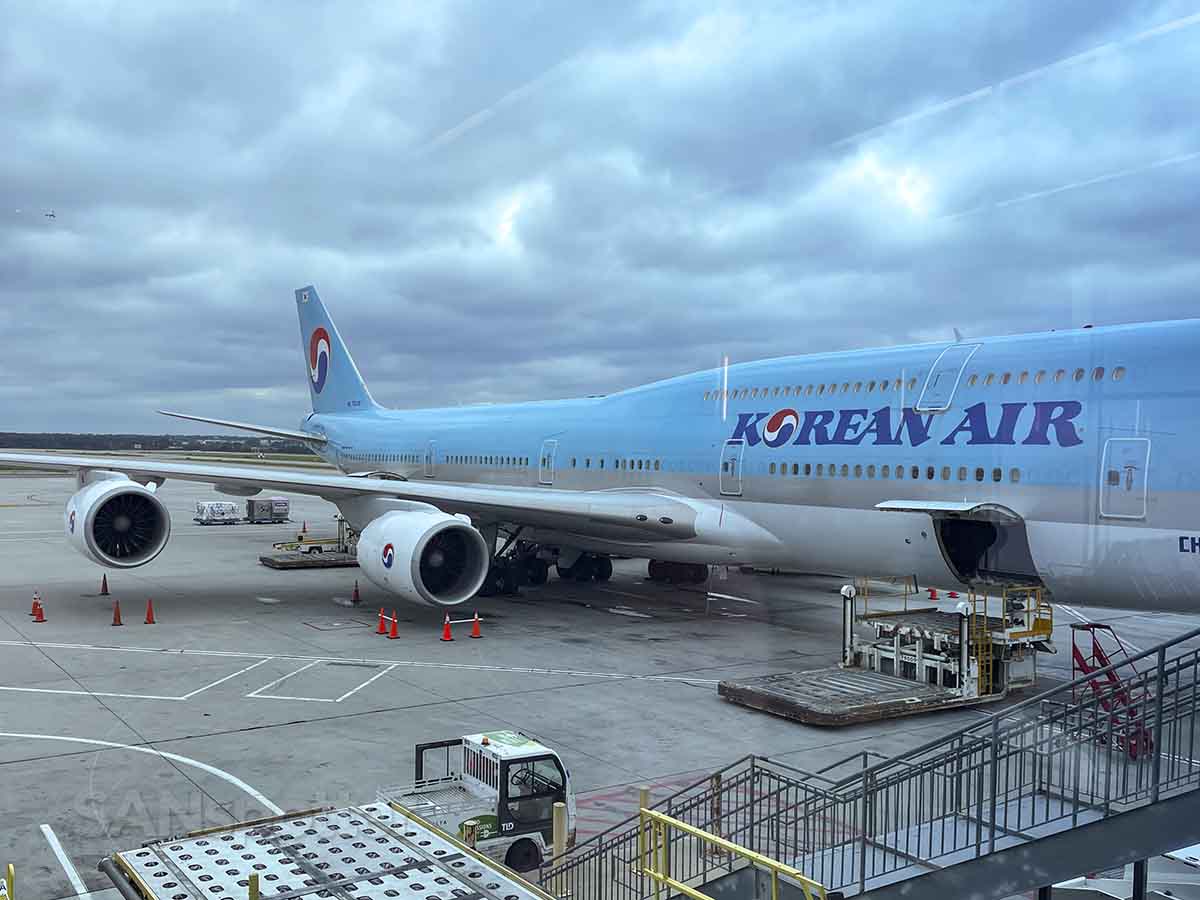
The most significant contributor to the fuel savings of the Korean Air 747-8 is the propulsion system. Unlike the Pratt & Whitney or GE engines found on the older 747-400 series, the 747-8 utilizes the General Electric GEnx-2B67. This engine is a derivative of the GEnx-1B developed for the 787 Dreamliner, scaled and modified for the specific requirements of the 747 airframe.
The GEnx-2B engines utilize a dual-spool, high-bypass turbofan design. One of the key innovations is the use of carbon fiber composite fan blades and a composite fan case. By reducing the weight of the rotating assembly, the engine requires less energy to achieve the necessary thrust. Furthermore, the high-pressure compressor operates at a pressure ratio of 23:1, one of the highest in commercial aviation history. This enables more complete combustion of fuel, ensuring that every drop of Jet A-1 produces maximum kinetic energy.
In practical terms for Korean Air, these engines provide a double-digit reduction in fuel burn and CO2 emissions. In 2026, where carbon taxes and emissions trading schemes (ETS) have become more stringent in both Europe and East Asia, the 16% reduction in fuel burn translates directly into millions of dollars in saved regulatory fees and fuel costs annually across the 747-8 fleet.
Aerodynamic Refinements and Raked Wingtips
Beyond the engines, the 747-8 features a complete redesign of the wing structure compared to the 747-400. The most visible change is the transition from vertical winglets to raked wingtips. While the winglets of the 1990s were effective at reducing induced drag by managing the vortices at the tip of the wing, raked wingtips offer superior efficiency for long-haul cruise segments.
Raked wingtips function by increasing the effective aspect ratio of the wing without significantly increasing the wingspan to a point that would require airport gate reclassification. These tips spread the wingtip vortices over a larger area, reducing the drag that pulls back on the aircraft. For Korean Air’s trans-pacific routes—such as Seoul (ICN) to Los Angeles (LAX) or New York (JFK)—the aircraft spends over 10 hours in the cruise phase. During this time, even a 1% reduction in drag resulting from the raked tips translates into thousands of kilograms of fuel saved per flight.
Additionally, the 747-8 incorporates fly-by-wire technology for its flight controls. This system allows for more precise control of the flight surfaces, enabling the aircraft's computers to make micro-adjustments that maintain the most aerodynamic "trim" possible. This eliminates the "hunting" for altitude or heading that can occur with older mechanical systems, further smoothing the flight path and conserving fuel.
Material Science and Weight Reduction
Weight is the enemy of fuel efficiency. In the construction of the 747-8, Boeing utilized advanced aluminum-lithium alloys and carbon fiber reinforced plastics (CFRP) in areas where the 747-400 used heavier, traditional aluminum.
- Aluminum-Lithium Alloys: These alloys are lighter and stronger than standard aircraft aluminum, allowing for thinner structural components without sacrificing integrity.
- Composite Usage: While not a "plastic plane" like the 787, the 747-8 uses composites in the spoilers, floor beams, and various fairings.
- Interior Weight Savings: Korean Air's 2026 cabin configurations utilize modern, lightweight seating materials and slimline galleys. Reducing the "dry operating weight" of the aircraft means the engines don't have to work as hard to keep the plane aloft, particularly during the fuel-heavy takeoff and initial climb phases.
Performance Comparison: 747-400 vs. 747-8
To understand the scale of the savings, it is necessary to compare the 747-8 directly with its predecessor. The following table outlines the technical shifts that contribute to the 747-8’s superior fuel economics.
| Feature | Boeing 747-400 (Legacy) | Boeing 747-8 Intercontinental | Impact on Fuel/Efficiency |
|---|---|---|---|
| Engine Type | PW4000 / CF6-80C2 | GEnx-2B67 | ~13-15% lower fuel burn per engine |
| Wing Design | Traditional + Winglets | Raked Wingtips + New Airfoil | Improved lift-to-drag ratio |
| Fuel Capacity | ~216,000 Liters | ~238,000 Liters | Increased range with lower burn rate |
| Max Takeoff Weight | 396,890 kg | 447,696 kg | Higher payload-to-fuel ratio |
| Noise Footprint | Standard | 30% Smaller Stage 4 | Reduced airport fees/curfew flexibility |
| Per-Seat Fuel Burn | Baseline | 16% Reduction | Lower operating cost per passenger |
Korean Air’s Strategic Fleet Evolution in 2026
As of 2026, Korean Air’s relationship with the 747-8 is in a state of transition. While the aircraft is significantly more efficient than the 747-400, it still operates with four engines in an era where twin-engine aircraft dominate. Korean Air has begun a strategic "right-sizing" of its fleet.
In a notable move during the mid-2020s, Korean Air reached an agreement to sell five of its 747-8i aircraft to Sierra Nevada Corp (SNC) for use in the U.S. Air Force's "Survivable Airborne Operations Center" (SAOC) project—commonly known as the next-generation "Doomsday Plane." This sale highlights the high value of the 747-8 airframe; it remains the only Western aircraft with the size, four-engine redundancy, and modern efficiency required for such high-stakes missions.
For the remaining 747-8s in the Korean Air fleet, the strategy in 2026 focuses on "high-density, high-yield" corridors. Routes like Seoul to London or Seoul to San Francisco benefit from the 747-8’s massive belly cargo capacity and its 368-seat configuration. By filling these aircraft to high load factors, Korean Air maximizes the fuel savings per passenger kilometer, making the 747-8 more economical than two smaller twin-engine flights on the same route.
Operational Tactics for Maximum Savings
Fuel savings are not achieved through hardware alone. Korean Air utilizes sophisticated flight planning software in 2026 to squeeze every ounce of efficiency out of the 747-8.
- Dynamic Rerouting: Using real-time weather data, the airline's dispatchers adjust flight paths to take advantage of favorable tailwinds (jet streams), which can reduce fuel burn by as much as 5% on long-haul segments.
- Continuous Descent Operations (CDO): Instead of the traditional "step-down" approach to landing, which requires bursts of engine power, the 747-8 is programmed for CDO. This allows the aircraft to glide at near-idle power from cruise altitude down to the final approach, significantly cutting fuel consumption and noise in the vicinity of Incheon International Airport.
- Sustainable Aviation Fuel (SAF): By 2026, Korean Air has integrated SAF blends into its refueling operations at major hubs. While SAF doesn't necessarily change the burn rate of the 747-8, it reduces the lifecycle carbon emissions, aligning the technical efficiency of the GEnx engines with corporate environmental goals.
Maintenance and Long-Term Viability
The fuel savings of the 747-8 are also protected through a rigorous maintenance regimen. The GEnx engines, while efficient, require specialized care to maintain their performance standards. Korean Air’s in-house maintenance, repair, and overhaul (MRO) division uses "digital twin" technology to monitor engine health in real-time. By identifying and correcting minor blade degradations or compressor stalls before they become major issues, the airline ensures that the engines continue to operate at their peak "as-delivered" fuel efficiency levels.
However, the cost of maintaining four engines versus two is an unavoidable reality. In the 2026 market, the fuel savings of the 747-8 must be balanced against the higher maintenance man-hours required for the quad-engine layout. This balance is the primary reason Korean Air is gradually pivoting toward the Boeing 777-9 for its future flagship needs, as the 777-9 promises even greater efficiency with only two engines.
Frequently Asked Questions
How much fuel does a Korean Air 747-8 save compared to a 747-400? On a typical long-haul flight, the 747-8 consumes roughly 16% less fuel per seat than the 747-400. This is achieved through the combination of more efficient GEnx engines and aerodynamic improvements like raked wingtips.
Why did Korean Air sell some of its 747-8 fleet in 2024-2025? Korean Air sold five 747-8i aircraft to Sierra Nevada Corp (SNC) to be repurposed for the U.S. Air Force’s "Doomsday Plane" project. This allowed the airline to modernize its fleet with newer twin-engine aircraft while capitalizing on the high resale value of the 747-8 airframe.
Is the 747-8 more efficient than the 777-300ER? In terms of pure fuel burn per seat, a fully loaded 747-8 is comparable to the 777-300ER. However, the 777-300ER often has lower total trip costs because it only has two engines to maintain. The 747-8 excels on routes where the extra capacity and cargo volume are consistently utilized.
What is the role of the GEnx-2B engine in fuel savings? The GEnx-2B is the primary driver of efficiency. It features composite fan blades and a high-pressure compressor that allows for a more efficient combustion process, resulting in double-digit fuel burn reductions compared to older-generation engines.
Does the 747-8 use Sustainable Aviation Fuel (SAF)? Yes, the Boeing 747-8 is certified to fly on a blend of up to 50% SAF. Korean Air has been increasingly using these blends in 2026 to meet international carbon reduction targets.
Final Recommendation for Industry Observers
For those analyzing the efficiency of the Korean Air fleet in 2026, the 747-8 represents a masterclass in evolutionary engineering. While it is likely the final four-engine passenger aircraft the airline will operate, its fuel-saving technologies—particularly the GEnx engine architecture—set the stage for the twin-engine giants of tomorrow. Operators and analysts should view the 747-8 not as an obsolete relic, but as a highly efficient "bridge" aircraft that allows Korean Air to manage high-volume traffic with a significantly lower environmental impact than was possible just a decade ago.
Image Gallery